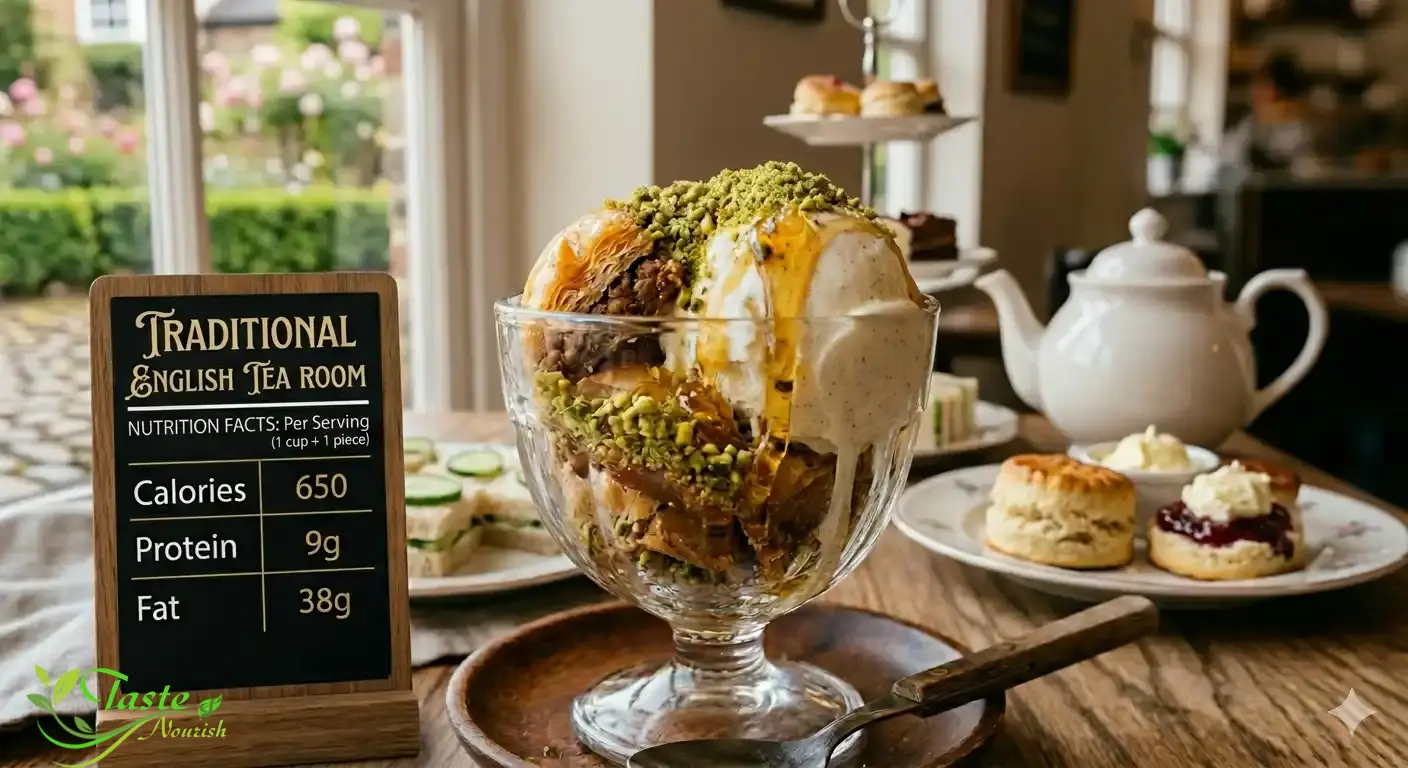
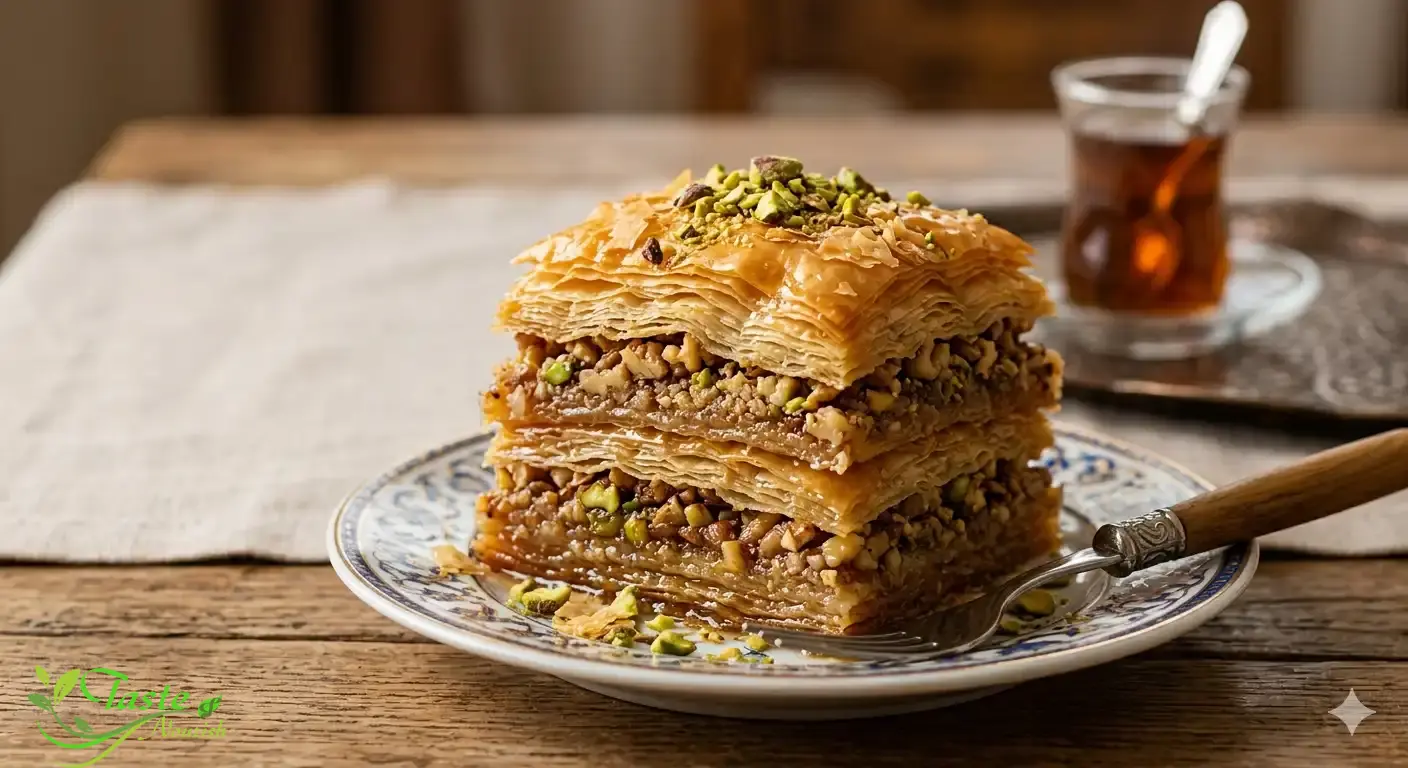
Have you ever taken a single bite of something and felt instantly transported somewhere ancient, aromatic, and warm? That’s exactly what Persian baklava — known in Farsi as Baghlava — does. It’s not just a dessert; it’s a sensory journey through centuries of Persian culinary tradition, royal kitchens, and family celebrations. Baklava is a layered pastry dessert typically made of filo pastry and filled with finely ground nuts, sweetened with either syrup or honey, and seasoned with various warming and sweet spices. But the Iranian version takes this already-magical formula and elevates it into something genuinely extraordinary — layering in floral notes of rose water, the warmth of cardamom, and the exotic golden glow of saffron.
Whether you’re a curious foodie, a home baker looking for your next challenge, or someone trying to reconnect with Persian food culture, you’ve come to exactly the right place. This guide is your one-stop reference for everything Persian baklava: its roots, its regional variations, how to make it at home, its nutritional profile, and why it stands beautifully apart from every other version of baklava in the world.
If you’ve only ever tasted baklava from a Greek or Turkish restaurant, you might think you know what the dessert is — but Persian baklava is a revelation in its own right.
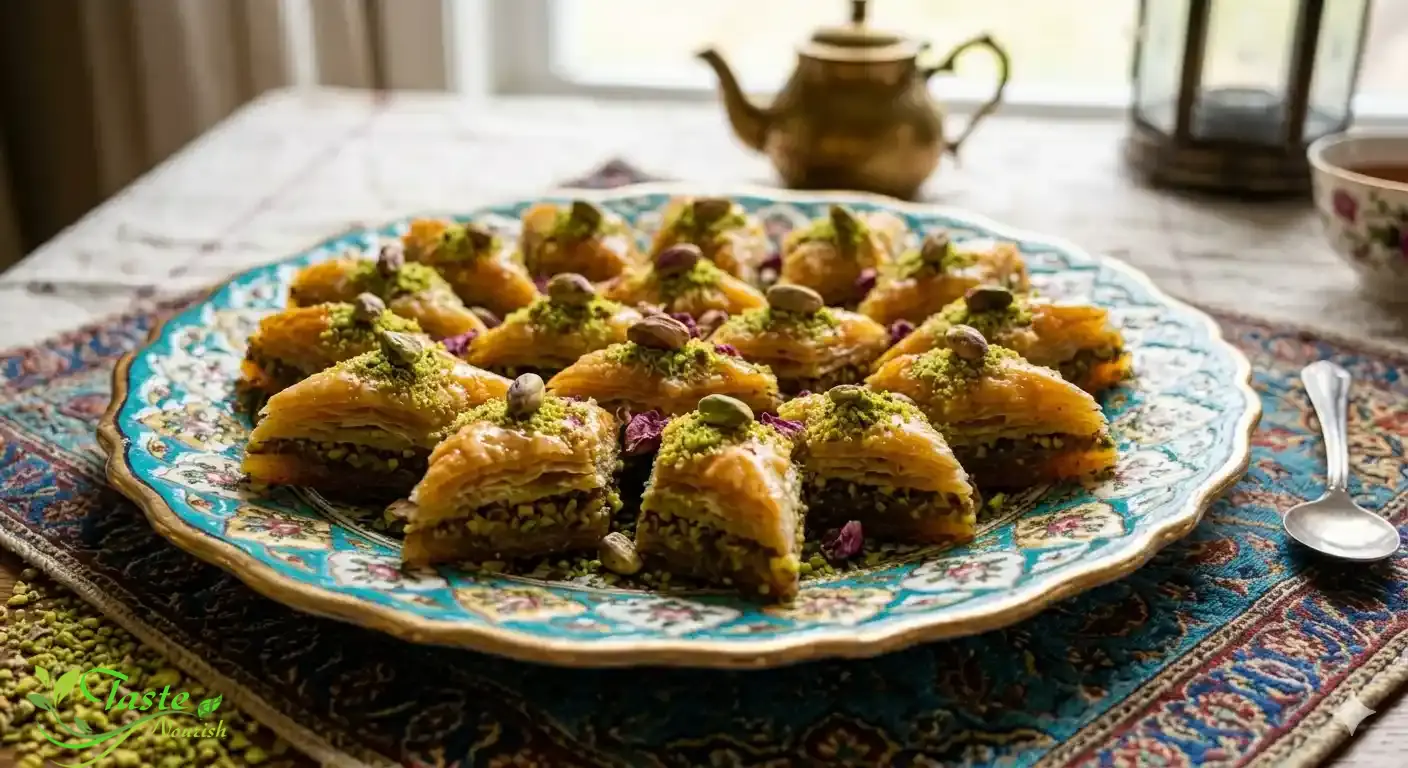
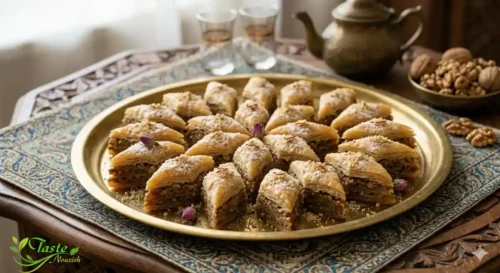
Persian Baklava is a crispy, flaky pastry layered with ground nuts, infused warm spices, and drenched in a fragrant rosewater and saffron honey syrup. What makes it stand out immediately is how it treats sweetness differently from its neighbors.
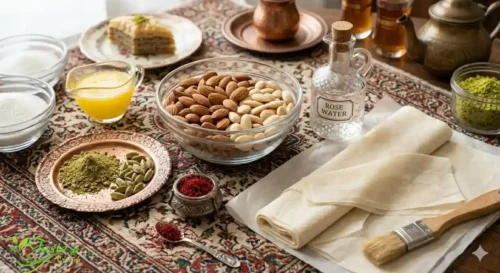
Ingredients for Persian baklava
Iranian or Persian baklava differentiates itself because it is drier and lighter than other regional varieties, and it is often flavored with rose water. Rather than being soaked in an overpowering sugar bath, the Persian version delivers a more restrained, perfumed sweetness that allows the flavors of the nuts and spices to genuinely shine through.
The Persian Name — Why Iranians Call It “Baghlava”
You might be wondering about the spelling — is it baklava or baghlava? Both are correct, depending on context. In Farsi, Iranians call this dessert Baghlava. The word “baghlava” is simply the Farsi phonetic adaptation of the wider regional term “baklava,” and the slight difference in spelling reflects a beautiful linguistic truth: every culture that embraced this dessert made it its own — in name, in flavor, and in spirit.
How to Make Persian Baklava — Step-by-Step Recipe
Making Persian baklava at home is genuinely more accessible than most people think. Yes, working with phyllo dough requires a little patience, but the results are so extraordinary that the effort is absolutely worth it. While baklava may seem intimidating to make, the recipe breaks it down into simple steps, making it approachable for home bakers.
3 cups blanched almonds or unsalted pistachios (finely ground in a food processor)
½ cup granulated sugar
2 tsp ground cardamom
For the Rose Water Syrup:
2 cups granulated sugar
1 cup water
4 tbsp rose water
2 tbsp fresh lemon juice
1–2 tbsp honey (optional, for extra depth)
A few strands of saffron dissolved in 1 tbsp warm water
Step-by-Step Instructions
Step 1: Prepare the Syrup First
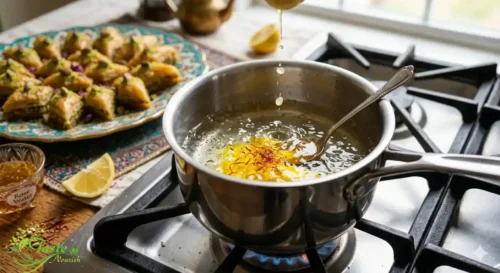
Always make the syrup before you bake, so it has time to cool completely. Combine sugar and water in a saucepan over medium heat, stirring until the sugar dissolves. Bring to a gentle boil, add the lemon juice, and simmer for 8–10 minutes until slightly thickened. Remove from heat and stir in the rose water and dissolved saffron. Set aside to cool completely. A cool syrup poured over hot baklava — or vice versa — is the secret to crisp pastry layers.
Step 2: Prepare the Nut Filling
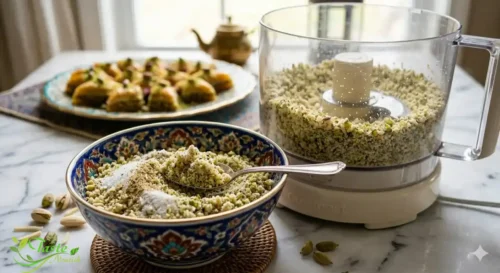
Place your almonds or pistachios into a food processor and pulse until finely ground — you want the texture of coarse breadcrumbs, not a paste. Transfer to a bowl, add the granulated sugar and ground cardamom, and mix well. Taste and adjust — the filling should be fragrant and mildly sweet, with cardamom providing a warm, aromatic backbone.
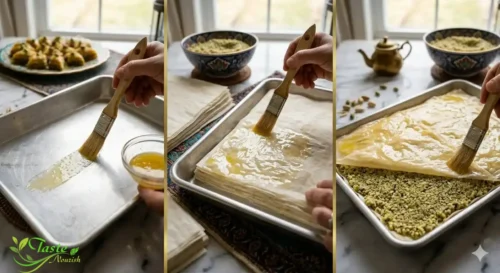
Step 3: Layer the Phyllo Dough
Brush your baking pan (approximately 13×18 inches) generously with melted butter. Lay one sheet of phyllo dough flat in the pan and brush it with butter. Repeat this process with half the total number of phyllo sheets — roughly 10–12 sheets — brushing each one carefully and patiently. Spread the nut filling evenly over the layered dough, then continue layering the remaining phyllo sheets on top, again brushing each layer with butter.
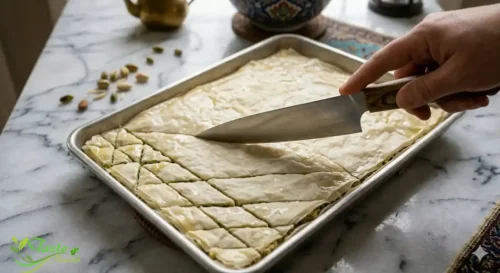
Step 4: Cut Before Baking
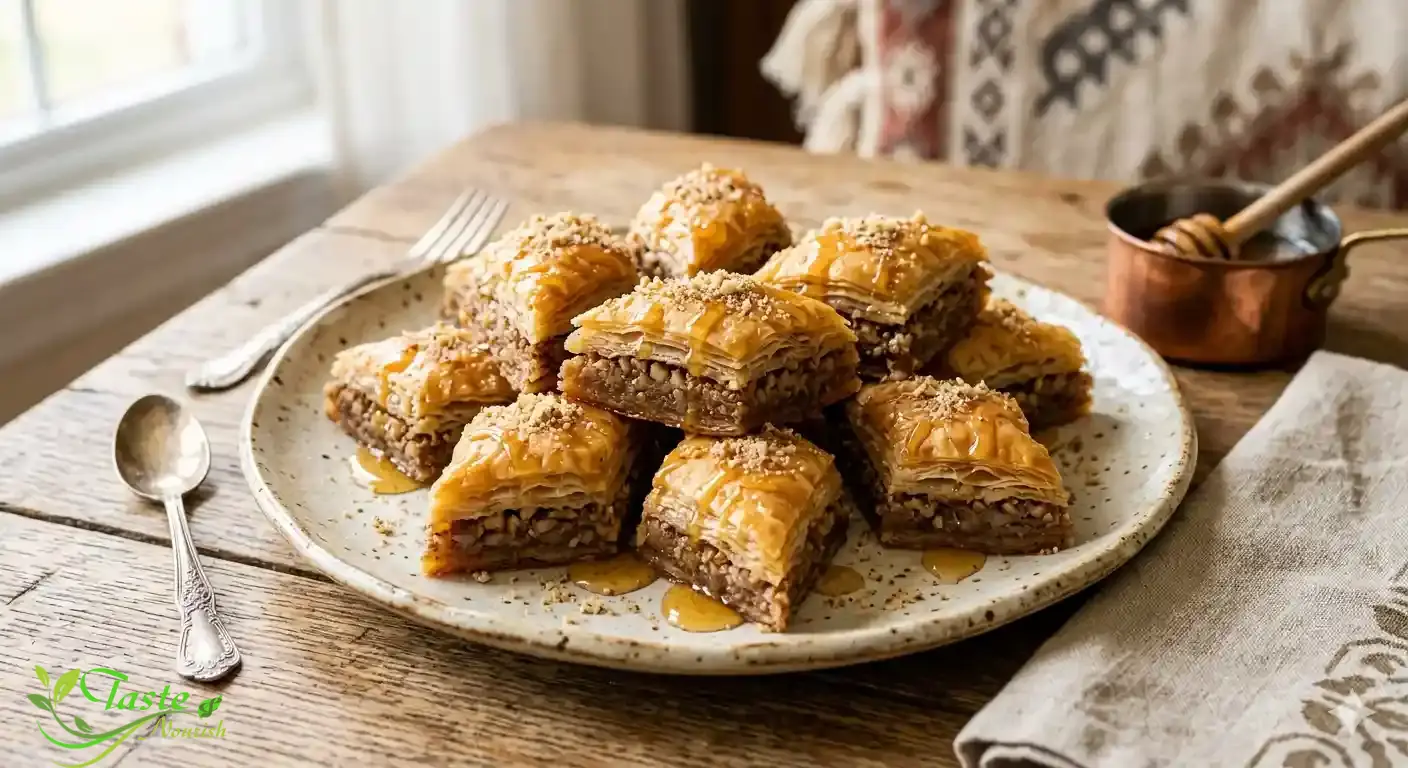
Using a very sharp knife, cut the assembled (but unbaked) baklava all the way through to the bottom in diagonal lines to create the classic diamond shapes. This step is crucial — once baked, the pastry becomes too brittle to cut cleanly. Most Persian-style baklava is cut smaller than Turkish baklava, reflecting an aesthetic preference for more delicate, refined portions.
Persian Baklava (Baghlava) | Layer the Phyllo Dough
Step 5: Bake to Golden Perfection
Bake at 350°F (175°C) for 35–45 minutes until golden brown and crisp. Keep an eye on the color — you want a deep, even golden hue across the top. Avoid baking at too high a temperature, which can over-brown the surface while leaving the middle undercooked.
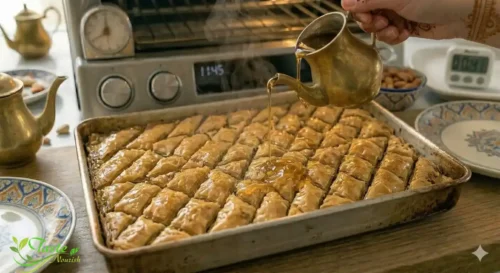
Step 6: Add the Syrup
The moment the baklava comes out of the oven, immediately and evenly pour the cooled syrup all over it. You’ll hear a satisfying sizzle. The hot pastry will absorb the fragrant syrup while maintaining its crispness — this is the magic moment. Let it rest for at least one hour before serving. The baked baklava takes about 1 hour to set up and can be stored in an airtight container at room temperature for up to 2 weeks.
Persian Baklava (Baghlava)
Tips for Perfect Persian Baklava
Never let your phyllo dry out. Keep unused sheets covered with a damp (not wet) kitchen towel while you work.
Use ghee or clarified butter for an authentically rich, nutty flavor instead of regular melted butter.
Cool syrup on hot baklava — this is the golden rule. Never pour hot syrup on hot baklava, as it will make the pastry soggy.
Finely grind your nuts. Persian-style baklava uses a much finer nut grind than Turkish versions, creating a smoother, denser filling.
Store uncovered at room temperature after the first day — covering it traps steam and softens the pastry.
What Makes Persian Baklava Unique? Key Characteristics
The Signature Flavors: Rose Water, Cardamom & Saffron
This is where Persian baklava truly distinguishes itself from every other version in the world. The flavor profile of Baghlava is rooted in three iconic Persian ingredients that have been used in Iranian cooking for over a thousand years.
Rose water (golab): Distilled from Damask roses, particularly from the famous rose gardens of Kashan, rose water provides a delicate floral fragrance that makes Persian baklava instantly recognizable. What is particularly unique and different about Iranian Baklava is how the layers of flaky pastry are sweetened with a fragrant and buttery syrup of rose water and cardamom.
Cardamom (hel): This warm, slightly citrusy spice is ground fresh and folded into the nut filling. It adds depth and complexity that elevates the entire dessert from merely sweet to genuinely aromatic.
Saffron (zafaran): The world’s most precious spice, and Iran is its largest producer. Saffron is the “red gold” of Iran, and it is a vital ingredient in Persian baklava, giving it a yellow-orange glow. Saffron is rarely used in traditional Turkish baklava recipes.
Together, these three ingredients create what food writers and chefs have described as a “floral-nutty profile” — a fragrance and flavor combination that is uniquely, unmistakably Persian. Persian baklava often uses almonds, cardamom, and rose water, offering a distinct floral-nutty profile compared to Turkish or Greek versions.
Nuts Used in Persian Baklava
The choice of nuts is another defining characteristic of Baghlava. Iranian Baklava can be made with pistachios, almonds, and walnuts. Each nut variety produces a different flavor and texture experience:
Almonds: The most traditional choice in many Persian regions, finely ground and mixed with cardamom and sugar. They provide a mild, buttery flavor that lets the rose water and cardamom truly shine.
Pistachios: Iran is one of the world’s top pistachio producers, so using them in Baghlava feels both natural and luxurious. Pistachio-filled Persian baklava has a vibrant green hue and a richer, slightly sweeter nuttiness.
Walnuts: Popular in Tabriz and the northern regions, walnuts add a slightly bitter, earthy depth that balances well with sweet rose water syrup.
Key Takeaway: Unlike Turkish baklava, which is almost synonymous with whole or coarsely chopped pistachios, Persian baklava uses finely ground nuts — creating a smoother, denser filling that melds seamlessly with the delicate pastry layers.
Persian Baklava vs. Turkish and Greek Baklava — What’s the Difference?
One of the most common questions people ask is: how exactly does Persian baklava differ from its Turkish and Greek counterparts? The answer lies in four key dimensions — dough, syrup, nuts, and sweetness level. Let’s break it down clearly.
Feature
Persian (Iranian) Baklava
Turkish Baklava
Greek Baklava
Primary Nuts
Almonds, pistachios, walnuts (finely ground)
Pistachios (whole or chopped)
Walnuts, almonds (coarser grind)
Syrup Type
Rose water + cardamom + honey/sugar
Light sugar syrup with lemon
Honey + cinnamon + cloves
Key Aromatics
Rose water, cardamom, saffron
Butter-forward, minimal spice
Cinnamon, cloves
Sweetness Level
Lighter, more subtle
Sweeter, richer
Rich and deeply sweet
Dough Type
Traditional homemade dough or phyllo
Ultra-thin phyllo (many layers)
Phyllo (often 33 layers)
Texture
Drier and lighter
Crisp and buttery
Dense and sticky
Turkish baklava uses a light sugar syrup that emphasizes the butter, while Persian baklava uses a thicker, floral syrup made with rosewater and honey or sugar, making it much more aromatic. This difference in syrup is really the soul of the distinction. The syrup used in Persian baklava is lighter and less sticky, resulting in a dessert that is subtly sweet and fragrant.
Greek baklava, by contrast, leans into the richness of honey and warming spices like cinnamon and cloves, producing a denser, stickier pastry. Persian baklavas mostly have the dough made from flour and eggs, while Greek baklava is made from phyllo dough.
None of these versions is “better” — they’re simply expressions of different culinary philosophies. But if you value fragrance, subtlety, and complexity over sheer sweetness, Persian baklava is likely to be your favorite.
Regional Varieties of Persian Baklava Across Iran
One of the most fascinating aspects of Baghlava is how dramatically it varies from one Iranian city to the next. Iran’s diverse geography — from the lush Caspian coast to the arid central plateau — has produced distinctly different baklava traditions, each as proud and delicious as the next.
In terms of shape, baklava in Iran is available in rhombus, square, and tubular types, and in terms of taste, it is available in pistachio, almond, coconut, and nut flavors. The most famous types are found in the cities of Qazvin, Yazd, and Tabriz.
Yazdi Baklava
Baklava Yazdi is one of the oldest types of Persian baklava and one of the famous souvenirs of Yazd. Yazd is an ancient desert city famous for its confectionery tradition — the city’s pastry shops are legendary across Iran, and Yazdi baklava is perhaps the most iconic of all regional varieties.
In the preparation of Yazdi baklava, an ingredient containing pistachio powder is used, and by pouring syrup on it, a special sweet baklava is prepared. The dough used in Yazdi baklava is a special lavash-style flatbread, making its texture quite different from phyllo-based versions.
Types of Yazdi baklava include lozi (almond-based), bidmeshki (willow-blossom flavored), and coconut varieties — each one a tiny piece of edible heritage.
Tabrizi Baklava
Tabriz, the capital of East Azerbaijan Province in northwestern Iran, has its own proud baklava tradition shaped by centuries of proximity to Turkey and the Caucasus.
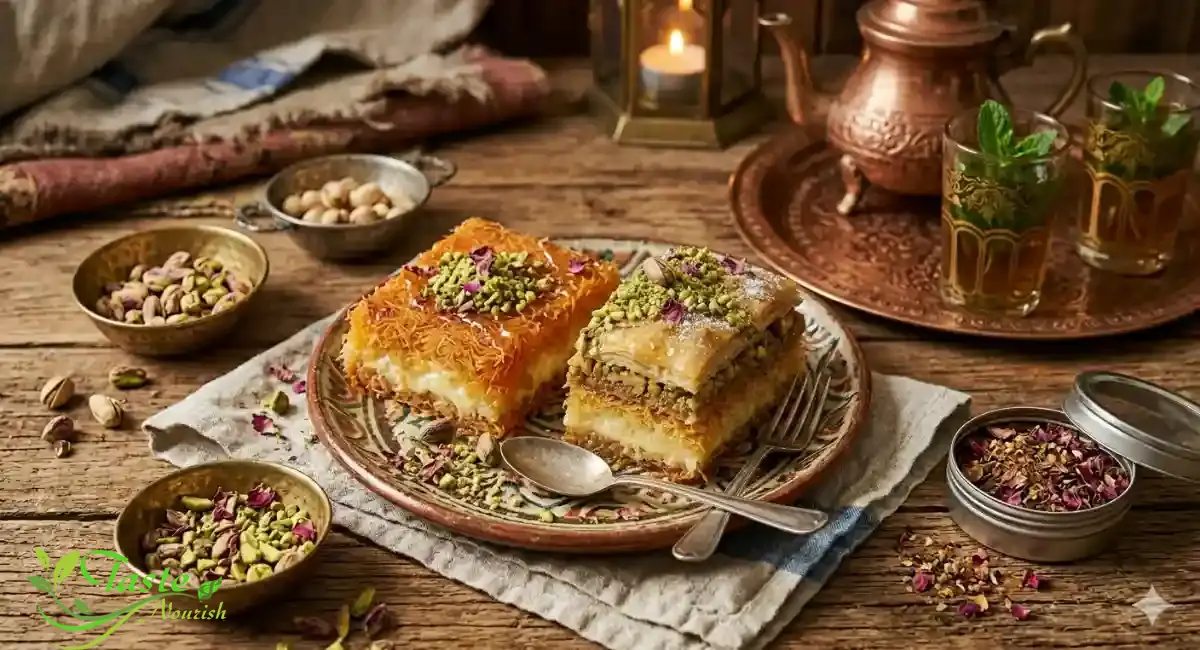
Tabrizi baklava is one of the common and popular sweets of the Tabriz people during the holy month of Ramadan. One particularly beloved variety is “Nasheh Khatai”, also known as stringy baklava — a visually stunning confection where the pastry is pulled into thin, hair-like strands.
Istanbul baklava is one of the most famous Persian baklavas of Tabriz, which is similar to its Turkish version. Another variety, Azari walnut baklava, uses the region’s excellent local walnuts for a robust, earthy flavor that pairs perfectly with sweet rose syrup.
Qazvini Baklava
Qazvin, located west of Tehran, is famous for its “rose baklava” — an exceptionally fragrant variety that pushes the floral notes of rose water to their absolute limit.
“Qazvini rose baklava” uses dough consisting of flour, oil or butter, sugar, thick syrup, milk, rose water, and egg yolk, with almonds, cardamom, and powdered sugar used in the filling. The difference between Baklava Qazvini and ordinary baklava is in its appearance.
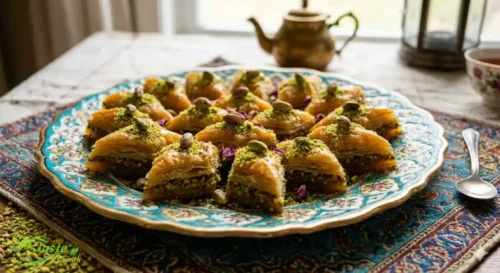
Qazvini baklava is often characterized by its beautiful decorative finish — the surface is typically adorned with ground pistachios or edible flower petals, making it as visually stunning as it is delicious.
Nutrition Facts and Health Considerations
Let’s be honest — Persian baklava is a treat, not a health food. But that doesn’t mean there’s nothing nutritionally valuable happening inside those flaky, fragrant layers. Understanding the nutritional profile helps you enjoy it mindfully.
Nutrition Facts Table (Per 100g Serving)
Nutrient
Amount
Calories
~430 kcal
Total Fat
29g
Carbohydrates
38–45g
Protein
6–7g
Sugar
20–25g
Calcium
Present (from nuts)
Iron
Present (from nuts)
Vitamin E
Present (from almonds)
Baklava typically has similar calorie content to a small brownie or slice of cheesecake, but it provides more healthy fats due to its nut content and slightly less sugar than some desserts.
The nuts — whether almonds, pistachios, or walnuts — are genuinely nutritious ingredients. Pistachios are very beneficial to the heart and can reduce LDL (bad cholesterol). Walnuts are a great source of omega-3 and rich in antioxidants. Almonds are good for the brain and brain cell formation in children.
Health Considerations Table
Factor
Detail
Best for
Occasional indulgence, celebrations
Portion recommendation
1–2 pieces per serving
Diabetics
Consume with caution; opt for honey-sweetened versions
Heart health
Nuts provide beneficial unsaturated fats
Allergy note
Contains tree nuts, wheat (gluten), dairy
For the best taste and texture, eat it within a few days of making it. Enjoy baklava as an occasional treat (1–2 pieces maximum) rather than a daily snack for sustainable nutrition.
The fragrant saffron in Persian baklava also brings its own health credentials — saffron is well-documented for its antioxidant and mood-supporting properties, making your indulgence feel just a little more virtuous.
Serving, Storing & Gifting Persian Baklava
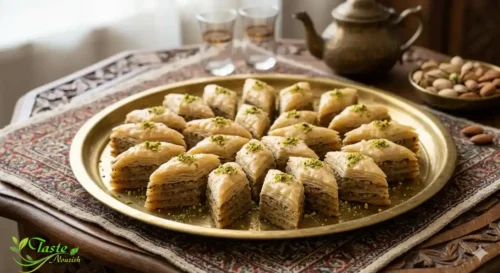
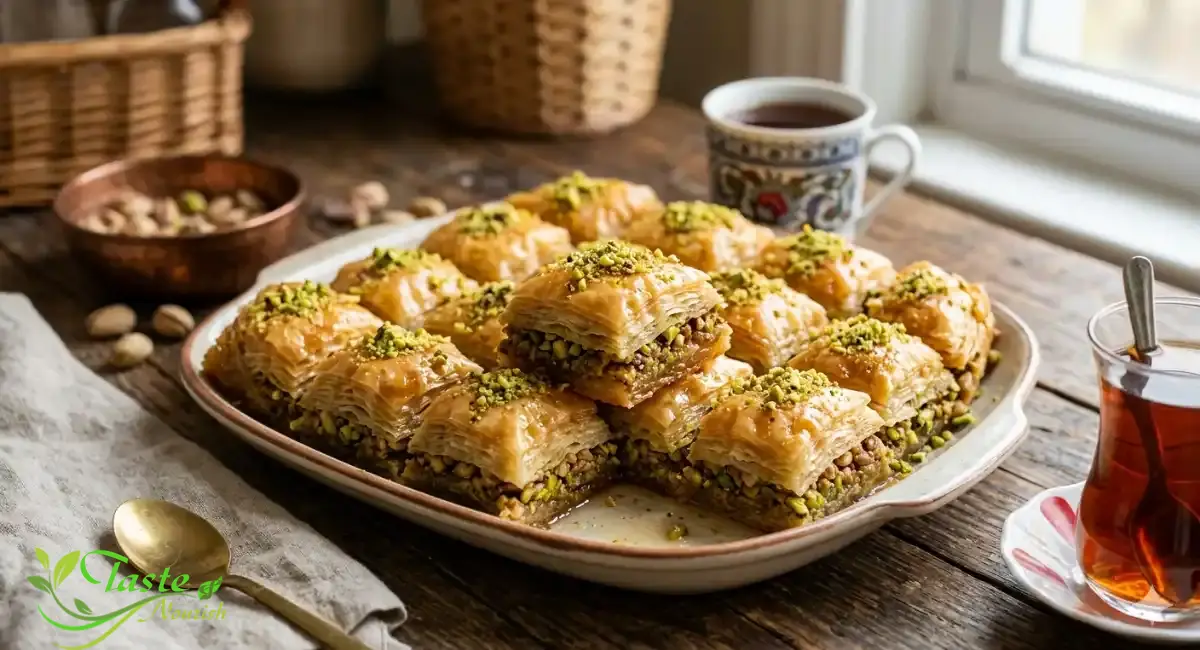
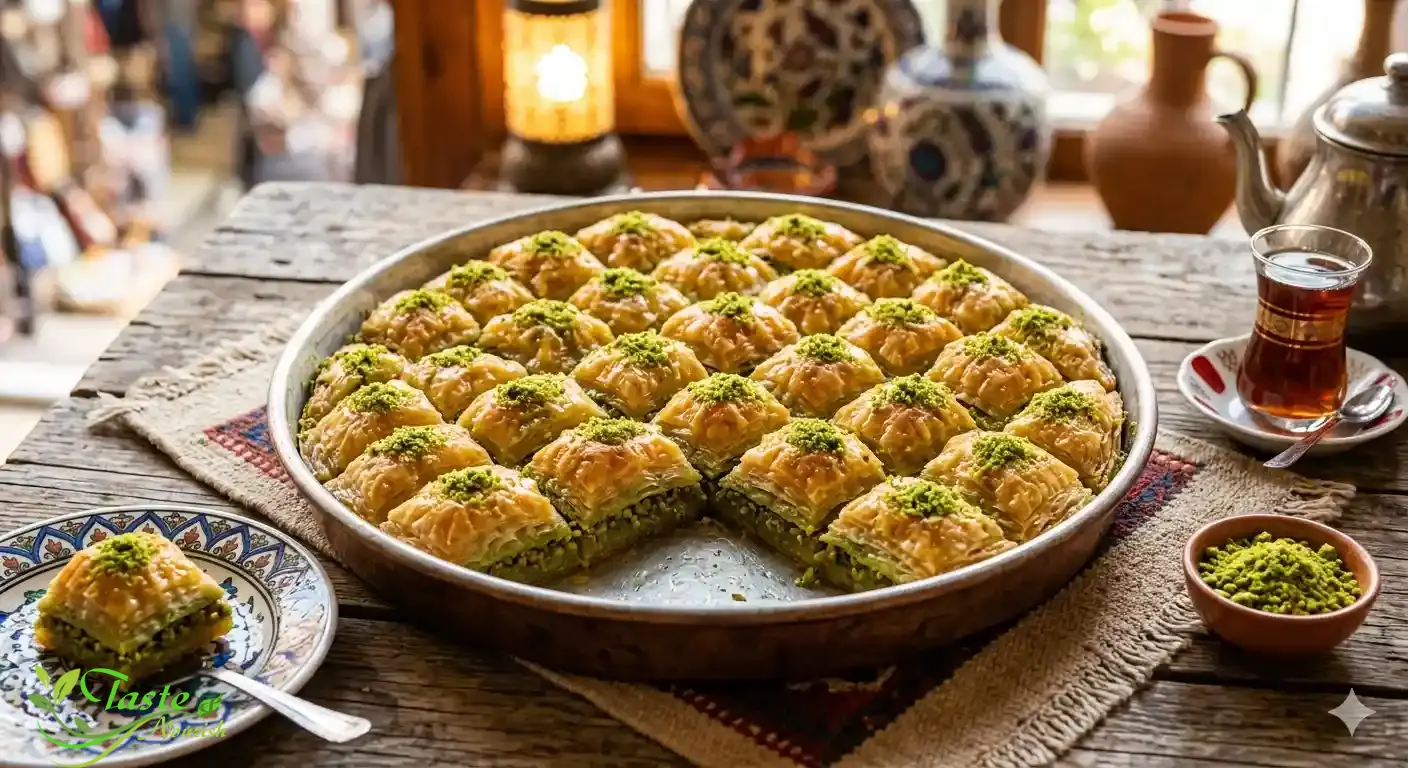
How you serve Persian baklava matters — presentation is woven into Persian food culture as deeply as the recipe itself. Traditionally, Baghlava is arranged on a decorative platter or tray, each diamond piece dusted with finely ground pistachios for a pop of brilliant green color.
Persian baklava is often enjoyed with a cup of Persian tea, making for a delightful pairing. That cup of hot, unsweetened black tea isn’t optional — it’s the counterbalance that makes the whole experience sing.
Persian baklava also makes a spectacular gift. In Iranian culture, bringing a box of homemade or artisanal Baghlava when visiting someone’s home is a gesture of deep respect and warmth. It communicates effort, care, and an understanding of tradition. Whether you’re bringing it to a dinner party, sending it as an Eid or Nowruz gift, or simply treating yourself, a well-made Persian baklava always arrives as something meaningful.
For storage, keep the pastry at room temperature in a single layer or loosely covered — avoid airtight containers for the first day as they trap moisture. After the first 24 hours, an airtight tin at room temperature preserves it well. Persian baklava can be stored in an airtight container at room temperature for up to 2 weeks — which means you can make a big batch ahead of time for a celebration without any quality loss.
Reader Note: If you’re making Persian baklava for a gift, consider packaging individual diamond pieces in small paper cups inside a decorative tin or wooden box. Dusting the top with ground pistachio right before gifting keeps the color vivid and the presentation professional.
The Rich History of Persian Baklava
From the Silk Road to the Safavid Era
The story of Persian baklava is inseparable from the broader story of Persian civilization itself. Iranian baklava has its roots in Persian cuisine, dating back to the Silk Road and the Safavid era.
In cities like Yazd, Qazvin, Tabriz, and Kashan, each region has its own version. The Silk Road was not only a trade route for silk and spices — it was a superhighway for culinary ideas, and Persia sat right at its crossroads. Merchants, diplomats, and travelers brought ingredients and techniques from China in the East and the Mediterranean in the West, and Persian chefs synthesized all of it into a cuisine of extraordinary sophistication.
Baklava, with its layered pastry and nut fillings, was perfectly positioned to flourish in this environment — it traveled well, stored beautifully, and could be adapted to whatever local nuts and aromatics were available.
The Safavid dynasty (1501–1736), in particular, was instrumental in refining Persian sweets into the artful confections we recognize today.
Royal kitchens in Isfahan and Tabriz were famous for their elaborate sweets culture, and Baghlava held a place of honor among the desserts served to royalty. Due to the proximity of Tabriz to Turkey, the oldest type of baklava exists in Tabriz.
This geographical connection explains why Tabrizi baklava shares certain qualities with its Turkish cousin, while still maintaining its distinctly Persian identity through the use of local aromatics and nut choices.
Persian Baklava and Its Role in Celebrations
Persian baklava is not an everyday treat — and that’s precisely what makes it so special. Iranian baklava, less sweet and more aromatic, is part of Nowruz and Eid al-Adha celebrations. During Nowruz (the Persian New Year, celebrated on the spring equinox), sweets are central to the festivities — they symbolize sweetness and abundance in the coming year.
Baghlava is one of the most coveted items on the Haft-Sin table spread, arranged alongside other traditional items. During Eid al-Adha and other religious celebrations, trays of diamond-cut baklava are shared with neighbors and guests as an expression of generosity and joy.
Iranians usually serve Baklava as a dessert or as a starter during a party, and they serve it in small portions, often alongside a cup of black tea.
This pairing is practically sacred in Iranian culture — the slight bitterness of unsweetened black tea cuts through the richness of the pastry, creating a flavor balance that is far greater than either element alone. It is inevitable to eat only one piece of Baghlava, so if you are hosting a party, consider two or more Baghlavas per person. That’s the warmth of Persian hospitality right there — always making sure no guest leaves hungry or unsatisfied.
Persian Baklava (Baghlava) FAQs
What is the difference between Persian baklava and regular baklava?
Persian baklava (Baghlava) is lighter, less sweet, and more aromatic than other baklava varieties. It uses a rose water and cardamom-infused syrup, finely ground nuts (typically almonds or pistachios), and often includes saffron. Turkish and Greek versions tend to be sweeter, richer, and use coarser nuts with different syrups.
Can I use store-bought phyllo dough for Persian baklava?
Absolutely. Store-bought phyllo dough works perfectly for Persian baklava and saves significant time. Just make sure to thaw it completely in the refrigerator overnight and keep unused sheets covered with a damp towel while you work to prevent drying.
Why is Persian baklava cut into diamond shapes?
Diamond-shaped cuts are the traditional presentation for Persian baklava, reflecting an aesthetic preference for elegance and refinement. In Persian culture, the smaller the cut, the more elegant the presentation — so Baghlava pieces are typically smaller than Turkish or Greek baklava portions.
How long does homemade Persian baklava last?
When stored properly at room temperature in an airtight container (after the first day), Persian baklava can last up to two weeks without any significant loss of flavor or texture. Refrigerating it can soften the pastry, so room temperature storage is strongly preferred.
What nuts are traditional in Persian baklava?
The most traditional nut in Persian baklava is the almond, finely ground with cardamom and sugar. Pistachios are also widely used, especially in Yazdi and Qazvini styles. Walnuts are more common in Tabrizi varieties. All three nuts are finely ground, unlike the chunkier nut preparations seen in Turkish baklava.
Authentic Persian baklava (Baghlava) layered with finely ground almonds, cardamom, and drenched in a fragrant rose water and saffron honey syrup. A traditional Iranian dessert served during Nowruz and Eid celebrations.
Ingredients
1 package (450g) phyllo dough, thawed
2 sticks (225g) unsalted butter, melted
3 cups blanched almonds or unsalted pistachios, finely ground
½ cup granulated sugar
2 tsp ground cardamom
2 cups granulated sugar (for syrup)
1 cup water
4 tbsp rose water
2 tbsp fresh lemon juice
1–2 tbsp honey
A few saffron strands dissolved in 1 tbsp warm water
Directions
Combine sugar and water in a saucepan over medium heat. Stir until sugar dissolves, bring to a gentle boil, add lemon juice and simmer 8–10 minutes. Remove from heat, stir in rose water and dissolved saffron. Cool completely before using.
Pulse almonds or pistachios in a food processor until finely ground. Mix with granulated sugar and ground cardamom in a bowl until combined.
Brush a 13x18 inch baking pan with melted butter. Layer half the phyllo sheets, brushing each with butter. Spread nut filling evenly, then top with remaining sheets, each brushed with butter.
Using a very sharp knife, cut the unbaked baklava all the way through in diagonal lines to create classic diamond shapes before baking.
Bake at 350°F (175°C) for 35–45 minutes until deep golden brown and crisp across the surface.
Immediately pour the completely cooled rose water and saffron syrup evenly over the hot baklava as soon as it exits the oven. Let rest for at least 1 hour before serving.
Conclusion
Persian baklava — or Baghlava, as Iranians lovingly call it — is far more than a sweet pastry. It is a living artifact of Persian civilization: a dessert that has survived empires, traveled Silk Road trade routes, graced royal tables, and found its way into the hands of home bakers all over the world. Its defining characteristics — the delicate floral syrup of rose water, the warmth of cardamom, the golden shimmer of saffron, and the finely ground nuts — make it unlike anything else in the world of baklava or pastry more broadly.
Whether you encounter it as Yazdi baklava at a confectionery in the desert city of Yazd, as Tabrizi walnut baklava during Ramadan in northwestern Iran, or as a freshly made tray on your own kitchen counter, the experience is always transformative. It reminds you that food, at its finest, is a form of cultural poetry — layered, fragrant, and impossible to forget.
Hanan Abo Samra is the founder of Taste & Nourish, sharing trustworthy nutrition guidance and recipes drawn from 20+ years of hands-on cooking experience. When she's not developing new recipes, Hanan is researching the science behind everyday ingredients to bring readers practical, evidence-based guidance for a healthier lifestyle.