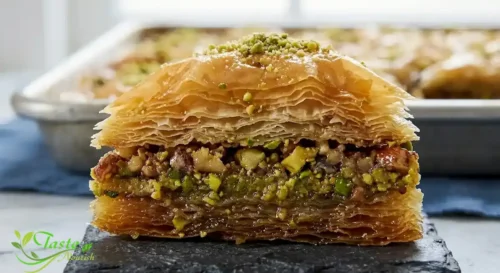
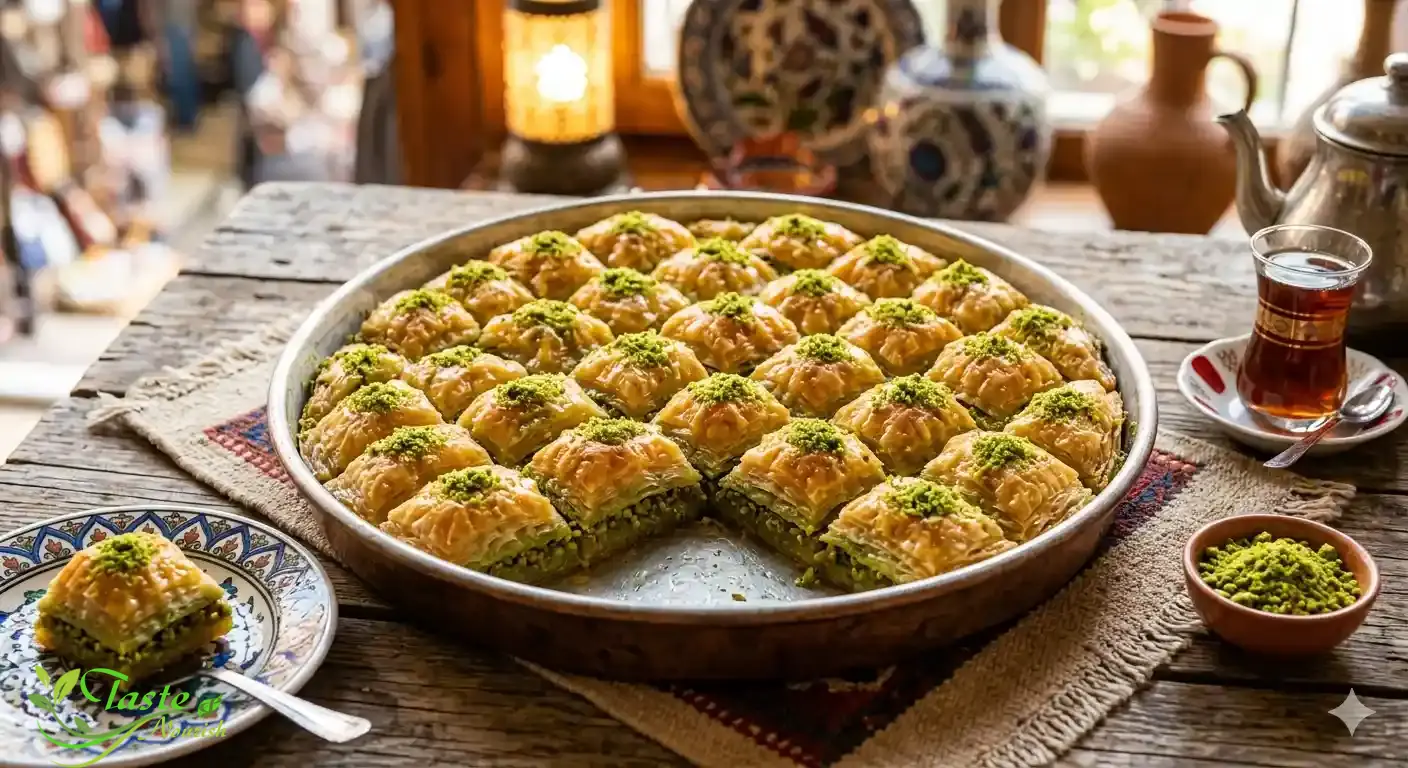
Crisp baklava starts with how you treat the filo, not just what goes between the sheets. This baklava filo pastry recipe walks you through thawing, brushing, layering, and cutting a 9 × 13-inch tray of walnut-pistachio baklava. You then finish it with cooled honey-lemon syrup so every layer stays flaky instead of soggy. You’ll also get exact bake cues, storage and freezing guidance, and fixes for the problems that trip up most first-time bakers.
For baklava filo pastry that stays crisp, brush each thawed sheet with a thin coat of clarified butter, layer it with a coarsely chopped walnut-pistachio filling, cut the tray into diamonds before baking, bake at 350°F (175°C) until deep golden, then pour cooled syrup over the hot pastry and let it rest uncovered for at least four hours.
Key Takeaways: Baklava Filo Pastry
Thaw baklava filo pastry in the refrigerator, keep it covered while you work, and brush thin, even coats of fat instead of soaking the sheets.
Clarified butter or ghee browns cleanly and crisps better than whole melted butter, which still contains water and milk solids.
Chop the nuts coarsely, about the size of small peas. Fine powder turns pasty between the layers.
Cut the pan into pieces before baking, and judge doneness by deep golden color rather than by the clock alone.
Pour cool or room-temperature syrup over the hot pastry. Hot syrup on hot pastry is what makes baklava soggy.
Rest the tray uncovered for at least four hours before cutting free and serving. Keep it loosely covered at room temperature afterward.
Handling Baklava Filo Pastry Without Cracks
Filo (also spelled phyllo) is stretched so thin that it dries out within minutes of exposure to air. Thaw the sealed package in the refrigerator overnight, then let it stand sealed at room temperature for about 30 minutes before unrolling, or follow your package if it says otherwise. Thawing on the counter, or unrolling while the dough is still cold, often leaves sheets that stick together or crack along the folds.
Once the roll is open, trim the stack to fit the pan, cover it with plastic wrap, and lay a lightly damp, well-wrung towel over the plastic. Keep the towel off the dough itself, because wet filo clumps and tears.
The fat matters as much as the dough. Whole butter is roughly 80 percent fat, with the remainder mostly water and milk solids. The water makes the sheets soft where it pools, and the milk solids brown quickly and can scorch before the center is baked. Clarifying the butter removes most of both, so the layers fry gently in pure fat as they bake and separate into distinct leaves.
Ingredients
Nut Filling
3 cups (300 g) raw, unsalted walnut pieces
1 cup (125 g) unsalted, shelled pistachios
2 tablespoons (25 g) granulated sugar
1 teaspoon ground cinnamon
¼ teaspoon ground cardamom
⅛ teaspoon fine salt
Pastry
1 pound (454 g) frozen filo (phyllo) dough, about 9 × 14 inches (23 × 35 cm) per sheet, thawed (you will use 34 sheets)
1¼ cups (about 285 g) unsalted butter, to yield about 1 cup (225 g) clarified butter, or 1 cup (225 g) ghee
Syrup
1½ cups (300 g) granulated sugar
1 cup (240 ml) water
½ cup (170 g) honey
1 tablespoon fresh lemon juice
1 cinnamon stick
2 wide strips of lemon or orange peel, with no white pith
Optional: 1 teaspoon rose water or orange blossom water
Ingredient Notes
Filo sheets. Sheet size and count vary by brand. If your sheets are larger than your pan, stack and trim them. If the package gives you fewer than 34 usable sheets, shorten the top layer but keep at least 10 sheets there. Filo is not interchangeable with puff pastry, and it is a different product from the shredded dough used for kunafa and kataifi.
Nuts. Raw nuts are fine because they bake for close to an hour. Use unsalted nuts so you control the seasoning. Walnuts and pistachios are both tree nuts, and the filo is wheat, so both are listed among the major food allergens by the U.S. Food and Drug Administration.
Rose or orange blossom water. Strength varies widely between brands. Start with the stated amount, add it off the heat, and taste a drop of the cooled syrup before adding more.
Ghee. Ghee is already clarified, so it saves a step and works one-to-one in place of the clarified butter.
Equipment
9 × 13-inch (23 × 33 cm) baking pan. Light-colored metal gives the crispest base. Glass works but may need a few extra minutes.
Sharp, thin-bladed knife for cutting through the layers
Pastry brush (silicone is fine)
2-quart saucepan for the syrup and a small saucepan for the butter
Food processor, or a large knife and cutting board, for the nuts
Kitchen scale, which is useful because chopped nuts pack unevenly in measuring cups
Plastic wrap, a clean kitchen towel, and a cooling rack
How to Make Baklava Filo Pastry Layers, Step by Step
1. Thaw the filo in the refrigerator overnight, still sealed. About 30 minutes before assembling, move it to the counter, still sealed.
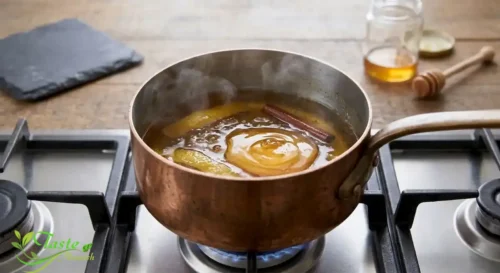
2. Make the syrup first so it has time to cool. Combine the sugar, water, cinnamon stick, and citrus peel in the 2-quart saucepan. Stir over medium heat only until the sugar dissolves, then bring to a boil and stop stirring. Add the lemon juice and simmer gently for about 7 minutes. Stir in the honey and simmer 1 more minute. When hot, the syrup should look like thin maple syrup. Remove from the heat, let it cool completely, then remove the cinnamon and peel and stir in the rose or orange blossom water if using.
3. Clarify the butter. Melt it slowly over low heat without stirring. Skim the white foam from the surface, then spoon or pour the clear golden fat into a bowl, leaving the milky layer behind. You should have about 1 cup (225 g). Keep it liquid and warm. If it firms up, rewarm it briefly.
4. Pulse the walnuts and pistachios in a food processor in short bursts until the pieces are about the size of small peas, with a few finer crumbs but no powder or paste. Chopping by hand also works. Toss with the sugar, cinnamon, cardamom, and salt, then divide into two equal bowls of roughly 2 cups (about 225 g) each.
5. Heat the oven to 350°F (175°C) with a rack in the middle position. Brush the bottom and sides of the pan lightly with clarified butter. Unroll the filo, trim the stack to fit the pan, and cover it as described above.
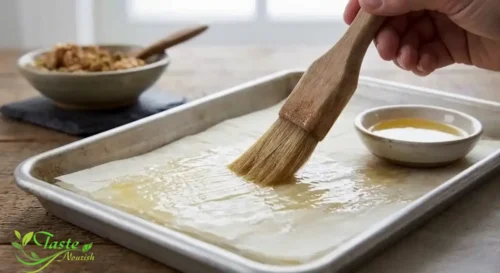
6. Lay one sheet in the pan and brush it with a thin, even coat of butter, roughly a teaspoon, working from the edges toward the center. Repeat until you have 12 buttered sheets. Torn sheets are fine in the lower layers. Patch them and keep going.
7. Scatter one bowl of nut filling evenly over the stack and press it gently flat with your palm.
8. Add 8 more buttered sheets, then the second bowl of filling, smoothed level.
9. Finish with 14 buttered sheets, using your best, unbroken sheets on top. Brush the top sheet with butter and tidy the edges.
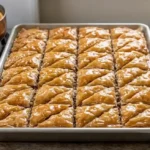
10. Cut before baking. Hold the knife flat against the layers and use a gentle sawing motion so the sheets do not drag. Make 3 lengthwise cuts to create four strips about 2¼ inches (5.5 cm) wide. Then cut diagonally at roughly a 45° angle, with lines about 2 inches (5 cm) apart, to form diamonds. Cut all the way to the bottom of the pan. You should feel the blade touch it.
11. Spoon the remaining 3 tablespoons or so of clarified butter along the cut lines so it seeps down between the pieces.
12. Bake for 50 to 60 minutes, rotating the pan once at about the halfway point if your oven browns unevenly. The baklava is done when the top is a deep golden brown rather than pale yellow, the cut lines are golden down through the layers, and the surface feels dry and firm when pressed lightly with the back of a spoon. If the top browns well before 45 minutes, tent it loosely with foil.
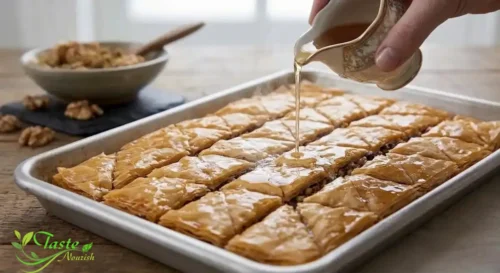
13. Pour the cooled syrup slowly over the hot baklava as soon as it leaves the oven, aiming along the cut lines. Add most of it, pause for a minute to see how quickly it soaks in, then add the rest. Stop if syrup is still pooling deeply in the corners.
14. Cool the pan on a rack, uncovered, at room temperature for at least 4 hours, and preferably overnight. Do not refrigerate it, and do not cover it until it is fully cool.
Why Syrup Temperature Decides the Texture
Just-baked filo is dry, open, and full of tiny air pockets. Cool syrup poured onto it moves in slowly through the cut lines, sweetening the layers while the pastry cools and firms back up around it. When hot syrup meets hot pastry, the layers absorb liquid faster than they can set, and they collapse into a damp, chewy block. Pouring syrup onto pastry that has already cooled is the other common method, and it works too, as long as one is hot and the other is cool.
The syrup should not be thin as water, either. A syrup that is too runny soaks in instantly, and one that is too thick sits on the surface. If your cooled syrup pours like honey, stir in water a tablespoon at a time until it flows like maple syrup.
From My Kitchen
I recommend setting everything within arm’s reach before the first sheet leaves its sleeve: the buttered pan, a bowl of warm clarified butter with a wide brush, the nuts split into two equal bowls, and a ruler for trimming. I also suggest making the syrup first, since it needs time to cool, and weighing the nuts instead of relying on cups, because chopped walnuts pack unevenly. If a sheet tears, patch it and keep going. The middle layers hide mistakes well.
Regional Styles Worth Knowing
Several culinary traditions across Turkey, Greece, and the Levant make baklava, and each has its own habits, so no single version is the only correct one. Walnut fillings with cinnamon and a honey-scented syrup are commonly associated with Greek-style baklava, while pistachio-heavy versions are widely made in Turkey and the Levant. Rose water or orange blossom water is a common finishing note in many Levantine recipes, and ghee or clarified butter is a frequent choice for the fat. This recipe sits between them: walnut and pistachio filling, a light spice note, and a lemon-brightened honey syrup.
Serving and Presentation
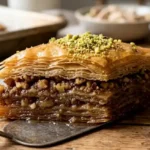
Serve baklava at room temperature in small pieces, because it is rich and sweet. Before lifting the first piece, run a thin knife along the cut lines again to free the layers. A pinch of finely chopped pistachio on top gives color without adding sweetness. Unsweetened tea or strong black coffee balances the sugar well, and paper liners help if you are serving a crowd.
Storing and Freezing Baklava Filo Pastry
Because this version has no eggs, cream, or fresh fruit, the main limits on storage are quality ones: crispness fades as syrup slowly migrates through the layers, and nuts can turn rancid over time. Keep the cooled baklava in a single layer, loosely covered, at cool room temperature.
A tightly sealed container too soon traps moisture and softens the top. In a hot or humid kitchen, refrigerating is reasonable, though the butter will firm, so let pieces stand at room temperature for a short while before serving. The texture is at its best in the first few days. Discard it if you see mold or notice a sour or rancid smell, and never taste it to check.
For longer storage, freeze fully cooled, syrup-soaked pieces in a single layer until firm, then wrap tightly and keep them in an airtight container. According to the USDA Food Safety and Inspection Service, freezing at 0°F stops microbial growth, and recommended freezer times are for quality rather than safety. Expect a slightly softer crumb after thawing. Thaw loosely covered in the refrigerator, then bring to room temperature. A few minutes on a rack in a 300°F (150°C) oven can restore some crispness, but watch closely.
Common Mistakes
Letting the Filo Dry Out
Uncovered sheets turn brittle and shatter when brushed. Keep the stack under plastic wrap and a damp towel, and work in a steady rhythm. Patch torn sheets in the middle layers. Reserve your best sheets for the top.
Pouring Hot Syrup on Hot Pastry
This is the most common cause of soggy baklava. The layers soak up liquid faster than they can firm up. Cool the syrup completely before the pan comes out of the oven. If you already poured it hot, there is no real fix, but leaving the tray uncovered for a full day will help the top recover some crispness.
Skipping the Pre-Cut
Once baked, the layers are brittle and fragment when cut, and the syrup cannot reach the center of the pan. Cut all the way through to the bottom before baking, then re-run the knife along the lines before serving.
Underbaking
Pale baklava tastes doughy and chewy, and the syrup turns the layers gummy. Judge by color and dryness, not only time. The top should be deep golden, with the cut edges golden as well. Next time, add 5 minutes and tent with foil if the top is already dark.
Too Much or Too Little Butter
Heavy brushing leaves greasy pools and heavy layers, while too little gives papery sheets that never separate. Aim for a thin, even coat, roughly a teaspoon per sheet, and keep the edges and corners covered.
Grinding the Nuts Too Fine
Nuts processed to powder form a dense paste once syrup hits them, flattening the layers. Pulse briefly and stop when the pieces are about pea-sized. If you have overprocessed, mix in a handful of hand-chopped nuts to restore some texture.
Troubleshooting
Why Are the Bottom Layers Soft or Wet?
Likely causes include butter pooling under the first sheets, too much syrup for the pan, a pale, underbaked base, or glass pans that bake more slowly. Brush the first sheets lightly, use a metal pan, and move the rack one position lower next time. Stop pouring when syrup collects in the corners.
Why Did My Syrup Turn Grainy?
Sugar crystals can form if the syrup is stirred after boiling, if crystals cling to the sides of the pan, or if the lemon juice was left out. To fix it, return the syrup to the pan with 2 to 3 tablespoons of water and heat gently until clear. Next time, dissolve the sugar before boiling, wipe the pan sides with a wet pastry brush, and keep the lemon juice.
Why Did the Top Layers Shift or Tear While Cutting?
A dull knife, pressing straight down, or uneven nut layers are the usual reasons. Use a sharp, thin blade, saw gently, and steady the top with your fingertips.
Substitutions
Nuts: Almonds, hazelnuts, or cashews can replace part or all of the walnuts. Almonds are firmer, so chop them slightly finer, while cashews give a milder, sweeter filling.
Butter: Ghee works one-to-one. Do not use regular melted butter unclarified in the same amount, because the extra water and milk solids soften and darken the layers.
Honey: To omit it, use 2 cups (400 g) sugar with 1¼ cups (300 ml) water, and keep the lemon juice since it helps prevent crystals. The flavor will be cleaner and less floral.
Filo: There is no reliable substitute. Puff pastry will bake into a different, bready dessert.
Gluten-free: I do not know of a gluten-free dough that mimics filo’s thin, flaky sheets, so this recipe is not suited to a straightforward swap.
Optional Lighter Adjustments
Baklava is a rich dessert, and the original proportions give it its characteristic crispness and sweetness. These changes are optional and modest, and they are not medical advice. People managing a health condition should follow guidance from their healthcare provider.
Less syrup sugar: Reduce the sugar in the syrup to 1¼ cups (250 g). The syrup will be thinner and less sweet and will soak in faster, so simmer it 1 to 2 minutes longer and pour a little less. Larger reductions risk a dull flavor and a syrup that does not carry through the layers.
Smaller pieces: Cutting the same tray into 32 pieces instead of 24 reduces the portion without changing the recipe.
Part olive oil: Replace up to one quarter of the clarified butter with a mild olive oil or neutral oil. This changes the fat profile and slightly reduces the buttery flavor and browning, but calories stay essentially the same.
Swapping honey for sugar, or the reverse, does not meaningfully change how sweet or light the syrup is, since both are added sugars here.
Variations
Pistachio-forward: Use 2 cups (250 g) pistachios and 2 cups (200 g) walnuts. The filling will be greener and more expensive. Reduce the cinnamon to ½ teaspoon so the pistachios stay in front.
Almond and orange blossom: Replace the walnuts with almonds, replace the cinnamon with extra cardamom, and use orange blossom water in the syrup.
Greek-style walnut: Use 4 cups (400 g) walnuts and no pistachios, and add ⅛ teaspoon ground cloves to the filling. Simmer an orange peel strip in the syrup.
Dairy-free: Replace the clarified butter with melted refined coconut oil or a neutral oil. The result will be less rich and will brown less. Coconut oil sets firm quickly, so keep it liquid while you brush.
Nutrition Facts
Per piece (1/24 of the pan). These are approximate values calculated from standard ingredient data, not laboratory analysis, and actual figures will vary with brands and how much syrup is absorbed.
Calories
About 340
Total fat
About 20 g
Saturated fat
About 7 g
Carbohydrate
About 38 g
Sugars
About 20 g
Fiber
About 2 g
Protein
About 5 g
Baklava Filo Pastry Recipe FAQs
Can I make baklava ahead for an event?
Yes. Bake and syrup it a day ahead and let it rest uncovered overnight. Once fully cool, cover loosely. The flavors settle during the rest, and it is easier to cut cleanly the next day.
Does baklava need refrigeration?
This version has no eggs, cream, or fresh fruit, so the limits are mainly about quality. Cool room temperature, loosely covered, is best. Refrigeration is reasonable in a hot or humid kitchen. Discard any piece with mold or an off smell.
Can I refreeze thawed filo?
It is best not to. Many brands advise against it, and filo that has thawed and refrozen tends to turn brittle or sticky. Plan to use the thawed package, and wrap any leftover sheets airtight and use them soon.
Can I use a different pan size?
An 8 × 8-inch (20 cm) pan takes half the recipe: about 17 sheets, divided as 6, 4, and 7, with half the filling and syrup. Start checking color around 40 minutes. A larger pan spreads the layers too thin, so I would not scale up without adding more sheets.
Is this baklava nut-free or gluten-free?
No. It contains tree nuts and wheat, both major food allergens. Take extra care if serving someone with an allergy.
How do I know the syrup is thick enough?
It should look like thin maple syrup when hot and pour smoothly once cool. If it pours like honey, stir in water a tablespoon at a time.
Why did my baklava turn out chewy instead of crisp?
Chewy baklava usually means the pastry was underbaked or the syrup was too hot or too abundant. Bake until the top is deep golden, use cooled syrup, and let the tray rest uncovered.
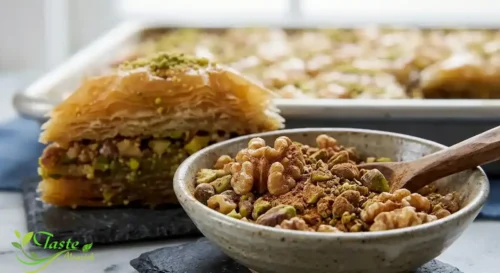
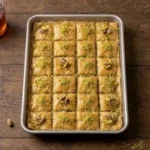
A 9 x 13-inch tray of baklava made with thin filo sheets, clarified butter, a coarsely chopped walnut and pistachio filling, and a cooled honey-lemon syrup poured over the hot pastry.
1¼ cups (about 285 g) unsalted butter, clarified (about 1 cup / 225 g), or 1 cup ghee
1½ cups (300 g) sugar, 1 cup (240 ml) water, ½ cup (170 g) honey, 1 tablespoon lemon juice, 1 cinnamon stick, 2 citrus peel strips, optional 1 teaspoon rose or orange blossom water
Directions
Thaw the filo in the refrigerator overnight, still sealed. About 30 minutes before assembling, move it to the counter, still sealed.
Combine the sugar, water, cinnamon stick, and citrus peel in a 2-quart saucepan. Stir over medium heat only until the sugar dissolves, bring to a boil, then stop stirring. Add the lemon juice and simmer gently for about 7 minutes. Stir in the honey and simmer 1 more minute. Cool completely, remove the cinnamon and peel, and stir in the rose or orange blossom water if using.
Melt the butter slowly over low heat without stirring. Skim off the foam, then spoon or pour the clear golden fat into a bowl, leaving the milky layer behind. Keep it liquid and warm.
Pulse the walnuts and pistachios until they are about the size of small peas, with no powder or paste. Toss with the sugar, cinnamon, cardamom, and salt, then divide into two equal bowls.
Heat the oven to 350°F (175°C) with a rack in the middle position. Brush a 9 x 13-inch pan lightly with clarified butter. Trim the filo to fit the pan and keep it covered with plastic wrap and a damp towel.
Lay down one sheet at a time and brush each with a thin, even coat of clarified butter until you have 12 buttered sheets.
Scatter one bowl of nut filling evenly over the stack and press it gently flat
Add 8 more buttered sheets, then the second bowl of filling, smoothed level.
Add 14 buttered sheets, using the best unbroken sheets on top. Brush the top sheet with butter and tidy the edges.
Using a sharp, thin-bladed knife and a gentle sawing motion, make 3 lengthwise cuts to create four strips about 2 1/4 inches (5.5 cm) wide. Cut diagonally about 2 inches (5 cm) apart to form diamonds, cutting all the way to the bottom of the pan.
Spoon the remaining 3 tablespoons or so of clarified butter along the cut lines.
Bake for 50 to 60 minutes, rotating the pan once at about the halfway point if the oven browns unevenly. The baklava is done when the top is deep golden brown, the cut lines are golden through the layers, and the surface feels dry and firm. Tent loosely with foil if the top browns well before 45 minutes.
Pour the cooled syrup slowly over the hot baklava as soon as it leaves the oven, aiming along the cut lines. Add most of it, pause for a minute, then add the rest. Stop if syrup is pooling deeply in the corners.
Cool the pan on a rack, uncovered, at room temperature for at least 4 hours, preferably overnight. Do not refrigerate it or cover it until fully cool.
Notes
Keep the filo covered while you work.
Cool syrup goes on hot pastry. Never hot on hot.
Store loosely covered at room temperature, or freeze in airtight packaging.
Conclusion
Good baklava rewards preparation more than skill. A covered stack of filo, warm clarified butter, and cooled syrup removes most of the problems. Because every kitchen differs in pan, oven, and filo brand, jot down your bake time and layer counts the first time. Next time you can adjust the syrup amount or oven position to match your results.
**Hanan Abo Samra** shares practical cooking insights, delicious recipes, and evidence-based nutrition information. Drawing on more than 20 years of hands-on cooking experience, she creates helpful food content that combines everyday cooking knowledge with information from reliable scientific sources. Her goal is to help readers better understand the foods they eat, explore their nutritional benefits, and prepare delicious meals with confidence.