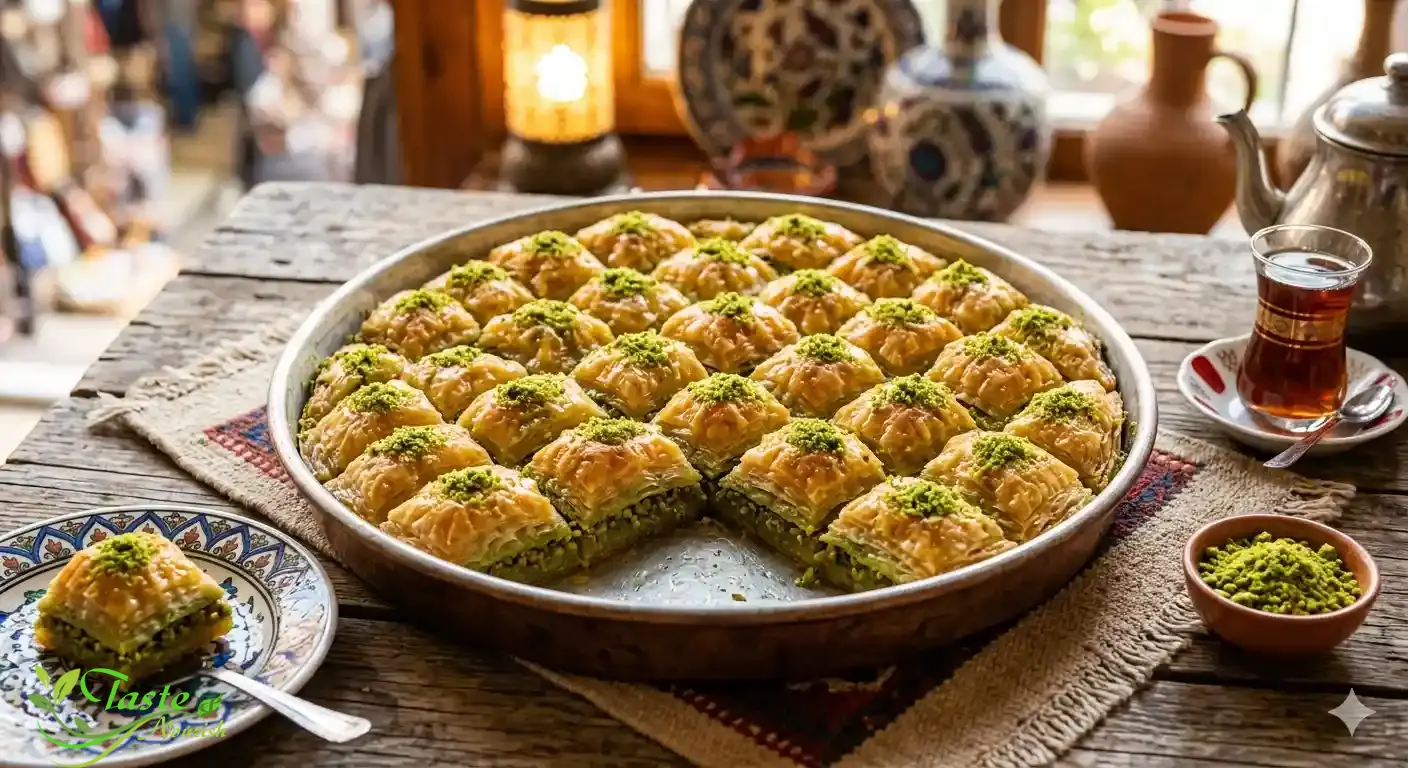
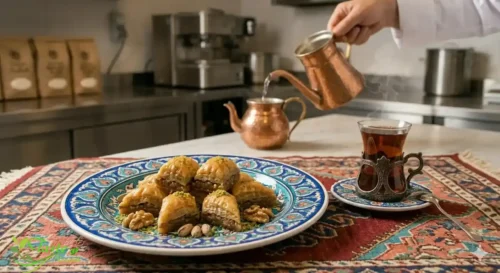
Have you ever bitten into something that made you close your eyes involuntarily? Something so layered in flavor, so architecturally precise, so steeped in history that eating it feels like a tiny act of time travel? That is exactly what Turkish baklava — or baklava turca as it is known in Spanish and Italian, and baklava turska in South Slavic languages — does to you the moment it touches your tongue.
It is not simply a dessert. It is a civilization compressed into forty paper-thin layers of dough, clarified butter, crushed pistachios, and the most perfectly balanced sugar syrup you have ever tasted. And in a world full of forgettable sweets, Turkish baklava is the kind that rewires your taste memory permanently.
Whether you are encountering it for the first time or you are a devoted enthusiast looking to deepen your appreciation, this guide covers everything you need to know: the history of Turkish baklava, its regional varieties, the intricate craft behind it, and how to make it in your own kitchen. Get comfortable — this is a story worth reading slowly.
What Is Turkish Baklava? An Introduction Worth Savoring
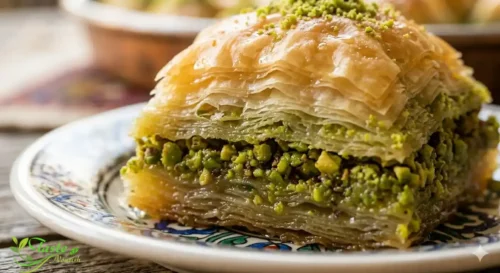
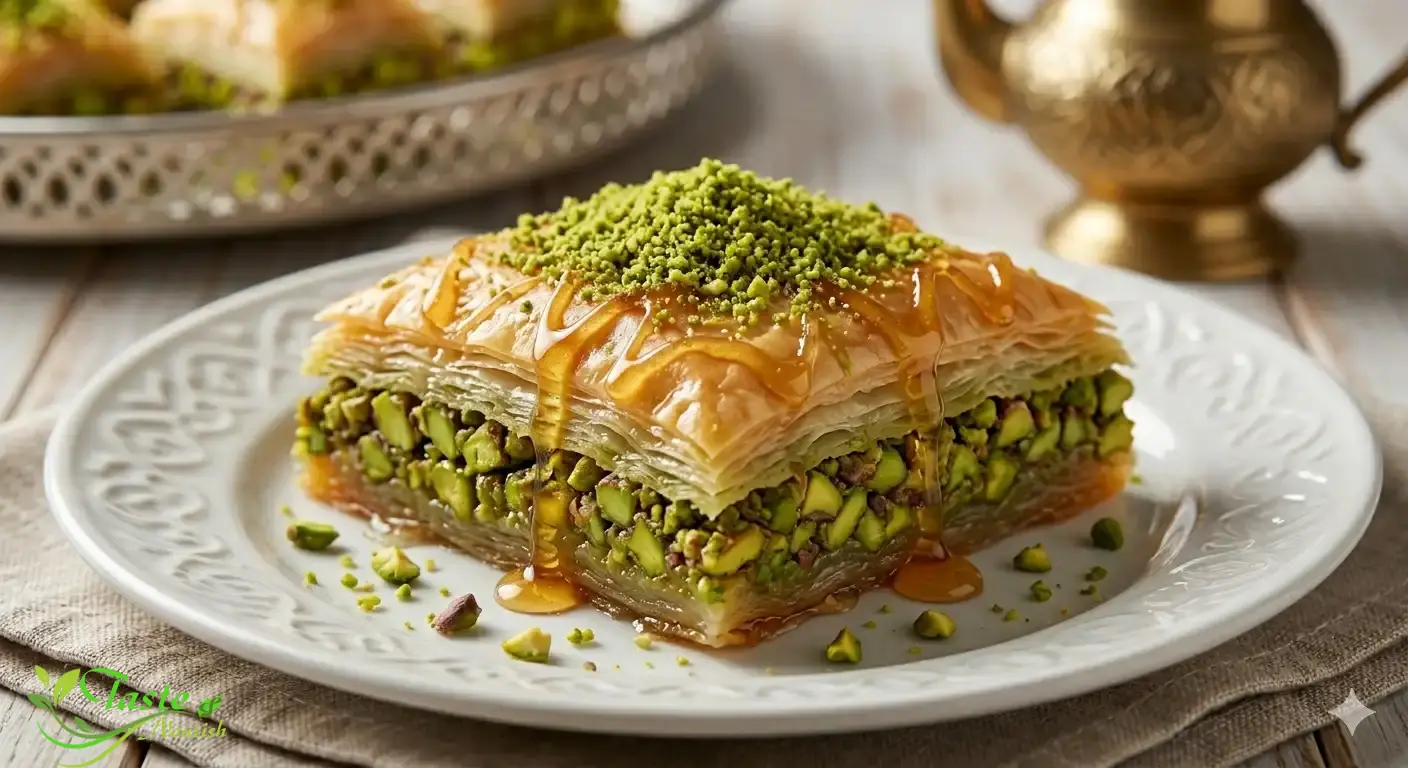
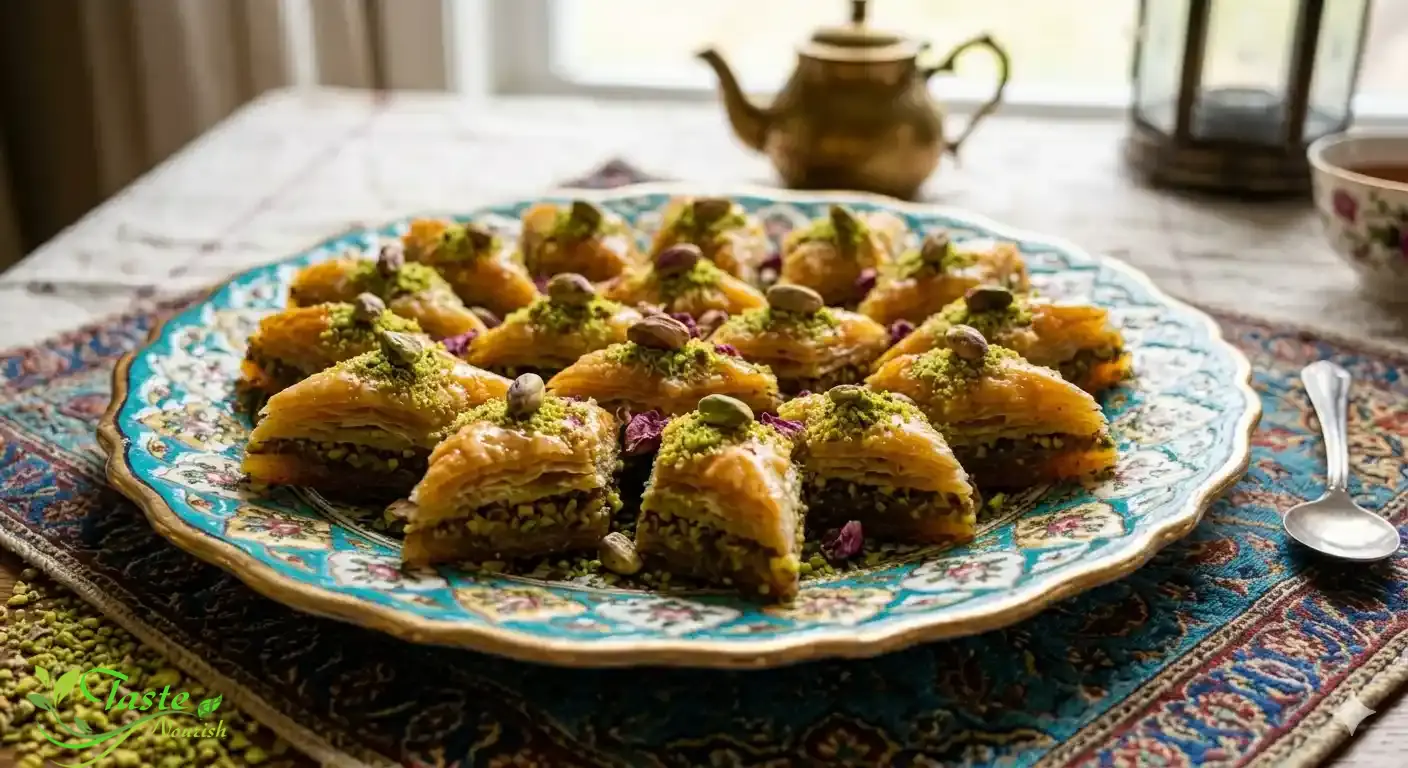
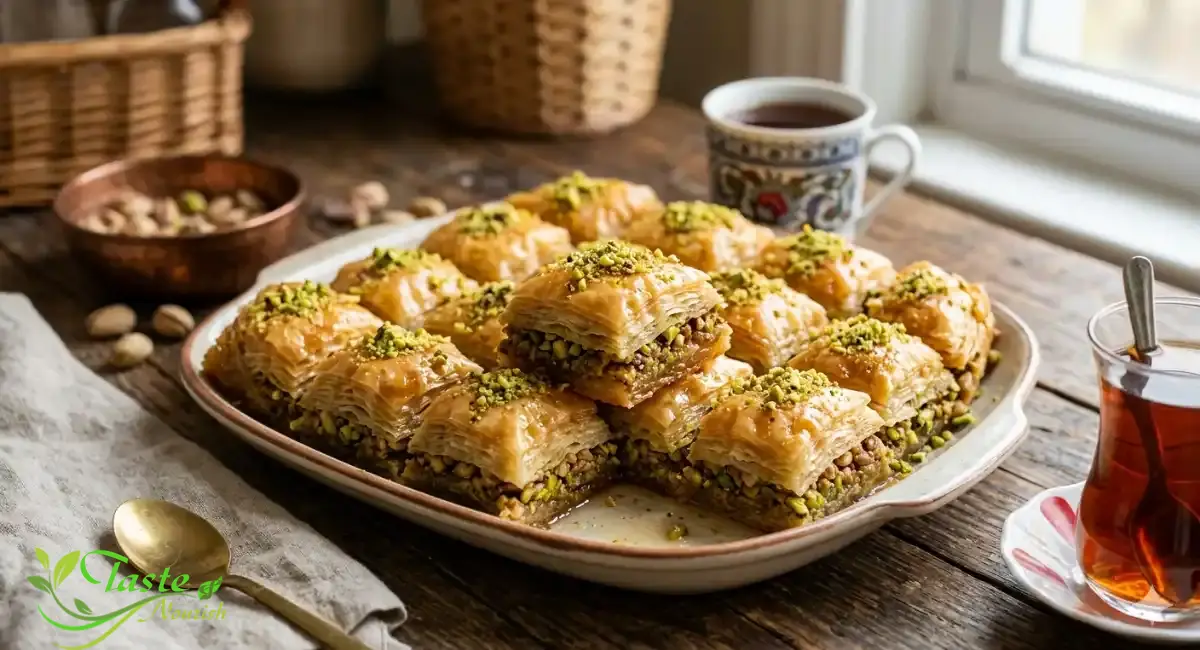
At its core, Turkish baklava is a rich, sweet pastry made from ultra-thin sheets of unleavened dough known as yufka, layered generously with finely ground or roughly chopped nuts — most commonly Gaziantep pistachios — and then soaked in a light, lemon-scented sugar syrup after baking.
The result is a dessert that manages to be simultaneously crisp and syrup-soaked, light and indulgent, simple in concept yet staggeringly complex in execution. Turkish baklava is celebrated for its delicate layers, rich sweetness, and deep cultural heritage, representing centuries of culinary refinement rooted in the traditions of the Ottoman Empire.
What separates Turkish-style baklava from all of its regional cousins is the use of a distinctly lighter syrup. While Greek baklava typically leans on honey and adds warm spices like cinnamon and cloves, and Lebanese versions incorporate rose water or orange blossom water for a floral character, Turkish baklava is characterized by its delicate layers of filo dough, generous filling of pistachios, and light, refreshing syrup — a balance that makes it feel refined rather than overwhelming.
This restraint is, ironically, what makes Turkish baklava so addictive. It invites you back for another piece rather than leaving you in a sugar-stunned stupor. Think of it as the difference between a bold perfume you can only wear occasionally and a perfectly calibrated scent you reach for every single day.
Key Takeaway: The defining qualities of authentic Turkish baklava are its gossamer-thin yufka layers, high-quality pistachio filling (particularly from Gaziantep), clarified butter, and a clear, light sugar syrup — not honey-based.
How to Make Authentic Turkish Baklava at Home — Step by Step
Making Turkish baklava at home is one of the most rewarding projects a home cook can undertake. It is demanding, but nothing about it is beyond a patient, attentive cook. The key is to respect the process rather than rush it. Here is a comprehensive guide to producing something genuinely close to the real thing.
Ingredients (makes approximately 30 pieces):
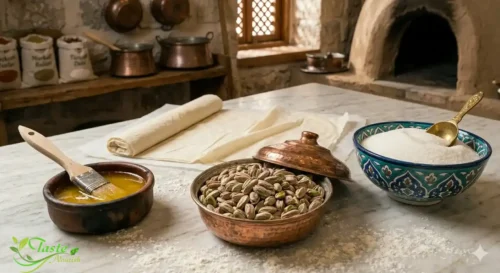
500g store-bought phyllo dough (or homemade yufka if you are ambitious)
250g unsalted butter, clarified
300g raw Gaziantep pistachios, finely ground (or a combination of pistachios and walnuts)
For the syrup: 400g sugar, 300ml water, juice of half a lemon
Step 1 — Prepare the clarified butter by melting unsalted butter over low heat and skimming the white foam from the surface. Pour the clear golden liquid into a separate bowl, leaving the milk solids behind. This is your sade yağ, and its quality determines everything.
Step 2 — Grind the nuts to a medium-fine consistency. You want texture — not powder, not chunks. The pistachio filling should feel slightly damp from its natural oils and smell intensely green and fresh.
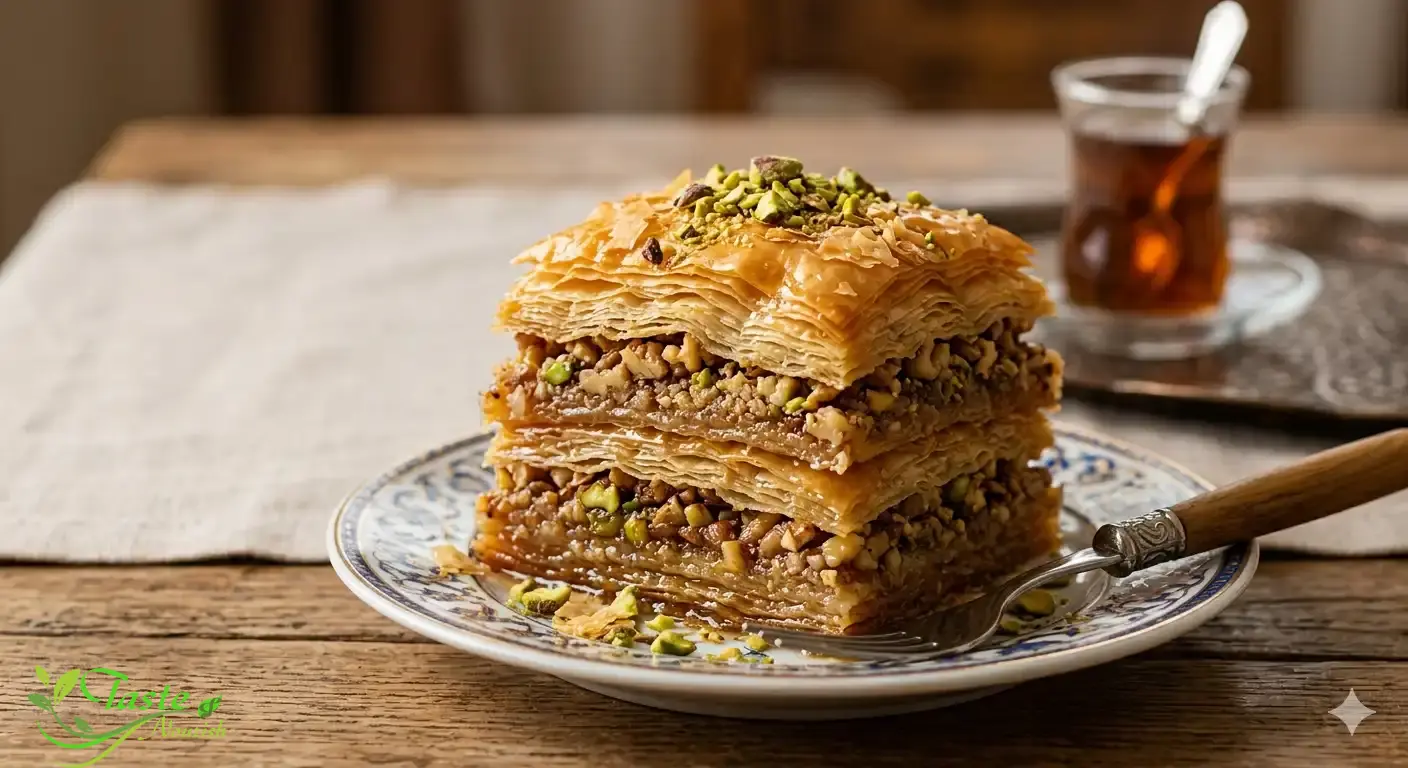
Step 3 — Layer the dough in a well-buttered rectangular tray. Place one sheet of phyllo, brush it with clarified butter, and repeat until you have laid 15–20 sheets. Spread your nut filling evenly across the surface, then continue layering another 15–20 sheets on top, buttering each one thoroughly.
Step 4 — Score the top with a sharp knife in a diagonal diamond pattern before baking. This is critical — it allows the syrup to penetrate evenly and gives you clean, presentable pieces after cutting.
Step 5 — Bake at 160–170°C (320–340°F) for 45–55 minutes until the top is a deep, even golden color. Watch it carefully — the line between perfectly golden and slightly burnt is narrow and unforgiving.
Step 6 — Make the syrup by combining sugar and water in a saucepan, bringing to a boil, and simmering for 10 minutes before adding the lemon juice. The syrup should be thin and clear, not thick or cloudy.
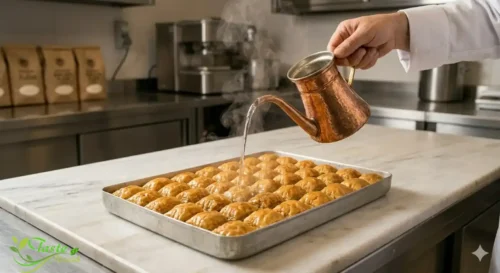
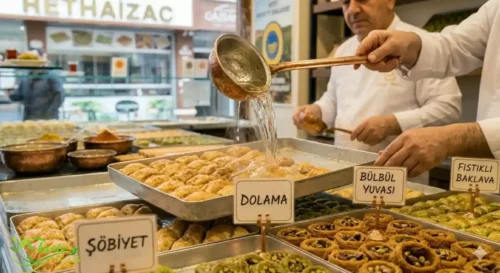
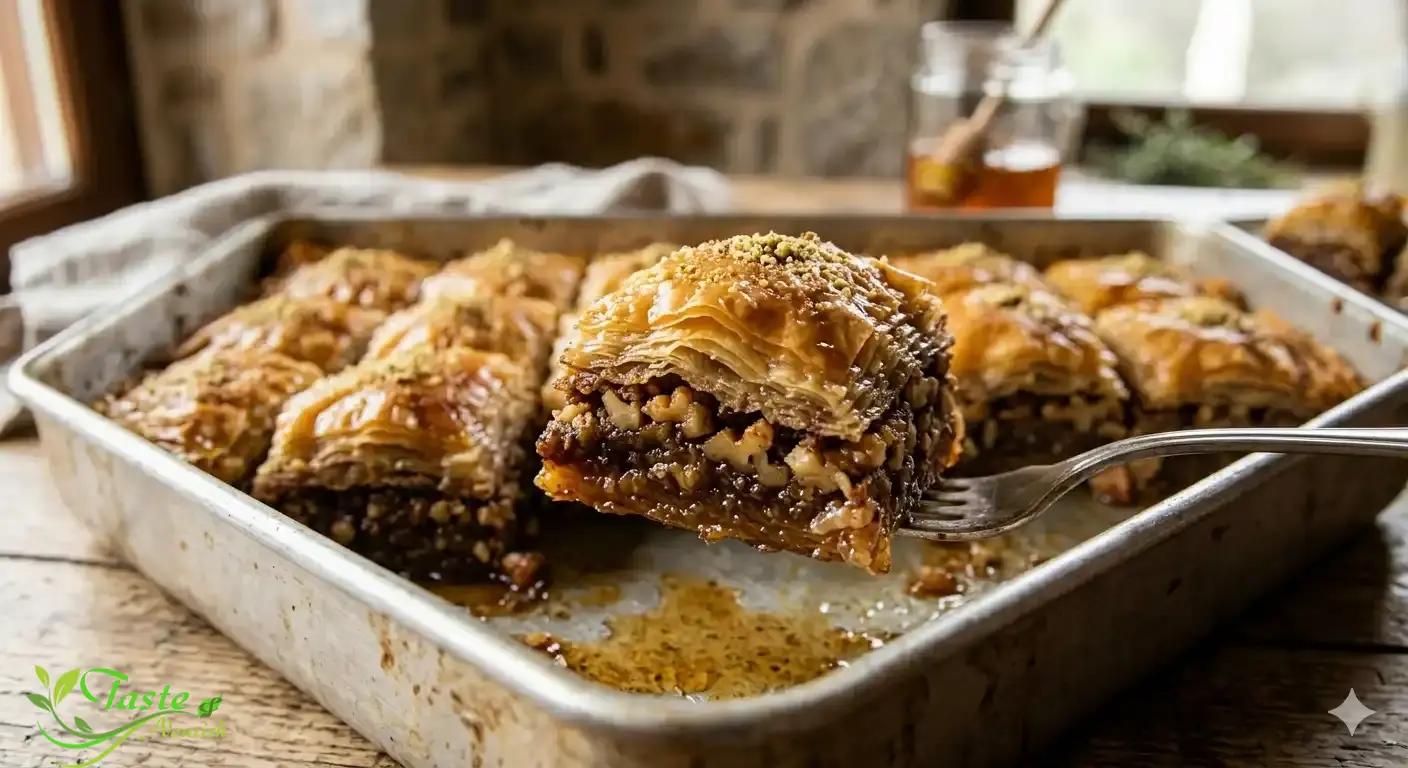
Step 7 — Pour the hot syrup over the hot baklava the moment it comes out of the oven. You will hear a glorious sizzle. Let it rest, uncovered, for at least 4 hours — ideally overnight — before serving. This resting period is not optional. It is when the syrup is absorbed, the layers settle, and the flavors merge into something unified and magnificent.
💡 Pro Tip: Never cover freshly syruped baklava with plastic wrap or a lid. The trapped steam will make the layers soggy. Leave it uncovered at room temperature and let time do its work.
The Art and Craft Behind Turkish Baklava
The Dough (Yufka) — Thinner Than a Whisper
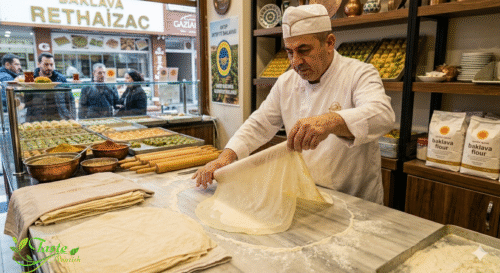
Making authentic Turkish baklava is less like cooking and more like engineering. The dough — yufka — must be rolled to a thickness of roughly 0.1 mm, which is thinner than a standard sheet of printer paper. Master pastry chefs, known as Usta, spend years learning how to roll dough so thin that you can read a newspaper through it.
Additionally, the selection of ingredients is vital; Gaziantep pistachios, harvested early for their vibrant green color, provide the signature flavor that distinguishes premium baklava from mass-produced versions. This is not something you achieve in a weekend baking class.
A skilled Usta typically apprentices for years under a master before being trusted with the dough roller, and even then their early efforts often end up as table-sized, lopsided sheets that cannot be used. The oklava — a long, thin rolling pin up to a meter in length — requires a specific sweeping motion, a controlled pressure, and an almost meditative patience that takes years to develop.
The linguistic roots of “baklava” offer clues to its evolution. While the etymology is debated, many linguists point to the Mongolian root bayla- (to tie, wrap, or pile up) combined with the Turkic verbal ending -v. The 11th-century lexicon Diwan Lughat al-Turk records yuvgha (folded bread), a direct ancestor of the phyllo used today.
In other words, the very name of this dessert is a linguistic time capsule, carrying within it thousands of years of nomadic Turkic food culture. Every time you say “baklava,” you are unknowingly speaking a very old language.
The Role of Clarified Butter (Sade Yağ)
If yufka is the skeleton of Turkish baklava, then clarified butter — sade yağ — is its soul. Every single layer of dough must be brushed generously with clarified butter before the next layer is placed on top. This is not optional, and it is not a step where you can cut corners.
Using high-quality butter ensures a rich, decadent flavor, while finely chopped nuts release their aromatic oils, infusing the pastry with their unique essence. The clarification process — slowly heating butter until the milk solids separate and can be skimmed away — produces a pure fat with a much higher smoke point and a cleaner, nuttier flavor than whole butter.
In Gaziantep, the best baklava workshops still use locally produced sheep’s milk butter for this step, and the difference it makes in the final product is, according to every serious baklava connoisseur, immediately noticeable. You can smell it before you even take a bite.
The Syrup — The Final Act of Perfection
Here is where many home bakers and even some commercial producers get Turkish baklava completely wrong: the syrup. In Greek or some Middle Eastern versions, honey is the primary sweetener, which creates a heavy, sometimes cloying result.
Authentic Turkish baklava uses a clear sugar syrup with lemon juice — and the technique of pouring it is just as critical as its composition. The syrup must be hot when the baklava comes out of the oven, but the baklava itself must also be hot.
Cold syrup on hot pastry, or hot syrup on cold pastry — both will make the layers soggy instead of creating that signature contrast between crisp exterior and syrup-saturated interior.
It is a dance of temperatures, a moment where science and tradition converge, and getting it right is what separates a truly great Turkish baklava from a merely decent one.
Popular Turkish Baklava Varieties You Must Try
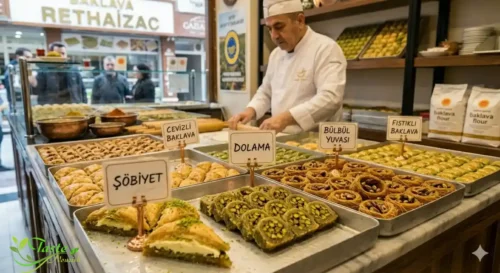
Different regions of Turkey have developed their unique baklava varieties that showcase local flavors and ingredients. The world of Turkish baklava is far more diverse than most people outside Turkey realize. Here is a breakdown of the most celebrated varieties:
Variety
Key Feature
Origin/Notes
Antep Baklavası
Classic pistachio-filled, crisp layers
Gaziantep; EU PGI Protected
Şöbiyet
Filled with clotted cream (kaymak) and pistachios
Softer texture; rich and creamy
Bülbül Yuvası
Rolled into a “bird’s nest” shape
Named after the nightingale; visually striking
Dolama / Sarma
Rolled rather than layered
Uses pistachio paste filling
Sütlü Nuriye
Made with milk instead of syrup
Lighter, milkier; modern favorite
Şireli Baklava
Uses grape molasses syrup
Distinct earthy-sweet flavor profile
Kadayıf Baklava
Shredded wheat dough (kadayıf) replaces yufka
Nuttier crust texture
Saray Sarması
Pistachios between elegantly layered yufka
“Palace Roll” — refined presentation
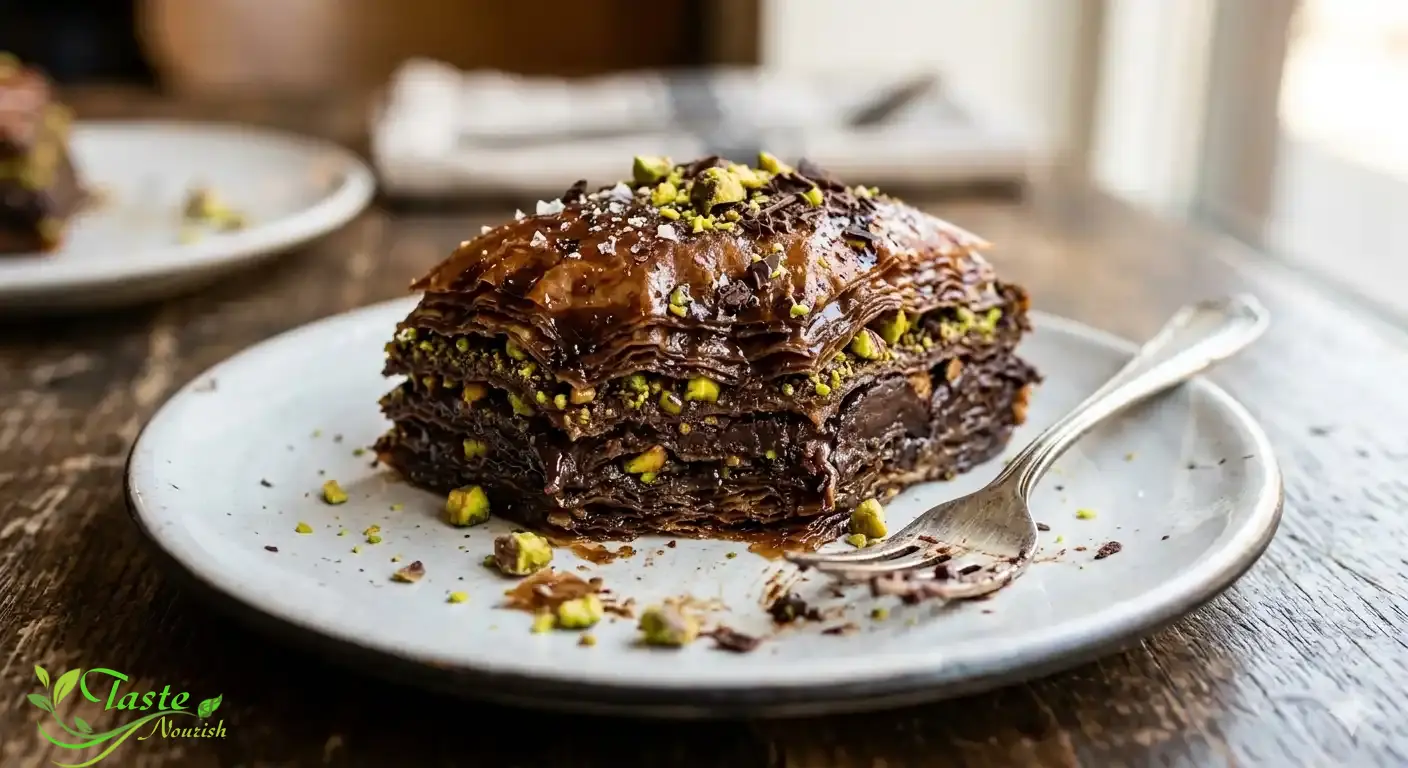
Şöbiyet contains clotted cream and has a softer texture. Bülbül Yuvası is round in shape, with pistachios or walnuts placed in the centre, and is visually appealing. Sütlü Nuriye, made with milk and a lighter syrup, has become increasingly popular on modern tables in recent years.
Each of these varieties tells you something about the city or region that created it — its available ingredients, its aesthetic sensibility, its relationship to sweetness. Trying all of them is not indulgence; it is education.
Turkish Baklava vs. Greek, Lebanese, and Armenian Baklava
This is one of the most hotly debated topics in Mediterranean and Middle Eastern food culture, and it deserves a clear-eyed, factual treatment. Greek baklava typically uses walnuts and includes spices like cinnamon and cloves. Lebanese baklava can feature rose water or orange blossom water in the syrup for a floral twist. Armenian baklava is known for its use of cinnamon and a thicker, honey-based syrup. Each variation offers a unique flavor profile that reflects the culinary traditions of its region.
Style
Nut
Syrup
Spices
Texture
Turkish
Pistachios (primarily)
Light sugar + lemon
None (pure)
Very crisp, light
Greek
Walnuts
Honey-based
Cinnamon, cloves
Heavier, softer
Lebanese
Mixed nuts
Rose/orange blossom
Subtle
Floral, aromatic
Armenian
Walnuts, almonds
Honey-heavy
Cinnamon
Thick, dense layers
The PGI designation of 2013 was significant not just commercially but culturally — it was the EU’s formal acknowledgment that Turkish baklava represents a distinct, protected culinary tradition with a documented geographic and historical provenance that places it firmly within the Turkish culinary canon. The Gaziantep baklava, described as a “pastry made of layers of filo pastry filled with semolina cream and Antep pistachio,” became the first Turkish product to receive this coveted status.
Where to Buy the Best Turkish Baklava
If you want the real thing without making it yourself, you have several excellent options. In Turkey, the gold standard is purchasing directly from a family-run baklavacı in Gaziantep. Murat and Cevdet Gullu are owners of Gulluoglu and say they are the sixth generation of a baklava-making family in Gaziantep, noting “The decades of developing baklava reached its peak in 1940, and that’s the recipe we are using today.” Establishments like Güllüoğlu and İmam Çağdaş have been producing baklava for multiple generations and ship their products internationally.
Beyond Gaziantep, Istanbul’s grand bazaar district and the city’s traditional pastry shops carry excellent baklava daily — look for trays that were baked that morning, since freshness is a key quality indicator.
Turkish baklava has conquered global palates, from Parisian patisseries to New York eateries. In Gaziantep, baklava tourism thrives, with factories offering tours and workshops. The city’s baklava exports exceed $300 million annually, a testament to its economic and cultural clout.
This means that wherever you are in the world, authentic Turkish baklava is more accessible than ever — through reputable online retailers, Turkish diaspora bakeries, and specialty food importers. The key when ordering online is to check that the product is shipped chilled (for fresh baklava) or vacuum-sealed (for shelf-stable versions), and that the listing specifies Gaziantep or Antep pistachio as the primary filling ingredient.
The Ancient Origins of Baklava — From Mesopotamia to the Ottoman Palace
The Earliest Recorded Roots
The story of baklava does not begin in Istanbul, nor even in Turkey. It begins far earlier, in a time before empires had mapped the world. Assyrians around the 8th century BCE layered flatbread with nuts and honey — a precursor to modern baklava. These early layered breads were baked in primitive wood-fired ovens, sweetened with whatever was available, and shared among communities as festive food.
They were not the architectural masterpieces we know today, but the DNA was already there: dough, nuts, sweetness, heat. If you think about it, humanity has been chasing this combination for nearly three thousand years.
Today, baklava has become a prominent symbol of Turkish cuisine, as the Turks inherited this culinary tradition and its recipes from their Ottoman ancestors. Although the recipe has evolved over centuries, its core elements remain unchanged — dozens of thin layers of phyllo dough filled with various crushed nuts such as walnuts, pistachios, or almonds, baked until golden and fragrant, then generously drizzled with a sweet syrup made from sugar, rosewater, honey, and lemon, resulting in a perfectly balanced sweet, nutty, and crispy delight.
The journey from that ancient Assyrian flatbread to the perfumed, gilded trays of Gaziantep is one of the most fascinating evolutionary arcs in all of culinary history. It crosses empires, religions, trade routes, and royal kitchens before arriving at the recognizable jewel we know today.
The Ottoman Refinement — Topkapı Palace and the Birth of Modern Baklava
The true transformation of baklava from rustic folk food to a dessert of breathtaking sophistication happened under the Ottomans. The transition from rustic nomadic layered breads to the refined palace pastry occurred in the Topkapı Palace.
The Matbah-ı Amire (Palace Kitchen) registers of 1473 provide the earliest written evidence of baklava being prepared for Sultan Mehmed II. Imagine the scale: the imperial kitchens employed hundreds of specialist cooks, each responsible for a single category of food, and the baklava chefs — the baklavacılar — were among the most prized. Their task was to roll dough so thin you could practically see through it, layer it with extraordinary precision, brush every single sheet with clarified butter, and produce a pastry that was worthy of a sultan’s table.
The traditional Turkish method would involve rolling out yufka using an oklava: a long, slender rolling pin. Tradition also dictates that the pastry should be so crisp that a coin dropped from a height of an arşın — an old unit of measurement equivalent to about 69 cm — should be able to pierce every layer and strike the bottom of the baking tray.
This is not just a charming folk test — it is a precise quality benchmark that tells you everything about the standard of Turkish baklava craftsmanship. The dough must be that thin, that uniform, that crisp. Anything less is not acceptable in the world of authentic Turkish baklava.
The Famous Baklava Procession — A Royal Tradition
Here is a piece of Ottoman history that most people have never heard of, and it is extraordinary. Turkish baklava was a staple of celebrations in the modern Turkish state and the old Ottoman Empire, where a special procession emerged known as the “baklava procession.” In the middle of the month of Ramadan in the late 17th century, the Sultan distributed trays of baklava to the Janissary units and other military units in Istanbul, with every ten soldiers sharing a tray of baklava, and great celebrations accompanied the movement of the trays through the streets.
This was not mere gift-giving. The Baklava Alayı — the baklava procession — was a deeply political and symbolic act. The Sultan was communicating loyalty, generosity, and imperial power through the medium of pastry. The soldiers who received these trays were not simply being fed; they were being honored, bound to their commander through the shared experience of this prestigious dessert.
Baklava also spread via charity kitchens known as imaret, which were part of mosque complexes and served meals to staff, visitors and the poor. Copper baklava trays listed in probate registers from the late 15th century onwards reveal that by this point it was no longer a dish exclusive to the elite, but was being made by middle-class families, too.
This democratization of baklava is one of the most important chapters in its history. As the recipe spread from palace kitchens to middle-class homes, regional variations began to emerge, each reflecting the local nuts, spices, and traditions of different parts of Anatolia.
Gaziantep Baklava — Turkey’s Crown Jewel with EU Protected Status
Why Gaziantep Pistachios Are Irreplaceable
If you have ever eaten truly great Turkish baklava — the kind that stops a conversation dead — there is a very good chance it was made with pistachios from Gaziantep. The ancient Anatolian city of Antep, today known as Gaziantep, is Türkiye’s gastronomic capital famous for being home to the world’s finest pistachios. These are not ordinary pistachios.
They are smaller, denser, and more intensely flavored than Persian or Californian varieties, with a distinctive bright green color that comes from early harvesting before the shell fully forms. When you grind them and layer them between sheets of buttered yufka, they release a perfume that is impossible to replicate with any other nut.
They are also loaded with natural oils that interact with the clarified butter and syrup in a way that creates a flavor depth you simply cannot achieve with a substitute.
Baklava chef Burhan Çağdaş, who was part of the team that prepared the Gaziantep Baklavası recipe for EU registration, highlights the rigorous process: “The EU carried out a very detailed examination, from the proportion of ingredients and the use of natural materials to the packaging and finally recognised our baklava.
The EU’s GI has played an important role in standardising Gaziantep Baklavası. Since the registration, demand has soared, especially from Europe, America and the Middle East.” That quote tells you everything. EU-level scrutiny was applied to every single aspect of production: the ratio of ingredients, the source of materials, even the packaging. This is not a casual designation — it is the world’s most rigorous food authenticity stamp.
PGI Recognition and What It Means
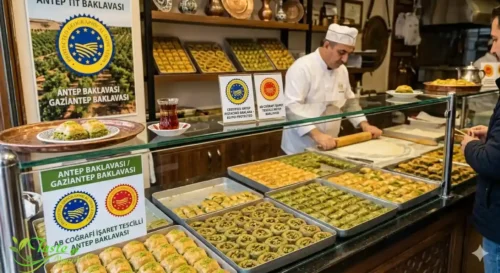
Turkish baklava is the first Turkish product to receive the EU protected status, joining other non-EU products like Indian Darjeeling tea, Mexican Tequila, and Blue Mountain coffee from Jamaica. The pastry, known as “Antep Baklavası” or “Gaziantep Baklavası,” has been granted PGI (Protected Geographical Indication) status. According to the official EU journal, “The most important raw material is Antep pistachio (Antep fıstığı), a registered agricultural product in Turkey.
Its dense taste and aroma are preserved in the final product and it gives its dark green colour to the lower part of Antep Baklavası/Gaziantep Baklavası.”
In a historic move in 2013, the European Union officially declared the dessert to be of Turkish origin, specifically from the Gaziantep region, marking the very first Turkish food product to receive such prestigious certification from Europe. This recognition effectively settled long-standing debates regarding the dish’s roots, thereby solidifying Turkey’s place as its true home.
What does this mean practically for you as a consumer? It means that if you buy something labeled “Gaziantep Baklavası” within the EU, it must actually be made in Gaziantep, using Antep pistachios, following the documented traditional method. It is your guarantee of authenticity — the culinary equivalent of a passport stamp.
📌 Reader Tip: When buying Turkish baklava online or at a specialty store, look for packaging that references Gaziantep origin or the EU PGI seal — these are your clearest indicators of a premium, authentic product.
The Cultural Significance of Baklava in Turkish Society
To understand Turkish baklava fully, you have to understand that it transcends its status as a dessert. In Turkey, baklava is a social currency.
Turkish baklava is commonly served during celebrations and major occasions, and offering it to guests is considered a gesture of respect and generosity, reflecting the importance of food in Turkish culture.
At weddings, at religious holidays — particularly Eid al-Fitr and Eid al-Adha — at births, graduations, business openings, and family gatherings, baklava is the universal messenger of joy, prosperity, and welcome.
There is a well-known Turkish expression — “Baklava gibi tatlı” (as sweet as baklava) — used as the highest compliment for a person, a situation, or an experience. When something is as good as baklava, it cannot get any better.
The cultural weight of this dessert also shows up in Turkish literature, poetry, and even military history, as we saw with the Baklava Procession. In 1941, making baklava was banned in Turkey because of the flour shortage during the Second World War, and only permitted again in 1944.
Think about what it means for a government to specifically legislate about a dessert. It tells you how central baklava was — and remains — to Turkish daily life and national identity. When the flour shortages of the war made it impossible to produce, the loss was felt not just as a culinary deprivation but as a cultural one. The return of baklava in 1944 must have felt like something being restored to its rightful place.
Conclusion
Turkish baklava — known as baklava turca in Spanish and Italian, and baklava turska in Bosnian, Croatian, and Serbian — is one of humanity’s great culinary achievements. It is a dessert that encodes nearly three thousand years of history, from Assyrian flatbreads to Ottoman imperial kitchens, from the charitable imaret kitchens of mosque complexes to the EU-protected workshops of Gaziantep. Its appeal is universal precisely because it is specific: rooted in a place, a craft, a set of irreplaceable ingredients, and a cultural tradition that treats every guest as someone worthy of the finest hospitality.
Understanding Turkish baklava means understanding that the best food is never accidental. Every layer of yufka, every gram of Gaziantep pistachio, every ladle of hot sugar syrup poured over a freshly baked tray represents a chain of human knowledge stretching back centuries — passed from master to apprentice, from grandmother to grandchild, from Istanbul to the world. The next time you eat a piece, close your eyes for a moment. You are tasting all of that at once.
Turkish Baklava (FAQs)
1. What makes Turkish baklava different from other types of baklava?
Turkish baklava is distinguished by its use of a lighter, clear sugar syrup (rather than honey), its very thin yufka dough rolled by hand, and its primary filling of Gaziantep pistachios rather than walnuts or heavily spiced nut blends. The result is a crisper, less sweet, and more refined pastry compared to Greek, Lebanese, or Armenian versions.
2. Is Gaziantep baklava officially protected?
Yes. Since 2013, Antep Baklavası/Gaziantep Baklavası has held Protected Geographical Indication (PGI) status from the European Union — the first Turkish food product ever to receive this honor. This means only baklava produced in Gaziantep using Antep pistachios and traditional methods can legally carry this name within the EU.
3. How long does Turkish baklava stay fresh?
Properly stored at room temperature in an airtight container, Turkish baklava stays fresh for up to 5–7 days. Refrigeration can extend this slightly but may affect the texture of the pastry layers. Avoid storing in the refrigerator if possible for the best crisp-to-syrup ratio.
4. Can I make Turkish baklava with store-bought phyllo dough?
Yes, and for most home cooks, this is the practical route. Commercial phyllo dough produces very good results as long as you thaw it properly (overnight in the refrigerator), handle it carefully to prevent tearing, and use quality clarified butter. The most important variables in your control are the quality of your pistachios and the precision of your syrup.
5. Why is Turkish baklava so expensive compared to other sweets?
Authentic Turkish baklava is expensive because it is intensely labor-intensive — rolling paper-thin dough by hand, layering it precisely, and baking it correctly requires significant skill and time. Add to this the high cost of premium Gaziantep pistachios (among the most expensive nuts in the world by weight) and clarified butter, and you have a product whose price reflects real craftsmanship and ingredient quality, not marketing.
Hanan Abo Samra is the founder of Taste & Nourish, sharing trustworthy nutrition guidance and recipes drawn from 20+ years of hands-on cooking experience. When she's not developing new recipes, Hanan is researching the science behind everyday ingredients to bring readers practical, evidence-based guidance for a healthier lifestyle.