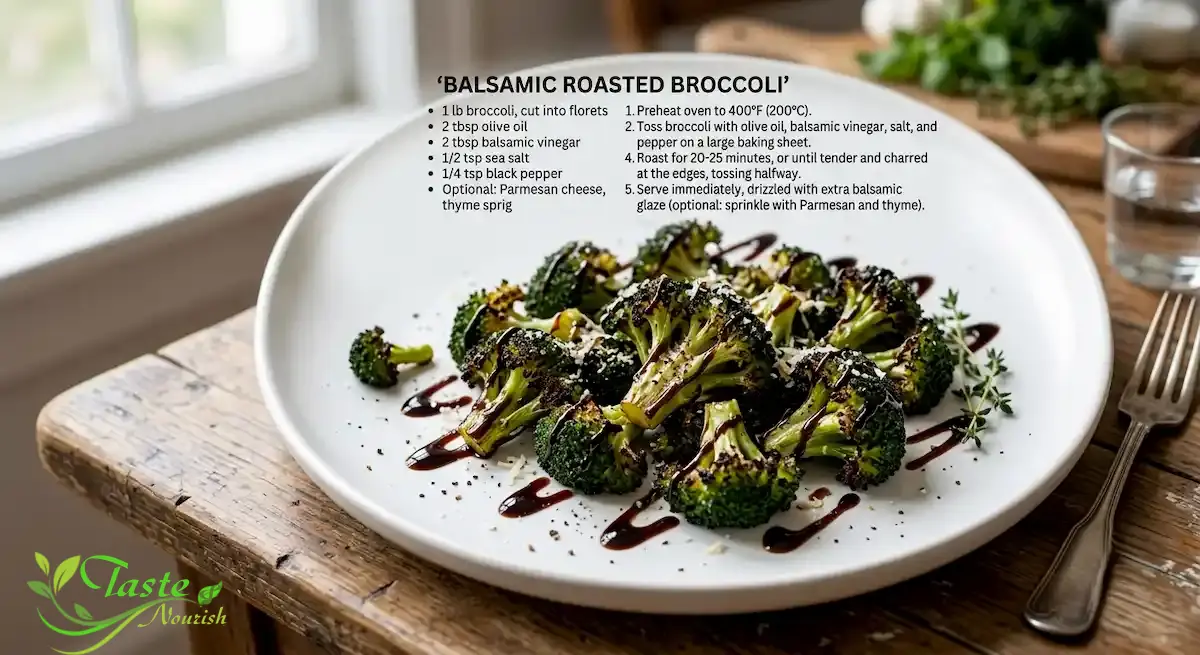
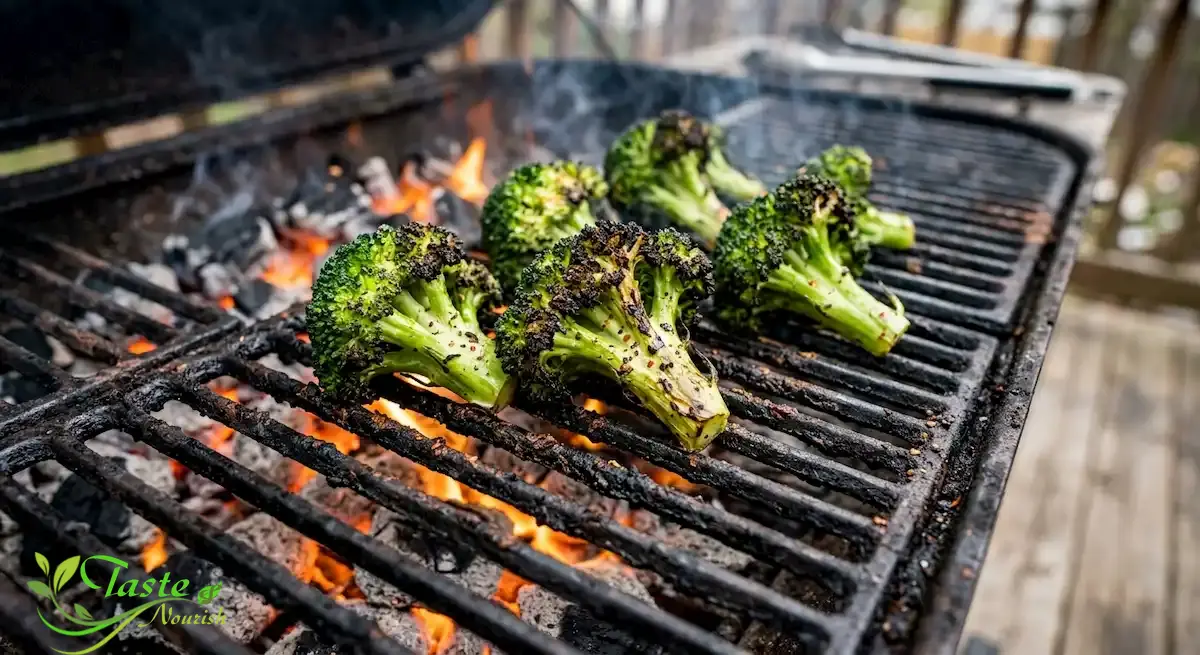
Jump to Recipe Print RecipeIf broccoli has ever felt like the vegetable you eat out of obligation, this balsamic roasted broccoli recipe is here to change your mind. High heat turns the florets golden and a little charred at the edges, and a splash of balsamic vinegar at the end adds a sweet-tangy finish that makes the whole pan disappear.It takes about 30 minutes from cutting board to table, uses one sheet pan, and needs nothing fancier than olive oil, garlic, and salt.
This balsamic roasted broccoli recipe tosses fresh florets in olive oil, roasts them at high heat until browned and tender-crisp, then finishes with a drizzle of balsamic vinegar and garlic for a tangy, savory side dish. It serves four, takes about 30 minutes total, and works alongside almost any main course, from roast chicken to a simple grain bowl.
Key Takeaways
This balsamic roasted broccoli recipe takes about 30 minutes total and uses just one sheet pan.
Adding balsamic vinegar after roasting, not before, keeps the broccoli from steaming and the vinegar from turning bitter.
Broccoli is a good source of vitamin C, vitamin K, and fiber, and it’s naturally low in calories.
Research on cruciferous vegetables like broccoli suggests they may support heart and digestive health, though most of the evidence comes from population studies rather than controlled trials.
People on blood thinners such as warfarin should keep their vitamin K intake, including from broccoli, fairly consistent from week to week.
What Makes This Balsamic Roasted Broccoli Recipe Work
Broccoli is a cruciferous vegetable, part of the same plant family as cauliflower, cabbage, and Brussels sprouts. Raw, it has a slightly bitter, grassy flavor that turns a lot of people off. Roasting changes that chemistry entirely.
High, dry heat caramelizes the natural sugars in the florets and browns the edges, which mellows the bitterness and adds a nutty, almost toasted flavor. Balsamic vinegar plays off that caramelization with its own sweet-tart edge, so the two flavors reinforce each other instead of competing.
This is also a forgiving recipe. You don’t need a marinade, a sauce that simmers for an hour, or any equipment beyond a sheet pan and an oven. It’s the kind of easy balsamic glazed broccoli recipe you can make on a Tuesday without planning ahead.
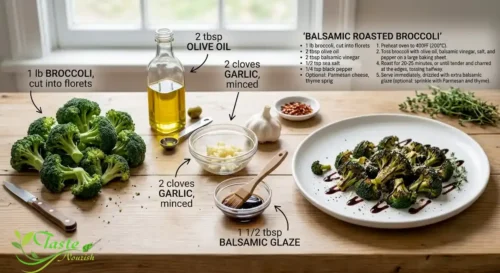
Ingredients for an Easy Balsamic Glazed Broccoli Recipe
This makes four side-dish servings. Amounts scale easily if you’re cooking for more people.
3 tablespoons balsamic vinegar, or 2 tablespoons balsamic glaze
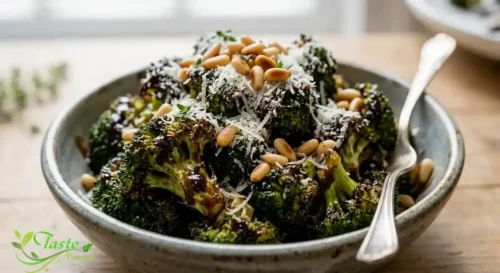
Optional: red pepper flakes, grated Parmesan, toasted pine nuts or slivered almonds, lemon zest
How to Make This Balsamic Roasted Broccoli Recipe
Step-by-Step Instructions
Preheat the oven to 425°F. Line a large sheet pan with parchment paper or foil.
Cut the broccoli into florets of similar size so they cook evenly. Pat them dry with a kitchen towel; excess moisture is the main reason roasted vegetables end up soggy instead of crisp.
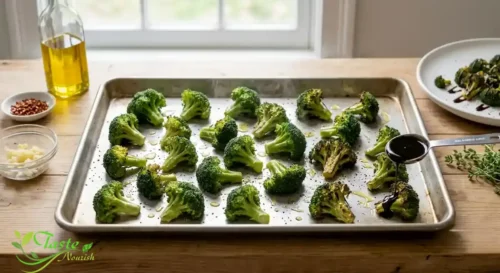
Spread the broccoli in a single layer on the sheet pan. Avoid crowding the pieces, since a packed pan traps steam and softens the broccoli rather than browning it.
Drizzle with olive oil, then scatter the minced garlic, salt, and pepper over the top. Toss with your hands or tongs until every piece is lightly coated.
Roast for 18 to 22 minutes, flipping the florets halfway through, until the edges are browned and slightly crisp and the stems are fork-tender.
Remove the pan from the oven and immediately drizzle the balsamic vinegar or glaze over the hot broccoli. Toss right away so the vinegar coats the florets and reduces slightly from the residual heat.
Taste and adjust seasoning. Add red pepper flakes, Parmesan, toasted nuts, or lemon zest if you’d like. Serve warm.
Recipe Notes and Substitutions
Balsamic glaze is thicker and sweeter than plain balsamic vinegar, so if you swap one for the other, start with a little less and adjust to taste. Frozen broccoli florets can work in a pinch, but thaw and pat them very dry first, since frozen broccoli holds more water and roasts less crisply than fresh. If you don’t have fresh garlic, ½ teaspoon of garlic powder mixed into the oil is a reasonable stand-in.
Nutrition Facts
Values below are estimated per serving (about 1½ cups) for the full recipe as written, serving four. Numbers will shift depending on exact portion sizes and any optional toppings you add.
Nutrient
Amount per serving
Calories
~120 kcal
Protein
~4 g
Total fat
~9 g
Carbohydrates
~11 g
Dietary fiber
~4 g
Sugars
~4 g
Vitamin C
~130% Daily Value
Vitamin K
~150% Daily Value
Folate
~14% Daily Value
Potassium
~9% Daily Value
Raw broccoli itself is remarkably low in calories, with roughly 31 calories per cup chopped, most of which come from carbohydrate and a modest amount of protein. The added calories in this dish come almost entirely from the olive oil.
Health Benefits of This Tangy Balsamic Broccoli Side
Broccoli’s reputation as a health food isn’t just marketing. It’s a genuinely nutrient-dense vegetable, and pairing it with olive oil in this tangy balsamic broccoli side may even help your body absorb some of its fat-soluble compounds more efficiently.
Rich in vitamin C: a single cup of raw broccoli provides close to a full day’s worth, which supports immune function and skin health.
High in vitamin K: important for normal blood clotting and bone metabolism.
Good fiber source: may support digestion and steady blood sugar response.
Contains glucosinolates: plant compounds that convert into sulforaphane, a molecule researchers have studied for its antioxidant and cell-protective activity.
Low in calories, high in volume: useful if you’re trying to eat more vegetables without a large calorie load.
Scientific Evidence Behind Broccoli’s Health Reputation
Most of the excitement around broccoli centers on sulforaphane, a compound formed when broccoli’s cells are cut or chewed. A comprehensive review published in the journal Cancers and hosted by the National Institutes of Health summarized decades of laboratory, animal, and early clinical research on sulforaphane’s antioxidant and cell-protective mechanisms, noting that while the compound shows consistent promise across study types, large-scale human trials are still limited.
Separately, observational research on cruciferous vegetables more broadly has linked higher intake with lower rates of certain chronic diseases. A large 2025 analysis pooling data from more than 97,000 people, covered by Harvard Health Publishing, found that those eating the most cruciferous vegetables had a meaningfully lower rate of colon cancer than those eating the least, with the benefit leveling off at modest daily amounts.
It’s worth being clear-eyed about what this evidence does and doesn’t show. Much of it is observational, meaning it can identify patterns and associations but can’t prove that broccoli itself directly causes a lower disease risk. People who eat more vegetables often have other health-supporting habits too. The research is genuinely encouraging, but “may help” is a more accurate summary than “prevents.”
Potential Risks and Side Effects
For most people, broccoli is very well tolerated. The most common complaint is gas or bloating, since broccoli contains raffinose, a type of fiber that ferments in the gut. Eating it cooked rather than raw, and in moderate portions, usually helps.
Broccoli’s high vitamin K content is the main interaction to be aware of. According to the National Institutes of Health’s Office of Dietary Supplements, vitamin K can interfere with the effectiveness of anticoagulant medications such as warfarin by counteracting the drug’s blood-thinning action. This isn’t a reason to avoid broccoli, but it is a reason to keep your intake steady rather than swinging between none and very large amounts.
Who Should Avoid It?
Very few people need to avoid broccoli outright. A few groups may want to talk to a doctor or dietitian before making changes:
People taking warfarin or similar anticoagulants, who should keep vitamin K intake consistent week to week rather than avoiding or overloading on broccoli.
People with diagnosed thyroid conditions, since very large amounts of raw cruciferous vegetables contain compounds that can interfere with iodine uptake, particularly in the context of an iodine-poor diet. Cooked, moderate portions are generally considered lower-concern.
People with a diagnosed broccoli or cruciferous vegetable allergy, which is uncommon but does exist.
Anyone with IBS or a sensitivity to fermentable fibers (FODMAPs), who may need smaller portions to avoid gas or bloating.
How Much Broccoli Should You Eat?
The USDA’s MyPlate guidelines recommend that most adults get about 2 to 3 cups of vegetables a day from a variety of sources, broccoli included. There’s no special upper limit specific to broccoli for a healthy adult eating a varied diet.
On the cruciferous vegetable research side, the colon cancer analysis mentioned earlier found that benefits appeared at intakes of roughly 20 to 40 grams per day, a little over a quarter cup, with the protective association leveling off beyond that. A single serving of this balsamic roasted broccoli recipe comfortably covers that range and then some.
How to Choose the Best Broccoli and Balsamic Vinegar
Good broccoli starts with tight, compact florets in a deep green color, sometimes with a slightly purplish tinge. Avoid heads where the florets have started to yellow or open into small flowers, which signals the broccoli is past its prime. The stalk should feel firm and heavy for its size, not rubbery or soft.
For the balsamic vinegar, you don’t need an expensive aged bottle for this recipe, but it’s worth checking the label. Vinegars labeled “Aceto Balsamico di Modena” and made mainly from grape must tend to have a rounder, less harsh flavor than very cheap versions padded with added sugar and caramel color. Balsamic glaze is simply balsamic vinegar reduced with a bit of added sugar, which makes it thicker and sweeter.
Storing and Reheating This Balsamic Roasted Broccoli Recipe
Store leftovers in an airtight container in the refrigerator for up to 3 to 4 days. To bring back some of the original crispness, reheat in a 400°F oven or an air fryer for about 5 minutes rather than the microwave, which tends to make roasted vegetables limp.
Raw, uncut broccoli keeps best unwashed in a loosely closed bag in the crisper drawer, where it typically lasts 3 to 5 days. If you want to freeze broccoli for later use, blanch the florets in boiling water for about 2 minutes first, then cool them quickly in ice water before freezing; this helps preserve color, texture, and nutrients.
Best Ways to Serve and Customize This Recipe
This dish is flexible enough to fit almost any meal. A few ideas worth trying:
Toss with grated Parmesan and toasted pine nuts right before serving.
Add a pinch of red pepper flakes for heat that plays well against the sweetness of the balsamic.
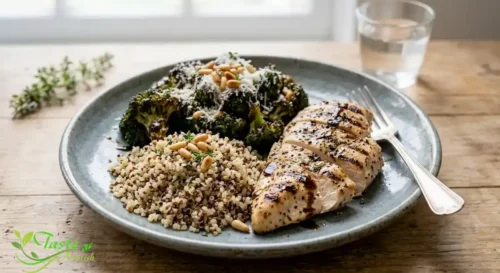
Serve over cooked farro, quinoa, or orzo for a heartier grain bowl.
Pair with roast chicken, grilled salmon, or a simple steak for a complete dinner.
Finish with a little lemon zest for brightness if you want a lighter, fresher edge.
Common Mistakes in a Balsamic Roasted Broccoli Recipe
Overcrowding the pan: too many florets packed together trap steam and prevent browning.
Adding balsamic vinegar before roasting: the sugar in the vinegar can scorch and turn bitter under high heat; add it after roasting instead.
Not drying the broccoli: wet florets steam rather than roast, leaving them soft instead of crisp-edged.
Under-seasoning: broccoli needs a fair amount of salt to taste balanced, especially once the tangy balsamic is added.
Myths vs. Facts
Myth
Fact
Roasting destroys all of broccoli’s nutrients.
Some heat-sensitive vitamin C is lost during roasting, but many other nutrients, including fiber and minerals, remain largely intact.
Anyone with thyroid concerns should avoid broccoli entirely.
Moderate, cooked portions are generally considered fine for most people; concerns mainly involve very large raw amounts alongside low iodine intake.
Balsamic glaze and balsamic vinegar are the same thing.
Balsamic glaze is balsamic vinegar reduced with added sugar, making it thicker and sweeter than plain vinegar.
Frozen broccoli can’t be roasted well.
It can work if thawed and thoroughly dried first, though fresh broccoli generally roasts crisper.
Roasting vs. Other Cooking Methods
How you cook broccoli affects both flavor and, to some degree, its nutrient profile. Here’s a general comparison:
Method
Flavor and texture
Nutrient considerations
Roasting
Caramelized, nutty, crisp edges
Some vitamin C loss from heat; minimal water contact limits nutrient leaching
Steaming
Bright green, tender, mild flavor
Generally retains more water-soluble vitamins than boiling
Boiling
Soft texture, milder flavor
More vitamin C and B vitamins can leach into the cooking water
Raw
Crunchy, slightly bitter, grassy
Highest vitamin C retention, but tougher on digestion for some people
Balsamic Roasted Broccoli Recipe FAQs
Can I use balsamic glaze instead of balsamic vinegar for roasted broccoli?
Yes. Balsamic glaze is thicker and sweeter, so use a little less than you would plain vinegar and adjust to taste.
Why does my balsamic roasted broccoli turn soggy?
Usually it’s from overcrowding the pan, not drying the florets before roasting, or adding the balsamic vinegar too early in the process.
Can I meal prep this recipe ahead of time?
You can roast the broccoli a day or two ahead and reheat it in the oven or air fryer, but the texture is noticeably better the day it’s made.
Is roasted broccoli healthier than steamed broccoli?
Neither method is clearly “healthier” overall. Steaming preserves slightly more water-soluble vitamins, while roasting adds flavor that can make people eat more vegetables overall, which has its own value.
Can I make this recipe with frozen broccoli?
Yes, though thaw it fully and pat it very dry first. Frozen broccoli holds more water than fresh, so it won’t crisp up quite as well.
What can I serve with balsamic roasted broccoli?
It pairs well with roast chicken, grilled fish, steak, pasta, or a grain bowl, and it also works cold the next day tossed into a salad.
3 tablespoons balsamic vinegar or 2 tablespoons balsamic glaze
Directions
Preheat the oven to 425°F and line a sheet pan with parchment paper.
Cut broccoli into even florets and pat dry.
Spread broccoli in a single layer without crowding the pan.
Toss with olive oil, garlic, salt, and pepper.
Roast 18 to 22 minutes, flipping halfway, until browned and tender.
Drizzle with balsamic vinegar immediately after roasting and toss to coat.
Add optional toppings and serve warm.
Conclusion
This balsamic roasted broccoli recipe earns its spot in a regular dinner rotation because it’s fast, forgiving, and genuinely good, not just good “for a vegetable.” Roasting brings out a natural sweetness that raw or boiled broccoli rarely has, and a simple balsamic finish ties the whole dish together without much effort.
Whether you’re eating it as a quick side dish or building it into a larger grain bowl, it’s an easy way to get a nutrient-dense vegetable onto the table without anyone at dinner feeling like they’re settling for it.
References
FoodData Central, U.S. Department of Agriculture, Agricultural Research Service
Hanan Abo Samra is the founder of Taste & Nourish, sharing trustworthy nutrition guidance and recipes drawn from 20+ years of hands-on cooking experience. When she's not developing new recipes, Hanan is researching the science behind everyday ingredients to bring readers practical, evidence-based guidance for a healthier lifestyle.