
Chia Seed Crackers Recipe: Crisp, Keto-Friendly, Baked or Dehydrated
Chia Seed Crackers Recipe: Crisp, Keto-Friendly & Easy
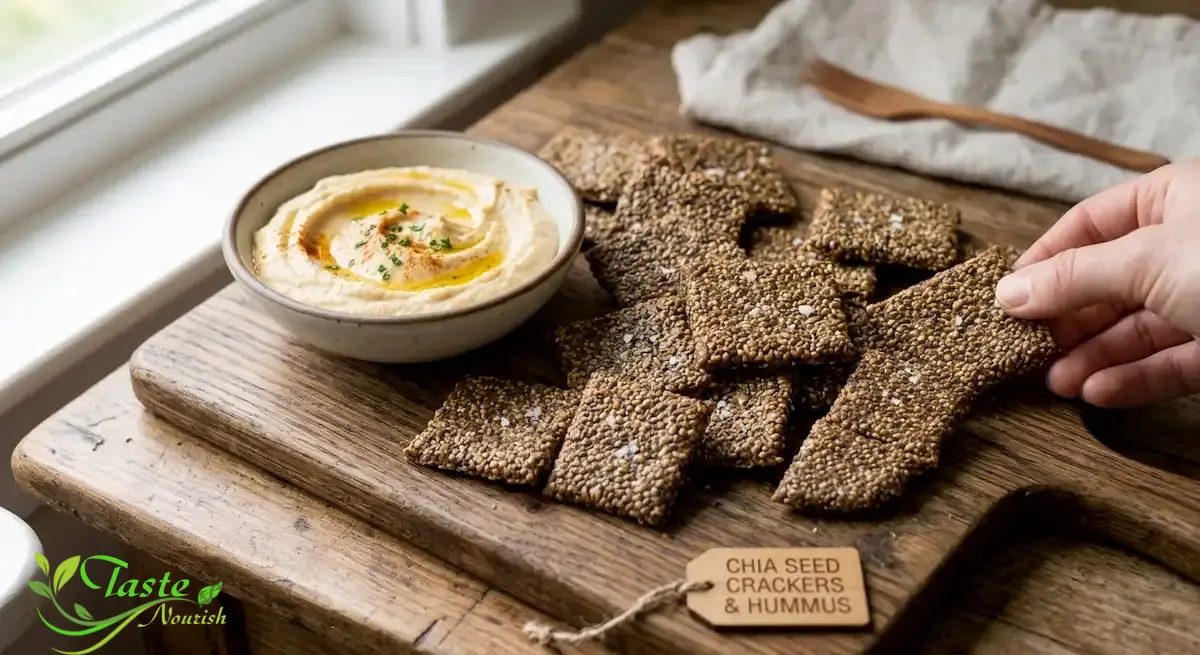
If you’ve never made your own crackers, chia seeds are one of the easiest places to start. This chia seed crackers recipe uses just three core ingredients — chia seeds, water, and seasoning — and turns them into thin, crisp, gluten-free crackers with almost no hands-on effort. The seeds do the work themselves: soaked in water, they swell and gel into a spreadable batter that dries into something surprisingly sturdy and snap-crisp.
This version works two ways. Bake it in a regular oven for a faster, slightly toasted result, or dry it low and slow in a dehydrator for a raw-style cracker with a cleaner, more mineral-forward flavor. Either way, you end up with a homemade chia cracker that holds up to a thick dip and tastes like something you’d pay a premium for at a specialty grocery store.
Quick Answer
This chia seed crackers recipe combines chia seeds and water with salt and dried seasonings, then lets the mixture gel into a thick, spreadable batter. Spread it thin on a lined sheet, score it into cracker shapes, and either bake at 300°F (150°C) for 45 to 60 minutes or dehydrate at 115°F (46°C) for 6 to 8 hours, until fully dry and crisp all the way through.
Key Takeaways
- This chia seed crackers recipe needs only chia seeds, water, and seasoning — no flour, eggs, or starch binders required.
- Chia seeds gel almost the moment they touch liquid, so whisk right away and let the mixture rest 15 to 20 minutes before spreading.
- Spreading the gel thin and evenly (about 1/8 inch) matters more than the exact bake time for getting a crisp result.
- You can bake these in a conventional oven or dry them in a dehydrator for a raw-style cracker — both methods are covered below.
- Because most of chia’s carbohydrate content comes from fiber, these crackers fit comfortably into a low-carb or keto way of eating.
What Are Chia Seed Crackers?
Chia seed crackers are a naturally gluten-free cracker built entirely around chia’s unusual ability to gel. When chia seeds meet liquid, the soluble fiber in their outer coating swells and forms a thick, mucilaginous gel that binds the seeds together without needing flour, eggs, or starch. Spread that gel thin and dry it out, and you’re left with a light, crisp, seed-studded cracker with a texture somewhere between a flax cracker and a sesame snap.
Because the base is essentially just chia and water, the flavor is a blank canvas — everything from garlic-herb to cheesy to sweet-cinnamon variations works from the same starting dough.
Ingredients
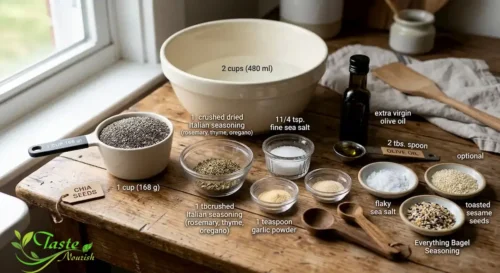
- 1 cup (168 g) chia seeds (white, black, or a mix)
- 2 cups (480 ml) water
- 1 1/4 teaspoons fine sea salt
- 1 teaspoon garlic powder
- 1 teaspoon onion powder
- 1 tablespoon dried herbs (such as rosemary, thyme, or Italian seasoning), crushed between your fingers
- 2 tablespoons extra virgin olive oil (optional)
- Optional finishing toppings: flaky sea salt, sesame seeds, or everything bagel seasoning
This batch makes roughly two standard half sheet pans of crackers, or about 30 to 36 pieces depending on how large you cut them.
Ingredient Notes
Chia seeds: White and black chia seeds behave identically and taste the same, so pick whichever you have or prefer visually. Use whole chia seeds rather than ground chia meal — the intact seed coating is what forms the gel network that holds the cracker together.
Ground chia absorbs liquid differently and produces a denser, less structured result, so it isn’t a straight swap here. USDA FoodData Central lists chia seeds as a concentrated source of dietary fiber and plant protein, which is part of why they gel and bind so effectively.
Water: Plain water keeps the chia flavor clean and lets the seasoning lead. Vegetable broth can be used in its place for a more savory cracker, but reduce the added salt if your broth is already salted.
Salt: Mix it into the gel itself rather than relying only on a finishing sprinkle. Since chia makes up most of the cracker’s volume, surface salt alone won’t season the interior.
Dried herbs and aromatics: Dried garlic powder, onion powder, and herbs work better here than fresh versions, which carry extra moisture that fights the drying process and can leave soft spots. If you want to use fresh herbs, mince them very finely and use them sparingly.
Olive oil (optional): A small amount rounds out the flavor and keeps the crackers from tasting flat or overly “seedy.” Chia seeds are also a plant-based source of alpha-linolenic acid (ALA), an omega-3 fatty acid, according to the NIH Office. Keep the oil to 2 tablespoons or less per batch — more than that can make the crackers greasy and slow down crisping.
How to Make the Chia Gel
The gel stage is the foundation of this entire recipe, so it’s worth doing carefully.
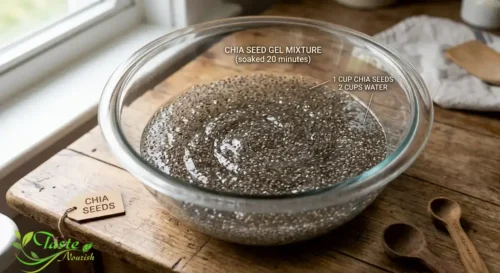
- In a medium mixing bowl, combine the chia seeds, water, salt, garlic powder, onion powder, and dried herbs.
- Whisk immediately and thoroughly. Chia seeds begin absorbing liquid and gelling within seconds, so mixing right away — before clumps have a chance to form — is what gives you a smooth, spreadable batter instead of a lumpy one.
- Let the mixture rest for 15 to 20 minutes, whisking once or twice partway through. It’s ready when it looks like a thick, cohesive gel that holds its shape on a spoon rather than dripping off.
This gelling happens because chia’s outer coating is rich in soluble fiber, which absorbs many times its weight in liquid and forms a viscous gel — the same soluble fiber mechanism behind chia pudding, as explained by Harvard Health Publishing. If your gel still looks thin and runny after 20 minutes, let it sit for another 5 to 10 minutes and whisk again before spreading.
How to Make Chia Seed Crackers, Step by Step
1. Preheat your oven to 300°F (150°C), or set your dehydrator to 115°F (46°C) if using that method instead.
2. Line a baking sheet with parchment paper (not foil — the gel tends to stick to foil).
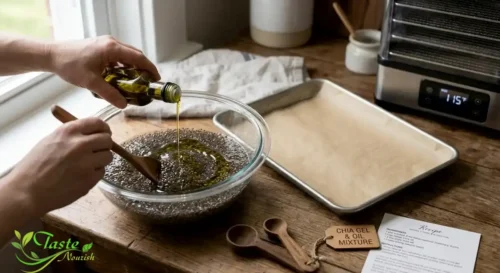
3. Stir the olive oil into the rested chia gel, if using.
4. Pour about half the mixture onto the lined sheet. Using an offset spatula or the back of a spoon, spread it as thin and evenly as you can, aiming for roughly 1/8 inch thick across the entire sheet, including the center.
5. Score the surface into cracker-sized squares or rectangles with a pizza cutter or sharp knife, cutting about halfway through the layer. This sets clean break lines so you’re not left prying apart one giant brittle sheet later.
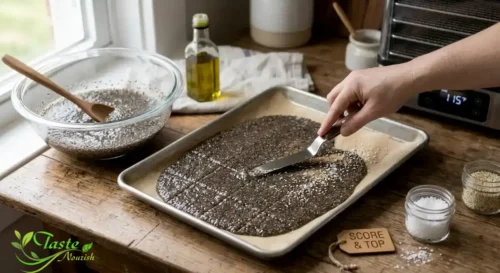
6. Sprinkle with any finishing toppings, such as flaky salt or sesame seeds, and press gently so they adhere.
7. Repeat with the remaining mixture on a second sheet.
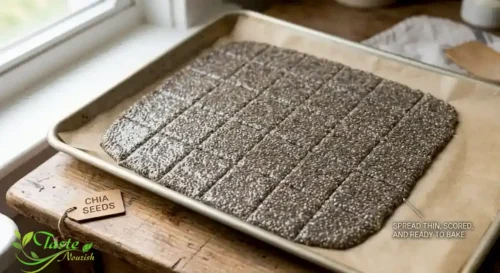
8. Bake for 45 to 60 minutes, checking at the 40-minute mark, until the crackers are firm and dry to the touch at both the edges and the center. Watch closely in the last 10 to 15 minutes — thin edges can go from golden to burnt quickly.
9. Turn off the oven and let the crackers sit inside with the door propped open for another 15 to 20 minutes as they cool. This extra time helps drive off any remaining moisture for a fully crisp finish.
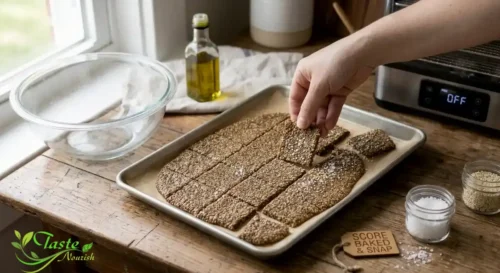
10. Let the crackers cool completely on the pan before breaking them apart along the scored lines.
Oven Method vs. Chia Seed Crackers Dehydrator Method
Both methods produce the same basic cracker, but with slightly different results:
- Oven (300°F / 150°C, 45 to 60 minutes): Faster, and the gentle heat gives the crackers a light golden color and a subtly toasted flavor.
- Dehydrator (115°F / 46°C, 6 to 8 hours): Slower, but the low temperature keeps the crackers raw-style, with a cleaner, more neutral flavor and no browning. Spread the gel onto dehydrator sheets or a mesh liner rather than a solid tray, since the low, steady airflow underneath is what dries the underside evenly.
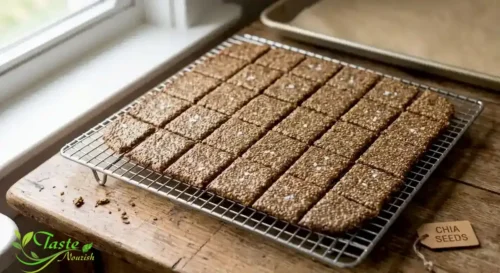
If you’re using a dehydrator, score the crackers the same way described above before you start drying, and check for doneness by breaking off a cooled corner piece rather than judging texture while it’s still warm.
How to Get the Best Texture
Crispness comes down to two things: even thickness and complete moisture removal.
Uneven spreading is the most common reason chia crackers turn out disappointing. If the center of the sheet is thicker than the edges, the edges will be fully dry — sometimes overly so — before the center has released enough moisture, leaving a gummy or leathery patch in the middle. Take an extra minute while spreading to check the thickness across the whole sheet, not just visually, but by pressing lightly with a fingertip.
Judge doneness only after the crackers have cooled completely. Warm chia crackers almost always feel softer and more pliable than they actually are; they firm up and crisp fully as they cool. A properly done cracker should snap cleanly when you bend it, not bend or fold.
How to Get the Best Flavor
On their own, chia seeds are mild and slightly nutty, so the seasoning blend does most of the flavor work here. Two things make the biggest difference:
- Season the gel, not just the surface. Salt and dried seasonings mixed directly into the batter flavor every bite, while a finishing sprinkle on top only seasons the surface.
- Layer a finishing touch. A light sprinkle of flaky salt, sesame seeds, or everything bagel seasoning pressed onto the surface before baking adds texture and visual appeal that the base seasoning alone can’t provide.
Are Chia Seed Crackers Keto-Friendly?
Yes — this chia seed crackers recipe fits well into a keto or low-carb pattern of eating, largely because of how chia’s carbohydrates break down. Per 100 grams, chia seeds contain roughly 42 grams of total carbohydrate, but about 34 grams of that is dietary fiber, according to (USDA).
Subtracting fiber from total carbohydrate leaves a relatively small amount of net (digestible) carbohydrate for a food that’s otherwise rich in protein and healthy fats.
A broader review of clinical research on chia seed supplementation found modest, statistically significant associations with improvements in blood pressure, cholesterol markers, and waist circumference, though the researchers noted the certainty of evidence ranges from moderate to low and chia should be viewed as one part of an overall diet, not a stand-alone remedy (PMC).
In other words, chia seed crackers can be a smart low-carb swap for grain-based crackers, but they’re not a substitute for medical or dietary guidance if you’re managing a specific health condition.
How to Serve Chia Seed Crackers
These crackers are sturdy enough to scoop thick dips without breaking, which makes them a natural fit for:
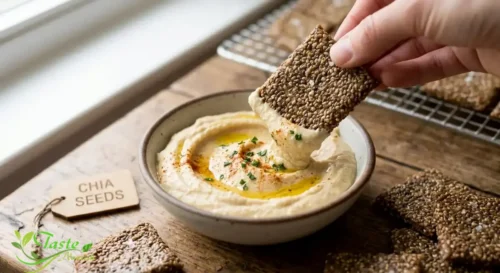
- Hummus, whipped feta, or baba ganoush
- Guacamole or a chunky salsa
- A cheese board, alongside soft or aged cheeses
- Herbed cream cheese or a soft goat cheese spread
- Crumbled over soups or salads for crunch
Storage
Once fully cooled, store the crackers in an airtight container at room temperature. Moisture is the main enemy of crispness — even a partially sealed container can let humidity back in and soften them within a day or two. If that happens, you can re-crisp a batch by spreading the crackers on a baking sheet and warming them in a low oven (around 250°F) for 5 to 10 minutes, then letting them cool completely again before serving.
As with any dry, shelf-stable food, quality (staleness, softening) and food safety are two different things. The FDA notes that mold on food isn’t necessarily a serious health threat but that the safest practice is to discard anything that shows visible mold, discoloration, or an off smell rather than trying to salvage it.
Common Mistakes
- Not whisking immediately after adding the water. Chia seeds start gelling on contact, so if you don’t whisk right away, dry pockets of seeds clump together and never fully hydrate. Whisk thoroughly the moment the water goes in.
- Spreading the mixture too thick. A thick layer stays gummy in the center no matter how long you bake it. Aim for an even 1/8 inch across the whole sheet, checking the middle as well as the edges.
- Skipping the pre-bake scoring. Without scored lines, you’re left trying to break one large, brittle sheet into pieces after baking, which usually means uneven, jagged shards instead of clean crackers.
- Seasoning only the surface. A sprinkle of salt or herbs on top looks nice but doesn’t flavor the bulk of the cracker. Mix seasoning into the gel itself.
- Judging crispness while the crackers are still warm. Warm chia crackers feel softer and more flexible than they really are. Always let them cool completely before deciding whether they need more time in the oven or dehydrator.
- Rushing the resting time. Spreading the gel before it’s had its full 15 to 20 minutes to hydrate results in a runnier mixture that’s harder to spread evenly and dries unevenly as a result.
Troubleshooting
- Soggy or chewy centers — Usually caused by spreading the layer too thick or pulling the crackers before they’re fully dry. Break the sheet apart and return the thicker or softer pieces to the oven or dehydrator for extra time, and spread thinner on your next batch.
- Won’t crisp up even after a long bake — This can happen in a humid kitchen or if your oven runs cooler than its dial suggests. Verify the temperature with an oven thermometer, extend baking in 10-minute increments, and finish with the oven door propped open as it cools.
- Bland flavor — Almost always means the seasoning stayed on the surface instead of getting mixed into the gel. Don’t be shy with salt in the base mixture next time.
- Crackers shatter unevenly when you try to break them apart — This is the telltale sign of skipping the pre-bake scoring step. Score about halfway through the layer before baking or dehydrating.
- Crackers stick to the parchment — Let them cool completely before attempting to remove them — trying to peel warm crackers off the paper is what causes tearing and sticking.
- Gel is too runny to spread — Give it another 5 to 10 minutes to rest and whisk again. If it’s still thin after that, stir in an extra tablespoon of chia seeds and let it sit a bit longer.
Variations
- Everything bagel: Add poppy seeds and sesame seeds to the gel, and finish with a generous sprinkle of everything bagel seasoning before baking.
- Cheesy: Stir 3 to 4 tablespoons of nutritional yeast or finely grated parmesan into the gel for a savory, umami-rich cracker.
- Spicy: Add 1/2 to 1 teaspoon of red pepper flakes or a pinch of cayenne to the base mixture.
- Extra crunch: Fold in 2 tablespoons each of sesame seeds, hemp hearts, or finely chopped pumpkin seeds after the gel has set, for more textural contrast.
- Sweet cinnamon: Skip the garlic powder, onion powder, and savory herbs. Add 1 to 2 teaspoons of ground cinnamon and a low-carb sweetener of your choice (or honey or maple syrup, if you’re not following keto) for a lightly sweet, snackable version.
Chia Seed Crackers Recipe FAQs
Can I use black chia seeds instead of white?
Yes. White and black chia seeds gel and taste the same, so the choice is purely visual.
Is this chia seed crackers recipe keto-friendly?
Yes. Because most of chia’s carbohydrate content is fiber rather than digestible starch, these crackers are naturally low in net carbs and work well on a keto or low-carb plan.
Can I make chia seed crackers without a dehydrator?
Absolutely — the oven method described above produces a fully crisp, delicious cracker without any special equipment. A dehydrator is only necessary if you specifically want a raw-style, unbrowned result.
Why is my chia gel too runny or too thick?
Runny gel usually just needs more resting time — give it another 5 to 10 minutes and whisk again. If it’s still thin, add an extra tablespoon of chia seeds. If the gel is too thick to spread at all, whisk in a tablespoon of water at a time until it loosens.
Can I substitute the water with vegetable broth?
Yes, and it adds extra savory depth. Just reduce the added salt to account for any sodium already in the broth.
How long do chia seed crackers stay fresh?
Stored in an airtight container at room temperature, they’ll stay crisp for about a week to ten days, though this depends heavily on humidity where you live. If they soften, a short stint in a low oven will re-crisp them.
Are chia seed crackers gluten-free?
Yes, as written, this recipe is naturally gluten-free since it contains no flour or grain-based ingredients. Just double-check any packaged seasoning blends you use, since some can contain hidden gluten-based fillers.
The Bottom Line
This chia seed crackers recipe proves you don’t need flour, eggs, or complicated technique to make a genuinely good homemade cracker — just chia seeds, water, patience through the gelling and drying stages, and a seasoning blend you like. Spread it thin, dry it fully, and let it cool before you judge the crunch, and you’ll have a sturdy, keto-friendly cracker ready for whatever you want to dip, top, or serve it with.