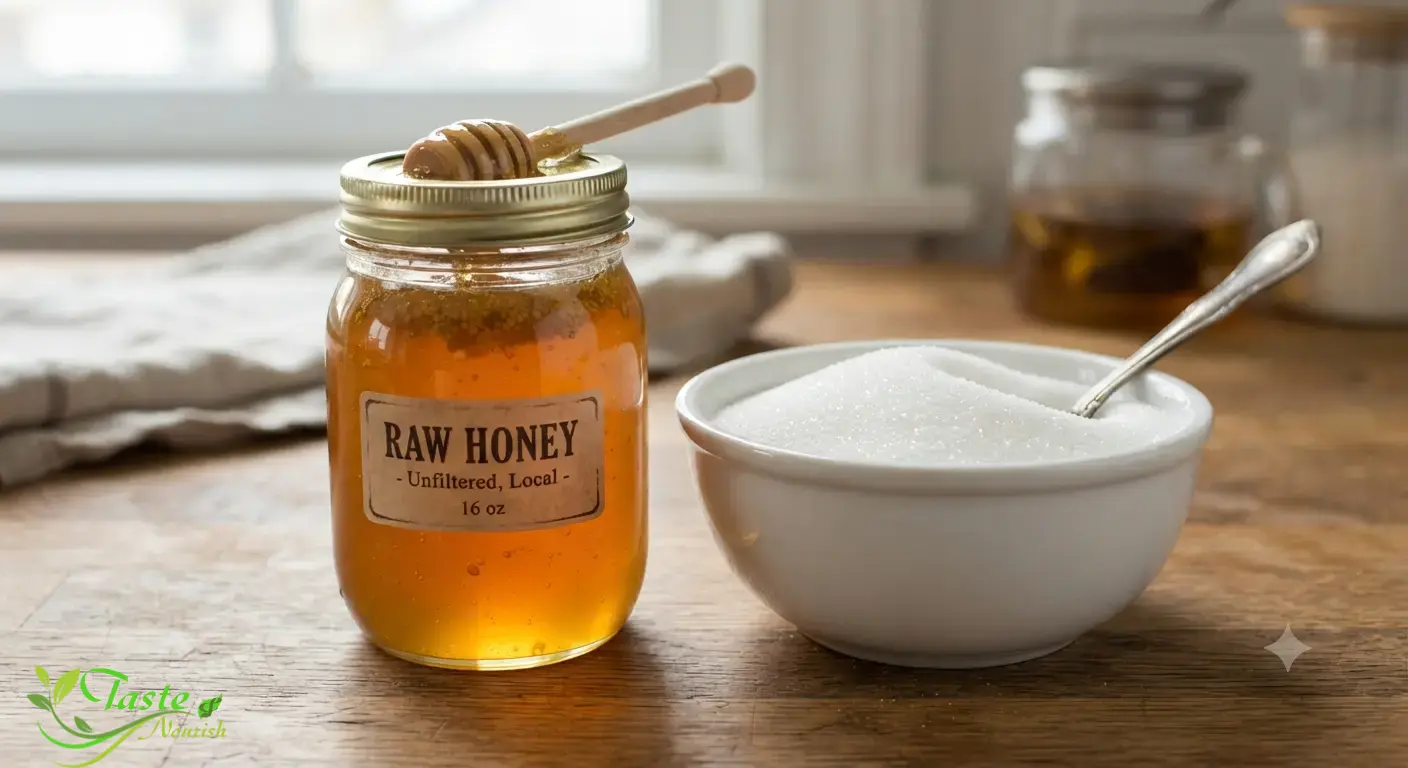
Honey has this reputation as the “healthy” sweetener — the one you can drizzle guilt-free because it’s natural. But is that true once you look at the numbers? If you’ve ever wondered whether swapping sugar for honey actually helps your blood sugar, you’re asking the right question, and the answer is more nuanced than most kitchen wisdom lets on.
This guide explains what is known about honey’s glycemic index, why reported values vary, and how serving size affects its carbohydrate contribution. It also discusses what these measurements can and cannot tell us about blood glucose management.
What Is the Glycemic Index (GI)?
The glycemic index (GI) ranks carbohydrate-containing foods according to their average effect on blood glucose compared with a reference food. Values of 55 or below are generally classified as low, 56–69 as medium, and 70 or above as high. GI does not predict an individual’s exact blood glucose response, and it does not account for the amount of carbohydrate in a typical serving.
Medium-GI foods fall in the 56-69 range, and honey almost always lands somewhere in this middle zone, though as you’ll see shortly, “almost always” is doing a lot of work in that sentence. Knowing your GI numbers matters most if you’re monitoring blood sugar for diabetes, trying to manage energy crashes, or aiming to keep insulin spikes in check throughout the day.
How GI Is Measured
Researchers measure GI in a lab setting using human volunteers, not guesswork. GI is calculated as the incremental blood glucose area over two hours following ingestion of 50 grams of available carbohydrate from the test food, compared against 50 grams of carbohydrate from a reference food like glucose or white bread. That reference-based system is why GI values can shift slightly between studies — different labs, different reference foods, different participant pools.
Key takeaway: GI isn’t a fixed, universal constant stamped onto every food. It’s a statistical average pulled from real physiological testing, and natural products like honey show more variation than manufactured foods because their composition changes from batch to batch.
The Glycemic Index of Honey: Key Numbers
Average GI Range of Honey
So what’s the actual number? Most nutrition databases and clinical sources place honey’s glycaemic index between 50 and 60, making it a moderate-GI food. Some sources push that range slightly wider — a GI ranging from 58 to 64 depending on the floral source and processing method — while broader estimates note the GI of raw honey ranges anywhere from 32 to 85, depending on the variety and processing. A pooled academic estimate puts the mean GI value of honey at 61, which lines up closely with most consumer-facing figures.
Honey vs Table Sugar GI Comparison
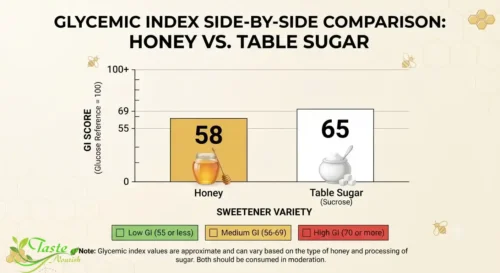
Here’s where it gets interesting for anyone choosing between the honey jar and the sugar bowl. Honey’s glycemic index sits at roughly 58 compared to table sugar’s 65, giving honey a modest but real advantage. Some comparisons show an even bigger gap — honey scoring 50 against sugar’s 80 — while others report honey averaging 58 against refined white sugar’s 68. The takeaway across nearly every source is consistent: honey generally scores lower than table sugar, but the margin is modest, not dramatic.
Sweetener
Typical GI Score
GI Category
Honey (average)
50-60
Moderate
Table sugar (sucrose)
65-80
High
Acacia honey
32
Low
Tupelo honey
74
High
Corn syrup
90
High
Why Honey’s GI Varies So Much
Floral Source and Fructose-Glucose Ratio
Not all honey is created equal, and this is the single biggest reason GI numbers bounce around so much. Honey’s GI is influenced primarily by its fructose-to-glucose ratio, floral source, and processing method. Fructose and glucose behave very differently in your body — fructose carries a low GI of around 23, while glucose sits at a steep 98 — so a honey variety richer in fructose will naturally land lower on the scale than one dominated by glucose.
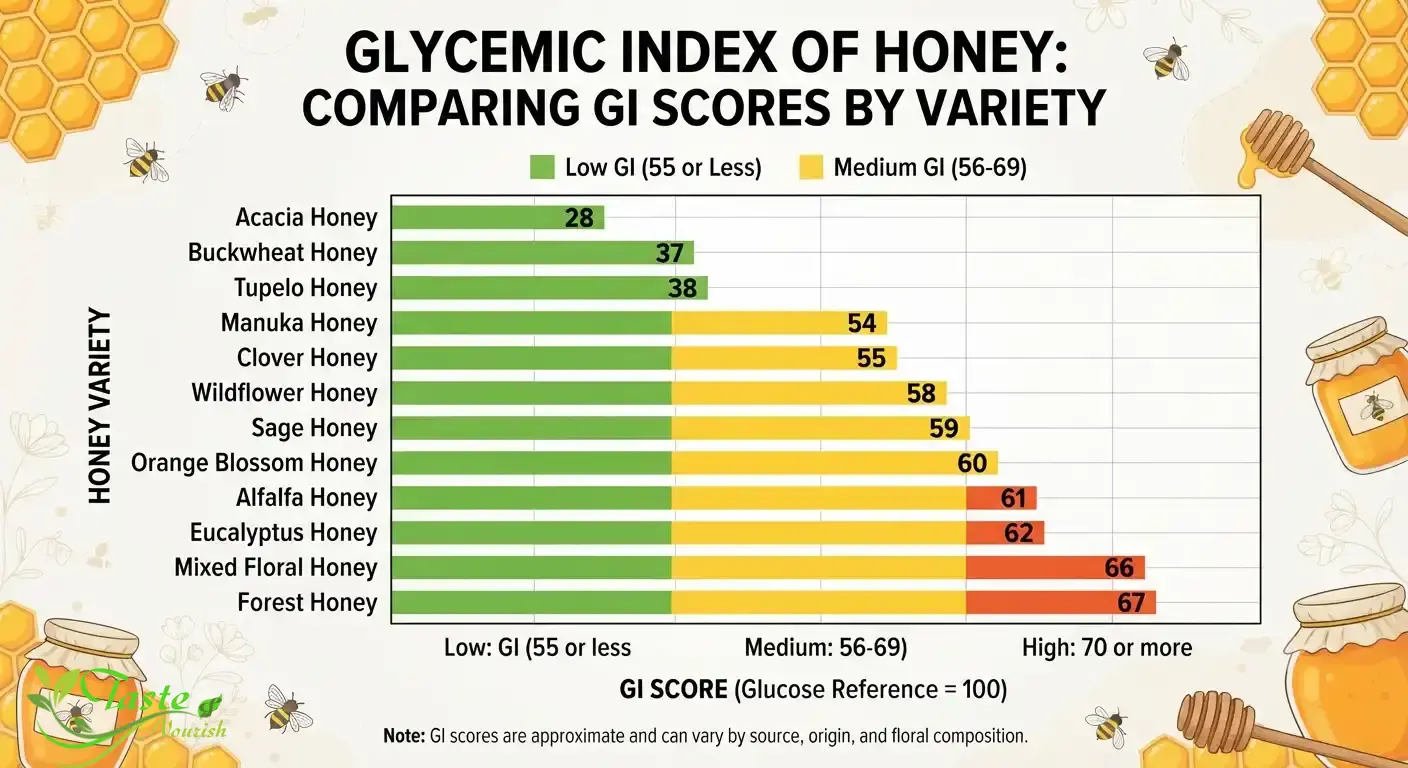
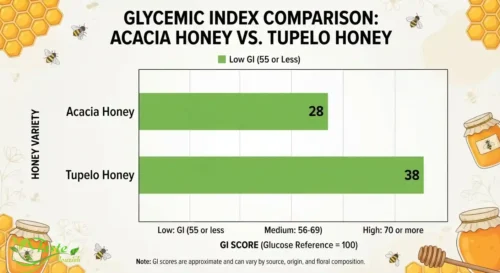
This explains the wide spread between varieties. Acacia honey has a low GI of 32, Manuka honey sits at a moderate 54-59, and tupelo honey climbs as high as 74. A separate clinical trial on Mexican honey varieties found similarly wide swings: highland honey scored 69.20, multifloral honey hit 75.24, and avocado honey came in at 66.36, with researchers noting fructose-to-glucose ratios of 1.45, 1.00, and 1.17 for those three types respectively.
Raw vs Processed Honey
Processing matters too. Raw honey retains its natural enzymes, pollen, and micro-particles, and several sources note that this intact structure can produce a gentler glucose response than heavily filtered or pasteurized honey.
GI by Honey Variety
Because honey isn’t one uniform product, comparing varieties side by side is the most useful way to shop smart. Here’s how several well-studied types stack up:
Honey Variety
Approximate GI
Category
Acacia
32
Low
Manuka
54-59
Moderate
Highland (Mexican)
69
Medium
Avocado
66
Medium
Multifloral
74-75
High
Tupelo
74
High
Reader note: If blood sugar stability is your main concern, acacia and Manuka honeys are generally your safer bets among common commercial options, while multifloral and tupelo varieties deserve smaller portions.
Glycemic Load of Honey Explained
GI vs GL — What’s the Difference
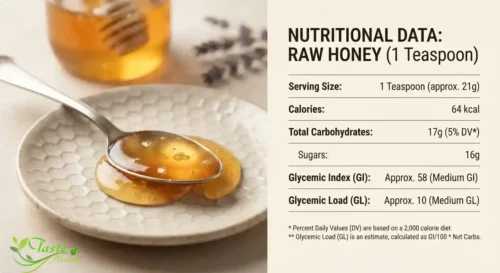
GI alone doesn’t tell the whole story, and this is a gap a lot of competing articles gloss over. The glycemic load (GL) considers both the GI and the amount of carbohydrate in a serving of food. A food can have a moderate GI but still spike your blood sugar significantly if you eat a large portion of concentrated carbs — and that’s exactly honey’s situation.
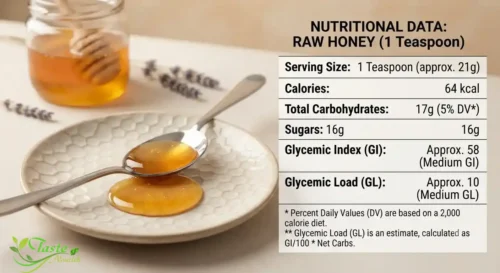
Glycemic load (GL) takes both the glycemic index and the amount of available carbohydrate in a serving into account. Because serving sizes differ, honey does not have one universal glycemic-load value. A larger serving provides more carbohydrates and may have a greater effect on blood glucose than a smaller one.
Check the serving size — GL calculations assume standard portions, not free-pouring.
Compare GI first — it tells you the speed of the sugar release.
Then check GL — it tells you the total blood sugar impact of your actual portion.
Watch cumulative intake — honey in tea, dressing, and baking adds up across a day.
Pair with protein or fiber — this slows absorption regardless of GI or GL.
Favor lower-GI varieties — acacia or Manuka reduce both numbers simultaneously.
Honey Nutrition Facts at a Glance
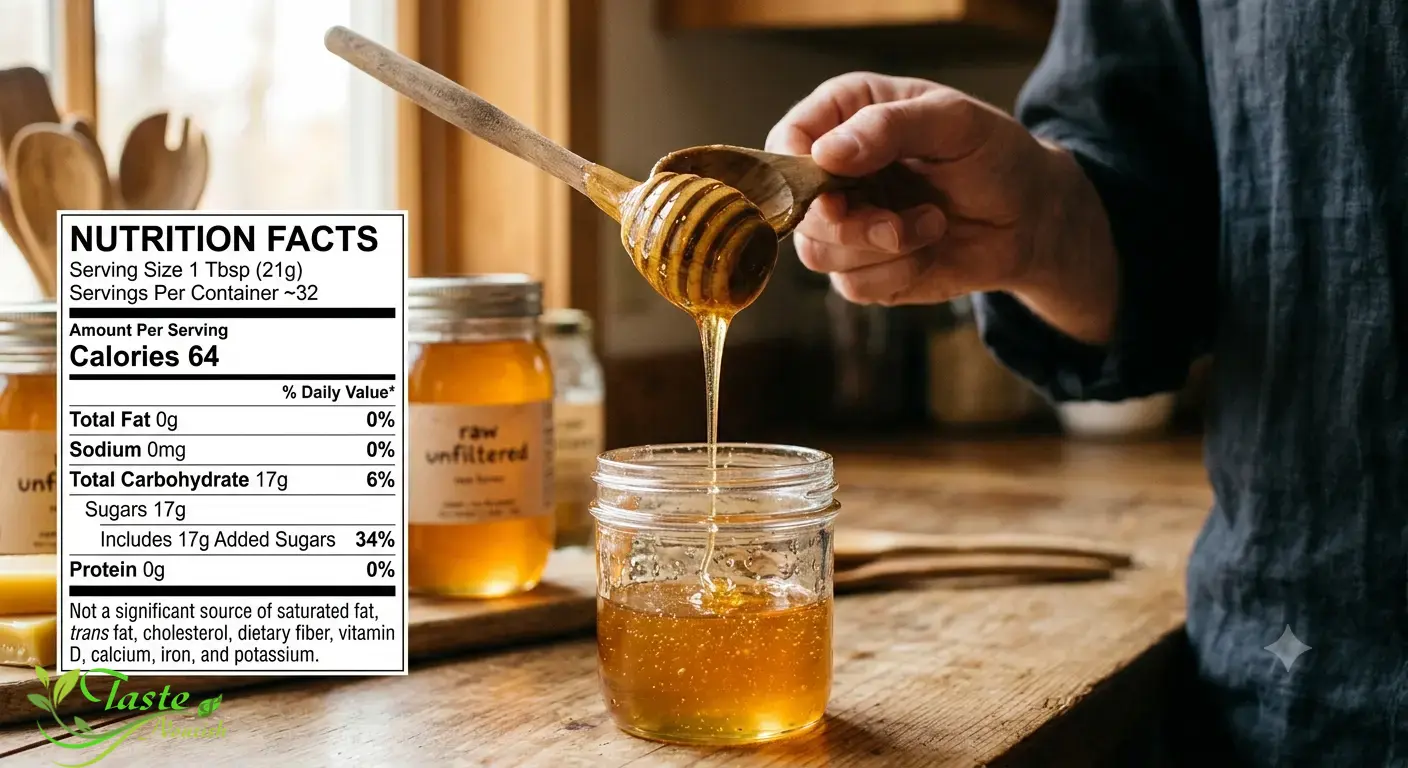
Beyond glycemic numbers, honey’s overall nutrition profile explains why it isn’t a simple sugar substitute. Honey is composed almost entirely of natural sugars — mainly fructose and glucose — with trace amounts of vitamins, minerals, and antioxidants, and it contains no fat or fiber and only small amounts of protein.
Nutrient (per 1 tbsp / 21g)
Approximate Amount
Calories
64
Total carbohydrates
17g
Sugars (fructose + glucose)
16-17g
Fiber
0g
Protein
0.1g
Fat
0g
Glycemic Load
10-12
One teaspoon, by comparison, delivers around 17g of carbs and 6g of sugar per full tablespoon serving reference, which is worth tracking against a daily carb budget of roughly 45-60g if you’re managing blood sugar closely.
Is Honey Safe for People With Diabetes?
What the Research Actually Shows
This is the question most people are really asking, and the honest answer is: it depends on how much and what kind. Honey can have significant effects on blood sugar levels in individuals living with diabetes mellitus, particularly type 2 diabetes, so it isn’t a free pass just because it’s “natural.
That said, some research points to real physiological differences between honey and refined sugar. Studies indicate honey’s slower glucose release can cut post-meal spikes by roughly 15-25% compared to refined sugars when consumed in small servings, and raw honey’s phenolic compounds have shown up to 20% better oxidative stress reduction compared to processed sugar in some trials.
Medical sources are more cautious about overselling this advantage, though — there’s no likely benefit to swapping sugar for honey if you have diabetes since both affect blood sugar in similar ways, largely because both remain concentrated simple carbohydrates.
“Honey’s glycemic index is slightly less than the GI score of sugar, but the GI only tells you how a food affects blood sugar in isolation — it doesn’t capture how that food behaves when combined with the rest of your meal.” — adapted from clinical nutrition guidance on glycemic response testing
Practical Tips for Diabetics
Stick to 1-2 teaspoons per serving rather than free-pouring.
Choose lower-GI varieties like acacia or Manuka when available.
Pair honey with protein or healthy fat to blunt the spike.
Track total daily carbohydrate intake, not just the honey portion.
Monitor your personal post-meal glucose response — individual reactions vary.
Discuss honey use with your healthcare provider if you’re on insulin or glucose-lowering medication.
How to Lower Honey’s Blood Sugar Impact
You don’t have to eliminate honey entirely — you just have to be strategic about it. Pairing it with fiber-rich or protein-heavy foods slows gastric emptying, which flattens the glucose curve considerably. Stirring a teaspoon into full-fat Greek yogurt, for instance, produces a much gentler blood sugar response than eating the same honey straight off a spoon.
Timing also plays a role: consuming honey after physical activity, when your muscles are primed to absorb glucose for glycogen replenishment, tends to blunt the spike compared to eating it at rest.
Choose raw, unfiltered honey over heavily processed varieties.
Opt for lower-GI floral sources like acacia when possible.
Combine honey with protein, fat, or fiber in the same sitting.
Keep portions to a level teaspoon rather than a heaping tablespoon.
Avoid pairing honey with other high-GI carbs in the same meal.
Time consumption around physical activity when your body’s insulin sensitivity is naturally higher.
Honey vs Other Sweeteners — Full Comparison
Sweetener
GI Score
Calories (per tbsp)
Notable Trait
Acacia honey
32
~64
Low-GI, gentle on blood sugar
Manuka honey
54-59
~60
Antibacterial properties
Table sugar
65-80
~49
No micronutrients
Tupelo honey
74
~64
Higher GI, fast spike
Corn syrup
90
~62
Very high GI
Dates (whole)
42-100
varies
High fiber offsets sugar
Bold takeaway: Honey doesn’t beat sugar by a wide margin on GI alone — its real edge comes from its micronutrient content and the flexibility to choose lower-GI floral varieties, something refined sugar simply can’t offer.
Conclusion
Honey sits in a genuinely moderate zone on the glycemic index, typically somewhere between 50 and 64, though specific varieties swing from a gentle 32 (acacia) all the way up to a sharp 74 (tupelo or multifloral). It edges out table sugar in most comparisons, but the gap is real rather than revolutionary, and honey’s high glycemic load means portion control matters just as much as the GI number on the label. If you’re managing diabetes or simply trying to steady your energy through the day, treat honey the way you’d treat any concentrated sweetener — enjoy it in small amounts, favor lower-GI floral sources, and pair it with protein or fiber whenever you can.
Used thoughtfully, honey can be part of a balanced diet; used carelessly, it’s still just sugar in a prettier jar.
Glycemic Index of Honey FAQs
1. Is honey’s glycemic index lower than sugar’s?
Generally yes, but modestly. Honey averages around 50-60 while table sugar typically sits closer to 65-80, so the advantage exists but isn’t dramatic.
2. What’s the difference between glycemic index and glycemic load for honey?
GI measures how fast honey raises blood sugar; glycemic load factors in portion size too. Honey’s GI is moderate, but its GL is high, meaning serving size matters a lot.
3. Does raw honey have a different GI than processed honey?
Raw honey tends to test lower due to intact enzymes and natural compounds, while heat-processed or heavily filtered honey can shift toward the higher end of the range.
This guide is for informational purposes only and should not replace professional medical or nutritional advice. Always consult with healthcare providers regarding specific dietary needs and health conditions.
**Hanan Abo Samra** shares practical cooking insights, delicious recipes, and evidence-based nutrition information. Drawing on more than 20 years of hands-on cooking experience, she creates helpful food content that combines everyday cooking knowledge with information from reliable scientific sources. Her goal is to help readers better understand the foods they eat, explore their nutritional benefits, and prepare delicious meals with confidence.