A spoonful of honey before bed has become one of those kitchen rituals that gets passed around like a family recipe — a little bit tradition, a little bit TikTok trend. Search “honey before bed” and you’ll find claims ranging from reasonable to wildly overstated, some promising it will flood your brain with melatonin overnight. The truth sits in a more modest, more interesting place: honey may genuinely support better rest for some people, in some situations, but not for the dramatic reasons most articles suggest.
This guide walks through what’s actually backed by research, what’s still theory, and how to use honey sensibly if you want to try it as part of your wind-down routine.
Key takeaways:
Honey’s effect on sleep is plausible but modest — it’s not a proven sedative.
The strongest clinical evidence involves honey easing nighttime cough in children, not general insomnia in adults.
A teaspoon or two is a reasonable amount; more isn’t better and may work against you.
Honey should never be given to infants under 12 months old, regardless of the reason.
Honey is mostly sugar — primarily fructose and glucose — so eating it does exactly what you’d expect: it raises blood sugar and triggers an insulin response. The interesting question is whether that response does anything useful for sleep, and the answer is genuinely more nuanced than most honey blogs let on.
The Blood Sugar and Glycogen Theory
One idea, popular among functional-medicine writers, is that honey before bed tops off your liver’s glycogen stores, which theoretically prevents the liver from signaling stress hormones like cortisol in the middle of the night when blood sugar dips. It’s a tidy story, and there’s some physiological logic to it — the liver does rely on glycogen overnight, and stress hormones can disrupt sleep.
That said, this specific chain of events hasn’t been directly tested in controlled human sleep studies, so it remains a reasonable hypothesis rather than an established fact.
The Tryptophan-Serotonin-Melatonin Theory
This is the explanation you’ll see repeated almost everywhere: carbohydrates like honey trigger insulin, insulin clears competing amino acids from the bloodstream, and that supposedly lets more tryptophan reach the brain, where it’s converted into serotonin and then melatonin.
A peer-reviewed review published through the National Institutes of Health examined this exact mechanism and found the evidence considerably weaker than the popular version suggests — the pathway is real in principle, but the review noted meaningful gaps in showing that a normal carbohydrate serving reliably changes brain chemistry enough to affect sleep in practice.
In plain terms, this is a “may help” story, not a guaranteed one, and it’s worth being skeptical of any source that states melatonin numbers with suspicious precision.
What the Research Actually Shows
Honey and sleep haven’t been studied together nearly as much as marketing content implies. What does exist is worth knowing, because it points to a much narrower — but real — benefit.
Honey, Nighttime Cough, and Sleep in Children
The best clinical evidence connecting honey to sleep comes from pediatric cough research, not general insomnia studies. A double-blind, randomized, placebo-controlled trial published in the American Academy of Pediatrics’ journal Pediatrics gave 300 children ages one to five a dose of honey or a placebo before bed during an upper respiratory infection. Parents rated the honey groups as having better relief from nighttime cough and better sleep quality than the placebo group.
A separate earlier trial from Penn State reached similar conclusions comparing honey to dextromethorphan, a common over-the-counter cough ingredient.
This matters because it’s the most rigorous sleep-related honey research available — but it’s specifically about honey easing a cough that was disrupting sleep, not honey acting as a sedative in otherwise healthy sleepers. It’s a meaningfully different claim than “honey makes you drowsy,” and stretching it into a general sleep aid claim isn’t supported by the data.
Honey’s Nutritional Profile at a Glance
Before deciding whether to add honey to your nightly routine, it helps to know exactly what you’re consuming. According to USDA FoodData Central, here’s what one tablespoon (21 grams) of honey provides:
Nutrient
Amount per Tablespoon (21g)
Calories
64 kcal
Total Carbohydrates
17.3 g
Sugars
17.2 g
Fiber
0 g
Protein
~0.1 g
Fat
0 g
Glycemic Index
Roughly 50–60, varies by floral source
Honey also contains trace minerals like potassium, calcium, and iron, along with polyphenol antioxidants that vary depending on the flower source the bees used — darker honeys like buckwheat tend to carry more of these compounds than lighter varieties like clover or acacia.
Honey vs. Table Sugar
People often reach for honey instead of sugar assuming it’s automatically the “healthier” swap. Nutritionally, the two are closer than most people expect.
Factor
Honey
Table Sugar (Sucrose)
Calories per tbsp
~64
~49
Fructose-to-glucose ratio
Roughly 40:30 (varies by source)
50:50
Glycemic index
~50–60 (varies by variety)
~60–65
Micronutrients
Trace minerals, antioxidants
Essentially none
Classified as added sugar
Yes
Yes
The Centers for Disease Control and Prevention explicitly counts honey among added sugars, right alongside syrups and table sugar, when tracking dietary intake. Honey isn’t a “free” sweetener just because it’s natural — it still counts toward your daily added sugar total.
How to Use Honey Before Bed
If you want to try honey as part of a wind-down routine, the practical details matter more than the mythology around it.
Timing and Amount
Most sources that discuss honey and sleep suggest one to two teaspoons, taken roughly 30 to 60 minutes before bed. There’s no clinical dosing standard for this use, so treat that window as a reasonable starting point rather than a prescribed amount. Larger amounts don’t appear to offer additional benefit and simply add more sugar and calories to your evening.
Best Ways to Take It
A few simple approaches show up consistently in how people actually use honey at night:
Straight off the spoon — the simplest method, taken about half an hour before lying down.
Stirred into warm (not hot) herbal tea, such as chamomile — heat above roughly 104°F can start to degrade some of honey’s enzymes and delicate compounds, so lukewarm is better than steaming.
Mixed into warm milk, a combination rooted in traditional bedtime routines across several cultures.
Paired with a pinch of sea salt, which some people use for trace minerals, though this step is optional and not required for any benefit.
Pro tip:Choose raw, minimally processed honey when possible. Ultra-filtered, heavily processed honey has usually lost more of its pollen, enzymes, and antioxidant content during production, so if the goal is getting the most out of honey’s natural compounds, raw varieties are the better pick. Honey doesn’t need refrigeration and stores well at room temperature in a sealed container; crystallization over time is normal and doesn’t mean it’s spoiled.
Potential Benefits Worth Knowing
Framed cautiously, here’s what’s reasonably supported when it comes to honey and evening use:
May ease nighttime cough, based on pediatric research, which can indirectly support better sleep when illness is the disruptor.
May contribute to steady overnight energy, since honey’s mix of glucose and fructose is metabolized somewhat differently than pure glucose.
Provides trace antioxidants, particularly in raw, darker honey varieties, which may support general health beyond any sleep-specific effect.
Offers a low-effort bedtime ritual, and the psychological comfort of a consistent wind-down routine is itself associated with better sleep habits, independent of what that routine involves.
None of these amount to honey functioning as a sedative. It’s best thought of as a small, low-risk addition to a routine — not a replacement for addressing the actual causes of poor sleep, like screen exposure, irregular schedules, or untreated sleep disorders.
Risks and Who Should Be Cautious
Honey is generally safe for most healthy adults in modest amounts, but there are real exceptions worth taking seriously.
Infants Under 12 Months
This is the one honey-and-bedtime rule that isn’t up for debate. The CDC states plainly that honey given to children younger than 12 months may cause a severe type of food poisoning called infant botulism, and recommends not giving honey to a child before their first birthday. This includes honey mixed into food, baked goods, or used on a pacifier — there’s no preparation method that makes it safe for infants in this age range.
Blood Sugar and Diabetes
Because honey is a form of sugar, anyone managing diabetes or insulin resistance should treat it the same way they’d treat any other sweetener: with portion awareness and, ideally, guidance from their care team. Research reviewed by the National Institutes of Health suggests honey may produce a somewhat gentler blood sugar rise than pure glucose in some studies, but findings across trials are inconsistent, and honey still raises blood glucose meaningfully. It’s not a substitute for medication or dietary guidance from a healthcare provider.
Weight Management
At roughly 64 calories per tablespoon, honey before bed adds up if it becomes a nightly habit layered on top of other sugar intake elsewhere in the day. This isn’t a reason to avoid it entirely, but it’s worth counting toward your overall added sugar total rather than treating it as calorie-free simply because it feels like a “natural remedy.”
Common Mistakes to Avoid
A few habits tend to undercut whatever benefit honey before bed might offer:
Using too much — more than a tablespoon or two adds sugar without adding benefit.
Stirring it into very hot liquid, which can break down some of honey’s natural enzymes.
Giving it to infants, even in tiny amounts or as a pacifier coating.
Relying on it as a fix for chronic insomnia instead of addressing sleep hygiene, stress, or an underlying sleep disorder.
Choosing heavily processed honey and assuming it carries the same properties as raw honey.
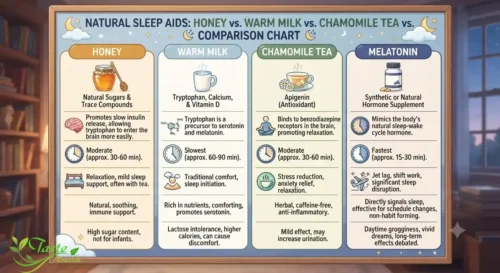
Honey vs. Other Bedtime Sweet Fixes
If honey doesn’t appeal to you, or you’re weighing it against other common nighttime options, here’s how it stacks up:
Option
Calories (typical serving)
Evidence Level
Notes
Honey (1 tbsp)
~64
Moderate for cough-related sleep disruption; weak for general sedation
Not for infants under 12 months
Warm milk
~150 (1 cup, whole)
Mostly anecdotal/traditional
Contains tryptophan, but amounts are small
Chamomile tea (unsweetened)
~2
Some clinical support for mild relaxation
Caffeine-free, low-calorie
Tart cherry juice
~130 (1 cup)
Limited but promising for melatonin content
Naturally contains melatonin
Melatonin supplement
0–5
Strong evidence for circadian-related sleep issues
Consult a doctor before regular use
Honey holds its own as a low-effort, low-risk option, but it’s not more clinically proven than several of the alternatives on this list — it’s simply more accessible and familiar.
Honey Before Bed FAQs
Q1. Does honey before bed actually help you sleep?
It may help indirectly, particularly if a nighttime cough is disrupting sleep, based on pediatric clinical trials. Direct evidence that honey acts as a general sedative in healthy adults is limited, so it’s more accurate to call it a plausible, low-risk addition than a proven remedy.
Q2. How much honey should I eat before bed?
Most informal guidance suggests one to two teaspoons, roughly 30 to 60 minutes before bed. There’s no established clinical dose for this specific use, so treating this as a starting point rather than a strict rule makes sense.
Q3. What’s the best type of honey for sleep?
No single variety has been shown to be superior for sleep specifically. Raw, minimally processed honey retains more of its natural enzymes and antioxidants than heavily filtered versions, which is why it’s generally recommended over ultra-processed honey.
Q4. Can honey before bed cause weight gain?
Any calorie source can contribute to weight gain if it adds up over time without being accounted for elsewhere in your diet. At about 64 calories per tablespoon, occasional use in modest amounts is unlikely to be significant, but a nightly habit is worth factoring into your total added sugar intake.
Q5. Is honey safe for kids before bed?
For children over 12 months, honey is generally considered safe and has some clinical support for easing nighttime cough. For infants under 12 months, honey should never be given in any form due to the risk of infant botulism.
Conclusion
Honey before bed isn’t the sleep miracle that some corners of the internet make it out to be, but it isn’t nothing either. The clearest, best-supported benefit is narrower than most people expect — easing a nighttime cough that’s interrupting sleep — while the popular tryptophan-melatonin explanation remains more theory than proven mechanism. Used in modest amounts, as part of a broader wind-down routine, honey is a low-risk, pleasant ritual for most healthy people. It’s just not a substitute for addressing the real drivers of poor sleep, and it has one firm exception: never for infants under 12 months old.
Hanan Abo Samra is the founder of Taste & Nourish, sharing trustworthy nutrition guidance and recipes drawn from 20+ years of hands-on cooking experience. When she's not developing new recipes, Hanan is researching the science behind everyday ingredients to bring readers practical, evidence-based guidance for a healthier lifestyle.