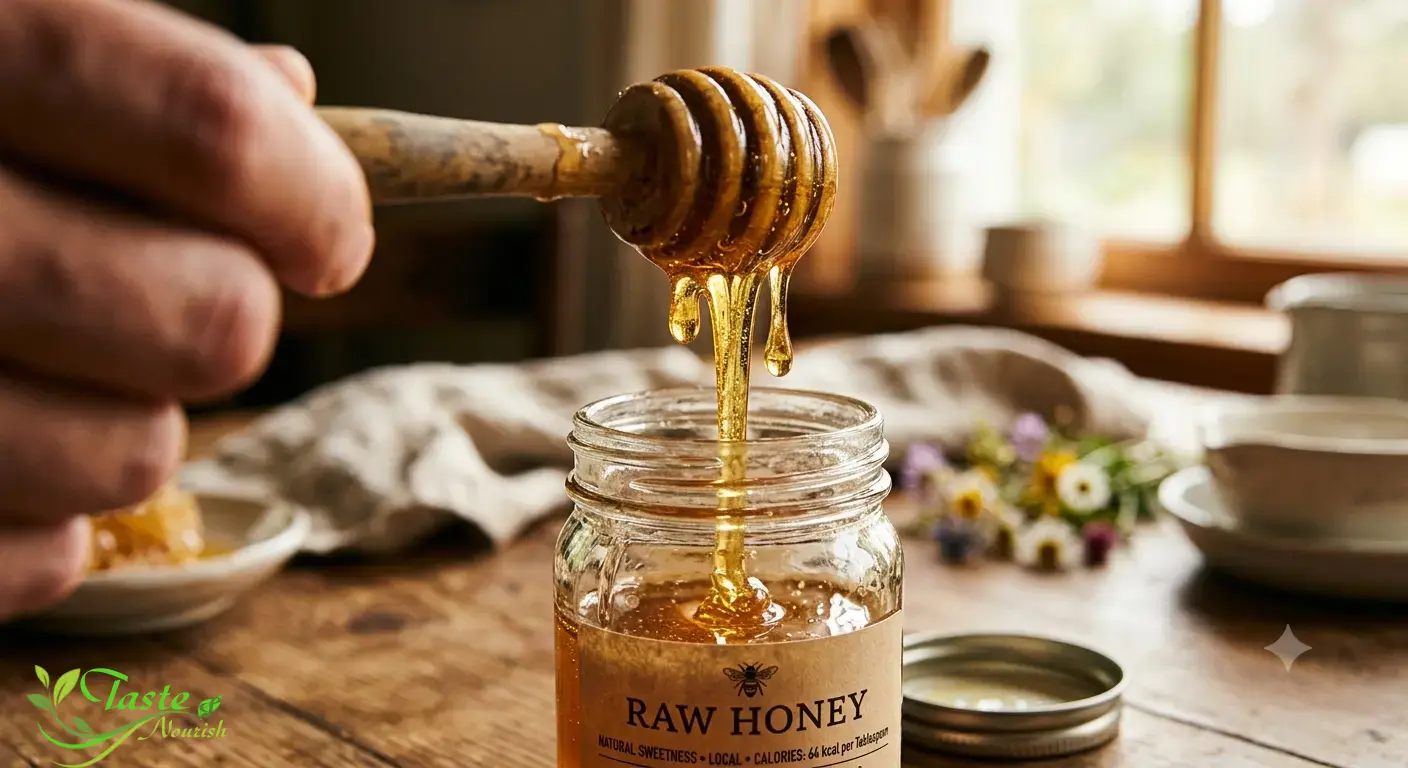
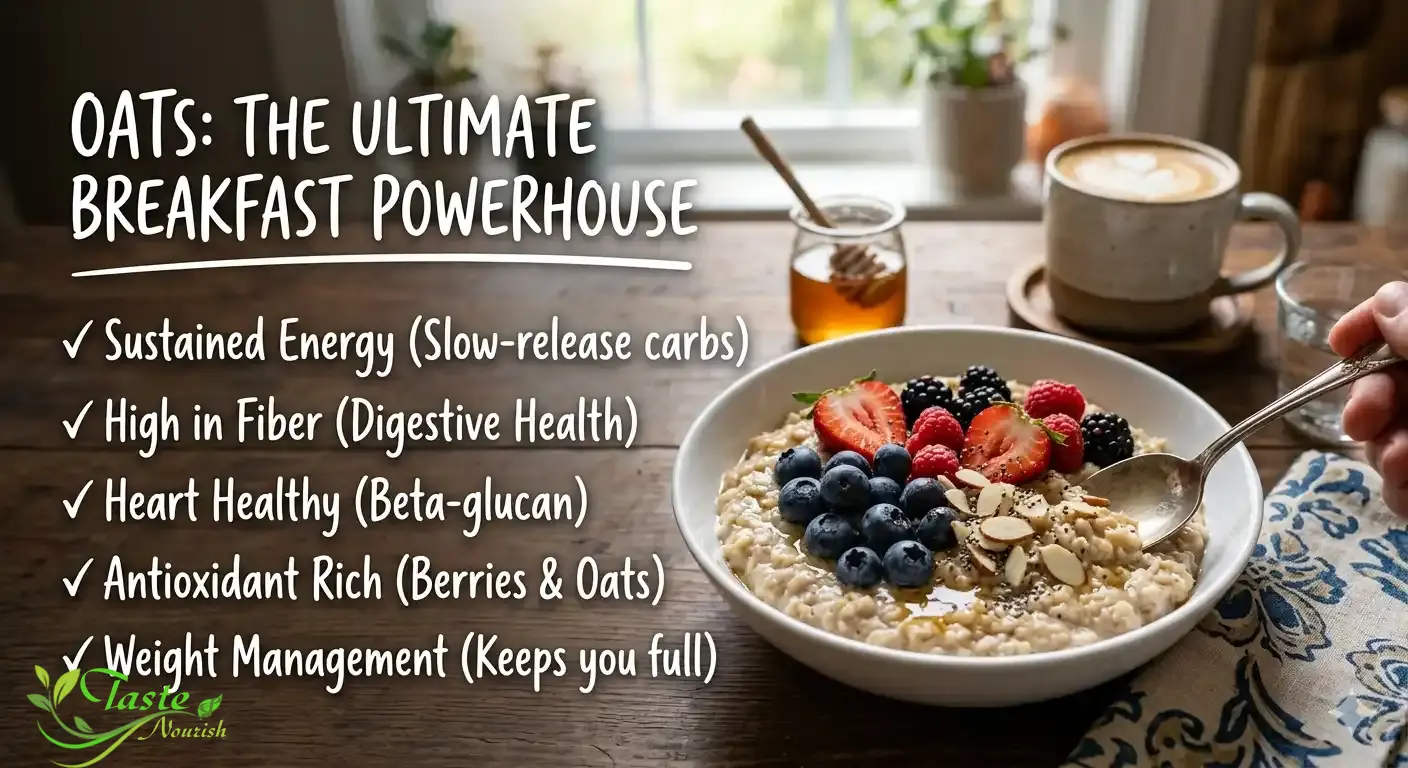
Honey looks innocent sitting in its little jar with that golden glow, but don’t let the rustic packaging fool you. Carbs in honey add up faster than most people expect, and if you’re tracking your daily intake for weight management, diabetes care, or a low-carb lifestyle, you need real numbers, not vague reassurances about “natural sweetness.”
This guide breaks down exactly how many carbs are in honey, what kind of carbs they are, and how honey stacks up against sugar, maple syrup, and agave so you can make an informed choice the next time you reach for that honey bear.
Honey is, structurally speaking, almost entirely carbohydrate. About 95 to 97% of honey’s dry weight is comprised of carbohydrates, with a 100g serving containing 82.2g of carbohydrates. That puts it among the most carb-dense foods you’ll find in any kitchen, which makes sense once you remember that honey starts life as flower nectar that bees concentrate down through evaporation and enzymatic activity.
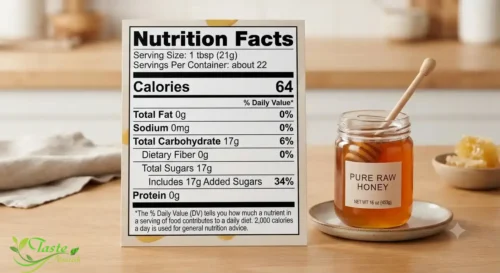
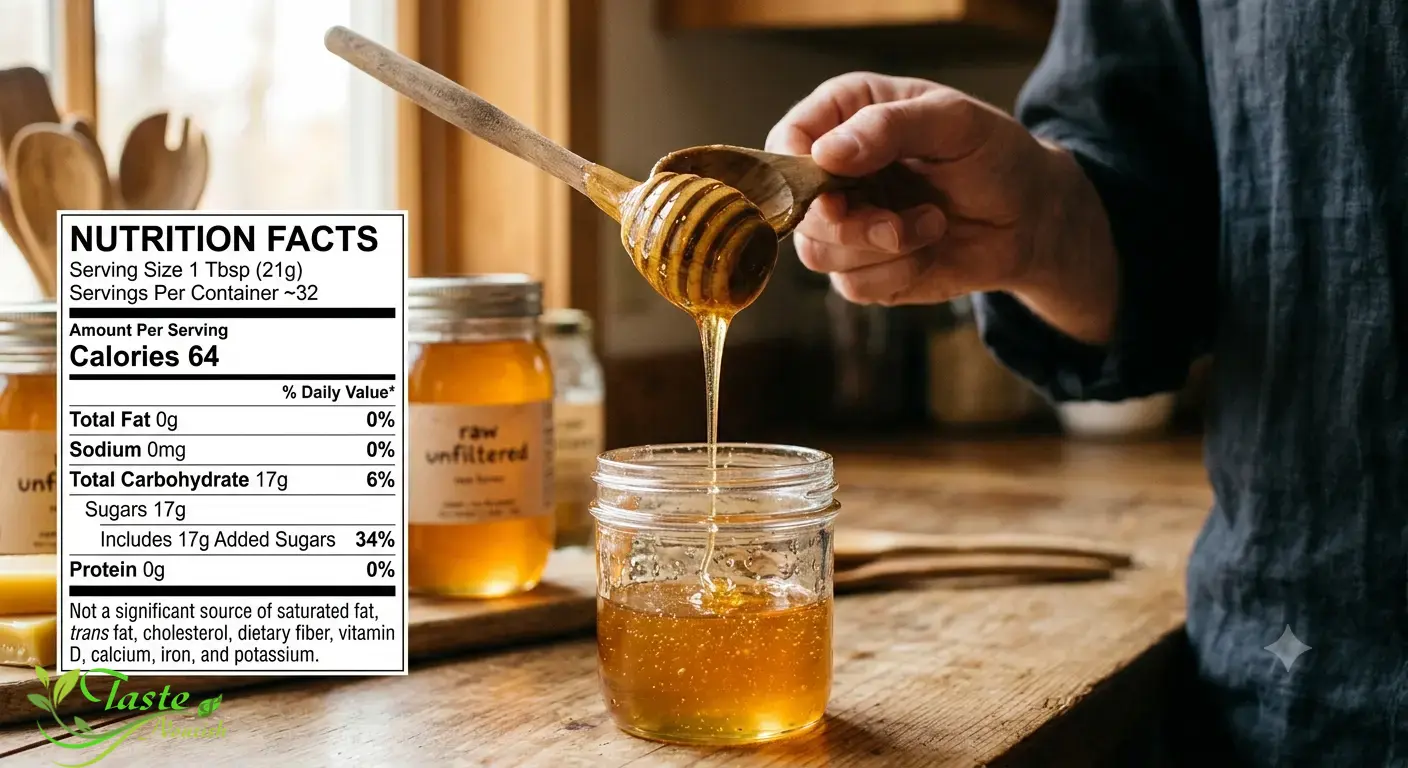
When you scale that down to real-world servings, the numbers stay impressive. A single tablespoon of honey contains 17.5g of total carbs and 17.3g of net carbs, paired with virtually no fat or fiber. That single tablespoon also carries roughly 64 calories, meaning nearly every calorie in honey comes straight from carbohydrate. Compare that to a tablespoon of fresh berries or a slice of whole-grain bread, and you start to see how concentrated honey’s sugar really is.
Carbs in a Tablespoon, Teaspoon, and Cup of Honey
Portion size matters enormously with honey because it’s easy to pour more than you intend. Here’s a quick breakdown of carb content across common serving sizes, useful whether you’re meal-planning, counting macros, or just curious about that drizzle on your toast.
Serving Size
Carbohydrates
Calories
1 teaspoon (7g)
5.8g
22 kcal
1 tablespoon (21g)
17.3–17.5g
64 kcal
1 packet (14g)
~11.5g
43 kcal
1 cup (339g)
~279g
1,031 kcal
100g
82.2g
304 kcal
Key takeaway: Even a single tablespoon delivers nearly a fifth of a recommended daily sugar allowance for some adults, so it’s worth measuring rather than free-pouring.
Honey Nutrition Facts at a Glance
Beyond carbs, honey carries a surprisingly minimal nutritional footprint elsewhere. One tablespoon of honey contains practically no fat and barely any protein, while the carbohydrates come overwhelmingly from fructose and glucose, the two simple sugars that deliver its signature sweetness. Trace minerals like potassium and magnesium, along with small amounts of vitamin C and antioxidant polyphenols, round out the profile, but none of these appear in nutritionally significant quantities.
Calories: 64 per tablespoon
Total carbohydrates: 17.3–17.5g per tablespoon
Sugars: roughly 17g, mostly fructose and glucose
Fiber: 0g
Protein: under 0.5g
Fat: 0g
What Types of Carbohydrates Does Honey Contain?
Not all carbs behave the same way once they hit your bloodstream, and honey’s carb profile is more nuanced than the blanket label “sugar” suggests. Roughly 95% of honey’s dry weight comes from simple sugars, primarily fructose and glucose, with smaller amounts of sucrose, maltose, and other minor sugars rounding out the mix. This dual-sugar composition is actually what gives honey its distinctive texture, sweetness curve, and resistance to crystallization compared to syrups made from a single sugar source.
Fructose vs. Glucose in Honey
Fructose and glucose play very different metabolic roles, and honey’s blend of the two is part of what separates it from straight table sugar. Glucose gets absorbed quickly into your bloodstream, giving you that immediate energy lift you might notice after a spoonful before a workout. Fructose, on the other hand, takes a slower route through your liver, which means it doesn’t spike blood glucose as dramatically on its own, though it still contributes calories and, in excess, can affect liver fat metabolism over time.
This combination explains why honey tends to taste sweeter than an equivalent amount of table sugar despite having a similar calorie count. Fructose is simply sweeter to the human palate than glucose or sucrose, gram for gram, which is part of why many bakers use slightly less honey than sugar when substituting in recipes. The ratio of fructose to glucose also varies by floral source, which is why clover honey tastes different from buckwheat or manuka honey even though all three share a similar carb count per tablespoon.
Why Honey’s Sugar Profile Differs From Table Sugar
Table sugar, or sucrose, is a disaccharide made of one glucose molecule bonded to one fructose molecule, and your body has to break that bond before absorbing either sugar. Honey, by contrast, already arrives mostly pre-broken into free fructose and free glucose thanks to enzymes bees add during processing. This doesn’t dramatically change the calorie math, but it does mean honey’s sugars are absorbed slightly differently, contributing to its somewhat gentler effect on blood sugar compared to straight sucrose.
Reader note: Don’t mistake “different absorption pattern” for “doesn’t count.” Honey’s carbs absolutely count toward your daily total, whether you’re managing diabetes, counting macros, or simply watching your sugar intake.
Honey’s Glycemic Index Explained
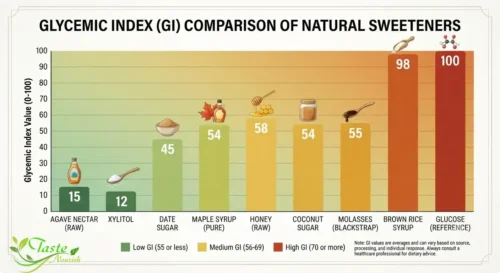
The glycemic index (GI) measures how quickly a food raises blood sugar compared to pure glucose, which sits at a benchmark of 100. Honey carries a glycemic index of roughly 58, which sits below table sugar’s GI of around 65 but above agave nectar’s GI of approximately 15-19. That places honey in the moderate-to-high GI range, meaning it does raise blood sugar meaningfully, just not quite as sharply as pure sucrose.
It’s worth noting that honey’s GI isn’t a single fixed number. Depending on floral source, processing, and testing methodology, estimates for honey’s GI range anywhere from 50 to 60, with darker, less-processed varieties sometimes trending lower than heavily filtered commercial blends. This variability is one reason nutrition experts caution against treating “honey” as a single uniform product when comparing glycemic impact across different brands or styles.
How Honey Affects Blood Sugar Levels
“Individual variability in honey’s impact on blood sugar levels depends on factors such as insulin sensitivity, metabolic health, and overall diet,” as nutrition researchers studying natural sweeteners have noted, underscoring that no single GI number tells the whole story for every person.
This means two people eating the identical tablespoon of honey could see meaningfully different blood glucose responses based on their individual metabolic health, gut microbiome, and what else they ate alongside it. Pairing honey with protein, fat, or fiber, such as drizzling it over Greek yogurt with nuts, tends to blunt the glucose spike compared to eating honey alone on an empty stomach. For people managing diabetes or insulin resistance, this pairing strategy matters more than the GI number itself.
Honey vs. Other Sweeteners: A Carb Comparison
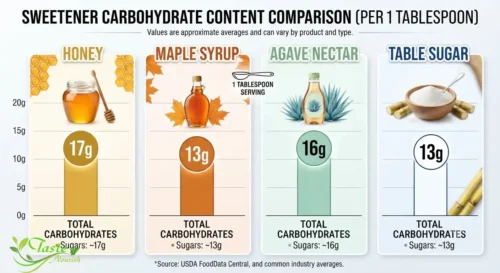
People constantly ask whether honey is “better” than sugar, maple syrup, or agave, and the honest answer is: it depends what you’re optimizing for. Calorie counts across natural sweeteners are remarkably close, but glycemic impact, mineral content, and processing level vary enough to matter for specific goals.
Sweetener (1 tbsp)
Carbs
Calories
Glycemic Index
Honey
17.3g
63–64
~58
Table sugar
~12.6g
49
~65
Maple syrup
~13.4g
52
~54
Agave nectar
15.8g
64
~15–19
Honey vs. Table Sugar
Gram for gram, honey actually has slightly more carbs per tablespoon than table sugar because honey contains a small amount of water weight diluting its sugar concentration less than you’d think, while also being denser and stickier per spoonful. A tablespoon of pure honey carries about 63 calories, 17.2 grams of sugar, and 17.3 grams of carbohydrates, edging out plain granulated sugar in raw carb count. The trade-off is that honey brings trace antioxidants, enzymes, and a lower GI to the table, advantages sugar simply doesn’t offer.
Honey vs. Maple Syrup
Maple syrup generally comes out ahead on the glycemic front. Nutritionally, maple syrup, honey, granulated sugar, and agave syrup are all comparable in terms of calories and composition, being nearly 100% carbohydrate, but maple syrup contains less sugar and less fructose than honey and sits lower on the glycemic index. If steady blood sugar is your top priority and you’re choosing between these two natural options, maple syrup has a slight statistical edge, though the difference is modest enough that portion control matters more than the choice itself.
Honey vs. Agave Nectar
Agave wins on paper when it comes to glycemic index, but the full picture is more complicated. Agave nectar is roughly 85% fructose with only about 10% glucose, and since fructose doesn’t spike blood glucose directly but instead gets processed through the liver into glycogen, glucose, or fat via de novo lipogenesis, agave’s low GI number doesn’t necessarily mean it’s the healthier metabolic choice overall. Honey’s more balanced fructose-to-glucose ratio, combined with its enzyme and antioxidant content, makes it arguably the more nutritionally rounded option despite the higher GI score.
Is Honey Keto-Friendly or Low-Carb?
Short answer: no, not in any meaningful serving. Honey is not considered keto-friendly because it contains 17 grams of carbohydrates per tablespoon, an amount that can quickly exceed daily carb limits on a ketogenic diet, which typically caps total daily carbs at 20-50g. A single tablespoon could consume your entire carb budget for the day on strict keto, leaving zero room for vegetables or anything else.
Net Carbs in Honey
For those tracking net carbs specifically, the math doesn’t improve much because honey contains essentially zero fiber to subtract. A tablespoon of honey contains 17.5g total carbs and 17.3g net carbs, meaning almost all of the carbohydrate weight counts directly against your daily allowance. Some keto-adjacent low-carb diets allow very small amounts, such as a teaspoon stirred into tea, but it requires careful portioning rather than free use.
Strict keto (20g carbs/day): Avoid honey entirely or use less than a teaspoon
Moderate low-carb (50-100g/day): A teaspoon occasionally can fit
General low-sugar diet: One tablespoon max, ideally paired with protein
Athletic/active individuals: Honey’s quick carbs can serve as useful pre-workout fuel
Diabetics: Consult a healthcare provider before regular use
Weight loss focus: Measure carefully; calories add up fast
Raw Honey vs. Processed Honey: Carb Differences
Raw and processed honey are nutritionally closer than marketing might suggest, though small differences do exist. Raw honey runs slightly lower in total sugars, containing about 76g per 100g serving compared to higher sugar content in commercially processed varieties. This gap is modest, just a few grams per serving, and won’t meaningfully change your carb tracking, but raw honey does typically retain more enzymes and pollen-derived compounds since it hasn’t been heated or filtered as extensively.
Quick tip: If you’re choosing between raw and processed honey purely for carb count, don’t expect a dramatic difference. Choose raw honey for flavor complexity and enzyme retention, not as a meaningful carb-reduction strategy.
Honey and FODMAPs: What You Should Know
If you have irritable bowel syndrome or another functional gut disorder, honey’s carb profile carries an additional wrinkle worth understanding. Honey is considered a high-FODMAP food because fructose, a monosaccharide only partially absorbed in the small intestine, gets fermented by gut bacteria when consumed in excess, and only about one tablespoon of honey is generally considered low enough in FODMAPs to be well-tolerated.
People managing Crohn’s disease, ulcerative colitis, or IBS should be especially cautious about portion size, since exceeding that single-tablespoon threshold can trigger bloating, gas, or digestive discomfort.
This matters even for people without diagnosed digestive conditions, since high-FODMAP foods consumed in large quantities can cause temporary GI upset in almost anyone. Sticking to modest portions, the same one-to-two-tablespoon range nutritionists generally recommend anyway, sidesteps this issue for most people without requiring any special accommodation.
Health Benefits of Honey Beyond Its Carbs
Carbs aside, honey isn’t nutritionally empty the way refined sugar is. Raw honey in particular carries bioactive polyphenols and antioxidants linked to reduced oxidative stress, along with trace antimicrobial compounds including hydrogen peroxide that have made it a folk remedy for wound care and sore throats for centuries. It also contains small amounts of enzymes like diastase and invertase, which support its natural digestive properties and contribute to its long shelf life when stored properly.
None of this erases the carbohydrate reality, but it does explain why nutritionists generally rank honey above refined white sugar when a sweetener is needed at all. The combination of moderate glycemic impact, trace minerals, and antioxidant content gives honey a nutritional edge over sugar even though both deliver a similar calorie and carb punch per spoonful. The distinction matters most when honey replaces sugar rather than when it’s simply added on top of an already sugar-heavy diet.
Practical Tips for Managing Honey’s Carb Impact
Enjoying honey without letting its carbs derail your goals comes down to strategy rather than elimination. A few practical habits make a real difference over time, especially if honey is a regular part of your routine rather than an occasional treat.
Measure with a spoon instead of free-pouring straight from the jar or bottle
Pair honey with protein or fat, like nut butter or yogurt, to slow sugar absorption
Stick to one to two tablespoons per day as a general upper limit
Use raw, less-processed honey for slightly better mineral and enzyme content
Avoid honey entirely for infants under one year due to botulism risk
Track honey’s carbs the same way you’d track any added sugar in your daily log
Following the American Heart Association’s broader added-sugar guidance gives helpful context here too. The AHA recommends men limit added sugar intake to roughly nine teaspoons per day, about 36 grams or 150 calories, while women should aim lower, and honey counts fully toward that ceiling regardless of its “natural” branding.
Carbs in Honey FAQs
How many carbs are in a tablespoon of honey?
A tablespoon of honey contains approximately 17.3 to 17.5 grams of total carbohydrates, almost all from natural sugars, alongside about 64 calories.
Is honey lower in carbs than sugar?
Not really. Honey actually contains slightly more carbs per tablespoon than table sugar, though it offers a somewhat lower glycemic index and trace antioxidants that sugar lacks.
Can I eat honey on a low-carb or keto diet?
Honey is generally not keto-compatible since a single tablespoon can use up most or all of a strict daily keto carb allowance; very small amounts may fit into more moderate low-carb plans.
Does raw honey have fewer carbs than regular honey?
The difference is minor. Raw honey runs slightly lower in total sugar content per 100 grams compared to commercially processed honey, but not enough to significantly change carb counting.
Why does honey have a lower glycemic index than table sugar?
Honey’s blend of fructose and glucose, along with its enzyme content, causes a somewhat more gradual blood sugar response compared to the rapid glucose release from pure sucrose in table sugar.
Conclusion
Honey earns its reputation as a more nutritionally interesting sweetener than refined sugar, but its carbohydrate content is not up for debate: roughly 17 grams per tablespoon, almost entirely simple sugars, with a moderate-to-high glycemic index that varies by floral source and processing. Whether you’re managing diabetes, following a low-carb or keto plan, or simply trying to eat with more awareness, treating honey as the concentrated sugar it is, rather than a health food you can use freely, is the smartest approach. Used in modest, measured amounts and paired thoughtfully with protein or fiber, honey can absolutely fit into a balanced diet. Used carelessly, it adds up just as fast as the sugar bowl it’s so often positioned to replace.
This guide is for informational purposes only and should not replace professional medical or nutritional advice. Always consult with healthcare providers regarding specific dietary needs and health conditions.
Hanan Abo Samra is the founder of Taste & Nourish, sharing trustworthy nutrition guidance and recipes drawn from 20+ years of hands-on cooking experience. When she's not developing new recipes, Hanan is researching the science behind everyday ingredients to bring readers practical, evidence-based guidance for a healthier lifestyle.