
Is Honey Healthier Than Sugar? What the Evidence Shows

Honey has a health halo that table sugar lacks. It comes from a hive, not a refinery, so many people assume it must be the smarter sweetener. So, is honey healthier than sugar? The answer depends on what you mean by “healthier”: calories, blood sugar, nutrients, or long-term outcomes.
I’d rather take the comparison apart piece by piece than hand you a one-word verdict. Below you’ll find the numbers side by side, what controlled trials show, and the places where health agencies treat the two sweeteners identically.
Quick Answer
Is honey healthier than sugar? Only marginally. Honey brings trace plant compounds and a glycemic index that averages slightly lower than table sugar’s, but it is still a free sugar with more calories per spoonful. Direct comparisons find largely similar metabolic effects, so treat honey as a flavor choice, not a health upgrade.
Key Takeaways: Is Honey Healthier Than Sugar?
- On nutrients, the question “is honey healthier than sugar” has a modest answer: honey’s minerals and plant compounds are real, but a spoonful supplies very little of them.
- Honey’s blood-sugar effect is less predictable than sugar’s, because it swings widely with the flower source.
- The best-looking trial results involve small, low-certainty improvements when honey replaces other sweeteners, especially raw or single-flower types.
- Those results do not support adding honey on top of the sugar you already eat.
- WHO and the FDA both count honey toward the same sugar limits as table sugar.
- Honey is never appropriate for babies under one year old.

What Is Honey, Compared With Table Sugar?
Honey is a thick sweetener bees make from nectar. Apart from water, it is mostly free fructose and glucose. Table sugar is refined sucrose, a molecule that splits into one glucose and one fructose during digestion. By the time either one is absorbed, your body is handling much the same two sugars.
This article stays on the head-to-head with sugar. For the broader picture of what honey may and may not do, see our overview of honey’s benefits and their evidence.
Honey vs Sugar Nutrition Facts, Side by Side
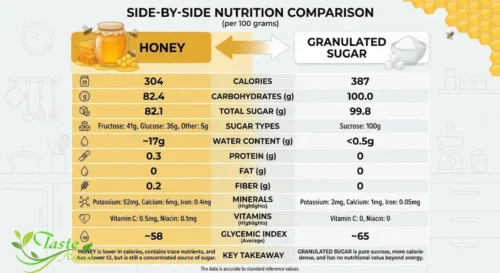
The table compares 100 grams of each, using the USDA FoodData Central entries for honey and for granulated sugar.
| Nutrient | Honey | Granulated sugar |
|---|---|---|
| Calories | 304 kcal | 387 kcal |
| Carbohydrate | 82.4 g | 100 g |
| Total sugars | 82.1 g | 99.8 g |
| Sucrose | 0.89 g | 99.8 g |
| Fructose (free) | 40.9 g | 0 g |
| Glucose (free) | 35.8 g | 0 g |
| Water | 17.1 g | 0.02 g |
| Potassium | 52 mg | 2 mg |
| Iron | 0.42 mg | 0.05 mg |
Per gram, honey has fewer calories because part of it is water. Per spoon the order flips, because honey is denser and a measuring spoon holds more of it. USDA lists a tablespoon of honey, about 21 g, at roughly 64 calories. Mayo Clinic notes that honey is sweeter, so you may use less, but it has slightly more carbohydrate and calories per teaspoon, so any savings are minimal.
Per 100 grams, the table shows honey with far more potassium and iron than sugar. In a serving, though, the amounts are tiny. USDA’s honey entry gives about 1% of the Daily Value or less per tablespoon for every vitamin and mineral that has one, which counts as “low” under FDA’s 5% threshold. Honey does contain small amounts of enzymes, amino acids, polyphenols and other minor components that sugar lacks. Whether amounts that small do anything at a normal serving has not been established in the trials discussed below.
That is the nutrition picture in one line: honey is a little lighter by weight and heavier by spoon, with trace extras. If you want to know how spoon size changes the total, the honey calories guide walks through teaspoon, tablespoon and cup amounts.
Is Honey Healthier Than Sugar for Blood Sugar?
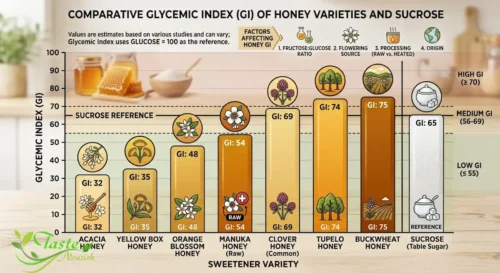
Slightly, on average, but not reliably. International tables list honey at an average glycemic index of 61 and sucrose at 65, a small gap given the variability reported around both averages.
Honey is the less predictable of the two. A review of honey’s composition puts its glycemic index anywhere from 32 to 85, depending on botanical source. In a randomized crossover trial of six Greek honeys in 11 healthy adults, fir and chestnut honeys scored 59 and 66 (medium), while citrus, heather, pine and thyme honeys scored above 70 (high). Composition partly explained the spread, so you generally can’t tell from a jar’s label how it will behave.
For the full range by variety and how glycemic load changes the picture, see our explanation of why honey’s glycemic index varies.
Is Honey Healthier Than Sugar in Clinical Trials?
In head-to-head testing, mostly no. In pooled trials where honey takes the place of other sugars, there are small, low-certainty improvements.
Head-to-head: honey, sucrose and corn syrup
One of the most direct comparisons is a randomized crossover trial in which 28 adults with normal glucose tolerance and 27 with impaired glucose tolerance ate honey, sucrose or high-fructose corn syrup, each supplying 50 g of carbohydrate a day, for two weeks at a time. Glucose, insulin and insulin-resistance scores did not differ between the sweeteners, body weight did not change, and triglycerides rose with all three. The trial was funded in part by the National Honey Board and USDA’s Agricultural Research Service, yet it did not favor honey.
Pooled trials: honey in place of other sugars
A systematic review and meta-analysis of 18 controlled trials with 1,105 participants found a small average drop in fasting glucose of 0.20 mmol/L, rated low certainty. HDL cholesterol also rose, with higher certainty. Most participants ate honey within otherwise healthy diets, and per the authors’ university summary, the median dose was 40 g a day, about two tablespoons. The same summary quotes a lead researcher framing the takeaway as a swap, not a reason to start adding honey.
The benefits clustered in raw honey and in single-flower types such as robinia (often sold as acacia) and clover. Those were subgroup findings, which are less reliable than the main result and need confirming in trials designed to test them. For what “raw” does and doesn’t mean on a label, see our look at how raw and regular honey differ.
Serving reality check
Both sets of trials used generous daily amounts, far more than a teaspoon in tea. A review of honey’s nutritional effects concluded that its positive effects appear at 50 to 80 g per intake. That is a lot of sugar. WHO’s guideline recommends keeping free sugars below 10% of total energy intake (a strong recommendation), with below 5% suggested as a further step (a conditional one). A modest honey habit can fit inside that limit. The doses behind the more encouraging findings are a different matter.
Where Honey and Sugar Are Treated the Same
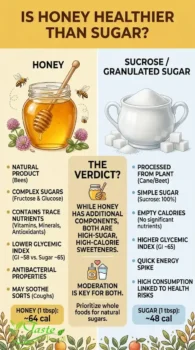
WHO’s definition of free sugars includes sugars naturally present in honey, syrups and fruit juices, so honey counts toward the same limit as table sugar. The FDA’s definition of added sugars likewise covers sugars packaged as such, such as a jar of honey. That is why a pure honey label shows a percent Daily Value for added sugars, even though it need not state the grams.
Some of the researchers behind the pooled analysis have argued that their findings should give pause to the free-sugar label for honey. That argument has not changed the guidance above.
The one safety rule specific to honey is for babies. Honey may contain spores of Clostridium botulinum, so it should never be given to babies under 12 months, while it is considered safe from age one.
Practical Ways to Choose and Use Each
- Use honey where its flavor shows. Tea, yogurt, dressings and glazes carry its floral and caramel notes. In a plain vanilla cake, you’re mostly paying for sweetness, and sugar does that job.
- Start with less. Honey tastes sweeter than granulated sugar, so begin below a spoon-for-spoon swap and adjust.
- Weigh it when it matters. A spoon of honey weighs more than a spoon of sugar. A lightly oiled or warmed spoon also keeps the sticky pour clean.
- Expect baking to change. Honey adds moisture and usually browns faster than granulated sugar. For swap ratios and texture, see our honey vs brown sugar guide.
- Keep one sweetener budget. A teaspoon of honey in each cup of tea is still added sugar, so count it alongside everything else you sweeten.
- Weigh other options on their own terms. Honey isn’t the only sugar with a wholesome reputation. For that comparison, see honey and maple syrup compared.
Honey vs Sugar FAQs
Is honey better than sugar for people with diabetes?
Generally, no. Mayo Clinic says there is generally no advantage to substituting honey for sugar in a diabetes eating plan, because both affect blood sugar. If you prefer honey’s taste, use it in moderation and count its carbohydrate. Your care team can tailor this to your medications and targets.
Does honey help with weight loss more than sugar?
Not on its own. In the crossover trial described above, body weight did not change with honey, sucrose or high-fructose corn syrup, so a swap alone is unlikely to move the scale.
Is honey easier on teeth than sugar?
There is no reason to assume so. WHO’s 10% limit rests on moderate-quality observational evidence on dental caries for free sugars as a group, and honey is part of that group.
My Bottom Line
My practical take: choose by taste and treat the spoon as sugar. Honey earns its place when its flavor improves the dish, or when it makes you happy to use a little less. If you want a starting point, tally the sweetened spoons in a typical day before deciding which sweetener to swap, because the total matters more than the type.
Conclusion
Is honey healthier than sugar? A little, in a few narrow ways, but the bigger lever is how much sweetener you use in the first place. Pick the one you enjoy enough to measure carefully, and keep honey away from infants.
Explore Honey by Topic
- Honey benefits and their evidence: what research supports across honey’s most-discussed health uses, with evidence levels.
- Honey nutrition per serving: the vitamins, minerals and sugars in honey, broken down by serving size.
- Honey vs agave nectar: fructose content, glycemic index and cold-drink uses compared.
- Honey and weight loss: whether honey helps with weight loss or only adds calories.
- Carbs in honey: how honey’s carbohydrates fit a keto or low-carb diet.
This article offers general nutrition information, not medical advice. If you have diabetes or another medical condition, a food allergy, or take medication, check with a qualified healthcare professional before changing how you sweeten your food.