
Baklava Filo Pastry: The Ultimate Guide to History, Techniques & Perfect Recipes
What Is Baklava Filo Pastry? Complete Guide to Layers, Recipes & Regional Secrets
What Is Baklava? A Deep Dive Into the World’s Most Iconic Layered Pastry
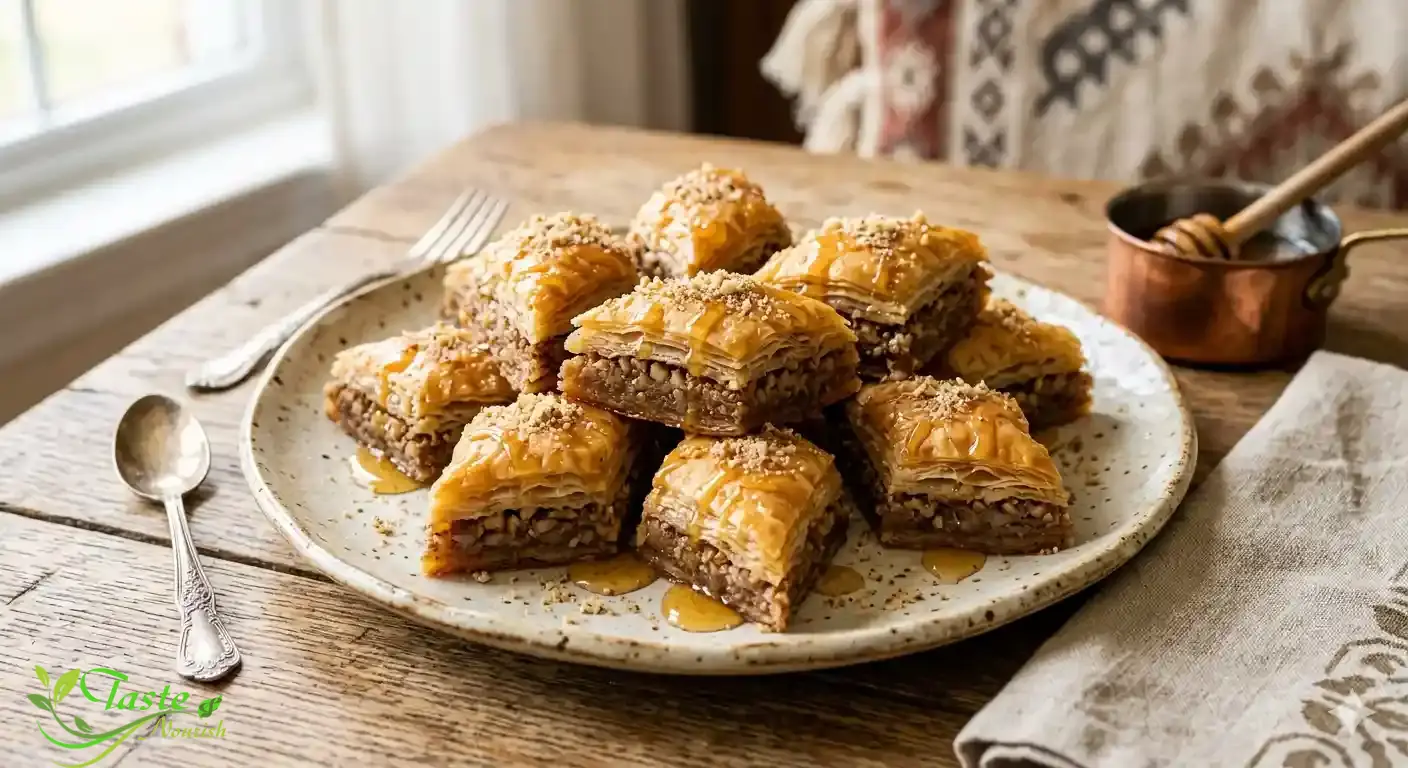
If there’s one dessert that has conquered every culture it has ever touched, it’s baklava filo pastry — the ancient, golden, achingly beautiful layered sweet that has graced royal tables, street market stalls, and family celebrations for over a thousand years. Whether you spell it filo, phyllo, or fillo, this paper-thin pastry is the soul of baklava, and understanding it is the key to making this iconic dessert at home with confidence.
In this ultimate guide, you’ll discover everything there is to know about baklava filo pastry: where it came from, why filo dough is unlike any other pastry in the world, how different cultures across the Middle East, Mediterranean, and Balkans have made baklava their own, and exactly how to make it perfectly — crispy, golden, and soaked in the right amount of syrup. Whether you’re a first-time baker or someone who grew up watching a grandmother stretch filo dough over a kitchen table, there’s something here for you.
We’ll walk through the history of baklava from ancient Mesopotamia to the Ottoman palace kitchens, break down the differences between Greek, Turkish, Lebanese, and Iranian styles, and give you the professional techniques that separate a soggy, disappointing batch from the kind of shatteringly crisp, honey-drenched masterpiece that makes people demand the recipe. So — are you ready to master the art of baklava filo pastry? Let’s get into it.
The Magic of Filo (Phyllo) Dough Explained
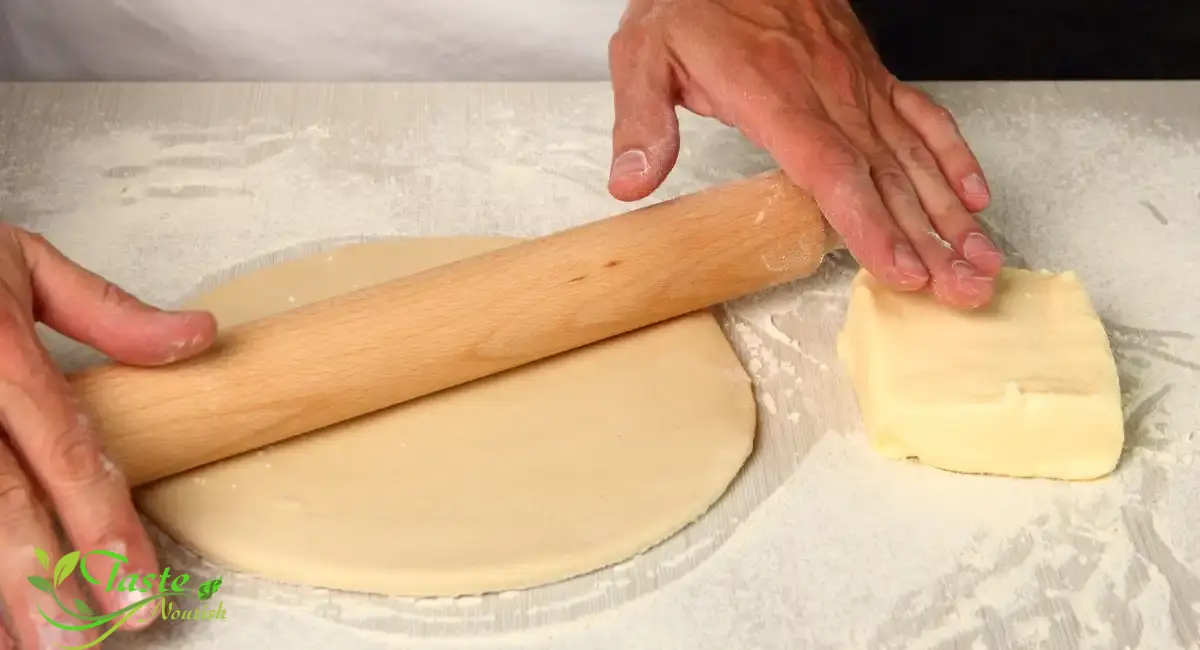
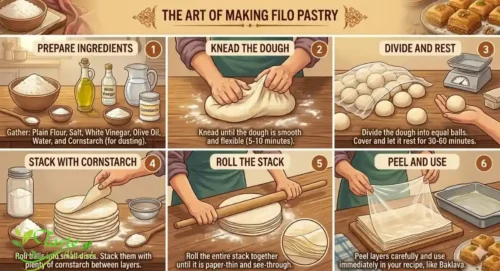
The word “phyllo” in Greek means “leaf” — and commercially, it is made of flour, water, salt, and oil. The dough is mixed and allowed to rest so the gluten in the flour relaxes, then rolled and stretched very thin before being cut into individual leaves. This is what separates filo from every other pastry dough in existence. Where puff pastry achieves its layers through lamination with fat, filo achieves its layers through sheer, almost impossible thinness.
Each sheet is so delicate that light passes through it. The difference between phyllo pastry and puff pastry is that puff pastry “puffs up” when cooked, revealing layers upon layers of flaky pastry, while phyllo pastry is like a single one of those thin flaky layers in puff pastry. In other words, filo is the raw, honest version of pastry — no shortcuts, no leavening agents, just paper-thin sheets of dough that transform in the oven into something transcendent.
Historically, making filo by hand was considered a genuine craft, not just a cooking skill. Some bakers even had to apprentice before being ready to make the paper-thin dough by hand. Today, most of us rely on store-bought frozen filo, and there’s absolutely no shame in that — it’s widely available and works beautifully when handled correctly. But understanding what filo is, at its core, helps you treat it with the respect it deserves.
Key Ingredients That Make Baklava Irresistible
Baklava is one of those rare desserts that achieves complexity with remarkably few ingredients. Filo/phyllo pastry, walnuts or pistachios (or other nuts), butter, honey, sugar, lemon, cinnamon, and water are all you really need. The magic isn’t in an exotic ingredient list — it’s in the technique, the ratios, and the patience you bring to the process. The nuts provide earthiness and texture, the butter creates richness and promotes that golden crunch, and the syrup ties everything together with sweetness that penetrates every layer.
Getting the balance right between these elements is what separates a good baklava from a great one. Filo vs. Phyllo — Are They the Same Thing?
Yes, absolutely — “filo” and “phyllo” are simply two different spellings of the same word, both referring to the same extraordinarily thin pastry dough. The word is Greek in origin, and you’ll also see it spelled “fillo” in some recipes. Don’t let the spelling variations confuse you when you’re shopping or following a recipe. Any box of filo/phyllo dough at the grocery store will work for baklava, regardless of how the manufacturer spells it on the packaging.
It’s also worth clarifying the difference between filo pastry and shortcrust or puff pastry, since home bakers sometimes wonder if they’re interchangeable. They’re really not — at least not for baklava. Making baklava with puff pastry results in a texture that is denser and not as airy and light as traditional baklava made with phyllo dough. Puff pastry can work as a shortcut in a pinch, but true baklava depends on filo’s unique combination of paper-thin layers and the way they crisp independently under heat. If you want the authentic crunch and the ability for syrup to penetrate between each layer, filo is non-negotiable.
Store-Bought vs. Homemade Filo Dough
For the vast majority of home bakers, store-bought frozen filo is the way to go. It’s consistent, affordable, and widely available. However, handmade filo dough is an experience unto itself — making filo by hand involves mixing and resting the dough so its gluten relaxes, rolling and stretching it very thin, then cutting it into individual leaves.
Home cooks who grew up in Mediterranean or Middle Eastern families often describe watching grandmothers stretch filo over entire kitchen tables as one of their most vivid food memories. The dough becomes so thin you can read a newspaper through it. It’s genuinely breathtaking to witness.
If you do use store-bought filo, the thawing process is critical. For best results, thaw phyllo pastry overnight in the fridge (even if the pack says otherwise), then take it out of the fridge 30 minutes prior to use. Rushing this process results in sheets that stick together, tear, and crumble — which is the source of most people’s frustration with filo pastry. Patience here pays enormous dividends.
How to Work With Filo Pastry Like a Pro
Working with filo dough intimidates a lot of people, and honestly, that intimidation is completely understandable. The sheets are thin, they dry out fast, they tear if you look at them wrong. But here’s the thing — with a few simple techniques, filo becomes genuinely manageable, and the results are so spectacular that the learning curve is more than worth it. Think of filo as a high-maintenance but incredibly talented collaborator. Treat it right, and it will make you look like a genius.
Thawing, Handling, and Layering Tips
The most important rule with filo is never let it dry out. Once filo sheets are exposed to air, they begin to crack and crumble within minutes. The professional solution is almost embarrassingly simple: keep a clean, barely damp kitchen towel draped over your stack of filo sheets at all times while you work. This single habit will transform your filo experience. You must keep the remaining phyllo covered with a damp towel at all times.
Work efficiently but calmly — don’t rush, but don’t leave your filo sitting uncovered while you answer a text message. Regarding thawing, thaw frozen phyllo pastry overnight in the fridge, even if the pack says otherwise, then take it out of the fridge 30 minutes prior to starting. This slow, gradual thaw prevents condensation from building up between sheets, which is what causes them to stick and become unworkable. Some bakers also trim the sheets to fit their baking pan before they start layering, keeping the trimmed stack under that damp towel throughout assembly. Small tears in individual sheets are completely fine — they won’t be visible in the finished baklava, since you’re building dozens of layers.
The Butter-Brushing Technique That Changes Everything
You don’t need to drown the filo leaves in butter — in fact, that is counterproductive. Brush very lightly, and the entire leaf does not have to be covered. This is a point of wisdom from a professional pastry baker, and it contradicts what many beginners instinctively do. More butter doesn’t equal more flavour or more crunch — it actually weighs down the filo and can result in a greasy, heavy baklava instead of the delicate, shattering crispness you’re aiming for. Use a wide pastry brush and apply melted butter in broad, gentle strokes. Each sheet should have a thin, even coating, not a puddle.
The type of butter matters too. Clarified butter — butter with the milk solids and water removed — is traditional in many Middle Eastern recipes, as it has a higher smoke point and a purer, more concentrated flavour. Regular unsalted butter works perfectly well for most home recipes. Whatever you use, make sure it’s fully melted and warm (not boiling) when you brush it on.
Step-by-Step: How to Make Classic Baklava with Filo Pastry
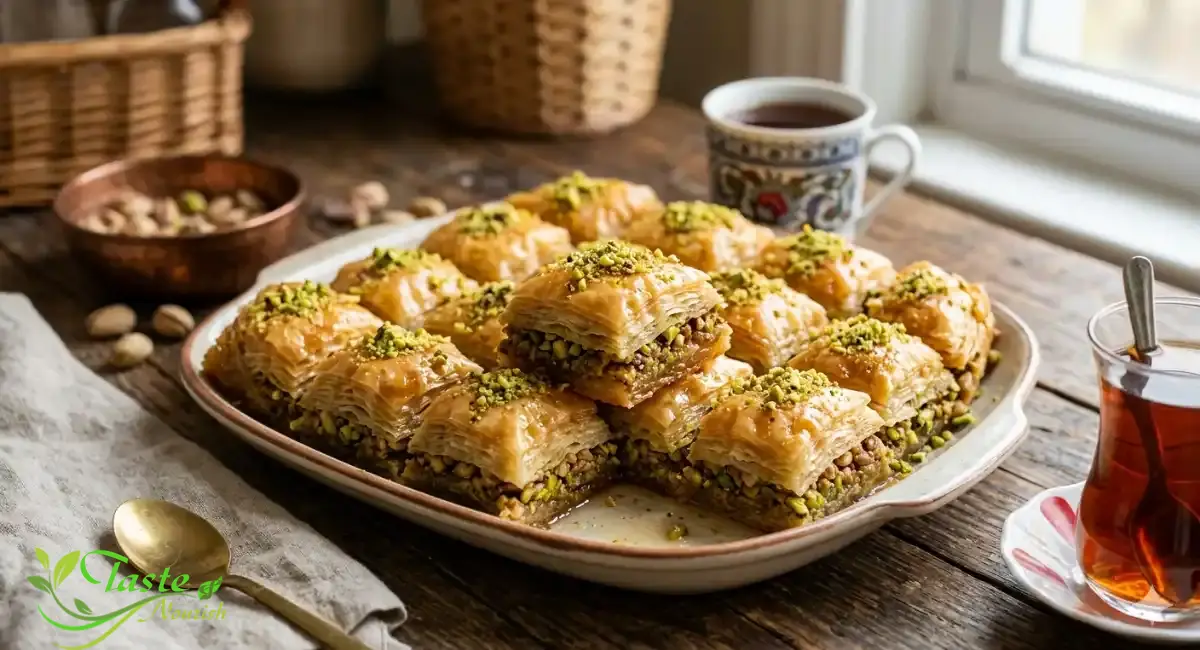
Now let’s get to the heart of the matter — actually making baklava. The process is straightforward once you understand the logic behind each step. Think of it as building a very delicious, very buttery lasagne. The assembly follows a consistent pattern: layers of buttered filo, a scatter of spiced nuts, more buttered filo, more nuts, and a thick cap of filo on top to seal everything in. The total sequence for a classic baklava should be phyllo layers of 8-5-5-5-5-8, with nuts in between those layers. This layering structure gives you that ideal ratio of pastry to filling — enough nut mixture to taste in every bite, but enough filo to provide structure and crunch.
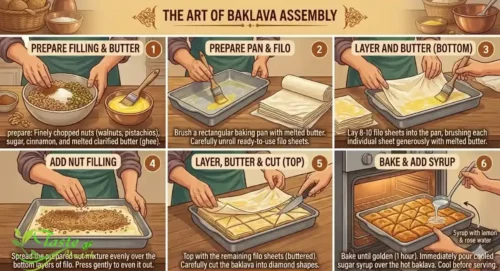
Once your baklava is assembled and scored with a sharp knife into diamond or square shapes (always cut before baking, never after), you bake it in a moderate oven. Bake the baklava for approximately 50 minutes, until golden on the edges and tops. Other recipes call for slightly longer baking at a lower temperature — bake at 325°F (163°C) for 1 hour and 15 minutes. Every oven is different, so use the golden colour as your guide rather than rigidly following a timer. You want deep, even gold — not pale and underdone, and not dark brown.
The Syrup Dilemma — Hot or Cold?
Here’s where you’ll find passionate debate in nearly every baklava recipe on the internet. The question of whether to pour hot syrup on hot baklava, or cold syrup on hot baklava (or the reverse), is genuinely important and affects the final texture. The temperature of the syrup and baked baklava is the key. If the baklava is hot, the syrup must be cold when it is poured on. If the baklava is cold, the syrup must be hot. The science behind this is actually quite elegant — the contrast in temperature creates a rapid absorption effect, and you can literally hear the baklava crackling as the cool syrup hits the hot pastry layers.
The cold-syrup-on-hot-baklava method is the most widely recommended approach, and it’s the one that consistently delivers crispy, non-soggy results. To avoid soggy baklava, use completely cooled liquid on hot pastry. After pouring the syrup, resist the urge to cover the pan — let the baklava cool completely at room temperature for at least 6 hours (ideally overnight) without being covered, to prevent sogginess so the baked pastry can soak up all of the syrup. Covering it while warm traps steam, which is the enemy of crispy filo.
Common Mistakes to Avoid When Making Baklava
Even experienced bakers make avoidable mistakes with baklava. The most frequent culprit is skipping the overnight thaw — rushing this step results in sheets that stick together and tear when separated, which is endlessly frustrating and entirely preventable. Another common error is using too much butter between layers. As noted earlier, a light hand with the pastry brush produces a far superior result than a heavy one. Drowning your filo in butter might feel luxurious, but it makes the finished baklava dense and greasy rather than light and shattering.
Cutting the baklava after baking (rather than before) is another mistake that leads to crumbled, messy pieces. The filo needs to be scored all the way through to the bottom of the pan before it goes in the oven, so that the syrup can penetrate each individual piece evenly. Using a dull knife or timid cuts results in jagged, uneven pieces — use a sharp chef’s knife and press firmly down through every layer.
Finally, don’t skip the resting time after adding the syrup. Baklava should be left uncovered on the counter to cool for at least 6 hours, or ideally overnight, so the pastry can fully absorb all of the syrup. Serving it too soon means the syrup hasn’t distributed evenly, and you’ll get overly sweet pieces next to dry ones.
Storage, Make-Ahead, and Freezing Tips
One of baklava’s most underrated qualities is how brilliantly it keeps — and actually improves — over time. Baklava actually improves as it sits. It’s one of the easiest desserts to prepare in advance, perfect for holidays or hosting. Baklava stays fresh for a week at room temperature or 3 months in the freezer. At room temperature, keep it loosely covered with a clean kitchen towel rather than an airtight container — you want airflow to maintain that characteristic crispness. Airtight containers trap moisture and soften the pastry. In the fridge, baklava can be stored in an airtight container for up to 2 weeks, but the pastry can become more chewy.
For freezing, wrap the pan tightly in plastic wrap and then foil. To thaw, place it on the counter or in the fridge. You can reheat in the oven for 10 minutes if you want it to be crisper. This make-ahead friendliness makes baklava an ideal dessert for entertaining — you can make it two or three days before your guests arrive, and it will taste even better on the day of serving than it did fresh from the oven. The Fascinating History of Baklava Filo Pastry.
Here’s where things get genuinely interesting. Ask a Greek grandmother, a Turkish chef, and a Lebanese home baker where baklava comes from, and you’ll get three passionate, wildly different answers. The truth — as with most food history — is far more nuanced and far more beautiful than any single national claim. Baklava belongs to everyone, and to understand it fully, you have to follow the filo dough through time.
Regional Variations of Baklava Around the World
One of the most delightful things about baklava is how dramatically it changes across regions while remaining recognizably itself. It’s like a musical theme that every culture has arranged in its own key — the core melody is always there, but the instrumentation is entirely different. Let’s take a tour through the world’s most distinct baklava traditions.
Ancient Origins — From Mesopotamia to the Ottoman Palace
Most historians agree that baklava’s roots can be traced back to ancient Mesopotamia. The earliest versions were made by layering thin sheets of dough with nuts and honey, a practice common in ancient Assyrian and Babylonian cultures. The recipe spread throughout the Middle East, with each region adding its unique touch. The ancient Greeks, for instance, adopted and adapted the recipe, adding their techniques such as using layers of filo dough, which they called “phyllo,” meaning “leaf.” So while the Greeks didn’t invent baklava, they arguably gave us the very dough that makes it what it is today. That’s a pretty significant contribution.
The word baklava is of Turkic origin. Although the dessert’s ultimate origin is disputed, many modern accounts relate it to the layered pastry traditions of Turkic Central Asia, and hold that baklava in something close to its modern form was developed in Ottoman cuisine. The Ottoman palace kitchens in Istanbul were essentially the fine-dining laboratories of their era — enormous, well-funded, and staffed by culinary artisans.
Palace kitchens in Istanbul played a major role in standardizing the use of ultra-thin phyllo dough and precise assembly methods, a process documented in historical culinary archives. When the Ottoman sultans put their imperial stamp on baklava, they elevated it from regional sweet to royal dessert. The Turks treated baklava as a dessert of the wealthy, and the Sultan would give it as a special gift. That says everything you need to know about its cultural status.
How Baklava Spread Across the World
The spread of baklava mirrors the expansion of empire, trade, and human migration — which is a poetic way of saying that wherever people went, they brought their sweets. Baklava’s reputation as a dish of importance meant that it was spread far and wide by bureaucrats along trade routes and pilgrimages during the zenith of the Ottoman Empire in the 16th century. This made the dessert a staple across Middle Eastern and Mediterranean cultures, from Algeria to Afghanistan.
Today, you can find baklava on every continent, in airport shops, high-end patisseries, and neigh bourhood bakeries alike. It is a popular dessert enjoyed in Arab, Bulgarian, Greek, Iranian, and Turkish cuisines, as well as across the Balkans and Central Asia.
What’s remarkable is that baklava didn’t spread as a fixed, standardized recipe. It evolved differently wherever it landed, absorbing local tastes, local nuts, and local aromatics. Numerous regional variations have emerged over the centuries, often based on locally available ingredients. “Gaziantep is a region famous for pistachios,” says one master baker, “so my great-grandfather used pistachios in his baklava.” In Greece, on the other hand, walnuts became the nut of choice, with cinnamon used to flavor the filling. This is the beautiful paradox of baklava — it’s the same dessert and a completely different one, depending on where you eat it.
Greek Baklava vs. Turkish Baklava
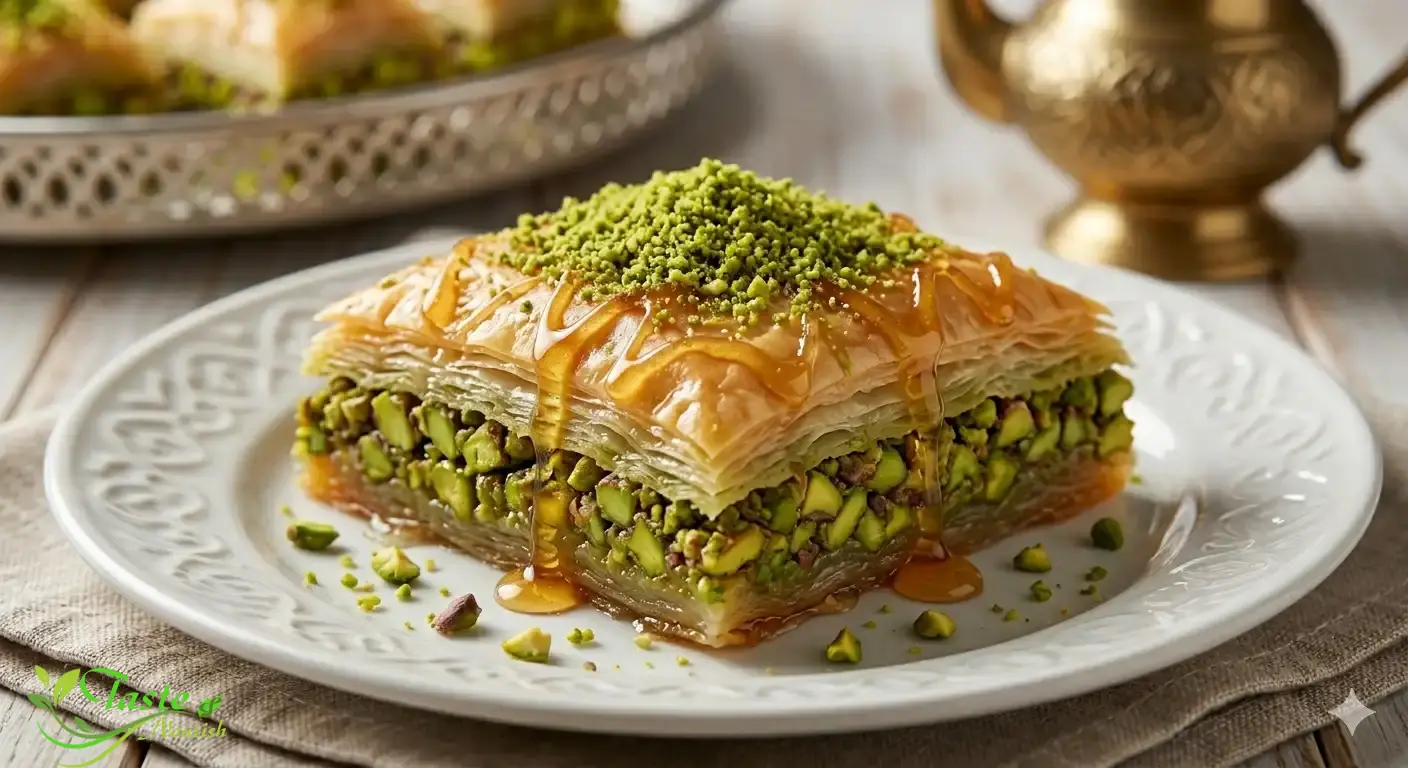
These two versions are perhaps the most commonly debated, and the comparison reveals a lot about both culinary cultures. Greek baklava is usually more syrupy and sticky because it’s sweetened with honey, while Lebanese baklava is sweetened with simple syrup. Greek baklava is flavored with cinnamon and lemon juice, while Lebanese baklava is flavored with cardamom and rosewater. Turkish baklava, particularly from the famous city of Gaziantep, is all about the pistachio — bright green, finely ground, and heaped generously between paper-thin layers of yufka (the Turkish term for filo). The syrup in Turkish baklava is typically a lighter sugar syrup rather than honey, allowing the nutty flavour to shine without being overpowered by sweetness.
Greek baklava, in contrast, leans into warmth and richness — walnuts spiced with cinnamon and cloves, drenched in golden honey syrup with a hint of lemon. Greek baklava became distinct through the use of walnuts, warm spices like cinnamon, and honey-based syrup. Neither version is “better” — they are simply beautiful expressions of different culinary philosophies, and anyone who tells you otherwise hasn’t eaten enough baklava.
Lebanese, Iranian, and Balkan Styles
The regional diversity of baklava extends far beyond the Greece-Turkey axis. In Lebanon, less syrup is used, so the baklava is drier and crunchier. In Algeria, the syrup is typically flavoured with orange blossom water. In Iran, it’s infused with fragrant cardamom and rose water. In Armenia, the nutty filling is spiced with cinnamon and cloves. In Cyprus, it’s common to use geranium-infused syrup, with a filling of almonds, cinnamon, and rose water.
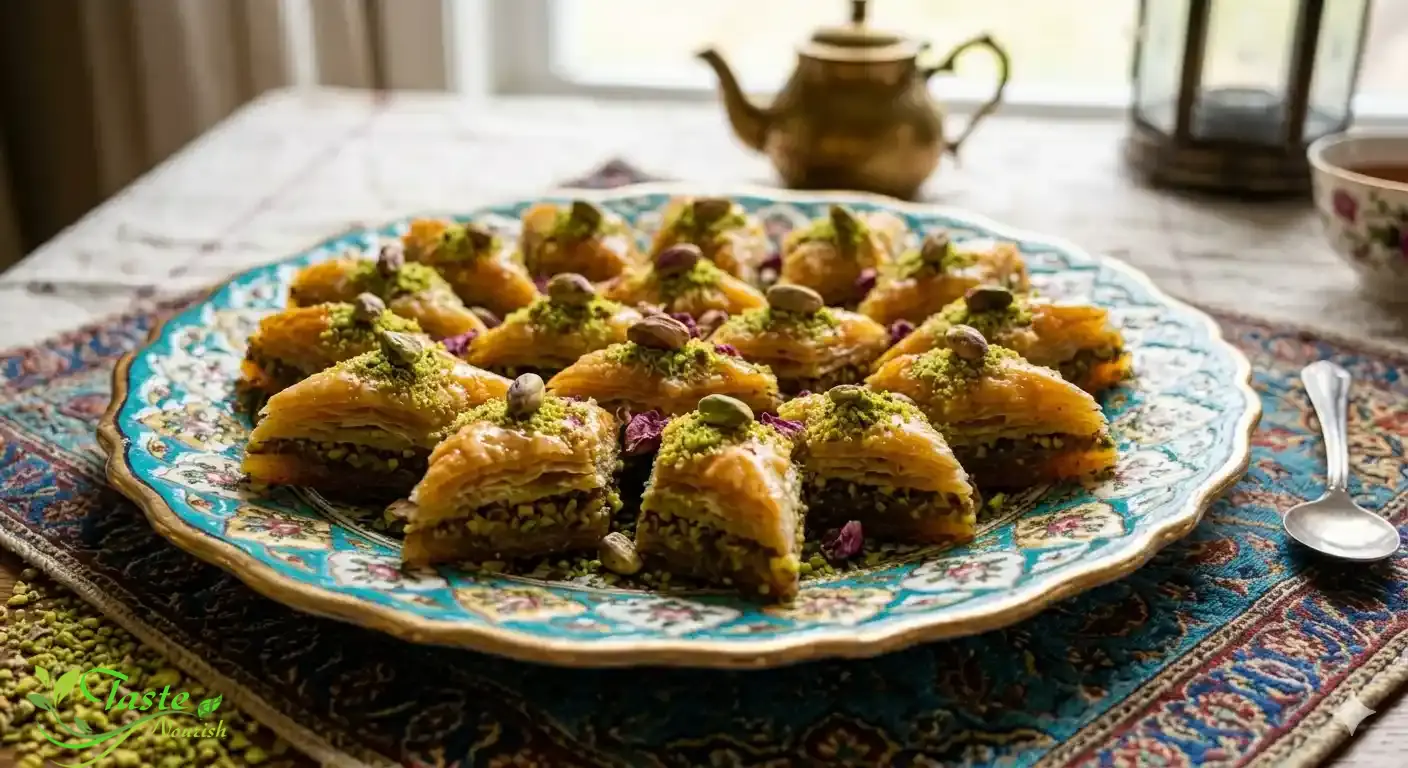
Iranian baklava is particularly distinctive — it is less crisp and uses less syrup than other baklava variations. Iranian baklava uses a combination of chopped almonds, hazelnuts or walnuts and pistachios spiced with saffron, cardamom, or jasmine, with rose water, lemon juice, sugar, honey, and water used in the syrup.
Regional Baklava Style Comparison Table:
| Region | Nut of Choice | Syrup Type | Key Flavourings | Texture |
|---|---|---|---|---|
| Turkey (Gaziantep) | Pistachios | Sugar syrup | Neutral | Light, crispy |
| Greece | Walnuts | Honey syrup | Cinnamon, lemon | Rich, sticky |
| Lebanon | Pistachios/mixed | Simple syrup | Rose water, orange blossom | Dry, crunchy |
| Iran | Almonds, pistachios | Honey/sugar | Rose water, saffron, cardamom | Less crispy |
| Armenia | Walnuts | Sugar syrup | Cinnamon, cloves | Dense, spiced |
| Algeria | Almonds | Sugar syrup | Orange blossom water | Crunchy |
| Cyprus | Almonds | Geranium syrup | Rose water, cinnamon | Floral, delicate |
| Albania | Walnuts | Sugar syrup | Lemon | Rhombus-shaped |
Conclusion
Baklava with filo pastry is more than a recipe — it’s a living piece of culinary history that has survived empires, crossed continents, and found its way into kitchens on every corner of the globe. From the royal palace kitchens of Ottoman Istanbul to your home oven, the fundamentals remain unchanged: paper-thin filo, generously spiced nuts, clarified butter, and a carefully balanced syrup. What changes — and what makes baklava so endlessly fascinating — is the way each culture has made it its own, layering in local flavours, local traditions, and local love.
Whether you prefer the honey-rich, cinnamon-spiced warmth of Greek baklava, the pistachio-laden elegance of Turkish baklava, or the rose-water perfumed delicacy of Lebanese style, you are participating in a tradition that stretches back thousands of years. Master the filo, respect the process, and baklava will reward you with one of the most deeply satisfying baking experiences imaginable.
Baklava Filo Pastry (FAQs)
1. What is the difference between filo pastry and puff pastry in baklava?
Filo pastry is ultra-thin, unleavened dough that crisps into individual papery layers when baked. Puff pastry is laminated with fat and puffs up into thick, airy layers. For authentic baklava, filo is essential — puff pastry produces a denser, chewier result that lacks the signature crispy layers and the ability to absorb syrup evenly between sheets.
2. Why is my baklava soggy?
Sogginess in baklava almost always comes down to one of three causes: pouring hot syrup onto hot baklava (instead of cold syrup on hot), covering the pan while it’s still warm (trapping steam), or not allowing enough resting time after the syrup is added. For crispy baklava, always use cooled syrup on hot baklava, leave the pan completely uncovered, and allow at least 6 hours (ideally overnight) for the syrup to absorb.
3. Can I use salted butter for baklava filo pastry?
Technically yes, but unsalted or clarified butter is strongly preferred. Salted butter can make the baklava taste slightly off, since the salt competes with the delicate sweetness of the syrup. Clarified butter is the traditional choice in many Middle Eastern recipes, providing a purer, more concentrated butter flavour and a higher smoke point that helps achieve an even golden colour.
4. How many layers of filo should baklava have?
Most classic recipes call for between 30 and 40 sheets of filo in total, arranged in a pattern of thicker base and top layers with thinner middle layers separated by the nut filling. A common structure is 8 sheets on the base, followed by alternating groups of 5 sheets and nut layers, finished with 8 sheets on top. The exact number can vary by recipe and regional tradition without significantly affecting the outcome.
5. Is baklava Greek or Turkish?
The most accurate answer is that baklava belongs to both cultures — and many others. Its roots trace back to ancient Mesopotamia, its modern form was largely standardized in Ottoman palace kitchens, and it has been embraced and adapted by Greek, Turkish, Lebanese, Iranian, Albanian, and dozens of other culinary traditions. Claiming it for any single nation misses the extraordinary multi-cultural story behind one of the world’s greatest desserts.