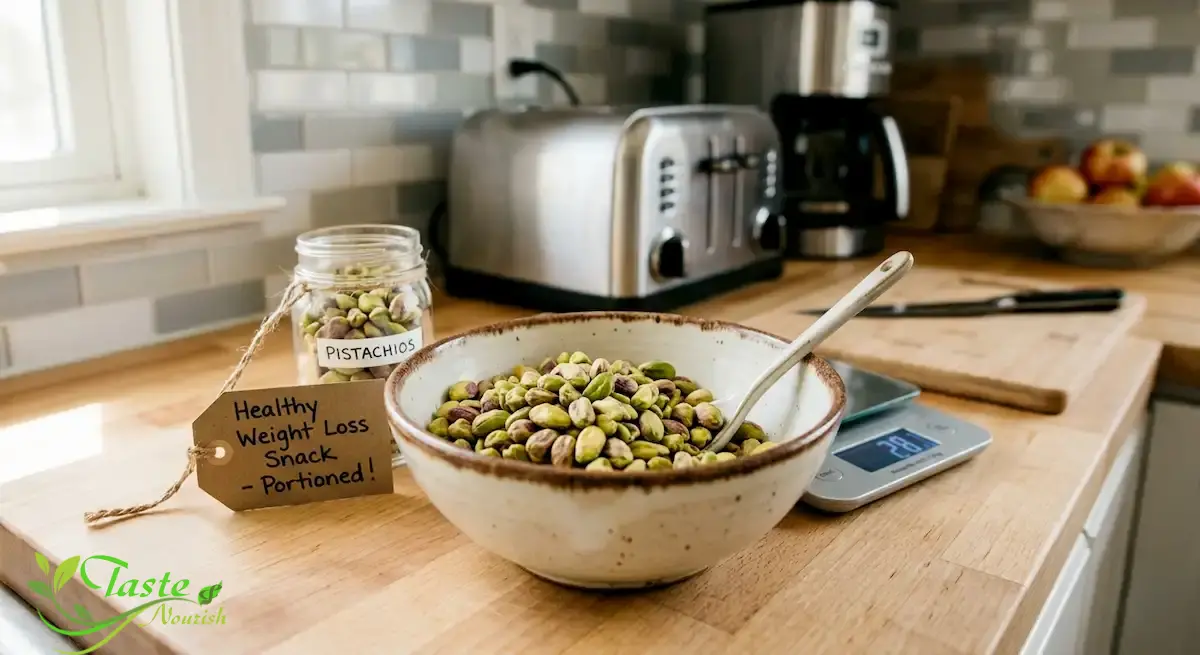
If you’ve ever poured a bowl of shelled pistachios while watching TV and wondered how much damage you just did to your daily calorie count, you’re not alone. Pistachios are one of the lowest-calorie tree nuts by volume, which makes tracking calories in pistachios a little more forgiving than with some other snacks. Still, the numbers depend heavily on whether you’re measuring by weight, by the handful, or by the shell.This guide breaks down exactly how many calories are in pistachios per serving, what those calories are made of, and how pistachios compare to other popular nuts.
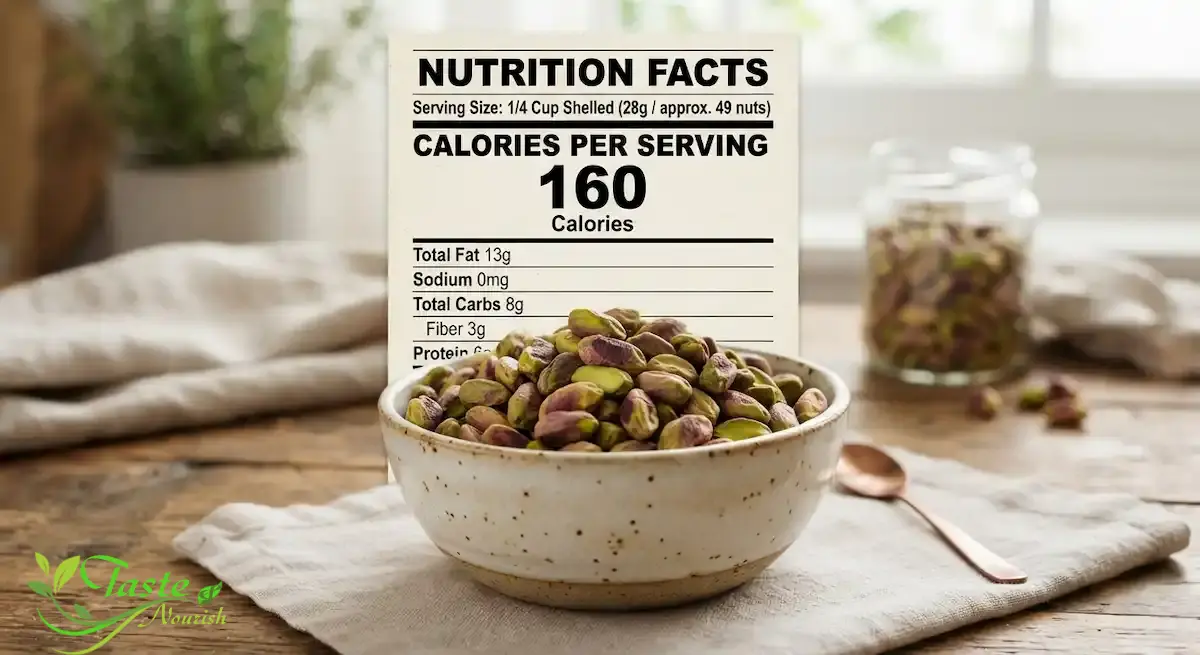
A standard 1-ounce serving of raw pistachios (about 49 kernels, or roughly a small handful) contains approximately 159 calories. That works out to around 560 calories per 100 grams. Most of those calories come from fat, but pistachios also deliver a solid dose of plant protein and fiber, which helps explain why they tend to be more filling than their calorie count suggests.
Key Takeaways
Calories in pistachios average about 159 per ounce (49 kernels), or roughly 560 per 100 grams.
Roasting adds only a marginal number of calories compared to raw pistachios.
Pistachios have one of the lowest calorie counts per kernel among common tree nuts, mainly because the shell takes up space without adding weight.
Research suggests regular pistachio consumption is associated with modest improvements in blood pressure and BMI, though it isn’t a weight-loss shortcut on its own.
Portion size matters more than the nut itself — a mindless “handful” can easily turn into two or three servings.
What Are Pistachios?
Pistachios (Pistacia vera) are the edible seeds of a small tree native to Central Asia and the Middle East, though today Iran and the United States (mainly California) are the world’s largest producers. Botanically, they’re a drupe, similar to a plum, with the pistachio kernel sitting inside a hard shell that naturally splits open as the nut matures.
That signature half-open shell is actually useful at the table: it’s one of the easiest visual cues for portion control, since you can see roughly how many you’ve eaten by the pile of empty shells left behind.
Pistachio Nutrition Facts
Beyond calories, pistachios bring a nutrient profile that’s fairly unusual among nuts. They’re higher in protein and potassium than many tree nuts, and they contain lutein and zeaxanthin, the same antioxidants found in leafy greens.
Pistachio Calories per Serving
Here’s how pistachio calories per serving break down across common measurements, based on USDA FoodData Central values for raw, unsalted pistachios.
Serving Size
Calories
Protein
Fat
Carbs
Fiber
10 kernels
~32
1.2 g
2.6 g
1.6 g
0.6 g
1 oz / 28 g (49 kernels)
159
5.7 g
12.8 g
7.7 g
2.9 g
1/4 cup (31 g)
176
6.3 g
14.2 g
8.5 g
3.2 g
1 cup, shelled (123 g)
699
25 g
56 g
34 g
13 g
100 g
560
20.2 g
45.3 g
27.5 g
10.6 g
An ounce of pistachios also provides around 291 milligrams of potassium, 0.4 milligrams of copper (roughly a third of the daily value), and about 0.5 milligrams of vitamin B6.
Calories in a Handful of Pistachios
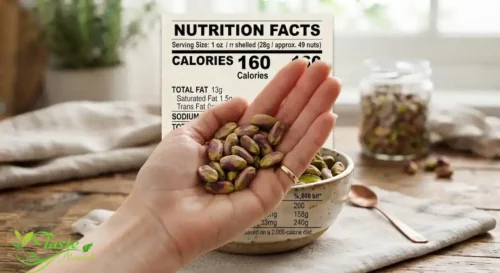
People often ask about calories in a handful of pistachios rather than a measured ounce, since that’s how most of us actually eat them. A loose adult handful generally lands close to the standard 1-ounce serving — about 49 kernels and 159 calories — though hand size and how tightly you cup your palm can shift that number up or down by 10 to 20 calories.
If you want a more reliable estimate than “handful,” counting kernels is your best bet: about 20 pistachios comes to roughly 65 calories, and about 30 comes to roughly 97 calories.
Health Benefits of Pistachios
Heart health: The FDA recognizes a qualified health claim that eating 1.5 ounces of most nuts, including pistachios, daily as part of a diet low in saturated fat and cholesterol may help reduce the risk of heart disease.
Blood pressure support: Clinical research in adults with type 2 diabetes found that replacing low-fat snacks with pistachios was associated with reduced ambulatory blood pressure over several weeks.
Weight and BMI: A meta-analysis of randomized controlled trials found that diets including pistachios were linked to modestly lower BMI compared to control diets, without a significant change in body weight or waist circumference.
Blood sugar management: Pistachios have a low glycemic index and pair a moderate amount of carbohydrate with fiber, protein, and fat, which may help blunt post-meal blood sugar spikes when eaten alongside other foods.
Antioxidant content: Pistachios are one of the few nuts that contain meaningful amounts of lutein and zeaxanthin, carotenoids also associated with eye health.
Scientific Evidence
A controlled feeding trial in adults with well-managed type 2 diabetes compared a diet that replaced low-fat snacks with pistachios (about 20% of daily calories) against a standard low-fat control diet. After four weeks on the pistachio diet, researchers observed favorable changes in systemic hemodynamics and a reduction in ambulatory blood pressure compared to the control period.
Separately, a systematic review and meta-analysis pooling eleven randomized controlled trials and more than 1,500 participants examined pistachio intake in relation to body weight measures. The pooled results showed a small but statistically significant reduction in BMI among participants eating pistachios compared to control groups, with no meaningful difference in overall body weight or waist circumference.
Both studies point to pistachios fitting reasonably well into a calorie-conscious diet when they replace less nutritious snacks, rather than being added on top of your usual eating pattern.
Potential Risks & Side Effects
Calorie density — Even though pistachios are lower in calories per kernel than most nuts, they’re still calorie-dense by weight, so unmeasured snacking can add up quickly.
Sodium — Roasted and salted varieties can carry a significant amount of added sodium, which matters for anyone watching blood pressure.
Digestive discomfort — Pistachios contain fermentable carbohydrates (fructans) that may cause bloating or gas in some people, particularly in large quantities or in those with IBS.
Allergic reactions — Pistachios are classified as a tree nut and can trigger reactions ranging from mild itching to severe anaphylaxis in people with tree nut allergies.
Who Should Avoid It?
Anyone with a diagnosed tree nut allergy, since cross-reactivity between tree nuts is common.
People on medically supervised low-sodium diets should choose raw or dry-roasted, unsalted pistachios rather than salted versions.
Those with known FODMAP sensitivity or active IBS symptoms may need to limit portion size, since pistachios rank higher in fermentable carbohydrates than many other nuts.
People managing kidney disease should talk to their care team, since pistachios are relatively high in potassium and phosphorus.
How Much Should You Eat?
A standard serving is 1 ounce, or about 49 kernels — roughly a small, loosely cupped handful. The FDA’s qualified health claim on nuts and heart health is based on 1.5 ounces (about 240 calories) per day as part of a diet that’s otherwise low in saturated fat.
For most healthy adults, sticking to one measured serving a day, most days of the week, is a reasonable way to get the potential benefits without overshooting your calorie needs. If weight management is a goal, treating pistachios as a replacement for another snack — rather than an addition to your usual intake — tends to work better than adding them on top.
How to Choose the Best Pistachios
Check the shell: If buying in-shell, look for shells that are naturally split partway open. Tightly closed shells are harder to open and may indicate the nut wasn’t fully mature.
Smell before you buy: Rancid pistachios have a noticeably sour or bitter smell due to the natural fats breaking down. Fresh pistachios smell mild and slightly nutty.
Raw vs. roasted: Raw pistachios are the most neutral option nutritionally; dry-roasted adds a small amount of extra calories but no significant nutrient loss.
Watch the sodium: If you’re buying roasted and salted, check the label — sodium content can vary widely between brands.
Buy from stores with good turnover: Because of their fat content, pistachios go rancid faster than lower-fat foods, so freshness at the point of purchase matters.
Storage Tips
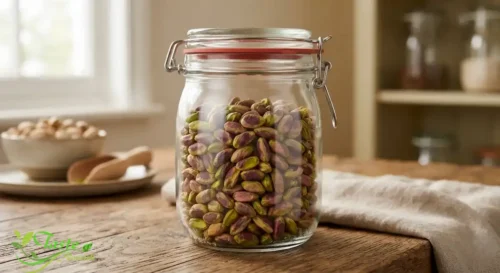
Store shelled pistachios in an airtight container in a cool, dark pantry for up to 2-3 months.
For longer storage, refrigerate shelled pistachios for up to 6 months or freeze them for up to a year.
In-shell pistachios last somewhat longer than shelled ones at room temperature, since the shell offers some protection from air and light.
Keep pistachios away from heat sources and direct sunlight, both of which speed up rancidity.
Best Ways to Eat or Cook Pistachios
Straight from the shell as a portion-controlled snack.
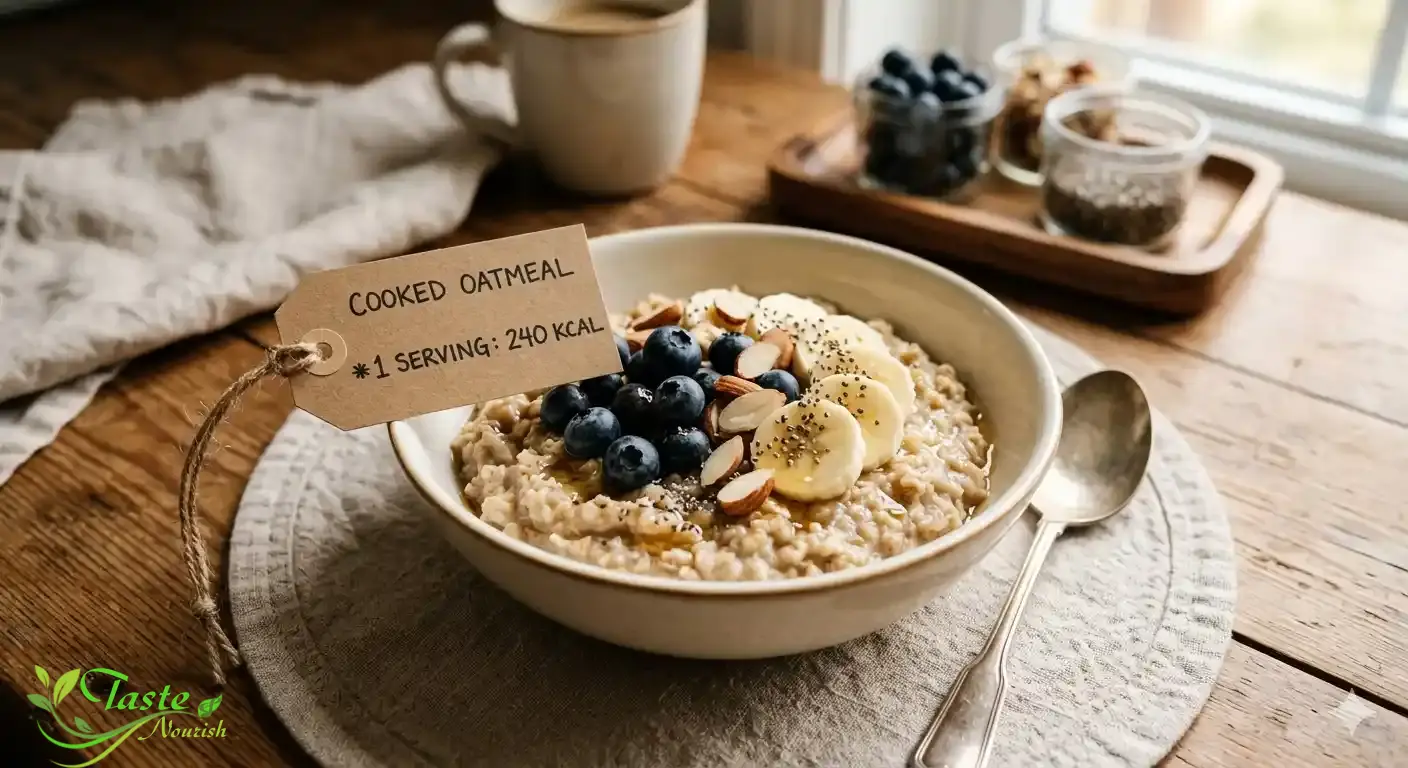
Chopped and sprinkled over yogurt, oatmeal, or salads for crunch.
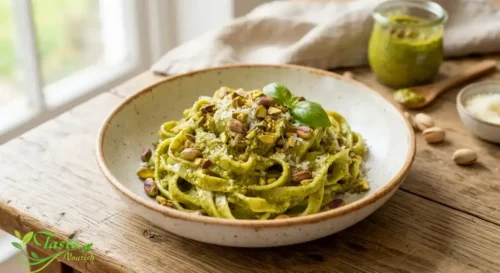
Blended into a pistachio pesto in place of pine nuts.
Folded into baked goods, ice cream, or traditional pastries like baklava.
Common Mistakes
Eyeballing “a handful” instead of measuring: Handfuls vary a lot from person to person, which throws off calorie tracking.
Weighing pistachios in the shell: If a recipe or tracking app calls for shelled weight, using in-shell weight will overstate the calorie count, since the shell itself is inedible and adds no calories you actually consume.
Choosing candied or chocolate-covered versions and assuming similar nutrition: Sweetened or coated pistachios can have significantly more sugar and calories than plain roasted or raw kernels.
Snacking straight from a large bag: Without a visual stopping point, it’s easy to eat well past a single serving.
Myths vs. Facts About Calories in Pistachios
Myth
Fact
Pistachios are so low-calorie you don’t need to portion them.
They’re lower per kernel than many nuts, but still calorie-dense by weight — portioning still matters.
The fat in pistachios is unhealthy.
Most of the fat is unsaturated, and research links pistachio consumption to modestly lower BMI rather than weight gain.
Roasted pistachios have far more calories than raw.
The difference is small — about 159 calories per ounce raw versus roughly 162 dry-roasted.
Pistachios are a low-fat nut because they’re lower-calorie.
Fat still makes up about two-thirds of their calories; they’re simply lower-calorie by kernel, not by fat percentage.
Calories in Pistachios vs. Other Popular Nuts
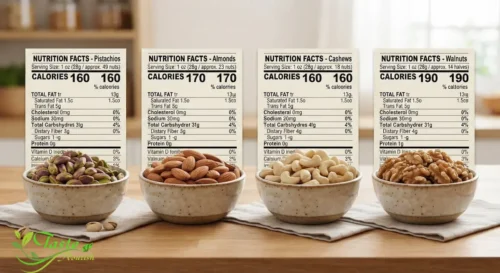
Here’s how calories in pistachios stack up against other common snacking nuts, per 1-ounce serving.
Nut (1 oz)
Calories
Protein
Fiber
Pistachios
159
5.7 g
2.9 g
Cashews
157
5.2 g
0.9 g
Peanuts
161
7.3 g
2.4 g
Almonds
164
6.0 g
3.5 g
Walnuts
185
4.3 g
1.9 g
Pistachios and cashews come in lowest on calories per ounce among these options, though almonds edge them out on fiber.
Calories in Pistachios FAQs
How many calories are in 20 pistachios?
About 65 calories, based on roughly 159 calories per 49 kernels.
Are pistachios good for weight loss?
They aren’t a weight-loss food on their own, but research suggests that including pistachios as a snack substitute, rather than an addition, is linked to modestly lower BMI over time.
Do roasted pistachios have more calories than raw?
Only slightly. Raw pistachios have about 159 calories per ounce, while dry-roasted versions run closer to 162 calories per ounce.
Are pistachio calories mostly from fat?
Yes, roughly 68% of the calories in pistachios come from fat, mostly unsaturated fat, with the rest split between carbohydrate and protein.
Can I eat pistachios on a low-carb diet?
Pistachios have more carbohydrate per ounce than some other nuts, so portion size is worth watching on a strict low-carb plan, though the fiber content offsets some of the net carbs.
Is it okay to eat pistachios every day?
For most healthy adults, a daily measured serving of around 1 to 1.5 ounces fits comfortably within general dietary guidance, particularly when it replaces a less nutritious snack.
Conclusion
Calories in pistachios land on the lower end for tree nuts, at about 159 per ounce, which is part of why they’ve become such a popular better-for-you snack. The bigger factor in how they fit your day isn’t really the nut itself, but the portion — measuring out a serving instead of snacking straight from the bag makes it much easier to enjoy the potential heart and blood sugar benefits without overdoing the calories.
Hanan Abo Samra is the founder of Taste & Nourish, sharing trustworthy nutrition guidance and recipes drawn from 20+ years of hands-on cooking experience. When she's not developing new recipes, Hanan is researching the science behind everyday ingredients to bring readers practical, evidence-based guidance for a healthier lifestyle.