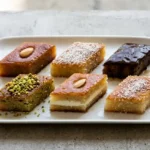
Baklava cheesecake takes everything people love about baklava (flaky buttered phyllo, spiced walnuts and pistachios, honey syrup) and sets it over a silky baked cream cheese filling. The trick is contrast. This recipe shows you how to keep the crust crisp, bake the filling gently, and add the syrup at the end, so every slice has crunch, cream, and just enough honey.
Baklava cheesecake is a baked cream cheese filling set over a crisp phyllo and nut crust, then finished with spiced nuts, honey syrup, and phyllo crisps. Bake it at 300°F (150°C) until the center reaches 160°F (71°C), chill at least six hours, and add the syrup just before serving.
Key Takeaways: Baklava Cheesecake
The best baklava cheesecake keeps three parts separate until the end: the chilled cheesecake, the crisp phyllo, and the syrup.
Brush each phyllo layer with a thin film of butter, then bake the crust until it is dry and golden before any filling touches it. A layer of ground nuts over the baked crust acts as a moisture barrier.
Beat the cream cheese smooth before adding the eggs, then mix the eggs on the lowest speed only until they disappear. This gives a dense, silky filling with fewer cracks.
Bake at 300°F (150°C) with a pan of hot water on the bottom rack. Judge doneness by an internal temperature of 160°F (71°C), the USDA minimum for egg dishes, plus set edges and a slight center ripple.
Chill for at least six hours. Spoon cooled syrup over the top only when you are ready to serve.
How This Cheesecake Borrows From Baklava
Baklava is made across the Middle East, the Balkans, and the Mediterranean, and cooks differ on the nuts and flavorings. Some use mostly pistachios, some mostly walnuts, and syrups may be scented with lemon, rose water, orange blossom water, cinnamon, or clove. This recipe uses a walnut and pistachio blend with cinnamon and a little cardamom, which sits between those styles. The fillings and the syrup are tuned to the cheesecake, not to a traditional baklava ratio, so do not expect it to taste like a tray of baklava.
Two things set it apart from a standard cheesecake. Phyllo is mostly air and starch, so it turns damp quickly if it sits under wet filling or syrup. The honey syrup is also very sweet, so the filling is kept tangy with sour cream and a restrained amount of sugar.
Ingredient Notes
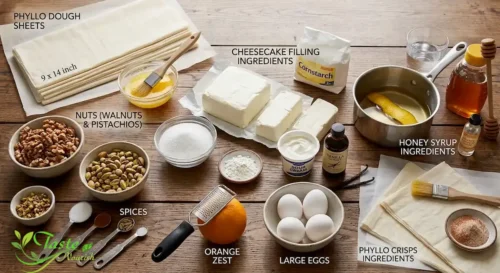
Phyllo: Thaw it in the refrigerator overnight, not on the counter, because condensation makes sheets stick together. Keep unused sheets under a damp towel while you work. This recipe assumes 9 × 14 inch (23 × 35 cm) sheets. Torn sheets are fine because they are layered.
Butter or ghee: Butter contains water and milk solids, which brown and flavor the phyllo. Ghee (clarified butter) is pure fat, so it makes a slightly crisper, nuttier crust. If you use it, a scant ½ cup (100 g) replaces the 8 tablespoons of butter.
Cream cheese: Use full-fat block cream cheese. Whipped or tub-style cream cheese contains more water and air and gives a looser filling. Reduced-fat versions are not reliable here.
Sour cream: It adds tang and tenderness that balance the honey. Full-fat plain Greek yogurt (the same weight) works, with a slightly thicker, tangier result.
Cornstarch: A small amount helps the filling set smoothly and tolerate the oven. One tablespoon of all-purpose flour can replace it, with a very slightly less silky texture.
Honey: Choose a mild honey such as clover or orange blossom. Dark honeys like buckwheat can dominate the nuts.
Orange blossom water: It is potent and strength varies by brand. Start with ¼ teaspoon in the syrup and add more only after tasting. Skip it if you dislike floral flavors.
Walnuts and pistachios: Use unsalted, shelled nuts. Pecans can replace walnuts, but the flavor becomes sweeter and less earthy. There is no reliable nut-free version of this dessert.
6 sheets phyllo dough (9 × 14 inches), thawed, plus 3 more sheets for the crisps
8 tablespoons (113 g) unsalted butter, melted, divided (6 tablespoons for the crust, 2 tablespoons for the crisps)
¾ cup (85 g) walnuts
¾ cup (90 g) unsalted shelled pistachios
3 tablespoons (38 g) granulated sugar
1 teaspoon ground cinnamon
¼ teaspoon ground cardamom
⅛ teaspoon fine salt
Cheesecake filling
24 ounces (680 g) full-fat block cream cheese, softened but still cool
¾ cup (150 g) granulated sugar
1 tablespoon (8 g) cornstarch
¼ teaspoon fine salt
½ cup (120 g) full-fat sour cream
2 teaspoons pure vanilla extract
1 teaspoon finely grated orange zest
3 large eggs, cool room temperature
Honey syrup
½ cup (100 g) granulated sugar
½ cup (120 ml) water
¼ cup (85 g) honey
1 wide strip lemon peel
1 teaspoon fresh lemon juice
¼ to ½ teaspoon orange blossom water (optional)
Phyllo crisps
3 sheets phyllo dough (from the amount above)
2 tablespoons melted butter (reserved from above)
1 tablespoon granulated sugar mixed with ¼ teaspoon ground cinnamon
Equipment
9-inch (23 cm) springform pan, at least 2½ inches (6 cm) tall
Rimmed baking sheet, plus a second one lined with parchment for the crisps
Stand mixer or hand mixer, and a rubber spatula
Food processor (or a knife and cutting board)
Pastry brush
Instant-read thermometer
Small saucepan
Metal baking pan for hot water
Instructions
1. Position one rack in the center of the oven and another on the lowest level. Heat the oven to 350°F (175°C). Lightly butter the pan and set it on a rimmed baking sheet. Spread the walnuts and pistachios on a second tray and toast them for 6 to 8 minutes, until fragrant. Cool them completely.
2. Pulse the cooled nuts with the 3 tablespoons sugar, cinnamon, cardamom, and ⅛ teaspoon salt in 6 to 8 short pulses, until the pieces are about the size of peas. Stop before the mixture turns pasty. You should have about 1¾ cups. Divide it into three portions: ¼ cup for between the phyllo layers, ¾ cup for over the baked crust, and the rest (about ¾ cup) for the top.
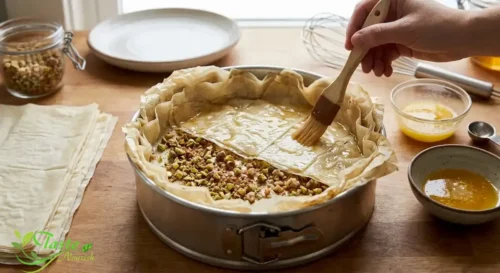
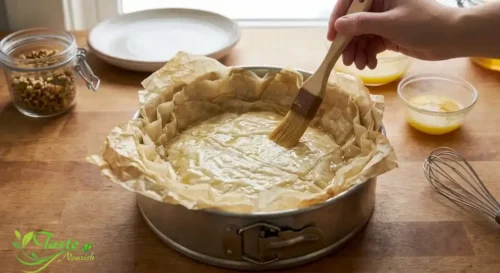
3. Cut each of the 6 crust sheets in half crosswise. Lay two halves side by side in the pan, overlapping slightly in the middle and letting the edges drape up the side. Brush lightly with butter. The coat should be thin, not pooling. Repeat with the remaining halves, staggering the overlaps, and sprinkle 2 tablespoons of the nut mixture over the second layer and again over the fourth. Brush the top layer with butter. The crust will look ragged, which is normal.
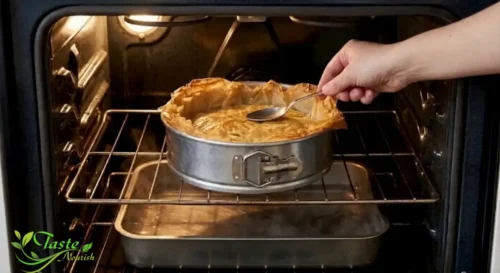
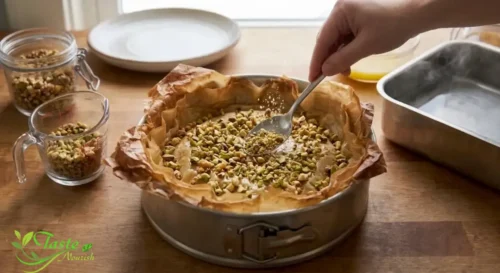
4. Bake the crust for 12 to 15 minutes, until it is dry and golden with deeper color at the edges. If the center puffs, press it down gently with the back of a spoon. Cool for 10 minutes. Reduce the oven temperature to 300°F (150°C), set a metal pan with about 3 cups (700 ml) of hot water on the lowest rack, and spread the ¾ cup nut portion evenly over the crust.
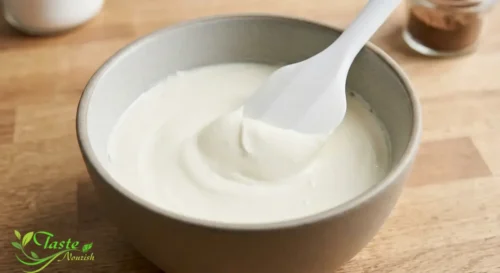
5. In a large bowl, beat the cream cheese, ¾ cup sugar, cornstarch, and ¼ teaspoon salt on low to medium speed for 1 to 2 minutes, until completely smooth with no lumps. Scrape the bowl and paddle. Add the sour cream, vanilla, and orange zest and mix for about 20 seconds.
6. Add the eggs one at a time on the lowest speed, mixing only until each one disappears into the batter. Stop as soon as the last egg is blended, then fold the batter a few times by hand. It should be thick and smooth, like soft pudding. Overmixing at this stage whips in air that rises in the oven and collapses into cracks as the cake cools.
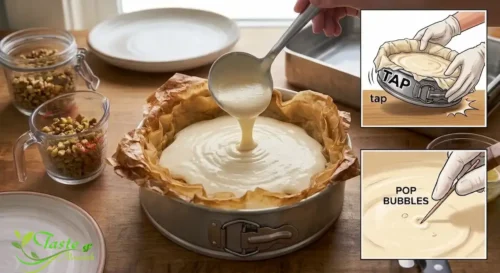
7. Pour the filling slowly over the nut layer, starting near the center so the nuts are not pushed aside. Tap the pan on the counter twice to release large air bubbles, and pop any surface bubbles with a toothpick.
8. Bake on the center rack for 70 to 90 minutes, checking at 70 minutes. The cake is done when the edges are set and matte about 2 inches (5 cm) in, the center still ripples slightly when the pan is nudged, and an instant-read thermometer in the center reads 160°F (71°C). The surface should be pale, not browned. Ovens vary, so rely on the thermometer and the visual cues, not the clock.
9. Turn off the oven, carefully remove the pan of hot water, and prop the oven door open about 1 inch (2.5 cm) with a wooden spoon. Leave the cake for 45 minutes. Move it to a wire rack and run a thin knife around the edge between the filling and the pan to free the side, so the cake can contract without tearing. Cool on the rack for about 45 minutes more, until barely warm.
10. Refrigerate the cheesecake uncovered for 1 hour, then cover it loosely and chill at least 6 hours, preferably overnight. The filling firms and the flavors settle as it chills.
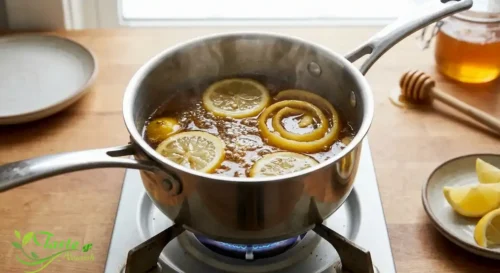
11. Make the syrup while the cake chills. Combine the ½ cup sugar, water, honey, and lemon peel in a saucepan and stir over medium heat until the sugar dissolves. Bring to a gentle simmer without stirring and cook for 8 to 10 minutes, until it thickens slightly, falls from a spoon in a thin stream, and has reduced to about ⅔ cup. Remove from the heat, discard the peel, and stir in the lemon juice. Cool to room temperature, then stir in the orange blossom water. It will thicken a little more as it cools and should pour like thin maple syrup.
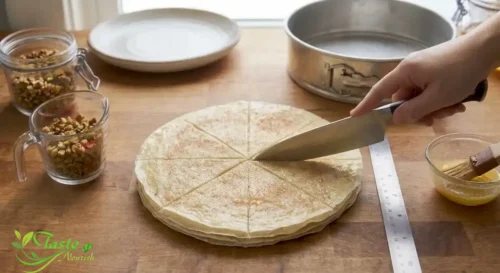
12. Make the crisps: heat the oven to 350°F (175°C). Brush each of the 3 phyllo sheets with butter and sprinkle each with some of the cinnamon sugar. Stack them, cut into 2-inch (5 cm) squares or triangles with a sharp knife or pizza cutter, and spread on the parchment-lined sheet. Bake for 8 to 12 minutes, checking at 8, until deep golden. They crisp further as they cool for 5 minutes.
13. Remove the pan ring from the chilled cheesecake. Scatter the remaining nut mixture over the top, drizzle about 5 tablespoons of the cooled syrup over the nuts, and arrange the crisps on top. Slice with a long sharp knife using a gentle sawing motion through the crust, wiping the blade between slices. Pass the remaining syrup at the table.
Notes
The crisps and syrup are meant to be added at serving. Topping the whole cake hours early is the fastest way to lose the crunch.
A very slight ripple in the center at 160°F (71°C) is normal, because the filling continues to firm as it cools and chills.
Nutrition Facts
Per slice (1/12 of the cheesecake, with about 2 teaspoons of syrup): approximately 540 calories, 39 g fat, 40 g carbohydrates, and 9 g protein. These figures are an estimate calculated from typical ingredient values, not a laboratory analysis, and they vary with brands, the amount of syrup used, and how much butter stays on the phyllo.
Why Baklava Cheesecake Turns Soggy, Cracks, or Stays Soft
Soggy crust. This happens when the crust was underbaked, the syrup went on hours before serving, or the cake was stored with the toppings on. Phyllo absorbs moisture quickly. Bake the crust until dry and golden, keep the nut layer under the filling, and add syrup and crisps only at the table. Once soaked, the crust will not fully crisp again.
Cracked top. Common causes are overmixing, overbaking, a hotter oven, or moving the cake from the oven to a cold room. Loosening the edge while it cools helps. If a crack forms anyway, the nut topping and syrup cover it well.
Greasy, heavy crust. Too much butter pools between the sheets and fries them instead of crisping them. Brush thinly and evenly. You should see the sheet through the butter.
Leathery phyllo edges. Sheets left uncovered dry out and bake tough. Keep them under a damp towel and work steadily.
Lumpy filling. Cold cream cheese leaves small bits that will not disappear once the eggs are in. Beat it smooth before adding anything else. If you see lumps after the eggs, they will remain.
Syrup too thick, thin, or crystallized. An under-simmered syrup is runny and soaks in, and an over-reduced one becomes sticky and may crystallize. Dissolve the sugar fully before simmering, avoid stirring once it boils, and keep the lemon juice. If the syrup is too thick after cooling, warm it gently with a splash of water.
Center still liquid after chilling. This means the filling did not reach 160°F (71°C) in the oven. Use the thermometer next time and check a few minutes earlier than the time suggests, since oven thermostats are often inaccurate.
From My Kitchen
I recommend baking the crust and filling a day ahead, then finishing the nuts, syrup, and phyllo crisps just before serving. Keeping those pieces separate is what keeps the top crunchy. I would also weigh the cream cheese, since weight is more consistent than package counts. Check the center with a thermometer instead of relying on the jiggle alone. Spoon the syrup on lightly. A teaspoon or two per slice lets you taste the honey without drowning the nuts.
Serving Baklava Cheesecake
Serve it cold or slightly cool. Letting the cake sit for 10 to 15 minutes before slicing softens the chill and brings out the cream cheese flavor. Do not leave it out for long: the leftovers guidance below also applies at a buffet or party table. A spoonful of plain Greek yogurt or lightly whipped, barely sweetened cream cuts the sweetness of the syrup. Strong coffee or unsweetened black tea also pairs well. Cut the crisps and nuts onto the slices as you serve, not in advance.
Baklava Cheesecake Variations
Pistachio-forward: Replace the walnuts with pistachios for a greener, milder flavor. It costs more and loses some of the earthy contrast the walnuts give.
Spiced citrus syrup: Add one cinnamon stick and two whole cloves to the syrup while it simmers and remove them with the lemon peel. Use lemon zest in the filling in place of orange zest for a sharper finish.
Mini baklava cheesecakes: You can bake the same filling in a lined muffin tin with a small phyllo cup in each well. I have not given exact times here because the bake would be much shorter and depends on the pan. Start checking at 20 minutes and use the same visual cues.
Gluten-free: Gluten-free phyllo exists, but it is generally more fragile and behaves differently, and I would not guarantee the crust texture. A baked crumb crust made with gluten-free cookie crumbs is a more predictable alternative, but it will not be baklava-like.
Storing and Freezing Baklava Cheesecake
This is a perishable egg and dairy dessert, so safety comes before texture. Refrigerate the cheesecake within two hours of baking and keep it in the refrigerator, as USDA guidance on leftovers recommends refrigerating perishable food within two hours (one hour above 90°F or 32°C) and eating refrigerated leftovers within 3 to 4 days. For the best texture, store the plain cheesecake without the syrup, extra nuts, or crisps, covered loosely once fully cold. Add the toppings to each slice as you serve it.
The crisps are best the day they are baked and soften in humid air. If they soften, a few minutes in a 300°F (150°C) oven restores much of the crunch. Keep leftover syrup in a clean covered jar in the refrigerator.
The cheesecake freezes acceptably, but not perfectly. Freeze it plain, with no syrup and no crisps. Freeze the chilled cake or individual slices on a tray until firm, then wrap tightly in plastic wrap and again in foil or an airtight container to limit freezer burn. According to USDA freezing guidance, food kept at 0°F (-18°C) stays safe, and recommended storage times relate to quality.
Thaw it in the refrigerator, which USDA identifies as the safest thawing method, not on the counter. Expect a slightly less silky filling and a softer crust, so add freshly baked crisps and fresh syrup at serving.
Baklava Cheesecake FAQs
Can I make baklava cheesecake ahead of time?
Yes. The cheesecake can be baked and chilled one to two days ahead, which keeps it well inside the refrigerated leftovers window. Make the crisps and syrup on the day you serve for the best contrast.
Do I need a water bath?
Not for this recipe. A full water bath risks leaks through the springform and wets the phyllo. A pan of hot water on the lower rack adds enough humidity to reduce cracking while keeping the crust dry.
Can I use store-bought baklava as the crust?
I would not recommend it. Finished baklava is soaked in syrup, so it makes a soft, very sweet base and adds extra moisture under the filling. Fresh buttered phyllo gives the crisp contrast the cheesecake needs.
Can I use a graham cracker crust instead?
You can, but it changes the dessert. A standard crumb crust (about 1½ cups or 150 g of crumbs mixed with 6 tablespoons of melted butter) bakes in about 10 minutes at 350°F (175°C). Keep the nut layer and the phyllo crisps if you want to hold on to the baklava character.
How do I make it less sweet?
Use less syrup instead of cutting the sugar in the filling, since the filling sugar affects texture. Serving the cake with plain yogurt or unsweetened whipped cream also helps, and the lemon juice in the syrup keeps the sweetness from tasting flat.
Can I make it nut-free?
Not in a way that still tastes like baklava. Tree nuts are central to both the flavor and the barrier layer, and they are one of the major allergens identified by the FDA. If a guest has a nut allergy, serve a different dessert instead of trying to modify this one.
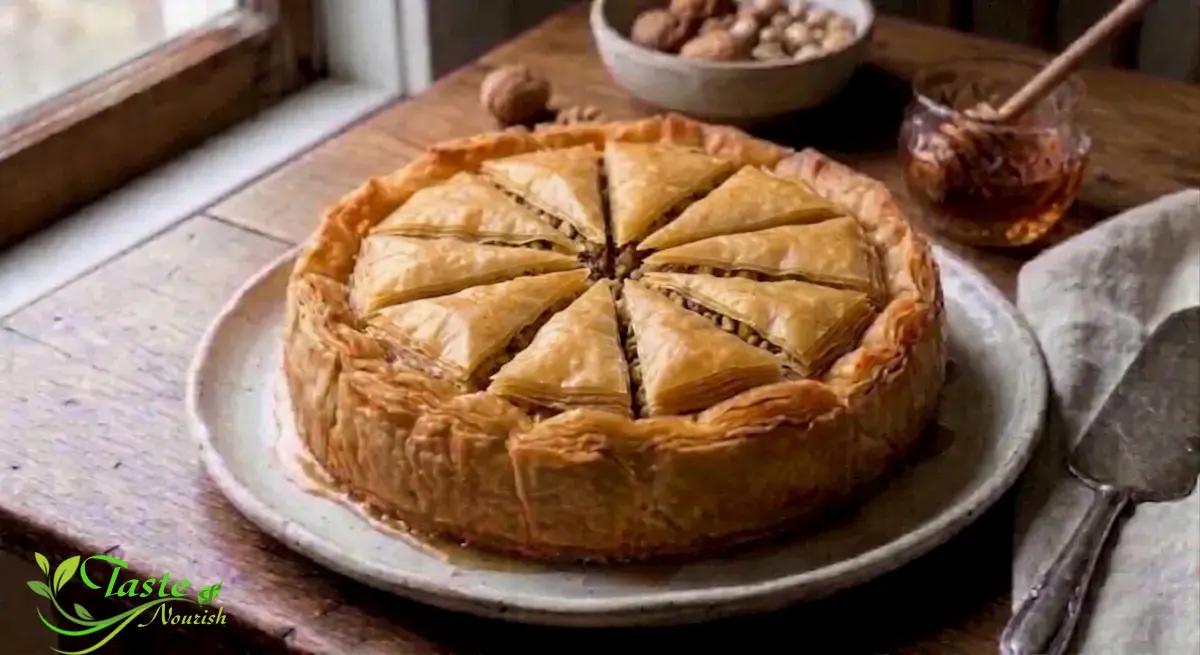
A baked cream cheese filling over a crisp phyllo and walnut-pistachio crust, finished with spiced nuts, honey syrup, and phyllo crisps.
Ingredients
6 sheets phyllo dough (9 × 14 inches), thawed, plus 3 more sheets for the crisps
8 tablespoons (113 g) unsalted butter, melted, divided (6 tablespoons for the crust, 2 tablespoons for the crisps)
¾ cup (85 g) walnuts
¾ cup (90 g) unsalted shelled pistachios
3 tablespoons (38 g) granulated sugar
1 teaspoon ground cinnamon
¼ teaspoon ground cardamom
⅛ teaspoon fine salt
24 ounces (680 g) full-fat block cream cheese, softened but still cool
¾ cup (150 g) granulated sugar
1 tablespoon (8 g) cornstarch
¼ teaspoon fine salt
½ cup (120 g) full-fat sour cream
2 teaspoons pure vanilla extract
1 teaspoon finely grated orange zest
3 large eggs, cool room temperature
½ cup (100 g) granulated sugar, for the syrup
½ cup (120 ml) water
¼ cup (85 g) honey
1 wide strip lemon peel
1 teaspoon fresh lemon juice
¼ to ½ teaspoon orange blossom water (optional)
1 tablespoon granulated sugar mixed with ¼ teaspoon ground cinnamon, for the crisps
Directions
Position one rack in the center of the oven and another on the lowest level. Heat the oven to 350°F (175°C). Lightly butter the 9-inch springform pan and set it on a rimmed baking sheet. Spread the walnuts and pistachios on a second tray and toast them for 6 to 8 minutes, until fragrant. Cool them completely.
Pulse the cooled nuts with 3 tablespoons sugar, cinnamon, cardamom, and ⅛ teaspoon salt in 6 to 8 short pulses, until the pieces are about the size of peas. Stop before the mixture turns pasty. Divide it into three portions: ¼ cup for between the phyllo layers, ¾ cup for over the baked crust, and the rest (about ¾ cup) for the top.
Cut each of the 6 crust sheets in half crosswise. Lay two halves side by side in the pan, overlapping slightly in the middle and letting the edges drape up the side. Brush lightly with butter. Repeat with the remaining halves, staggering the overlaps, and sprinkle 2 tablespoons of the nut mixture over the second layer and again over the fourth. Brush the top layer with butter.
Bake the crust for 12 to 15 minutes, until dry and golden. If the center puffs, press it down gently with the back of a spoon. Cool for 10 minutes. Reduce the oven temperature to 300°F (150°C), set a metal pan with about 3 cups (700 ml) of hot water on the lowest rack, and spread the ¾ cup nut portion evenly over the crust.
Beat the cream cheese, ¾ cup sugar, cornstarch, and ¼ teaspoon salt on low to medium speed for 1 to 2 minutes, until completely smooth with no lumps. Scrape the bowl and paddle. Add the sour cream, vanilla, and orange zest and mix for about 20 seconds.
Add the eggs one at a time on the lowest speed, mixing only until each one disappears into the batter. Stop as soon as the last egg is blended, then fold the batter a few times by hand. It should be thick and smooth, like soft pudding.
Pour the filling slowly over the nut layer, starting near the center. Tap the pan on the counter twice to release large air bubbles, and pop any surface bubbles with a toothpick.
Bake on the center rack for 70 to 90 minutes, checking at 70 minutes. The cake is done when the edges are set and matte about 2 inches (5 cm) in, the center still ripples slightly when the pan is nudged, and an instant-read thermometer in the center reads 160°F (71°C).
Turn off the oven, carefully remove the pan of hot water, and prop the oven door open about 1 inch (2.5 cm). Leave the cake for 45 minutes. Move it to a wire rack and run a thin knife around the edge to free the side. Cool on the rack for about 45 minutes more, until barely warm.
Refrigerate the cheesecake uncovered for 1 hour, then cover it loosely and chill at least 6 hours, preferably overnight.
Make the syrup: combine ½ cup sugar, water, honey, and lemon peel in a saucepan and stir over medium heat until the sugar dissolves. Bring to a gentle simmer without stirring and cook for 8 to 10 minutes, until slightly thickened and reduced to about ⅔ cup. Remove from the heat, discard the peel, and stir in the lemon juice. Cool to room temperature, then stir in the orange blossom water if using.
Make the crisps: heat the oven to 350°F (175°C). Brush each of the 3 phyllo sheets with butter and sprinkle each with cinnamon sugar. Stack them, cut into 2-inch (5 cm) squares or triangles, and spread on a parchment-lined sheet. Bake for 8 to 12 minutes, checking at 8, until deep golden. Cool for 5 minutes.
Remove the pan ring from the chilled cheesecake. Scatter the remaining nut mixture over the top, drizzle about 5 tablespoons of the cooled syrup over the nuts, and arrange the crisps on top. Slice with a long sharp knife using a gentle sawing motion through the crust, wiping the blade between slices. Pass the remaining syrup at the table.
Final Thoughts on Baklava Cheesecake
A baklava cheesecake succeeds or fails on contrast. The filling should stay cool and silky, and the crust and crisps should stay crunchy. The syrup should add sweetness without making either one wet. If this is your first time making it, bake the cheesecake a day ahead and treat the syrup, nuts, and crisps as a quick finish at the table.
After one batch, you will know whether you prefer more syrup, a stronger orange blossom note, or a pistachio-heavy topping, and each of those is easy to adjust without touching the structure of the cake.
**Hanan Abo Samra** shares practical cooking insights, delicious recipes, and evidence-based nutrition information. Drawing on more than 20 years of hands-on cooking experience, she creates helpful food content that combines everyday cooking knowledge with information from reliable scientific sources. Her goal is to help readers better understand the foods they eat, explore their nutritional benefits, and prepare delicious meals with confidence.