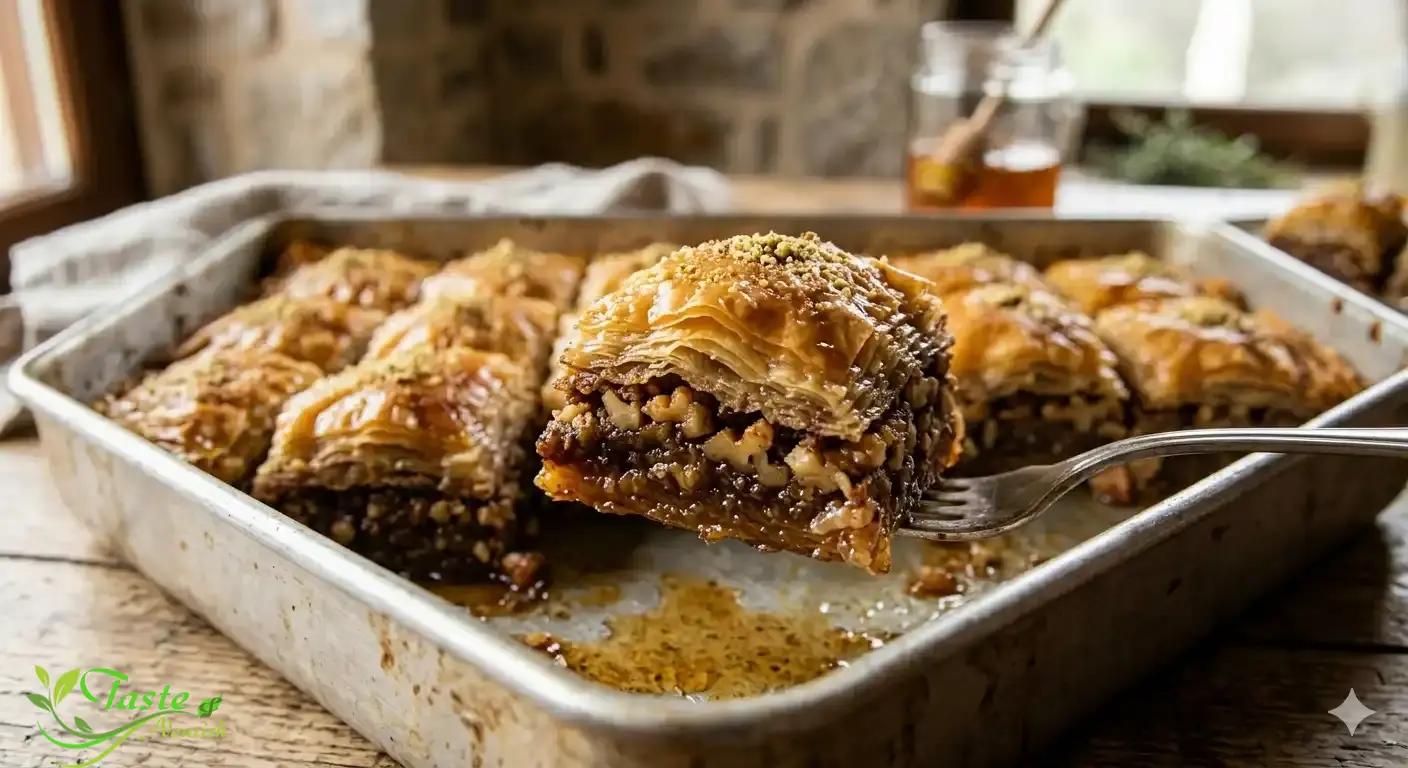
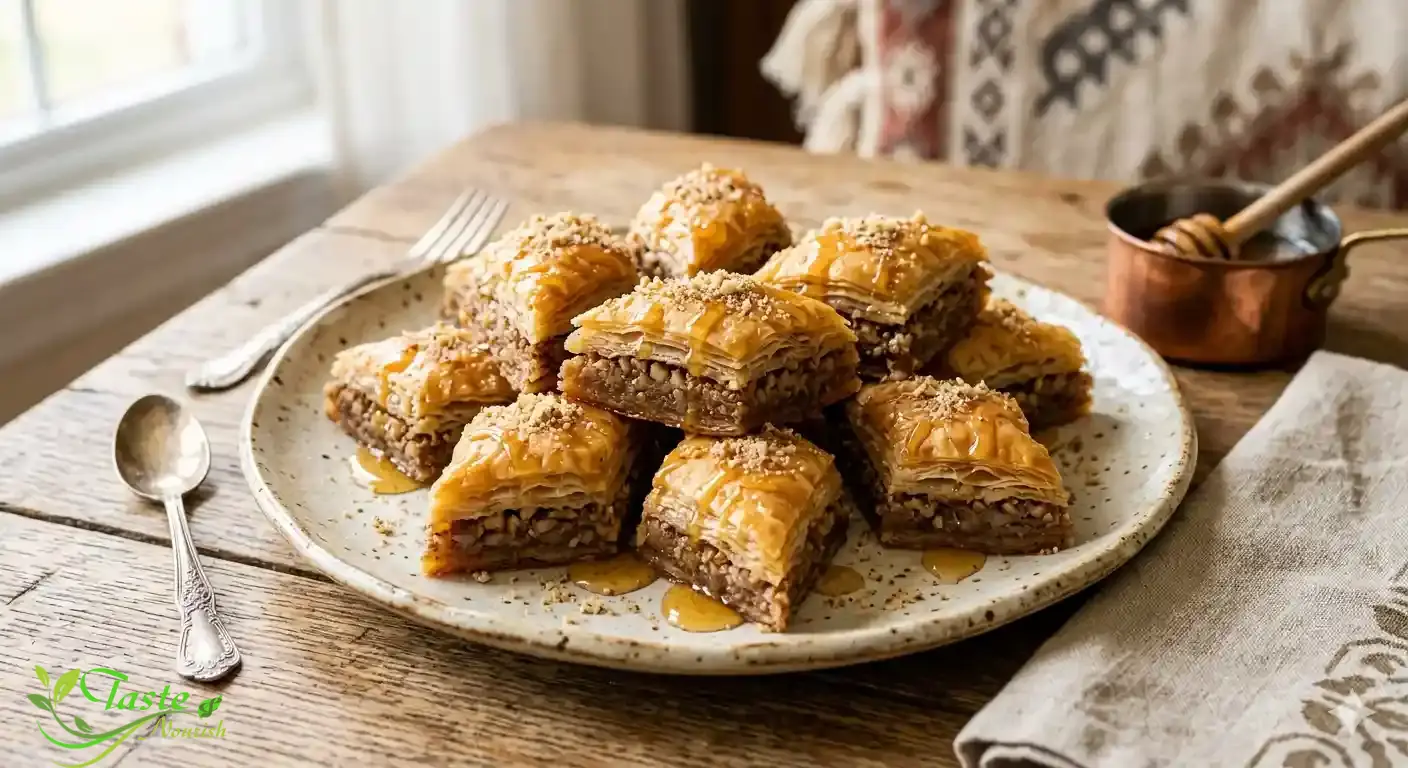
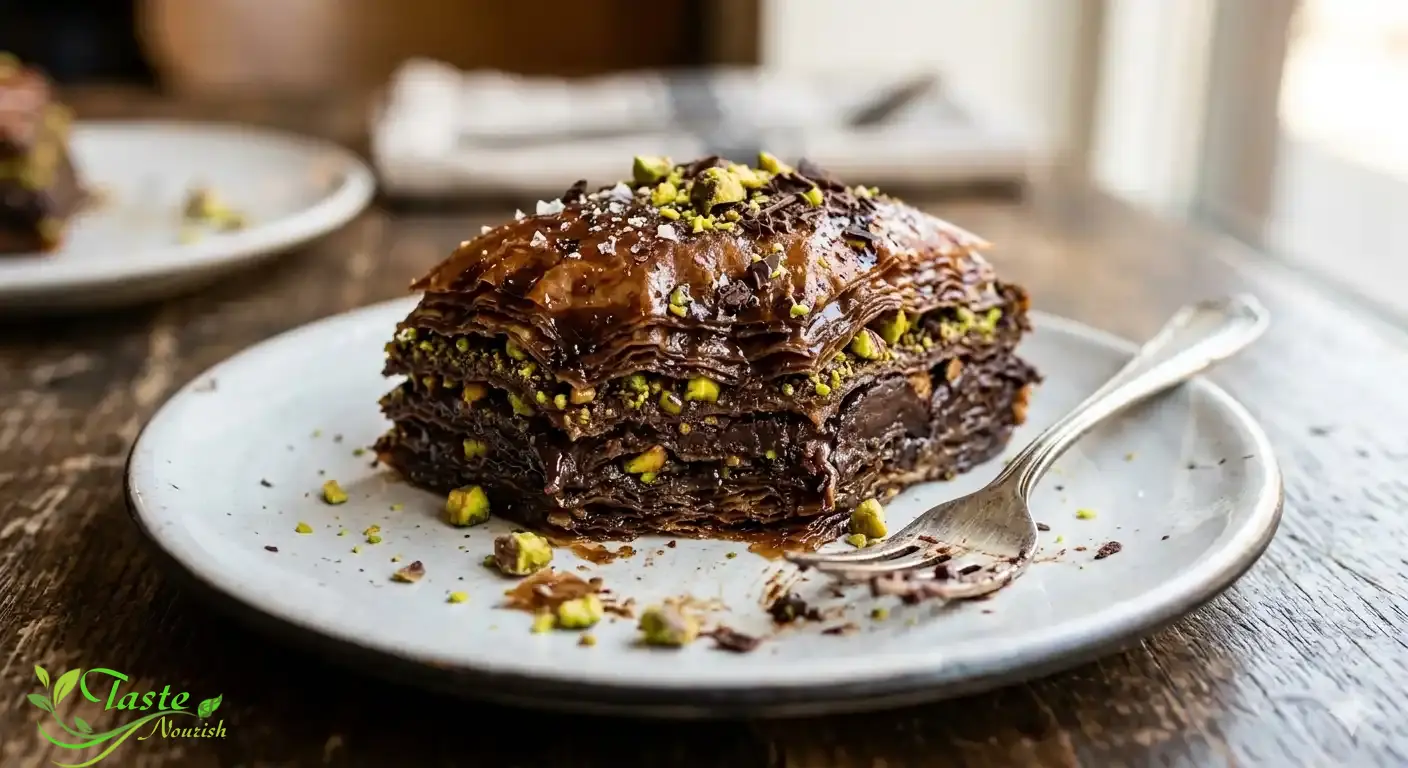
If there is one dessert that carries centuries of history, culture, and sheer indulgence in every single bite, it is Greek baklava. Picture this: impossibly thin layers of golden phyllo pastry, stacked high with crushed walnuts kissed by cinnamon and cloves, all drenched in a fragrant, amber-colored honey syrup. It’s the kind of dessert that makes your eyes close involuntarily on the first bite. Whether you’ve tasted it at a Greek festival, stumbled upon it in an Athenian bakery, or are simply dreaming of making it at home, this guide covers absolutely everything you need to know — from its ancient origins to its most closely guarded baking secrets.
What Is Greek Baklava?
Greek baklava is a traditional layered pastry dessert made from thin sheets of phyllo dough, a spiced walnut filling, clarified butter, and a generous pour of honey-lemon syrup. Greeks categorize baklava under the broad family of desserts called Siropiasta — syrupy sweets that are deeply beloved in Greek cuisine. This is a dessert that belongs to festive tables, family gatherings, name day celebrations, and Easter feasts. It is rich, sticky, aromatic, and deeply satisfying in the way that only food rooted in centuries of tradition can be.
What separates Greek baklava from its many regional cousins is not just a recipe — it is a whole philosophy of sweetness. The classic Greek baklava recipe relies on three core ingredients: filo dough, walnuts, and honey syrup. There are no shortcuts, no rosewater, no pistachio detours (unless you’re getting creative), just an honest, bold dessert that has been perfected over generations. The layers are generous, the syrup is thick and fragrant, and the result is something that is simultaneously crunchy, chewy, sticky, and melt-in-your-mouth tender — all at once.
Essential Ingredients for Authentic Greek Baklava
Before you start layering and buttering, let’s talk ingredients. The quality of your baklava is directly proportional to the quality of what you put into it. This isn’t a dessert where you can substitute powdered honey, pre-ground walnuts, or margarine and expect a good result. Here’s what you need, and why each component matters.
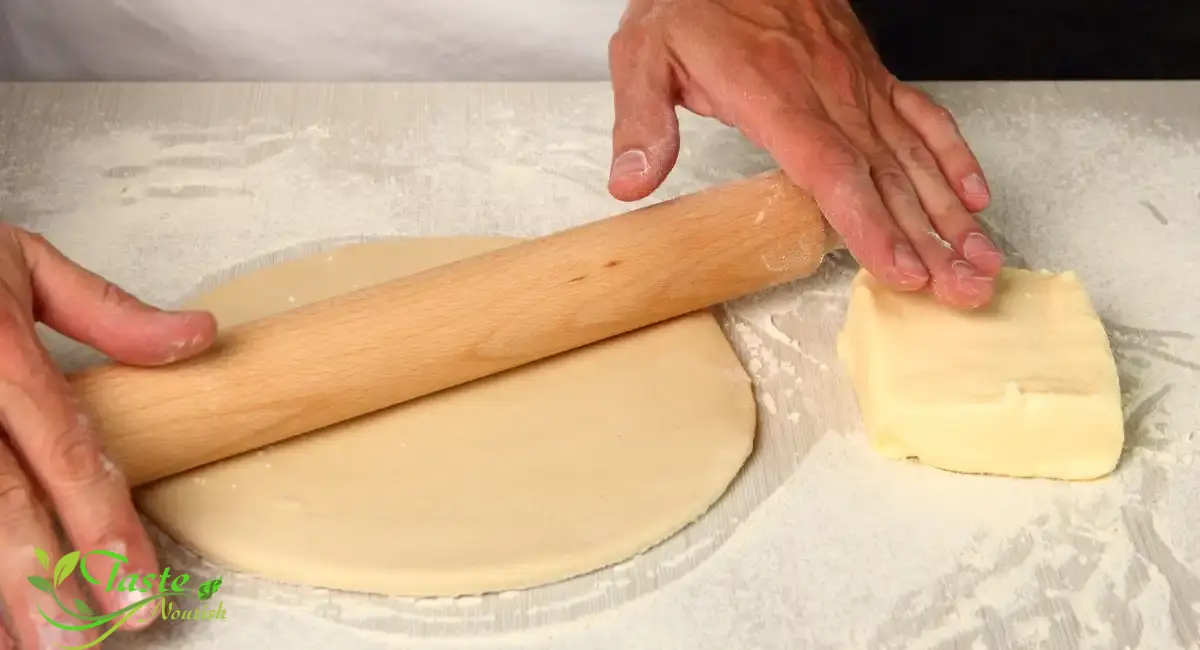
Phyllo dough (also spelled filo) is the foundation of baklava — those impossibly thin, translucent sheets that crisp up in the oven like delicate golden leaves. Phyllo dough can typically be found in the freezer section of most grocery stores, and it must be thawed overnight in the fridge before using. One of the most important skills in baklava-making is handling phyllo without it drying out and cracking.
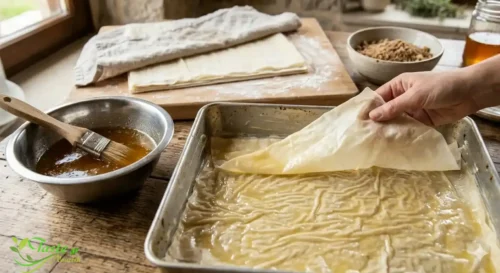
It dries incredibly fast once exposed to air, so the standard trick is to keep unused sheets covered under a clean, slightly damp kitchen towel while you work with the rest. For the most authentic result, extra-thin phyllo is recommended — the nearly transparent kind that has approximately 15–16 sheets per pound. The thinner the sheet, the more delicate and crispy the final layers will be.
The Nut Filling — Walnuts and Beyond
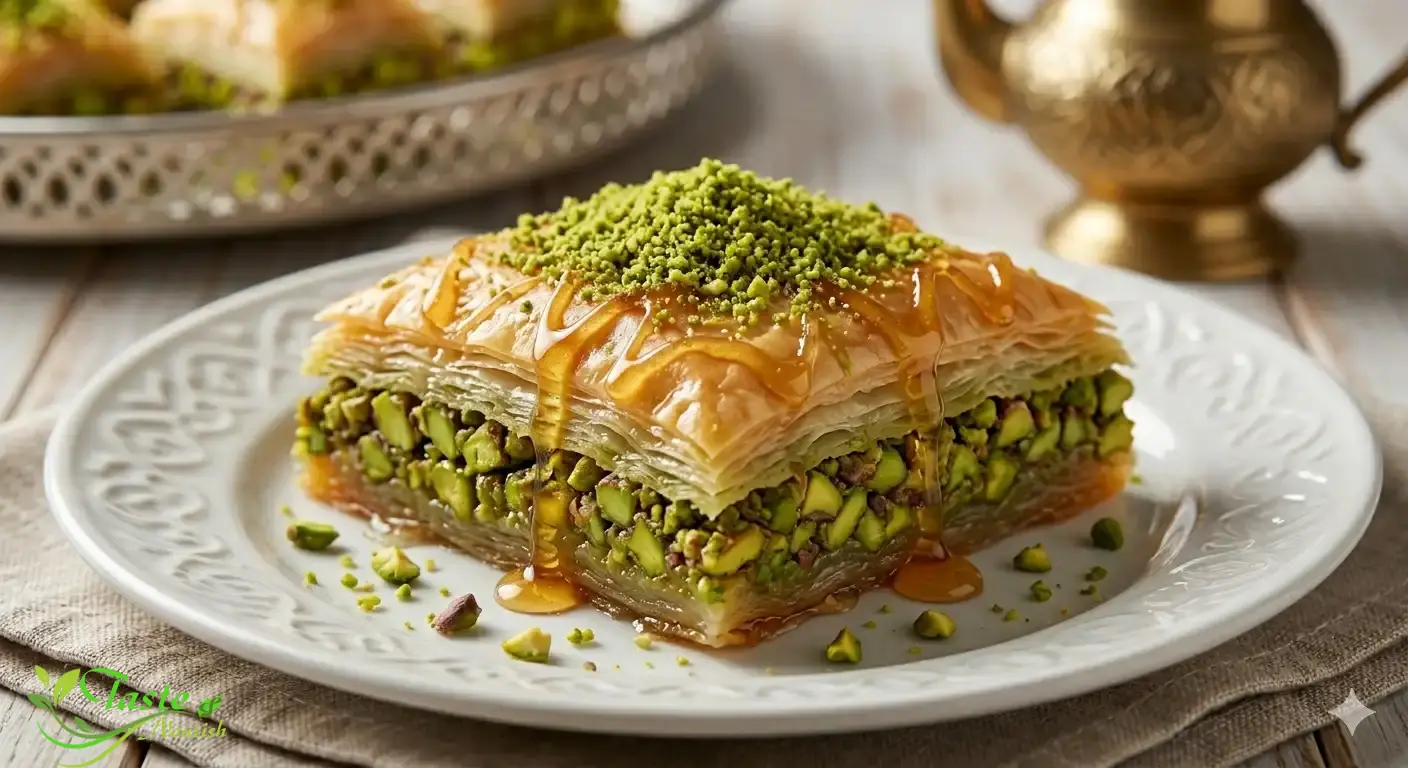
The main nuts used in Greek baklava are walnuts, which serve as the filling of choice — as opposed to the pistachios more commonly associated with Turkish, Iranian, and Lebanese versions. Walnuts bring a slightly bitter, earthy richness that pairs beautifully with the sweetness of honey. They’re coarser in texture than pistachios, which gives each bite a more substantial, almost hearty crunch.
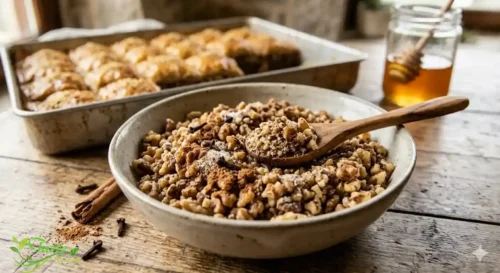
Some Greek recipes also incorporate almonds into the mix for added texture and a lighter, slightly sweet nuttiness. Ground cinnamon and cloves are key flavorings in the nut mixture, infusing the dessert with warmth and depth that give Greek baklava its distinctive flavor profile.
Choosing the Right Butter
This is where many home bakers unknowingly shortchange themselves. Butter is not just a lubricant between phyllo sheets — it’s a flavor agent. For the most authentic Greek baklava, clarified butter or ghee is ideal; in Greece, sheep and goat butter that’s already clarified is the traditional choice.
Regular salted butter works perfectly well for home baking and is widely used across modern Greek recipes. The key is that you need a lot of it, applied generously and consistently to every single sheet. There are no shortcuts here. Under-buttered phyllo won’t crisp up properly, and it won’t have that golden, caramelized color that makes baklava so visually stunning.
Here’s a quick comparison of the key ingredients in Greek baklava vs. other regional styles:
Feature
Greek Baklava
Turkish Baklava
Lebanese Baklava
Primary Nut
Walnuts (+ almonds)
Pistachios
Walnuts or pistachios
Syrup Base
Honey + lemon
Sugar + lemon
Sugar + orange blossom
Spices
Cinnamon + cloves
Minimal
Minimal or rosewater
Butter Type
Clarified/regular butter
Clarified butter
Clarified butter
Phyllo Layers
33 (symbolic)
~26
Varies
Sweetness Level
High
Medium-high
Medium
Shape
Diamond/square
Diamond
Various
How to Make Greek Baklava: Step-by-Step
Making homemade Greek baklava is one of those kitchen projects that looks intimidating but is actually very approachable once you break it into parts. You’re essentially doing three things:
making a spiced nut filling, layering phyllo with butter, and making a honey syrup. None of these steps are technically difficult — they just require patience and attention. Let’s walk through it.
Recipe Instructions:
“Preheat oven to 180°C. Melt butter and grease baking dish.”
“Mix chopped walnuts, sugar, cinnamon, and cloves in a bowl.”
“Layer one-third of phyllo sheets, brushing each with melted butter.”
“Sprinkle half the nut mixture, add another third of buttered phyllo sheets.”
“Add remaining nut mixture and finish with final third of buttered phyllo.”
“Cut into diamond shapes, bake 1 hour until golden brown.”
“Boil syrup ingredients 10 minutes. Cool completely, then pour over hot baklava.”
Preparing the Nut Mixture
Start by roughly chopping your walnuts. You want them chunky enough to give texture but fine enough to spread evenly between layers. Make sure the walnuts are finely crushed for even distribution throughout the layers — too coarse and they’ll tear the delicate phyllo dough. Combine your chopped walnuts with ground cinnamon and ground cloves, and a small amount of sugar.
The standard ratio for the filling is approximately 3 cups of chopped walnuts combined with ground cinnamon, ground cloves, and 1 cup of sugar, mixed together until evenly distributed. Some bakers add a tablespoon of fine breadcrumbs to the mixture — this is a traditional trick that helps absorb excess butter and keeps the filling from becoming greasy during baking.
Layering and Baking
This is where the magic happens, and where your patience will be rewarded. Start by melting your butter and lightly greasing your baking dish, then layer one-third of the phyllo sheets into the pan, brushing each individual sheet with melted butter before adding the next. Then add half your nut mixture. Layer the next third of the phyllo, again buttering every single sheet, then add the remaining nuts.
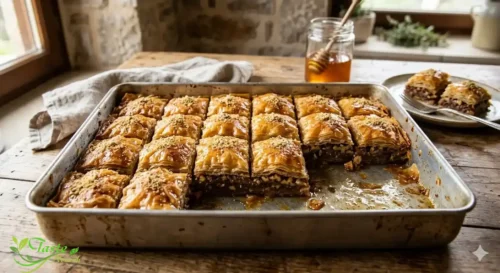
Finish with the final third of your phyllo sheets, all buttered, then pour any remaining melted butter over the top. Before baking, cut through all the layers with a sharp knife into diamond or square shapes — this is critical, as trying to cut baked baklava cleanly is a nightmare. Bake in a 180°C (350°F) preheated oven for approximately 1 hour, or until the top is beautifully golden brown.
Making the Honey Syrup
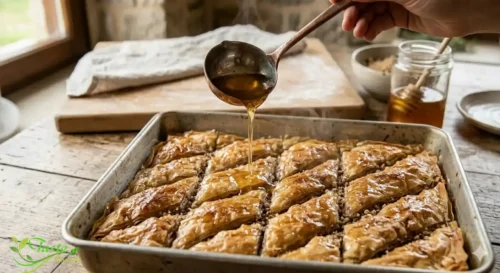
While your baklava is baking, prepare the syrup so it has time to cool. Combine water, sugar, honey, lemon juice, and a cinnamon stick in a small saucepan, bring to a boil, and simmer for about 10 minutes until the syrup becomes slightly sticky. The lemon juice is not just a flavoring — it prevents crystallization in the syrup, keeping it glossy and pourable.
Once the syrup is done, let it cool completely. When your baklava comes out of the oven, pour the cooled syrup evenly over the entire hot pan. You’ll hear it sizzle and hiss as the syrup seeps into those hot, golden layers — one of the most satisfying sounds in all of cooking. Let the baklava rest and soak for at least 4 hours (overnight is even better) before serving.
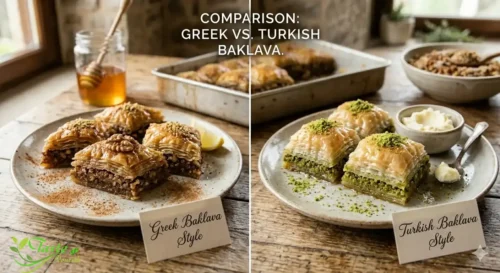
Greek Baklava vs. Turkish Baklava
The Greece-vs-Turkey baklava debate is one that no dinner table can survive unscathed, and it deserves a proper examination.
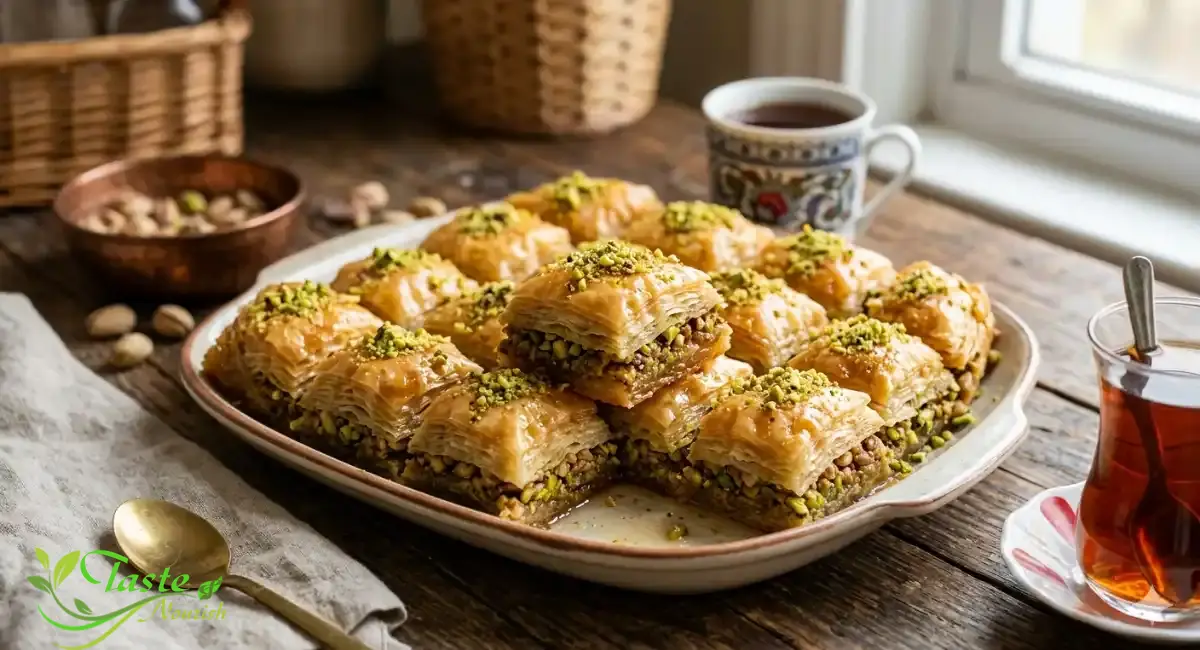
Turkish baklava is made using a sugar-based syrup, which is usually mixed with rose or orange blossom water, bringing a floral note to the scent and taste —
while Greek baklava uses honey enhanced with cloves, cinnamon, and sometimes vanilla, providing a warm, aromatic sweetness.
These are fundamentally different flavor profiles:
Turkish baklava is lighter, more delicate, and almost architectural in its precision; Greek baklava is richer, stickier, and bolder.
Turkish baklava ordinarily uses a light neutral oil, while Greek baklava is typically made with melted butter, which contributes to its richer taste and taller profile. The shape also differs:
Greek baklava is made in square or rectangular pans and cut into squares or diamonds, while Turkish baklava is often made in round pans.
The clove in each piece of Greek baklava serves a dual purpose — as a symbolic garnish and as a structural pin that holds each piece together during cutting, making the finished product considerably taller than the Turkish version.
Neither version is objectively “better” — they’re simply different expressions of the same ancient idea, adapted by two cultures with their own magnificent culinary souls.
Pro Tips for Perfect Greek Baklava Every Time
Even experienced bakers run into trouble with baklava. Here are the most important insider tips that separate a good baklava from a truly great one.
Keep your phyllo covered. The moment phyllo sheets are exposed to air, they begin to dry and crack. Work quickly and always keep the unused portion of your dough covered with a slightly damp towel. A torn sheet doesn’t ruin baklava — just patch it and keep going — but dried, crumbly sheets are much harder to work with.
Don’t skimp on the butter. Every layer of phyllo needs butter. Every. Single. One. This is not the place for calorie-counting. The butter is what makes the layers separate, crisp, and golden. Use a pastry brush and coat each sheet generously, right to the edges.
Always cut before baking. Pre-cutting your baklava before it goes in the oven is non-negotiable. Cut into diamond shapes, cutting all the way through to the base before baking. Trying to cut fully baked baklava shatters the top layers and creates a mess. A sharp knife and a firm hand are all you need.
Hot baklava + cool syrup. The rule is hot baklava paired with cool syrup — this contrast keeps the phyllo dough from turning soggy while still ensuring proper absorption. If your syrup is still warm when your baklava comes out of the oven, let it cool down before pouring.
Let it rest overnight. Freshly poured baklava is good. Overnight-rested baklava is extraordinary. Giving it 8–12 hours allows the syrup to penetrate every layer completely, resulting in that intensely rich, evenly soaked texture that Greek baklava is famous for.
Storing and Serving Greek Baklava
One of the genuine joys of making Greek baklava at home is that it keeps beautifully without refrigeration — in fact, refrigerating it is usually a mistake. Cold temperatures cause the butter to harden and the syrup to crystallize, making the texture stiff and less enjoyable. Store your baklava at room temperature, covered loosely with foil or in an airtight container, and it will remain delicious for up to two weeks. Some bakers claim it actually tastes better on day three or four, once the flavors have fully developed and the syrup has settled.
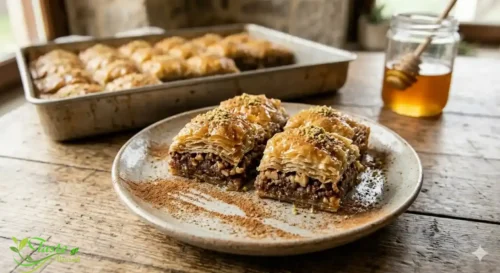
When it comes to serving, baklava is traditionally cut into small diamond or square pieces, since it’s extremely rich and a little goes a long way. Serve it alongside strong Greek coffee (ellinikos kafes) or a cup of mint tea — the bitterness of the coffee cuts through the sweetness of the honey beautifully.
For a more contemporary presentation, a small scoop of vanilla ice cream alongside a warm piece of baklava creates a stunning contrast of temperatures and textures. If you’re serving it at a party, arrange the pieces on a tray lined with parchment paper and dust lightly with ground cinnamon — the presentation alone will make guests reach for a piece before you’ve even set the tray down.
Why Greek Baklava Is in a League of Its Own
Ask any Greek grandmother and she’ll tell you — without blinking — that her baklava is the best thing you will ever eat. And she’s probably right. But beyond family pride, there are real, tangible reasons why authentic Greek baklava stands apart from every other version of this pastry. It comes down to three things: the honey, the spices, and the tradition.
Greek baklava stands out for its simplicity and rich flavor. Unlike other regional versions that may use rosewater or cardamom, Greek baklava typically features phyllo dough, chopped walnuts, cinnamon, and a lemony honey syrup poured over the crispy layers after baking. That simplicity is actually what makes it so extraordinary.
When you work with fewer ingredients, each one has to be exceptional — and in Greek baklava, every component carries weight. The honey needs to be good-quality and fragrant. The walnuts need to be fresh and nutty. The phyllo needs to be paper-thin and perfectly buttered. There’s nowhere to hide.
The Role of Honey in Greek Baklava
Honey isn’t just a sweetener in Greek baklava — it’s the soul of the dish. Greek baklava uses honey that is often enhanced with cloves, cinnamon, or vanilla, which provides a warm, aromatic sweetness throughout the dessert.
Greek honey, particularly thyme honey from the islands or pine honey from northern Greece, has a complexity and floral depth that ordinary grocery store honey simply cannot replicate. If you want to make truly authentic Greek baklava, sourcing a quality Greek honey is one of the best investments you can make. Think of it the way an Italian chef thinks about olive oil — it’s not a background note, it’s the whole melody.
The way honey syrup is applied to Greek baklava is also crucially important, and there’s a golden rule that every Greek home baker knows by heart: pour cool syrup over hot baklava, or hot syrup over cool baklava.
This contrast ensures that the phyllo dough absorbs the syrup properly without becoming soggy. Mess this up and you’ll end up with a beautiful disaster — soggy layers that fall apart the moment you try to lift a piece. Get it right, and each layer absorbs the syrup slowly, creating that perfectly moist-yet-crispy texture that makes baklava so irresistible.
The Spiritual Significance of 33 Layers
It might surprise people outside Greece to learn that making baklava is, in some ways, a spiritual act. The number of phyllo sheets is not arbitrary. Traditional Greek baklava layers precisely 33 sheets of filo inside — each representing a year of Jesus Christ’s life. For deeply religious Greek Orthodox families, baking baklava for Easter or Christmas isn’t just cooking — it’s a form of devotion.
The clove pressed into the top of each diamond-shaped piece symbolizes the nails of the cross. Even the cutting pattern carries meaning: those distinctive diamond shapes are the most common in Greek baklava, and they’re not just aesthetic — they make portioning ceremonially easy.
This religious and cultural symbolism elevates Greek baklava beyond a simple dessert and into the realm of heritage food. This symbolic detail reinforces baklava’s role in Greek religious and cultural celebrations rather than everyday indulgence.
You won’t typically find Greeks eating baklava on a random Tuesday evening. It shows up at Easter, Christmas, weddings, baptisms, and name day feasts — always present, always anticipated, always the centerpiece of the dessert table.
The Ancient Roots of Baklava
One of the most passionately debated questions in the culinary world is: who invented baklava? Greeks and Turks have been arguing over this for decades, and honestly, both sides have compelling cases. Many food historians believe that it was the Greeks who invented the phyllo (or filo) pastry dough that forms the foundation of baklava today. The argument traces back to ancient Greece, where a dessert called gastrin — a layered sweet made from nuts and honey sandwiched between thin dough — was prepared as early as the second century BC. Think of it as baklava’s great-great-grandmother.
Some culinary historians argue that the recipe was later adopted and transformed by the Turkish people, who refined it into the form we recognize today. The Ottoman Empire, which sprawled across Greece, Turkey, and much of the Middle East for centuries, was essentially the great melting pot of baklava culture.
Ingredients, techniques, and traditions flowed freely across borders, and baklava evolved differently in each region it touched. The most balanced perspective is that Turkey can reasonably claim that the modern form of baklava was perfected in Ottoman kitchens, while Greece can equally claim that baklava became deeply embedded in Greek culinary and religious traditions, developing its own distinct identity and flavor profile. Rather than fighting over ownership, we should perhaps just be grateful the dessert exists.
How Greek Baklava Differs From Other Versions
Walk into a bakery in Istanbul, Beirut, and Athens and you’ll find three entirely different desserts wearing the same name. The differences are subtle but meaningful. Unlike Turkish and Arabic baklava, which typically use a simple sugar syrup, Greek baklava is drenched in a rich syrup made from honey, cinnamon, and cloves — imparting a deep, spiced flavor that is uniquely Greek.
Turkish baklava tends to be lighter, more refined, and precision-focused, with a thin sugar syrup. Lebanese baklava leans into floral notes with orange blossom water. Greek baklava, by contrast, is bold, aromatic, and unapologetically sweet — honey is the star, and it doesn’t hide.
The Greek version is traditionally made with 33 phyllo sheets, representing the 33 years of Christ’s life, with a clove placed on top of each piece to symbolize the cross. That’s not just a recipe instruction — that’s a spiritual statement baked into a dessert.
Around Lent, Greek bakers sometimes increase the layers to 40, aligning with the 40 days of fasting. This level of symbolic meaning embedded in a pastry is something few desserts in the world can claim. It transforms Greek baklava from mere food into a cultural artifact.
Conclusion
Greek baklava is far more than a dessert — it is a window into centuries of Mediterranean history, Orthodox tradition, and culinary mastery. From its possible ancient roots in the gastrin of ancient Greece to the lovingly maintained recipes passed down in Greek households today, this extraordinary pastry has endured because it speaks a universal language: indulgent sweetness, warmth, and the pleasure of sharing food with people you love.
The combination of shatteringly crisp phyllo, spiced walnut filling, and fragrant honey syrup creates something that no other dessert in the world quite replicates. Whether you make it at home following the traditional 33-layer method or discover it for the first time at a Greek festival, Greek baklava deserves every bit of the reverence it receives. Make it once, make it properly, and it will become one of the most requested recipes in your repertoire.
Greek Baklava FAQs
What makes Greek baklava different from Turkish baklava?
Greek baklava uses walnuts and a honey-lemon syrup spiced with cinnamon and cloves, while Turkish baklava typically features pistachios and a lighter sugar-based syrup. Greek baklava is also traditionally made with 33 phyllo layers for religious symbolism, uses butter rather than oil, and tends to be richer and stickier in texture.
Can I use pistachios instead of walnuts in Greek baklava?
You can, though walnuts are the most traditional and authentic choice for Greek-style baklava. Some Greek recipes do incorporate almonds alongside walnuts for added texture. Pistachios are more commonly associated with Turkish and Middle Eastern versions of the dessert.
How long does homemade Greek baklava stay fresh?
Stored at room temperature in an airtight container, Greek baklava stays fresh and delicious for up to two weeks. Avoid refrigerating it, as the cold causes the butter to harden and the syrup to crystallize, negatively affecting the texture.
What is the secret to crispy baklava that doesn’t get soggy?
The key is always pouring cool syrup over hot baklava (or hot syrup over completely cool baklava). This temperature contrast allows proper syrup absorption without making the phyllo layers soggy. Also, butter every single phyllo sheet generously and cut the baklava before baking, not after.
Is Greek baklava served warm or cold?
Greek baklava is traditionally served at room temperature. It can be enjoyed slightly warm right after baking, but most Greeks agree it reaches its best flavor and texture after resting overnight, once the syrup has fully penetrated all the layers.
Hanan Abo Samra is the founder of Taste & Nourish, sharing trustworthy nutrition guidance and recipes drawn from 20+ years of hands-on cooking experience. When she's not developing new recipes, Hanan is researching the science behind everyday ingredients to bring readers practical, evidence-based guidance for a healthier lifestyle.