
Types of Cinnamon Explained: 4 Main Kinds Made Simple
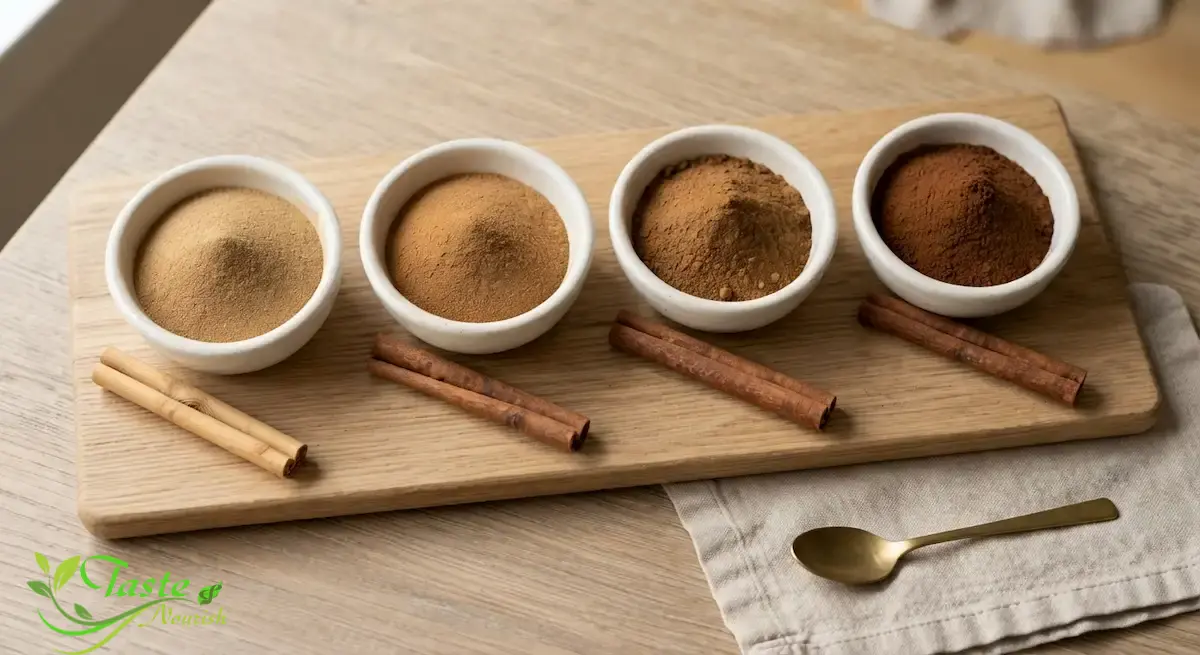
Walk down the spice aisle and every jar says “cinnamon,” but the bark inside can come from several different trees, with different flavor, price, and coumarin content. Knowing which one you are holding changes how much you use and what you use it for. These are the types of cinnamon explained in plain kitchen terms.
Most home cooks never need to buy more than two jars. The trick is knowing which two, and why a recipe that works with one can taste flat or harsh with another.
Quick Answer
The types of cinnamon explained simply: there are two groups. Ceylon cinnamon (Cinnamomum verum, “true” cinnamon, from Sri Lanka) is mild and low in coumarin. Cassia is the stronger, spicier group, and it includes Chinese cassia, Indonesian (Korintje) cassia, and Saigon (Vietnamese) cinnamon. Saigon is a type of cassia, not a separate category. Cassia is the type most commonly sold in the US, so an unlabeled jar of “cinnamon” is almost certainly cassia. Use cassia or Saigon for bold baking, and Ceylon when you use cinnamon in larger amounts every day.
What You Need to Know Before You Buy
Cinnamon is the dried bark of various Cinnamomum trees. The National Center for Complementary and Integrative Health (NCCIH) describes the main split: Ceylon cinnamon, grown primarily in Sri Lanka, and cassia cinnamon, grown in southeastern Asia and the most common type sold in North America. NCCIH lists the cassia tree under two Latin names, C. aromaticum and C. cassia, so you will see both.
The practical differences come down to three things: how strong the flavor is, how much coumarin the bark contains, and whether the label tells you what you are getting. This article covers all three. For what research says about cinnamon and health, see our guide to the health benefits of cinnamon.
Types of Cinnamon Explained at a Glance
| Type | Also called | Botanical name | Main source | Group | Flavor (general description) |
|---|---|---|---|---|---|
| Ceylon | True cinnamon, Sri Lanka cinnamon | Cinnamomum verum | Sri Lanka | Ceylon | Mild, delicate, subtle |
| Cassia (Chinese) | Chinese cinnamon | C. cassia (also C. aromaticum) | China and southeastern Asia | Cassia | Bold, spicy, the “classic” American cinnamon taste |
| Korintje | Indonesian cinnamon, Padang cassia | C. burmannii | Indonesia | Cassia | Strong but a little smoother |
| Saigon | Vietnamese cinnamon, Vietnamese cassia | C. loureiroi | Vietnam | Cassia | The most intense of the common types |
The flavor column is a general description, not a measurement. Intensity varies by harvest, grind, and how old the jar is. Botanical references such as Wikipedia’s cinnamon entry list Indonesian, Chinese, and Saigon cinnamon together as the cassia species, which is why the “Group” column puts three of the four types in one family.
The Four Main Types in Detail
Ceylon Cinnamon
Only the thin inner bark of the Ceylon tree is harvested, which gives a finer, more crumbly texture and a light brown color, according to a Herb Society of America fact sheet. It is more aromatic than cassia but subtler in flavor, and it is sold as quills or powder.
Its main practical advantage is low coumarin, covered in the coumarin section below. Its main drawback is that the gentle flavor can disappear in recipes built around butter, brown sugar, or long baking times. Our Ceylon versus cassia head-to-head goes deeper on how these two compare.
Cassia Cinnamon (Chinese)
This is the workhorse. The bark is thicker, the color is usually darker, and the flavor is the sharp, warm spice most Americans picture when they think “cinnamon.” It is also cheaper than Ceylon, which is a large part of why it dominates store shelves.
Korintje Cinnamon (Indonesian)
Korintje is cassia from Indonesia. The Daily Meal’s guide to cinnamon types describes it as the cassia most often sold in the US, which means it is likely what is in many supermarket jars even though the label rarely says so. Compared with Saigon, it is generally treated as the gentler cassia.
Saigon Cinnamon (Vietnamese)
Saigon cinnamon is grown in Vietnam and is sold as a premium cassia for people who want more punch. It gets its own section below because it is the type that causes the most confusion.
Saigon Cinnamon vs Cassia: Is Saigon a Type of Cassia?
Yes. Saigon cinnamon (C. loureiroi) is one of the cassia species, which is why it also goes by the name Vietnamese cassia. The label “Saigon” tells you where it was grown and that it is a stronger-than-average cassia. It does not mean it belongs to the Ceylon family.
On flavor strength, Saigon is generally considered the most intense of the common types. The Daily Meal guide reports that Saigon’s essential oil has the highest cinnamaldehyde ratio, the compound mainly responsible for cinnamon’s characteristic flavor, among the cinnamons it covers.
On coumarin, treat it as you would any cassia. In a Canadian Food Inspection Agency survey, the only ground sample labeled Saigon measured 5,040 ppm of coumarin, which is about 5 grams per kilogram. That is within the range BfR reports for cassia, though one sample is not a rule.
If you swap Saigon into a recipe written for ordinary cassia, start with a little less, around three-quarters of the amount, and adjust the next batch. That is a starting point, not a tested ratio, because jars vary.
What Is the Most Common Cinnamon Sold in the US?
Cassia. NCCIH calls it the most common type sold in North America, and the American Heart Association’s article on cinnamon types says the same for the United States. A Canadian Food Inspection Agency report on coumarin in cinnamon-containing foods explains why: Ceylon is typically more expensive and milder, and because of economics and a public preference for a spicier profile, most cinnamon sold is cassia.
The jar will usually just say “cinnamon.” Unless it names Ceylon or Cinnamomum verum, assume cassia.
Types of Cinnamon Explained by Coumarin Content
Coumarin is a natural flavor compound found in cassia cinnamon in relatively high amounts. Germany’s Federal Institute for Risk Assessment (BfR) says cassia cinnamon averages about 3 grams of coumarin per kilogram, with the highest measured levels reaching 10 grams per kilogram, while Ceylon contains only low levels it considers safe.
BfR sets a tolerable daily intake of 0.1 mg of coumarin per kilogram of body weight. By its calculation, a 60 kg (132 lb) adult reaches that limit with about 2 grams of cassia a day, which is a bit under a teaspoon of ground cinnamon. In especially sensitive people, coumarin can affect the liver, usually reversibly.
That sounds alarming but needs context. BfR says a slight overshoot for a week or two is not a concern, and a risk arises only from very large amounts of high-coumarin cassia over a long period. Its advice is moderation for cassia, and Ceylon for anyone who regularly uses large amounts, such as cinnamon sugar on rice pudding every day. If you have a liver condition, ask your doctor about regular cinnamon use.
Types of Cinnamon Explained: Which One to Use for What
- Cinnamon rolls, coffee cakes, and spiced cookies: cassia or Saigon, because the stronger flavor holds up against butter and sugar (see our overnight cinnamon rolls recipe).
- Toast and sprinkling blends: any type works. For a daily habit, Ceylon keeps coumarin low; our cinnamon sugar recipe lets you choose.
- Rice pudding, oatmeal, and yogurt: Ceylon, as BfR specifically recommends it for frequent, generous use in dishes like rice pudding.
- Custards, poached fruit, and delicate desserts: Ceylon, so the cinnamon supports the dish instead of dominating it.
- Spreads and finishing butters: a smooth, unbaked spread shows off the cinnamon, so pick the type you like best (see cinnamon butter).
- Pumpkin pie spice and five-spice blends: cassia is the typical choice, though blends rarely say which type they contain.
When a recipe does not say which type it was written for, assume cassia. If you use Ceylon instead, add cinnamon gradually and taste where you can; if you use Saigon, hold back a little.
How to Tell Which Type of Cinnamon You Have
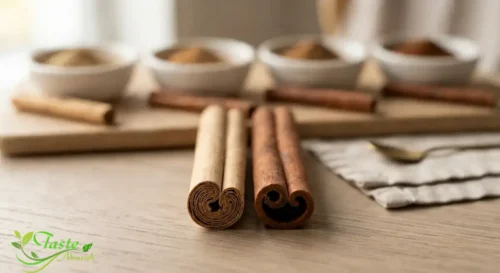
Sticks are the easy case. BfR notes that a cassia stick forms a thick, single roll, while a Ceylon stick looks like a cut cigar, made of several fine rolled layers. Ceylon is also typically lighter brown.
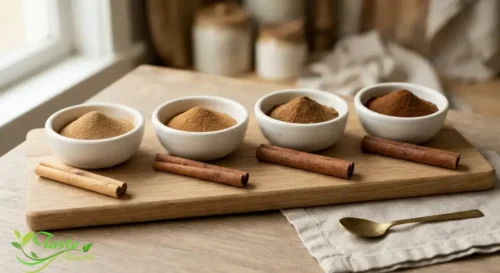
Ground cinnamon is the hard case. BfR says it is hardly possible for consumers to tell Ceylon and cassia powder apart by sight, so rely on the label. Look for “Ceylon” or Cinnamomum verum for true cinnamon, and “Saigon” or “Vietnamese” for that cassia. If the label says only “cinnamon,” treat it as cassia.
Cinnamon Nutrition at a Glance
According to the USDA FoodData Central entry for ground cinnamon, 100 grams provides about 247 calories, 4 grams of protein, 80.6 grams of carbohydrate, 1.2 grams of fat, and 53 grams of fiber. A teaspoon provides roughly 6 calories, about 2 grams of carbohydrate, and about 1 gram of fiber. The entry does not specify a species, and values vary by product, so the label on your jar is the best reference.
Common Mistakes to Avoid
- Assuming “true” means better for every use: it describes botanical identity, and Ceylon’s main documented advantage is lower coumarin, so choose by recipe too.
- Dismissing cassia as the lesser spice: it is a perfectly good cinnamon with a bolder flavor; just use it in moderation if you eat a lot.
- Dumping ground cinnamon into wet batter: whisk it into the dry ingredients so it spreads evenly instead of clumping.
- Using a Ceylon stick in a long, hard simmer and expecting it to stay intact: its thin layers break apart more easily than thick cassia sticks.
Troubleshooting
The cinnamon flavor is faint. You may have swapped Ceylon into a recipe designed for cassia, or the jar may be old. Add more in small steps, or switch to cassia for that recipe.
The flavor is harsh or overpowering. This is usually Saigon used at full cassia amounts. Cut back next time.
Ground cinnamon floats and clumps in a drink. It does not dissolve. Use a stick, or whisk it into a small amount of the liquid first.
Types of Cinnamon Explained FAQs
Is Vietnamese cinnamon the same as Saigon cinnamon?
Yes. Saigon cinnamon, Vietnamese cinnamon, and Vietnamese cassia are different names for Cinnamomum loureiroi.
Does the cinnamon in pumpkin spice and five-spice contain coumarin?
It can. The Canadian Food Inspection Agency report on cinnamon-containing foods found pumpkin spice and Chinese five-spice mixes had the highest average coumarin content, which it attributed to their high cinnamon share.
Are cinnamon supplements the same as the spice?
Not necessarily. BfR warns that supplements may contain high amounts of cassia and that coumarin content varies with the type of cinnamon and how it is processed. Check which species is listed.
Is cassia cinnamon safe for children?
Occasional cinnamon in food is not the concern. BfR notes that a 15 kg (33 lb) child reaches the tolerable daily intake with about 0.5 grams of cassia a day, so avoid giving young children cassia daily in large amounts, and consider Ceylon for regular use.
Do I need to buy Ceylon if I only bake occasionally?
No. For occasional baking in normal amounts, cassia or Saigon is fine. Ceylon matters more when you use cinnamon heavily and often.
Key Takeaways: Types of Cinnamon Explained
- The types of cinnamon explained in one line: Ceylon is the mild, low-coumarin “true” cinnamon, and cassia, Korintje, and Saigon are the stronger, higher-coumarin cassia group.
- Saigon cinnamon is a type of cassia, and it is generally the most intense of the common types.
- Cassia is the type most commonly sold in the US, so an unlabeled jar is almost certainly cassia.
- Use cassia or Saigon for bold baking, and Ceylon for frequent, generous use such as rice pudding or daily sprinkling.
- Ground cinnamon cannot be identified by sight, so read the label for Ceylon, Cinnamomum verum, or Saigon.
Conclusion
Once you have the types of cinnamon explained, the choice gets easy: match the strength to the recipe and the coumarin level to how much you use. Cassia and Saigon bring boldness to rolls and cookies, while Ceylon is the gentler option for everyday amounts. When a label only says “cinnamon,” assume cassia and enjoy it in moderation.
Explore Cinnamon by Topic
- What the research says about cinnamon: the health evidence for cinnamon, and what it does and does not show.
- Ceylon vs cassia cinnamon: a closer side-by-side look at the two main cinnamon groups.
- Cinnamon simple syrup: a quick way to use cinnamon in coffee, tea, and cocktails.
- Cinnamon banana bread: a baking recipe where the cinnamon type noticeably affects the flavor.