
Cabbage: 5 Types, Origin, Taste, and Plant Family
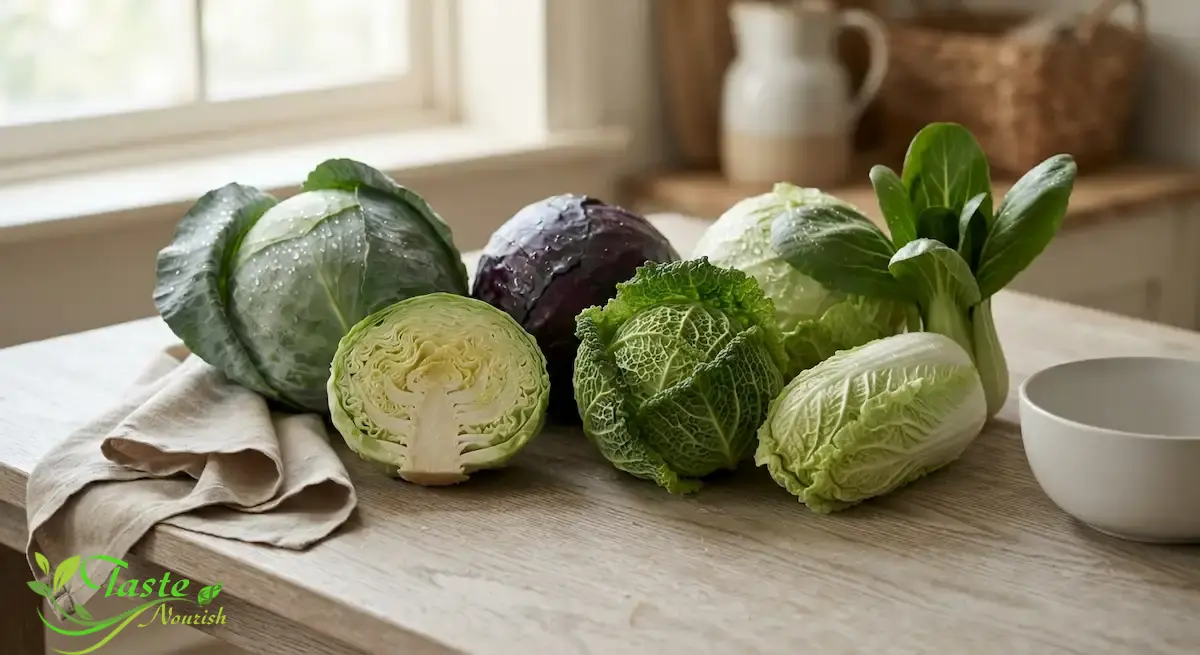
Cabbage looks simple, but it sits at the center of one of the most remarkable plant groups in the kitchen. The species that gives you a tight green head also gives you kale, broccoli, cauliflower, and Brussels sprouts. The “Chinese cabbage” in the produce aisle turns out to be a different species altogether.
This guide covers what people most often ask about cabbage: what it is, its scientific name and plant family, where it came from, how it tastes, and how the main types differ. It sticks to facts and classification rather than recipes.
Quick Answer
Cabbage is a leafy vegetable with the scientific name Brassica oleracea var. capitata, grown for its dense head of waxy leaves. It belongs to the mustard family (Brassicaceae), which makes it a brassica and a cruciferous vegetable. It is the same species as kale, broccoli, cauliflower, and Brussels sprouts. The flavor ranges from mild to peppery when raw and turns sweeter when cooked. Exactly where it was first domesticated is still debated, with recent genetic studies pointing to the Mediterranean region and the Middle East.
What Is Cabbage?
Britannica describes cabbage as a vegetable and fodder plant of the mustard family. Its many forms were developed by long cultivation from wild cabbage. In everyday use, “cabbage” means head cabbage, which is a major table vegetable across the temperate zones of the world.
The leaves are succulent, hairless, and coated in wax. That coating often gives them a gray-green or blue-green tint. The plant grows best in mild to cool climates and tolerates frost, while hot weather hurts both growth and quality.
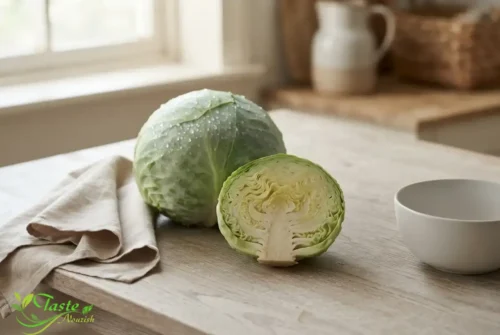
The edible part is the head: leaves folded tightly over one another into a compact ball. Heads vary a lot. They can be pointed, round, or flat, and soft or hard. Colors run from shades of green and gray-green to magenta or red. Weights range from about 2 to 7 pounds (under 1 kg to over 3 kg), according to the same Britannica entry.
Scientific Name and Plant Family
The scientific name of cabbage is Brassica oleracea var. capitata. Each part of that name places the plant at a different level of classification.
| Level | Name | What it includes |
|---|---|---|
| Family | Brassicaceae (mustard family, also called Cruciferae) | Cabbage, broccoli, cauliflower, bok choy, arugula, horseradish, and many more |
| Genus | Brassica | Cabbage and its closest crop relatives |
| Species | Brassica oleracea | Cabbage, kale, collards, broccoli, cauliflower, Brussels sprouts, kohlrabi |
| Variety | capitata | The head-forming cabbages |
Family and species names come from Britannica’s entry on cabbage. A peer-reviewed review of cruciferous vegetables notes that Brassica is simply the Latin word for cabbage.
The Same Species as Kale, Broccoli, and Cauliflower
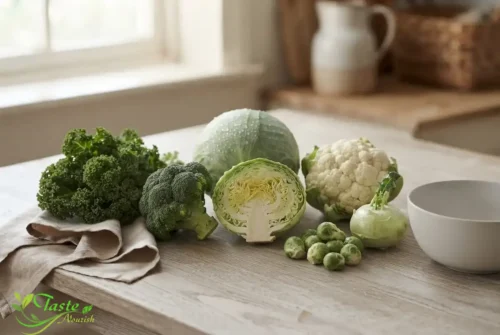
The authors of that 2021 study compare the situation to dog breeds. Broccoli, Brussels sprouts, cabbage, cauliflower, kale, and kohlrabi all belong to one species. Centuries of selection pushed different plant parts to extremes:
- A large head of folded leaves: head cabbage
- Loose, open leaves: kale and collards
- Small heads along the stem: Brussels sprouts
- A swollen, bulb-like stem: kohlrabi
- Flower clusters: broccoli and cauliflower
Is Cabbage a Vegetable, a Leafy Green, or a Cruciferous Vegetable?
Cabbage fits all three labels. “Leafy green” is the only one that depends on who is drawing the line.
A vegetable
The part people eat is the leaves, so cabbage is a vegetable, not a fruit. MyPlate counts green, red, napa, and Savoy cabbage in the vegetable group. More specifically, they sit in the “other vegetables” subgroup.
A leafy green, with a caveat
Food-safety guidance treats cabbage as a leafy green. The CDC’s leafy greens page names lettuce, spinach, cabbage, kale, and bok choy together. Nutrition grouping is different. MyPlate’s dark-green subgroup includes kale, spinach, bok choy, and broccoli, but cabbage is filed under “other vegetables.” The National Cancer Institute’s cruciferous vegetable fact sheet makes the same point: cruciferous vegetables fall into both the dark-green and the “other” categories. For a closer look at one of the dark-green leafy vegetables, see our guide to spinach health benefits.
A cruciferous vegetable
The National Cancer Institute lists cabbage among the cruciferous vegetables. The word comes from the flowers of the family, which have four equal petals arranged like a cross. These plants also share sulfur-containing compounds called glucosinolates, which shape their flavor (covered below).
A brassica
Yes. Cabbage belongs to the genus Brassica, so it is a brassica in the strict botanical sense. Napa cabbage and bok choy are brassicas too, but they come from a related species, Brassica rapa, as the types section below explains.
Origin and History
Wild cabbage and the origin debate
The traditional account is that cultivated cabbages were developed from wild cabbage, a plant that grows on rocky coasts in western Europe. Genetic work over the past few years has complicated that story, and the studies do not fully agree.
The 2021 study analyzed 224 plants. It found that the closest living wild relative of cultivated B. oleracea is Brassica cretica, a plant native to the Aegean. That supports an origin of cultivation in the eastern Mediterranean. The same study concluded that many plants labeled “wild” B. oleracea are feral, meaning escaped crops, and called an origin in England unlikely.
A Wageningen University & Research team, writing in Horticulture Research, proposed a two-step domestication. The first step was in western Europe and the second in the Middle East. Head cabbages and cauliflowers were probably selected there from kale-like plants. One researcher called it highly likely that tin traders carried those early plants by ship around 2500 BC. That is a hypothesis, not a documented fact. The safest summary is that cabbage was domesticated thousands of years ago somewhere around the Mediterranean and the Middle East.
What the earliest records show
Wageningen researchers note that Greek and Roman writers mentioned these vegetables as far back as 400 BC. They described kale-like types and already very large cabbages. The 2021 study adds details. Theophrastus recorded three kinds: a curly-leaved type, a smooth-leaved type, and a bitter wild type. Pliny described at least ten more about 200 years later. The same authors treat seeds found at a site in northwestern Syria, dated to roughly 3,000 to 3,250 years ago, as the oldest relatively reliable evidence of cultivation.
How the head took shape
The tight, hard-headed cabbage we know best is a later development. Britannica says hard-headed types were developed in northern Europe during the Middle Ages. Soft-headed types such as Savoy are believed to have originated earlier, in southern Europe.
Name and Meaning
The English word comes from a name based on shape. Merriam-Webster traces it to Middle English caboche, borrowed from a Norman and Picard French word that literally meant “head.” The word is first recorded in the 15th century. Etymonline traces it further back to Latin caput, “head,” though dictionaries differ on the deeper origin. Merriam-Webster also lists a separate English noun spelled the same way, with a different possible source in a French word for cheating or theft.
What Does Cabbage Taste Like?
Raw cabbage ranges from mild to peppery, depending on the type, and cooking tends to make it sweeter. UMass Extension’s cabbage produce spotlight describes green cabbage as peppery raw and sweeter cooked, red cabbage as slightly peppery, Savoy as mild, and napa as mild and sweet.
Why it tastes the way it does
The National Cancer Institute explains that glucosinolates, the sulfur-containing compounds in cruciferous vegetables, are responsible for their pungent aroma and bitter flavor. The Harvard T.H. Chan School of Public Health’s science of flavor article adds a detail: an intact cruciferous vegetable barely smells. Chopping, cooking, or chewing damages the cells and releases an enzyme, myrosinase. The enzyme breaks glucosinolates into the compounds that create the aroma and bite. Harvard also notes that roasting or sautéing brings out natural sweetness, and that the harsh reputation of these vegetables comes largely from overboiling.
Research backs up the cooking effect. A University of Reading doctoral thesis on cabbage flavor found that cooking reduced both perceived bitterness and the amount of sulfurous aroma compounds. Consumers liked the cooked cabbage more. It also found that cooked cabbage tasted less bitter than raw to every taste-gene group studied.
Common Types and Varieties
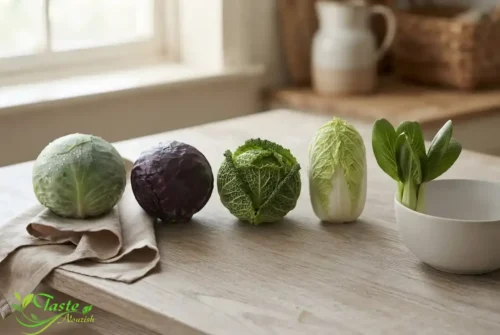
Hundreds of cabbage varieties exist, but a handful of types account for most of what shoppers see.
| Type | Species | Appearance | Flavor |
|---|---|---|---|
| Green cabbage | Brassica oleracea | Round head of smooth green leaves, paler toward the center | Peppery raw, sweeter cooked |
| Red cabbage | Brassica oleracea | Round head of dark red or purple leaves, usually smaller and denser than green | Slightly peppery |
| Savoy cabbage | Brassica oleracea | Compact head of curled, crinkled green leaves | Mild |
| Napa cabbage | Brassica rapa | Long, light green oval leaves | Mild and sweet |
| Bok choy | Brassica rapa | Upright, loose growth rather than a round head | Mild and fresh, slightly more peppery than cabbage |
Appearance and flavor for the first four rows follow UMass Extension, with University of Illinois Extension on red cabbage’s size and density. The bok choy flavor note comes from UF/IFAS Extension. University of Kentucky Extension notes that Chinese cabbages such as napa and bok choy often grow upright instead of forming a round head.
Napa and bok choy are not just cabbage in another shape. Britannica places both in Brassica rapa, a related species. MyPlate still counts napa as a cabbage, in the “other vegetables” group. Bok choy goes in the dark-green group.
The types also differ in how they keep. Britannica notes that very hard, late-maturing heads suit winter storage, while softer types are best used promptly after harvest. UMass Extension says unwashed green and red cabbage kept in the refrigerator in a plastic bag can last up to 2 months, while Savoy and napa last up to a week.
Cabbage Nutrition at a Glance
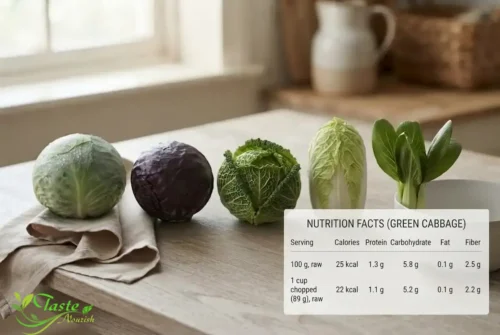
The USDA FoodData Central entry for raw cabbage gives the values below, with 1 cup chopped weighing 89 grams. They are approximate, since variety and preparation change them.
| Serving | Calories | Protein | Carbohydrate | Fat | Fiber |
|---|---|---|---|---|---|
| 100 g, raw | 25 kcal | 1.3 g | 5.8 g | 0.1 g | 2.5 g |
| 1 cup chopped (89 g), raw | 22 kcal | 1.1 g | 5.2 g | 0.1 g | 2.2 g |
FAQs About Cabbage
Is red cabbage a different plant from green cabbage?
No. Britannica groups head cabbages as one form of Brassica oleracea, with heads ranging from green and gray-green to magenta or red. Color is the main difference. University of Illinois Extension adds that red heads are usually smaller and denser, with a slightly peppery flavor, and that the color changes easily.
Does eating cabbage prevent cancer?
The evidence does not support that claim. The National Cancer Institute explains that glucosinolates are being studied for possible anticancer effects, but human studies have shown mixed results. Some case-control studies found lower risk for certain cancers, while several large cohort studies found little or no association. The agency does note that eating more vegetables in general may protect against some diseases, including some cancers.
How much cabbage counts as one cup of vegetables?
MyPlate lists 1 cup of chopped or shredded green, red, napa, or Savoy cabbage, raw or cooked, as 1 cup of vegetables.
Should cabbage be washed before eating?
Yes. CDC guidance for leafy greens, which includes cabbage, is to wash your hands first, discard torn or bruised leaves, and remove the outer leaves of the head. Then rinse the cabbage under running water. The CDC advises against using bleach or any other disinfectant on produce.
Why do some people find cabbage more sulfurous than others?
Part of the answer is in the mouth. A laboratory study mixed raw cabbage with fresh saliva from 21 people. It found about a 10-fold difference between individuals in how many sulfur compounds were produced from a compound in the cabbage. The more of these compounds a person’s saliva produced, the stronger the garlic-like odor they reported.
Key Takeaways: Cabbage
- Cabbage is Brassica oleracea var. capitata, a member of the mustard family, Brassicaceae.
- It is the same species as kale, broccoli, cauliflower, Brussels sprouts, and kohlrabi, each selected for a different plant part.
- It is a vegetable, a brassica, and a cruciferous vegetable. Whether it counts as a leafy green depends on whether you use food-safety or nutrition grouping.
- Domestication happened thousands of years ago, probably around the Mediterranean and the Middle East. Hard-headed types developed in northern Europe in the Middle Ages.
- Raw flavor runs from mild to peppery, and cooking makes it sweeter, because chopping and cooking change glucosinolates.
- Napa cabbage and bok choy belong to a different species, Brassica rapa, though MyPlate counts napa as cabbage.
Conclusion
With cabbage, the plant’s classification explains most of what you notice at the store and the table. The tight head is just one of several shapes the species can take. Its mustard-family chemistry accounts for the peppery bite and the sweetening effect of cooking. Knowing that napa and bok choy are a separate species also clears up the most common mix-up in the produce aisle.
Explore Brassicas by Topic
- health benefits of kale: what kale, a close relative of cabbage, offers nutritionally, and what the evidence supports.
- health benefits of broccoli: a look at another Brassica oleracea crop and what research says about it.
- health benefits of spinach: nutrition and benefits of a dark-green leafy vegetable often compared with cabbage.
- most healthy foods in the world: a roundup of 13 nutrient-rich foods for building a varied plate.