Flaxseed nutrition facts show a small seed with an outsized nutrient profile: mostly fiber and fat, with a concentrated dose of plant-based omega-3s in every spoonful. If you’re deciding whether to add flaxseed to smoothies, oatmeal, or baking, here’s exactly what’s in it — calories, macros, vitamins, and minerals per tablespoon and per 100 grams — based on USDA data, so you know what you’re actually getting before it hits your bowl.
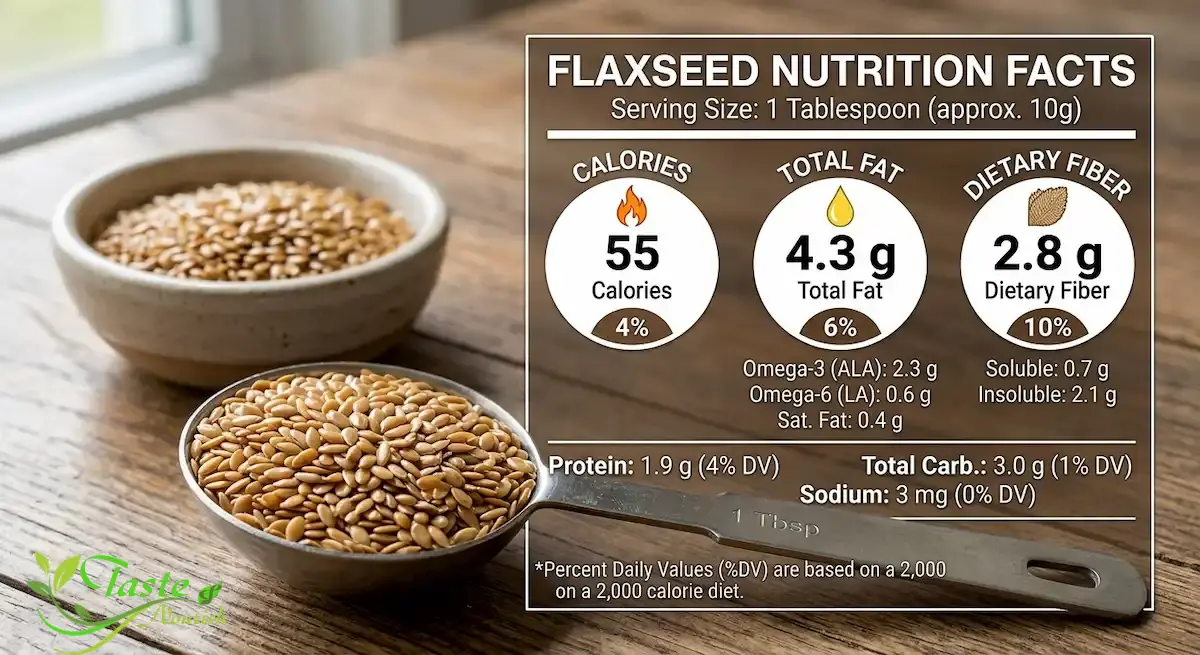
One tablespoon of whole flaxseed (10 g) has about 55 calories, 4.3 g of fat (mostly the omega-3 ALA), 3 g of carbohydrate, 2.8 g of fiber, and roughly 1.9 g of protein. These flaxseed nutrition facts also include meaningful amounts of magnesium, manganese, thiamin, and phosphorus. Ground flaxseed provides the same nutrients per gram, but a tablespoon of it weighs less and therefore shows slightly lower numbers on the label.
Key Takeaways: Flaxseed Nutrition Facts
A tablespoon of whole flaxseed has about 55 calories and 4.3 g of fat, most of which is the plant omega-3 fatty acid ALA (alpha-linolenic acid).
Flaxseed is one of the few foods where fiber and fat make up the bulk of the calories — carbohydrate content is low and mostly fiber, not sugar.
Whole and ground flaxseed have identical nutrient composition by weight; the “per tablespoon” numbers differ mainly because ground flaxseed is fluffier and weighs less per spoonful.
Flaxseed is the richest common dietary source of lignans, plant compounds with mild estrogen-like and antioxidant activity that aren’t reflected on a standard nutrition label.
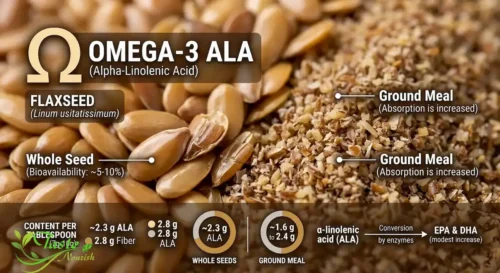
Grinding flaxseed (or buying it pre-ground) makes its fat and nutrients more accessible, since whole seeds can pass through the digestive tract largely intact.
What Is Flaxseed?
Flaxseed, also called linseed, comes from the flax plant (Linum usitatissimum), one of the oldest cultivated crops in the world. The small, oval seeds are usually golden or reddish-brown and have a mild, nutty flavor. You’ll find them whole, ground into “flaxseed meal,” pressed into oil, or milled into flour. Nutritionally, whole and ground flaxseed are the most relevant forms — flaxseed oil retains the fat but loses the fiber and most of the lignans.
Flaxseed Nutrition Facts
The numbers below come from the USDA FoodData Central entry for flaxseed and from Mayo Clinic’s published serving data for ground flaxseed. Because flaxseed is calorie- and fat-dense for its size, small serving sizes matter here more than they do for most foods.
Flaxseed Calories and Macros Per Tablespoon
Nutrient
1 tbsp whole (10 g)
1 tbsp ground/meal (7 g)
% Daily Value (whole)
Calories
55
37
3%
Total Fat
4.3 g
~3 g
6%
Saturated Fat
0.4 g
—
2%
Monounsaturated Fat
0.8 g
0.5 g
—
Polyunsaturated Fat
2.9 g
2 g
—
ALA (omega-3)
2.35 g
~1.6 g
No established DV*
Total Carbohydrate
3 g
2 g
1%
Dietary Fiber
2.8 g
2 g
10%
Sugars
0.2 g
<0.2 g
—
Protein
1.9 g
1.3 g
4%
*The FDA has not set a Daily Value for omega-3 fats. For context, the National Academies’ Adequate Intake for ALA is about 1.6 g/day for adult men and 1.1 g/day for adult women, so one tablespoon of whole flaxseed provides more ALA than most adults need in a day.
Carbohydrates and Fiber
Flaxseed’s carbohydrate content is almost entirely fiber. A tablespoon of whole seed has about 3 g of total carbohydrate, and roughly 2.8 g of that is dietary fiber — a mix of soluble and insoluble types. Sugar content is negligible. This is part of why flaxseed doesn’t spike blood sugar the way many carbohydrate-containing foods do; there’s very little digestible carbohydrate left once fiber is accounted for.
Protein in Flaxseed
Flaxseed contributes a modest but real amount of protein — about 1.9 g per tablespoon, or roughly 18 g per 100 g. It’s not a primary protein source at typical serving sizes (you’d need about a quarter cup to get 8–9 g of protein), but it does contain all nine essential amino acids in smaller amounts, along with notable levels of arginine and glutamic acid.
Fat in Flaxseed: Mostly Omega-3s
Fat makes up the largest share of flaxseed’s calories — about 67% of them, according to USDA data. What sets flaxseed apart is the type of fat: most of it is alpha-linolenic acid (ALA), a plant-based omega-3 fatty acid. One tablespoon of whole flaxseed provides about 2.35 g of ALA, according to NIH’s Office of Dietary Supplements, which is more than the daily Adequate Intake for most adults in a single spoonful. The remaining fat is a mix of monounsaturated fat (mostly oleic acid) and the omega-6 fat linoleic acid.
It’s worth noting that ALA is not the same as the long-chain omega-3s (EPA and DHA) found in fatty fish. The body can convert some ALA into EPA and DHA, but conversion rates are low — generally under 15%. Flaxseed is a good way to increase ALA intake, but it isn’t a direct substitute for fish-derived omega-3s if that’s specifically what you’re after.
Flax Seeds Vitamins and Minerals
Flaxseed isn’t a major source of most vitamins, but it does provide meaningful amounts of a few minerals and B vitamins relative to its small serving size.
Nutrient
Amount per 1 tbsp whole (10 g)
% Daily Value
Manganese
0.25 mg
11%
Thiamin (B1)
0.17 mg
14%
Magnesium
40 mg
10%
Phosphorus
65 mg
5%
Selenium
2.6 mcg
5%
Vitamin B6
0.05 mg
3%
Zinc
0.4 mg
4%
Iron
0.6 mg
3%
Folate
9 mcg DFE
2%
Calcium
26 mg
2%
Potassium
82 mg
2%
At a single tablespoon, none of these hit particularly high percentages — flaxseed is more useful as a small, consistent contributor to mineral intake than as a concentrated source of any one nutrient. The numbers scale up if you use 2–3 tablespoons, which is a common serving in baked goods or smoothies.
Flaxseed Macros and Nutrition Per 100 Grams
For comparison purposes — including comparing flaxseed to other seeds — it helps to see the numbers on a standard 100 g basis, which is how most food databases report flaxseed nutritional value.
Nutrient
Amount per 100 g
Calories
~534 kcal
Fat
~42 g (ALA ~23 g)
Carbohydrate
~29 g
Fiber
~27 g
Protein
~18 g
Magnesium
~390 mg
Phosphorus
~640 mg
Potassium
~810 mg
Calcium
~255 mg
Because 100 g of flaxseed is roughly 10 tablespoons, this isn’t a realistic single serving — it’s included for reference and comparison, not as a suggested amount to eat.
Whole vs. Ground Flaxseed: Why the Nutrition Label Numbers Differ
This trips people up more than almost anything else about flaxseed. Whole and ground flaxseed have the exact same nutrient composition per gram — grinding doesn’t add or remove calories, fat, or fiber. What changes is density. Ground flaxseed is fluffier and less compact, so a tablespoon of it weighs less (about 7 g) than a tablespoon of whole seeds (about 10 g).
That’s the entire reason a flax seeds nutrition label for “ground flaxseed” often shows fewer calories per tablespoon than one for whole seeds: you’re simply measuring less mass by volume.
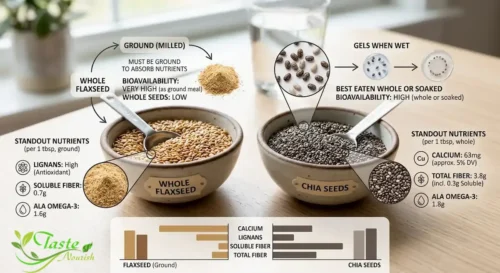
The more important difference is digestibility, not composition. According to Mayo Clinic, whole flaxseed’s hard outer coat can pass through the digestive tract largely intact, meaning your body may not fully access the oil, fiber, and lignans inside. Grinding the seed — or buying pre-ground flaxseed meal — breaks that coat open so the nutrients are more available. If you’re eating flaxseed specifically for its ALA or lignan content, ground is the more reliable choice.
Lignans: Flaxseed’s Other Standout Compound
Beyond the macros and minerals on a standard label, flaxseed is notable for its lignan content. Lignans are plant compounds with a chemical structure similar to estrogen and antioxidant properties; flaxseed contains far more of them than most other commonly eaten foods. They don’t appear on a Nutrition Facts panel because there’s no established Daily Value for them, but they’re a big part of why flaxseed is studied separately from other seeds.
Some of the research on flaxseed and hormone-sensitive conditions, cholesterol, and menopausal symptoms specifically focuses on this lignan content rather than on the fiber or fat alone.
What This Nutrient Profile May Mean for Your Health
It’s worth being precise about what the evidence actually shows, since flaxseed is often described with more certainty than the research supports.
Cholesterol: Several human studies cited by Mayo Clinic have found that daily flaxseed intake can modestly lower total and LDL (“bad”) cholesterol, likely due to the combined effect of fiber and lignans.
Blood pressure: Some research suggests flaxseed may help lower blood pressure, though results are less consistent than for cholesterol.
Blood sugar: Evidence in people with type 2 diabetes is mixed — some studies show a modest benefit, others show none, and flaxseed oil specifically has not been shown to help.
Digestive regularity: This is one of flaxseed’s more reliable effects. Its fiber content, particularly when the seed is ground, is commonly used to support regularity.
Menopause and cancer: Research in these areas is inconsistent, according to Mayo Clinic, and flaxseed should not be treated as a treatment for either.
None of this makes flaxseed a treatment for any condition. It’s a nutrient-dense food that may modestly support a few specific markers when eaten regularly as part of an overall healthy diet — not a substitute for medical care.
How Much Flaxseed Is Reasonable to Eat?
There’s no official government-recommended daily amount for flaxseed specifically. Based on the amounts used in most clinical research and general guidance from Mayo Clinic, 1 to 2 tablespoons of ground flaxseed per day is a commonly cited, reasonable amount for most healthy adults, with some sources noting that up to about 4 tablespoons spread across meals is generally well tolerated.
Going well beyond that mainly adds calories and fat without a clear additional benefit, and larger amounts are more likely to cause digestive discomfort (see the safety section below).
Practical Ways to Add Flaxseed to Meals
Flaxseed’s mild, nutty flavor makes it easy to work into food you’re already eating, without needing to build a recipe around it.
Oatmeal or cereal: Stir a tablespoon of ground flaxseed into hot or cold cereal.
Smoothies: Blend in ground flaxseed for extra fiber and a slightly nutty edge; whole seeds are harder for a blender to break down fully.
Yogurt: Mix into plain or Greek yogurt along with fruit.
Baking: Add to muffin, pancake, or bread batter — it holds up well to heat.
Egg substitute: One tablespoon of ground flaxseed mixed with three tablespoons of water and left to sit for a few minutes forms a gel that can replace one egg in some baking recipes.
Sauces and condiments: A teaspoon stirred into mustard, mayonnaise, or salad dressing adds texture without changing the flavor much.
Savory dishes: Mix into meatballs, veggie burgers, chili, or lasagna filling, where it blends in unnoticed.
Flaxseed vs. Chia Seeds: How the Nutrition Compares
Flaxseed and chia seeds get compared often since both are small seeds valued for fiber and plant omega-3s. They’re not interchangeable nutritionally.
Nutrient (per 2 tbsp)
Flaxseed, ground (~14 g)
Chia seeds (1 oz / 28 g)
Calories
~75
~140
Fiber
~4 g
~11 g
Protein
~2.5 g
~4 g
Fat
~6 g
~9 g (~7 g unsaturated)
Calcium
~50 mg
~180 mg (18% DV)
ALA (omega-3)
~3.2 g
~5 g
Chia seeds are noted by Harvard’s Nutrition Source as the richest common plant source of omega-3s and provide substantially more calcium and fiber per equivalent serving. Flaxseed is lower in calories per serving and offers a nutrient chia doesn’t: a concentrated dose of lignans. Neither is objectively “better” — they suit slightly different purposes, and many people use both.
Possible Drawbacks and Safety Considerations
Flaxseed is generally well tolerated in typical food amounts, but a few points are worth knowing.
Digestive symptoms at high doses — Larger amounts of flaxseed or flaxseed oil supplements can cause bloating, gas, or diarrhea, according to NIH’s National Center for Complementary and Integrative Health (NCCIH). Starting with a smaller amount and increasing gradually, along with adequate water intake, tends to reduce this.
Raw or unripe seeds — NCCIH specifically advises against eating raw or unripe flaxseeds, which may contain compounds that can be problematic in large amounts. This guidance is about unprocessed or unripe seeds rather than the dried whole or ground flaxseed sold for food use, but if you’re ever uncertain about a source, cooking or baking flaxseed further reduces these compounds.
Medication interactions — NCCIH notes there are theoretical reasons flaxseed or flaxseed oil could interact with blood-thinning medications such as anticoagulants or antiplatelet drugs. If you take these medications, talk with your healthcare provider before adding flaxseed supplements or large amounts of flaxseed to your routine.
Pregnancy and breastfeeding — Some research on flaxseed use during pregnancy suggests it may be unsafe in larger or supplemental amounts, though the evidence isn’t conclusive, and little is known about safety during breastfeeding, per NCCIH. Typical culinary amounts are different from concentrated supplements, but it’s reasonable to check with a healthcare provider if you’re pregnant or nursing.
Allergies — Flaxseed allergy is uncommon but has been reported. As with any new food, introduce it gradually if you haven’t eaten it before.
Who May Need to Be Careful
People taking anticoagulant or antiplatelet medications, those who are pregnant or breastfeeding, and anyone with a known seed allergy should talk to a healthcare provider before making flaxseed a regular part of their diet, particularly in concentrated forms like flaxseed oil or supplements. This is general dietary guidance, not a medical directive — a doctor or registered dietitian can advise based on individual health history.
Storing Flaxseed to Keep It Fresh
Flaxseed’s high fat content makes it prone to going rancid, especially once ground. Mayo Clinic Health System recommends storing flaxseed meal in the refrigerator in an airtight, opaque container to slow spoilage from heat, light, and air exposure. Whole flaxseed is more stable and can typically be kept in a cool, dark pantry, but refrigerating it — or grinding only what you plan to use soon — helps preserve its quality longest.
Rancid flaxseed will smell noticeably sharp, bitter, or “paint-like” rather than nutty; if it smells off, it’s best to discard it rather than taste-test it.
Common Misconceptions About Flaxseed Nutrition
Myth: Whole and ground flaxseed have different nutritional value.
They contain the same nutrients per gram. The difference is how much of that nutrition your body actually absorbs, since whole seeds can pass through undigested.
Myth: Flaxseed oil gives you all the same benefits as the whole seed.
Flaxseed oil concentrates the ALA fat but contains none of the fiber and very little of the lignan content found in whole or ground seeds.
Myth: Flaxseed’s omega-3s are the same as fish oil’s omega-3s.
Flaxseed provides ALA, a precursor the body converts into EPA and DHA at a low rate (under 15%). It’s a useful source of plant omega-3s but isn’t a direct swap for fish-derived omega-3s.
Myth: More flaxseed always means more benefit.
Beyond about 1–2 tablespoons a day, additional intake mainly adds calories and fat rather than proportionally more benefit, and larger amounts raise the chance of digestive discomfort.
Flaxseed Nutrition Facts FAQs
How many calories are in a tablespoon of flaxseed?
About 55 calories in one tablespoon of whole flaxseed (10 g), or about 37 calories in one tablespoon of ground flaxseed (7 g), based on USDA and Mayo Clinic data. The difference comes from ground flaxseed weighing less per tablespoon, not from a difference in nutrient content per gram.
Is ground flaxseed more nutritious than whole flaxseed?
Not more nutritious by weight — the nutrient content per gram is identical. Ground flaxseed is generally considered the more useful choice because its broken outer coat lets your body access the fat, fiber, and lignans more easily than whole seeds do.
How much flaxseed should I eat per day?
There’s no official recommended amount, but 1 to 2 tablespoons of ground flaxseed per day is a commonly suggested, reasonable serving for most healthy adults, based on general guidance from Mayo Clinic.
Does flaxseed have enough protein to count as a protein source?
It contributes protein — about 1.9 g per tablespoon — but at typical serving sizes it’s a minor protein contributor rather than a primary source. It’s more significant nutritionally for its fiber and omega-3 fat content.
Does flaxseed need to be refrigerated?
Ground flaxseed benefits from refrigeration in an airtight container because its fat content makes it prone to rancidity. Whole flaxseed is more stable and can be kept in a cool pantry, though refrigeration extends its freshness too.
Can you eat flaxseed raw?
Dried whole or ground flaxseed, uncooked, is how most people eat it — stirred into yogurt or cereal, for example — and this is standard practice. NIH’s NCCIH specifically advises against eating raw or unripe (unprocessed, green) flaxseeds in large amounts, which is a different scenario from using the dried, mature flaxseed sold for food.
Conclusion
The flaxseed nutrition facts add up to a small seed that’s dense in fiber and fat, particularly the plant omega-3 ALA, along with modest but real contributions of magnesium, manganese, thiamin, and a few other minerals. Its lignan content is what sets it apart from most other seeds nutritionally, even though that doesn’t show up on a standard label.
A tablespoon or two of ground flaxseed a day, added to food you’re already eating, is a reasonable way to use it — just store it properly, introduce it gradually, and check with a healthcare provider first if you take blood-thinning medication or are pregnant or breastfeeding.
Hanan Abo Samra is the founder of Taste & Nourish, sharing trustworthy nutrition guidance and recipes drawn from 20+ years of hands-on cooking experience. When she's not developing new recipes, Hanan is researching the science behind everyday ingredients to bring readers practical, evidence-based guidance for a healthier lifestyle.