
Rice Calories: Complete Guide by Type, Cup & Serving Size
Rice Calories Explained: White, Brown, Basmati & More
Rice is the base of more meals than almost any other food on the planet. But if you’ve ever tried to log a bowl of it in a calorie tracker, you’ve probably run into the same wall: the numbers online rarely agree with each other.
That’s not because anyone’s lying to you. It’s because rice calories depend on a handful of specific variables — the type of rice, whether it’s measured raw or cooked, and how big your “serving” actually is. Get those three things straight, and the confusion mostly disappears.
This guide breaks down calories by rice type, shows you exactly how cooking changes the numbers, and covers the health questions people usually ask right after: is brown rice actually better, does arsenic matter, and how does rice fit into a weight-management plan.
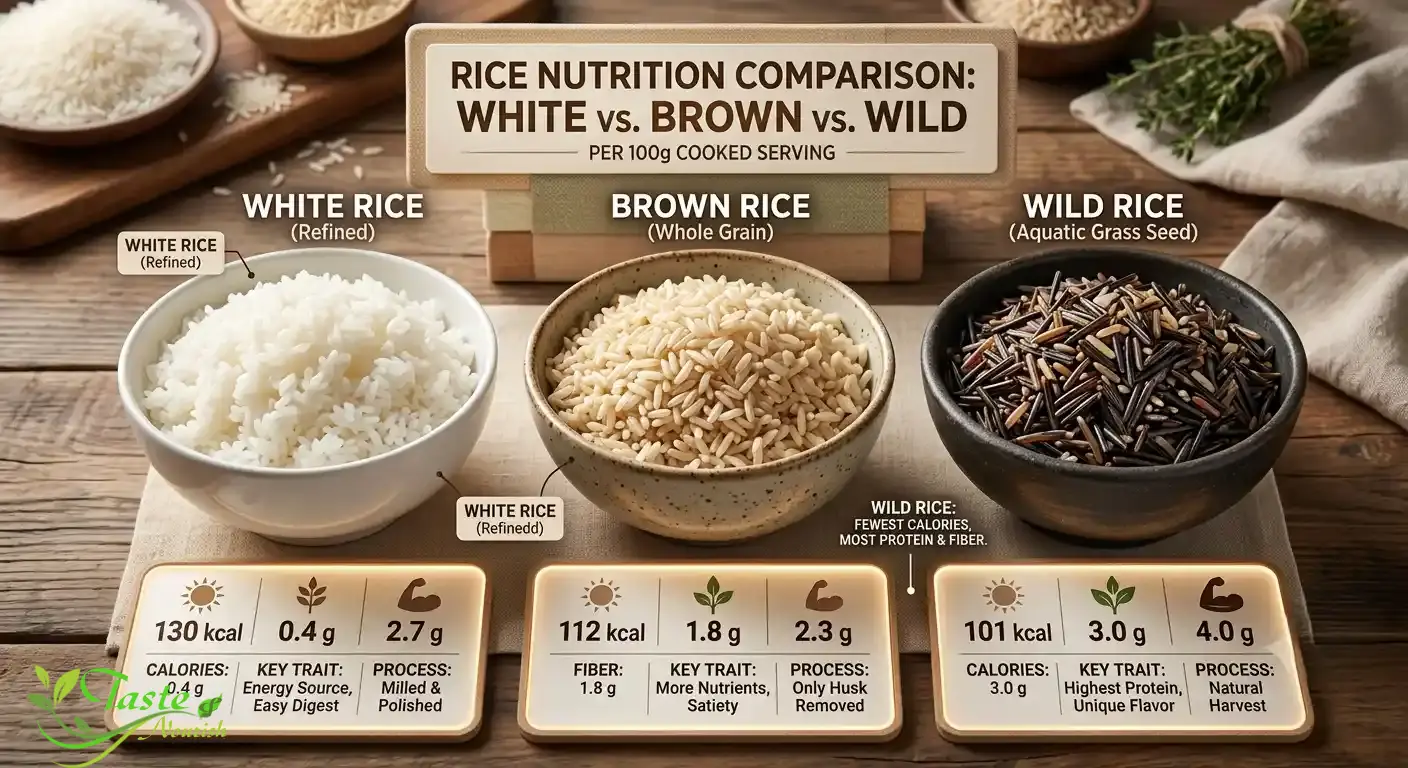
Key Takeaway: A 100-gram portion of plain cooked white rice has about 130 calories. Brown rice is close, at roughly 123 calories. The real differences between rice types show up in fiber, protein, and glycemic response — not raw calorie count.
What Determines the Calories in Rice?
Three factors decide the number you see on a label or in a calorie app: the variety of rice, its preparation state, and your portion size. Miss any one of these, and your calorie count will be off — sometimes by a lot.
Raw vs. Cooked Rice
This is the single biggest source of confusion in rice nutrition. Dry rice absorbs two to three times its weight in water as it cooks, which means the same 100 grams of rice weighs far more — and looks far less calorie-dense — once it’s on your plate.
Raw white rice runs around 360–365 calories per 100 grams. Cook it, and that same original amount of rice, now spread across roughly 300 grams of cooked weight, works out to about 130 calories per 100 grams. No calories are lost in cooking — the rice just absorbs water and takes up more space per gram.
This is why nutrition labels always specify whether they’re describing rice “as purchased” (dry) or “as prepared” (cooked).
♦ If you’re comparing numbers between two sources and they don’t match, check this detail first.
Portion Size and Serving Confusion
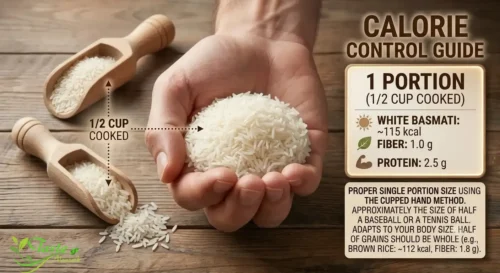
The second issue is serving size. “A serving of rice” means different things depending on where you look. A half-cup of cooked rice is one thing; a heaping restaurant scoop is another entirely — and the calorie gap between them can be 150 calories or more.
For consistency, it helps to think in ounce-equivalents the way U.S. dietary guidance does: a half-cup of cooked rice counts as one ounce-equivalent from the grains group. Most adults need somewhere between five and eight ounce-equivalents of grains a day, with at least half coming from whole grains.
Pro Tip: Weigh your cooked rice once with a kitchen scale and note how full your usual bowl looks at that weight. After that, you can eyeball portions accurately without pulling out the scale every time.
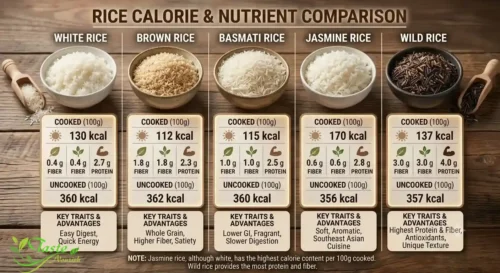
Calories in Rice by Type (Per 100g, Cooked)
Not all rice is nutritionally identical. Here’s how the most common varieties compare when cooked, measured per 100 grams — a portion that’s roughly the size of a tennis ball or half a standard cup.
| Rice Type | Calories (per 100g cooked) | Protein | Carbs | Fiber |
|---|---|---|---|---|
| White rice (long-grain) | ~130 kcal | 2.7 g | 28.2 g | 0.4 g |
| Brown rice (long-grain) | ~123 kcal | 2.7 g | 25.6 g | 1.6 g |
| Basmati rice | ~121 kcal | 3.5 g | 25.2 g | 0.6 g |
| Jasmine rice | ~129 kcal | 2.7 g | 28.0 g | 0.3 g |
| Wild rice | ~101 kcal | 4.0 g | 21.3 g | 1.8 g |
Figures for white and brown long-grain rice reflect USDA FoodData Central records; basmati, jasmine, and wild rice figures reflect typical values reported across nutrition databases and can vary somewhat by brand and cooking method.
White Rice
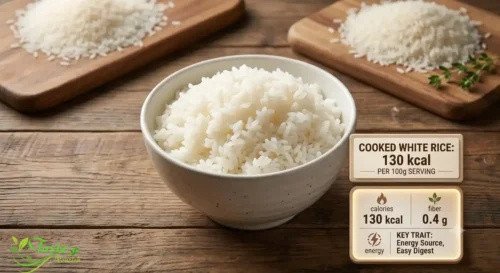
Plain white rice is milled to remove the bran and germ, leaving mostly starchy endosperm. According to USDA FoodData Central, cooked long-grain white rice contains about 130 calories, 2.7 grams of protein, 0.3 grams of fat, and 28.2 grams of carbohydrate per 100 grams. It’s the fastest-cooking, mildest-tasting option, which is part of why it shows up in more cuisines than any other rice variety.
Brown Rice
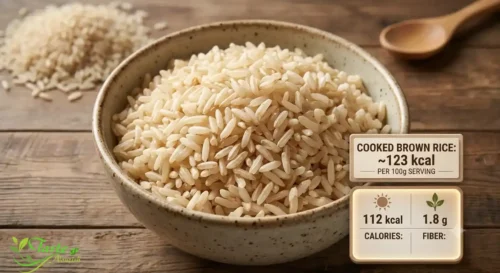
Brown rice keeps its bran and germ layers intact, which is why it’s classified as a whole grain. Per USDA data, cooked brown rice runs slightly lower in calories than white — about 123 per 100 grams — but delivers roughly four times the fiber, at 1.6 grams versus 0.4 grams. It also retains more B vitamins, magnesium, and phosphorus than its polished counterpart.
Basmati Rice
Basmati is a long-grain, aromatic rice grown mainly in India and Pakistan. It tends to land slightly lower in calories than standard white rice, around 121 per 100 grams cooked, while offering a bit more protein per serving. Basmati also has a comparatively lower glycemic index among white rice varieties, which some people find useful for steadier post-meal blood sugar.
Jasmine Rice
Jasmine rice, native to Thailand, is soft, slightly sticky, and lightly floral in aroma. Nutritionally, it’s very close to standard white rice — about 129 calories per 100 grams cooked — but it tends to have a higher glycemic index, meaning it can raise blood sugar somewhat faster than basmati or brown rice.
Wild Rice
Wild rice isn’t technically rice — it’s the seed of an aquatic grass. That distinction shows up in its numbers: it’s the lowest-calorie option on this list at roughly 101 calories per 100 grams cooked, with the highest protein content of the group. It also has a notably chewy texture and nutty flavor that sets it apart from true rice varieties.
White Rice vs. Brown Rice: A Side-by-Side Nutrition Comparison
This is the comparison people ask about more than any other, so it’s worth laying out clearly.
| Category | White Rice (cooked) | Brown Rice (cooked) |
|---|---|---|
| Calories (100g) | ~130 kcal | ~123 kcal |
| Fiber | 0.4 g | 1.6 g |
| Protein | 2.7 g | 2.7 g |
| Glycemic index | Higher (roughly 64–73) | Lower (roughly 55–68) |
| Micronutrients | Fortified with some B vitamins | Naturally higher in B vitamins, magnesium, manganese |
| Cooking time | Faster | Slower |
| Shelf life | Longer (low oil content) | Shorter (bran oils can turn rancid) |
According to Harvard Health Publishing, brown rice is generally the healthier default for most people, mainly because of its fiber and lower glycemic profile — both of which are associated with better blood sugar control and steadier satiety. That said, white rice isn’t “unhealthy.”
Its lower fiber content can actually make it easier to digest, which is part of why it’s often recommended during digestive flare-ups or for people managing conditions like IBS.
The calorie gap between the two is small enough that it shouldn’t be the deciding factor in which one you choose. Fiber, micronutrients, and how the rice fits into your overall meal pattern matter more than a 7-calorie difference per 100 grams.
How Many Calories Are in a Cup of Rice?
Cups are the most common way home cooks measure rice, so here’s how the numbers translate from 100-gram figures to a full cup.
| Rice Type | Calories per 1 Cup Cooked (~158–202g) |
|---|---|
| White rice | ~205 kcal |
| Brown rice | ~248 kcal |
| Basmati rice | ~190–210 kcal |
| Jasmine rice | ~205–215 kcal |
| Wild rice | ~165 kcal |
Brown rice actually comes out higher per cup than white rice, even though it’s lower per 100 grams — because a cup of cooked brown rice weighs more (about 202 grams versus roughly 158 grams for white). This is exactly the kind of mismatch that trips up calorie tracking if you’re not paying attention to weight versus volume.
Pro Tip: If precision matters to you — for diabetes management, athletic performance, or a structured weight-loss plan — weigh rice in grams rather than measuring by cup. Cooked rice compacts differently depending on how it’s scooped, which can swing a “cup” measurement by 20–30 calories in either direction.
Rice Calories and Weight Management
Rice isn’t inherently fattening, and it isn’t a “diet food” either — it’s a neutral carbohydrate source that behaves according to how much of it you eat and what you eat it with. The confusion usually comes from portion creep: a modest half-cup side becomes a heaping plate, and 100 calories quietly turns into 400.
Because rice is nearly all carbohydrate with very little protein or fat, it digests relatively quickly on its own. Pairing it with protein, healthy fats, or fiber-rich vegetables slows that digestion down and tends to improve satiety, which can make it easier to manage overall calorie intake across a meal.
Brown, wild, and basmati rice have a modest edge for weight management thanks to their fiber content and, in basmati’s case, a somewhat lower glycemic index. But none of these differences are dramatic enough to make or break a weight-loss plan on their own — portion size still does most of the work.
Portion Control Tips That Actually Work
- Use the cupped-hand method. One cupped palm of cooked rice is roughly a 150-gram portion, a reasonable visual reference when a scale isn’t handy.
- Serve rice last. Filling your plate with vegetables and protein first naturally limits how much rice ends up on it.
- Pre-portion after cooking. Divide a cooked batch into single-serving containers right away instead of eating straight from the pot.
- Watch restaurant portions specifically. A single serving at a restaurant can easily be 300–400 calories of rice alone, well above a typical half-cup to one-cup home portion.
Health Benefits Associated with Rice
- Naturally Gluten-Free: Rice is naturally free of gluten, making it a safe and reliable staple food for individuals with celiac disease or gluten sensitivity.
- Easy to Digest: Plain rice is gentle on the digestive system, low in fat, and contains virtually no added sugar, making it suitable for a wide range of dietary needs.
- Rich in Whole-Grain Benefits: Whole-grain varieties such as brown, wild, and black rice provide higher amounts of fiber, vitamins, minerals, and antioxidants compared to refined white rice.
- Supports Long-Term Health: According to Harvard Health Publishing, consuming approximately three servings of whole grains per day is associated with a significantly lower risk of all-cause mortality, as well as reduced cardiovascular disease and cancer mortality. Choosing rice that contains brown rice is one practical way to increase whole-grain intake.
- May Help Improve Blood Sugar Control: A randomized controlled trial published in Diabetes Technology & Therapeutics found that brown rice, particularly when consumed with legumes, produced lower post-meal blood glucose and insulin responses than white rice. These findings suggest that whole-grain rice may contribute to better blood sugar management as part of a balanced diet.
- Supports a Healthy Dietary Pattern: Incorporating whole-grain rice into a balanced eating plan may provide sustained energy while supporting overall metabolic and cardiovascular health.
Potential Risks and Who Should Be Cautious
Rice is safe for the vast majority of people to eat regularly, but there are two areas worth knowing about.
Arsenic in Rice
Rice absorbs arsenic from soil and water more readily than most other crops, a fact confirmed by the U.S. Food and Drug Administration. Brown rice tends to contain more inorganic arsenic than white rice because arsenic concentrates in the bran layer, which white rice has had removed during milling.
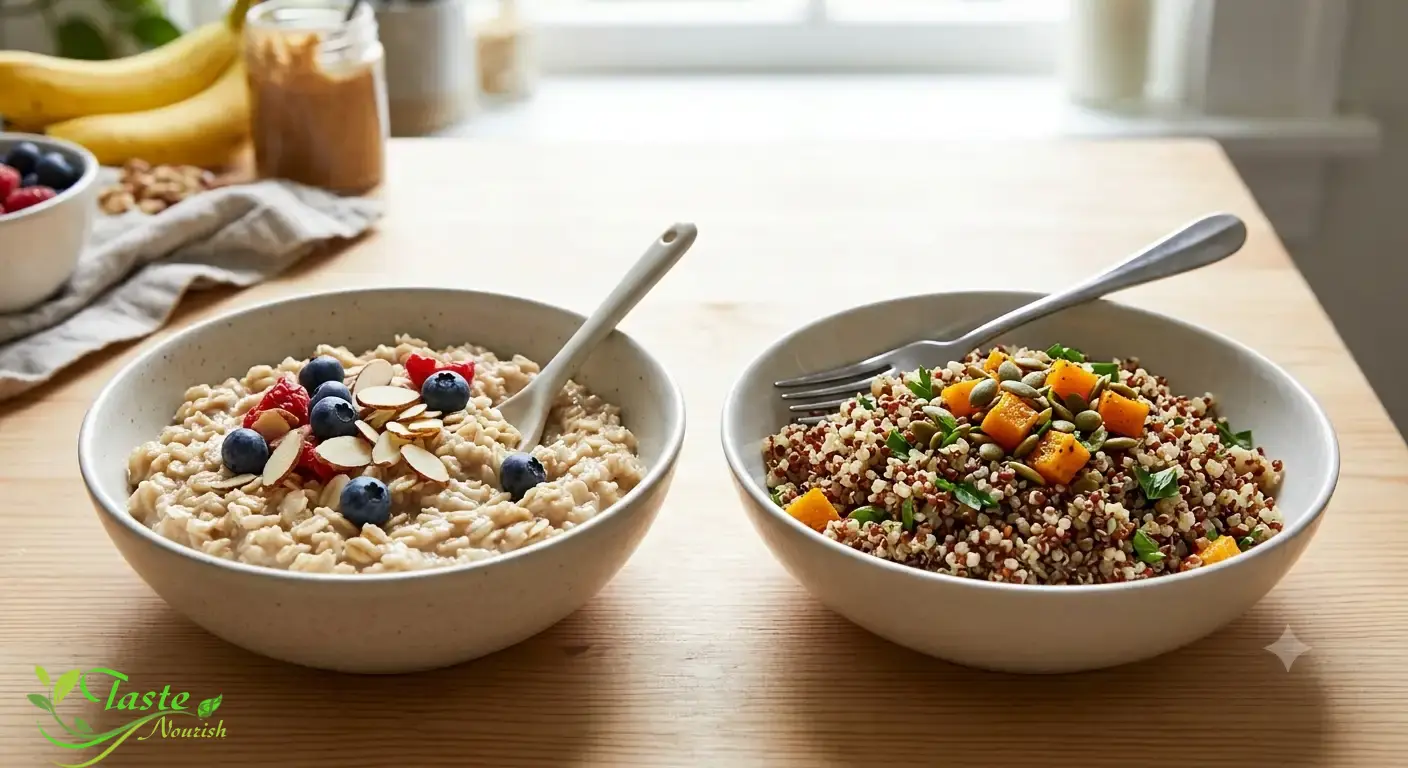
The FDA doesn’t advise the general population to change their rice consumption patterns because of arsenic, but it does recommend eating a varied diet — rotating rice with other grains like oats, quinoa, and barley — rather than relying on rice as the sole grain at every meal. This guidance is especially relevant for infants and young children, whose diets are less varied and who eat more food relative to their body weight than adults do.
Cooking method can meaningfully reduce arsenic exposure. Research cited by the FDA shows that cooking rice in excess water — similar to how pasta is prepared — and draining it afterward can cut inorganic arsenic content by roughly 40 to 60 percent, though this method also reduces some of the added nutrients in enriched rice.
Key Takeaway: Arsenic in rice is a “pattern of eating” concern, not a reason to avoid rice entirely. Variety and moderation address it effectively for most people.
Blood Sugar and Glycemic Index
White and jasmine rice have relatively high glycemic index values, meaning they can raise blood sugar faster than lower-GI grains. This matters most for people managing diabetes, prediabetes, or insulin resistance, who may benefit from choosing basmati or brown rice more often, or pairing rice with protein, fat, and fiber to blunt the blood sugar response.
People managing diabetes shouldn’t need to eliminate rice from their diet. Portion size, rice type, and what the rice is eaten alongside all influence blood sugar response more than any single factor in isolation.
Buying and Storage Tips
- Check the ingredient list on flavored or instant rice products — many add significant sodium and oil, which changes the calorie count well beyond what plain rice contributes.
- Store raw rice in an airtight container in a cool, dry pantry; white rice keeps almost indefinitely this way, while brown rice’s natural oils mean it’s best used within about six months for freshness.
- Refrigerate cooked rice within two hours of cooking, and use it within about four to six days to keep it safe to eat.
- Cooling and reheating rice increases resistant starch, a change that may modestly reduce the digestible calories and slightly improve blood sugar response compared with rice eaten fresh off the stove — a small but genuinely useful trick if you meal-prep.
Common Rice Calorie Myths, Debunked
Myth: Cooking rice “burns off” calories. Not true. The calorie count per 100 grams drops because water is added, not because energy is lost. The total calories in your original dry portion stay the same; they’re just distributed across more weight.
Myth: Brown rice is dramatically lower in calories than white rice. Not really. The gap is around seven calories per 100 grams — nutritionally meaningful mostly because of fiber and micronutrients, not raw calorie savings.
Myth: All “healthy” rice swaps are automatically lower in calories. Not always. Jasmine rice, often perceived as a lighter option, has a similar calorie count to standard white rice and a higher glycemic index than basmati or brown rice.
Myth: Fried rice and plain rice have roughly the same calorie count. Far from it. Oil, butter, and add-ins used in fried rice preparations can double or even triple the calorie count per 100 grams compared with plain steamed or boiled rice.
Conclusion
Rice calories aren’t complicated once you separate the variables that actually matter: type, preparation state, and portion size. Plain cooked white rice runs about 130 calories per 100 grams, brown rice about 123, and the differences between rice varieties show up far more in fiber, protein, and glycemic response than in raw calorie counts.
For most people, rice can fit comfortably into a balanced diet — whole-grain varieties offer a modest nutritional edge, arsenic exposure is manageable through dietary variety, and portion size remains the single biggest lever for anyone tracking calories closely.
Rice Calories FAQs
1. How many calories are in a cup of cooked rice?
A cup of cooked white rice has about 205 calories, while a cup of cooked brown rice has about 248 calories, largely because brown rice weighs more per cup once cooked.
2. Is brown rice actually lower in calories than white rice?
Only slightly — about 123 calories per 100 grams for brown rice versus 130 for white. The bigger difference is fiber, where brown rice provides roughly four times as much.
3. Do raw and cooked rice have different total calories?
No. The total calories in a given amount of dry rice stay the same after cooking; they’re just spread across more weight because the rice absorbs water.
4. Which type of rice has the fewest calories?
Wild rice, at roughly 101 calories per 100 grams cooked, though it’s technically a grass seed rather than true rice.
5. Does reheating rice change its calorie count?
Cooling and reheating rice can increase its resistant starch content, which may modestly lower the calories your body actually absorbs and slightly improve its effect on blood sugar, though the change is generally small.
References
- U.S. Department of Agriculture, Agricultural Research Service. “Rice, white, long-grain, regular, enriched, cooked.” FoodData Central, FDC ID 168878. https://fdc.nal.usda.gov/food-details/168878/nutrients
- U.S. Department of Agriculture, Agricultural Research Service. “Rice, brown, long-grain, cooked.” FoodData Central, FDC ID 169704. https://fdc.nal.usda.gov/food-details/169704/nutrients
- U.S. Food and Drug Administration. “What You Can Do to Limit Exposure to Arsenic.” https://www.fda.gov/food/environmental-contaminants-food/what-you-can-do-limit-exposure-arsenic
- Harvard Health Publishing, Harvard Medical School. “Brown Rice Versus White Rice: A Head-to-Head Comparison.” https://www.health.harvard.edu/diet-and-nutrition/brown-rice-versus-white-rice-a-head-to-head-comparison
- Mohan V, Spiegelman D, Sudha V, et al. “Effect of Brown Rice, White Rice, and Brown Rice with Legumes on Blood Glucose and Insulin Responses in Overweight Asian Indians: A Randomized Controlled Trial.” Diabetes Technology & Therapeutics, 2014;16(5):317–325. https://doi.org/10.1089/dia.2013.0259