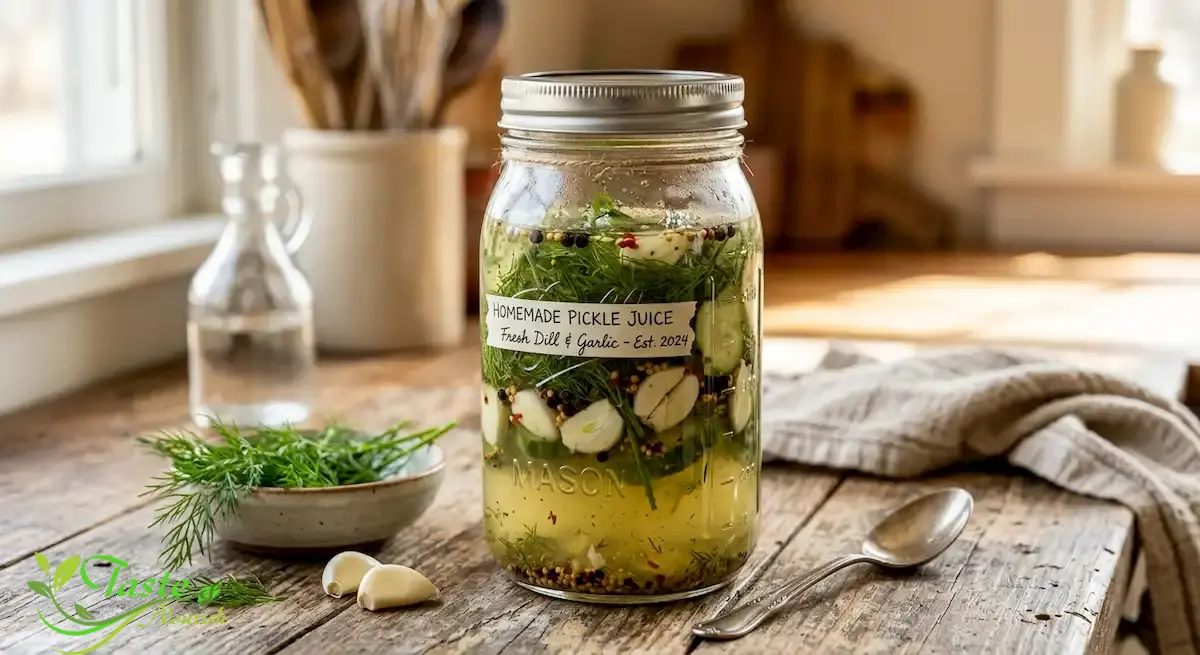
If you’ve ever finished a jar of pickles and paused before pouring the leftover brine down the drain, you’re not alone. A good pickle juice recipe turns that salty, garlicky liquid into something worth sipping on purpose — whether you’re making a batch from scratch or repurposing what’s left in the jar. This version uses five pantry staples plus fresh dill and garlic, and it comes together with about ten minutes of hands-on work.
This pickle juice recipe combines water, distilled white vinegar, kosher salt, garlic, and fresh dill, simmered briefly to dissolve the salt and release flavor, then chilled for at least four hours. Serve it cold in small 1–2 tablespoon pours, either straight or diluted over ice, for that classic tangy, salty pickle brine flavor.
Recipe at a Glance
Detail
Time / Amount
Prep Time
10 minutes
Cook Time
5 minutes
Chill Time
4 hours (overnight preferred)
Total Time
About 4 hours 15 minutes, mostly hands-off
Yield
2 cups (about 8 servings, 2 tablespoons each)
Difficulty
Easy
Key Takeaways
This pickle juice recipe uses just five pantry staples plus fresh dill and garlic, and it’s ready to drink in about four hours.
Making your own brine lets you control the salt, tang, and spice level in a way store-bought jars don’t.
The traditional serving is small — 1 to 2 tablespoons — not a full glass.
Leftover jar brine from store-bought pickles can be used the same way, no separate recipe required.
Because it’s high in sodium, this isn’t the right drink for everyone; people managing blood pressure or kidney conditions should check with a doctor first.
Why You’ll Love This Pickle Juice Recipe
It’s bright, tangy, and genuinely refreshing once chilled, with a flavor you can dial up or down depending on how much garlic and dill you use. Making it at home also means nothing goes to waste — you’re not throwing out a jar’s worth of well-seasoned brine. And because it uses ingredients most kitchens already have, there’s no special shopping trip required.
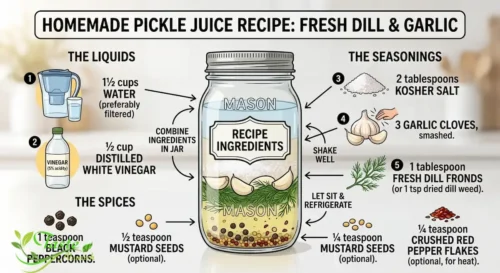
¼ teaspoon crushed red pepper flakes (optional, for heat)
Ingredient Notes & Substitutions
Distilled white vinegar gives the classic sharp, clean pickle flavor most people expect. Apple cider vinegar works as a substitute, but it’s milder and slightly sweet, so the finished brine will taste softer and less sharp — a real trade-off, not a one-to-one swap.
Use kosher salt rather than table salt. Table salt often contains anti-caking agents that can cloud the brine. Fresh dill gives a rounder, grassier flavor than dried, but dried dill weed is a fine substitute if that’s what’s on hand.
Kitchen Tools You’ll Need
You don’t need anything specialized: a small saucepan, a glass jar with a tight-fitting lid, and a fine-mesh strainer if you prefer a clear brine without floating garlic and dill. A non-reactive lid (plastic-lined or glass) is worth using, since vinegar can corrode bare metal over time.
How to Make This Pickle Juice Recipe
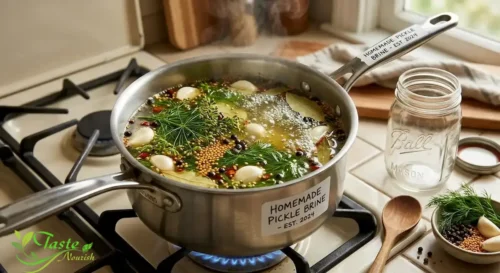
Combine the water, vinegar, and salt in a small saucepan. Heat over medium, stirring occasionally, until the salt fully dissolves and the liquid looks clear — about 3 to 4 minutes. You don’t need a hard boil.
Add the garlic, dill, peppercorns, and mustard seeds if using. Let the mixture simmer gently for 2 minutes; you’ll notice the dill turn fragrant and the garlic soften slightly.
Remove from heat and let the brine cool to room temperature, about 30 to 45 minutes.
Strain into a clean glass jar if you want a clear brine, or leave the aromatics in for a stronger flavor that deepens over the next day or two.
Refrigerate for at least 4 hours, ideally overnight, so the flavors have time to meld.
Serve chilled, either as a 1 to 2 tablespoon pour on its own or diluted with cold water over ice.
Expert Tips for the Best Pickle Juice
Taste the brine before chilling and adjust salt in small increments; it’s easier to add than to fix an over-salted batch.
Let the brine rest overnight rather than drinking it same-day — the flavor is noticeably more balanced after 12 hours.
Filtered water gives a cleaner, less mineral-heavy taste than straight tap water in some areas.
Common Mistakes to Avoid
Boiling too hard: A vigorous boil can make garlic taste bitter and cloud the brine. A gentle simmer is enough to dissolve the salt and release flavor.
Using table salt: Additives in table salt can leave the brine cloudy or slightly metallic-tasting. Stick with kosher or pickling salt.
Skipping the chill time: Warm or freshly cooled brine tastes harsh and one-note. The overnight rest is what rounds out the flavor.
Drinking large amounts at once: This is a sodium-dense liquid. A shot-sized pour is traditional; a full glass is not necessary and adds up in sodium quickly.
Recipe Variations, Including Reusing Leftover Pickle Juice
For a spicier version, increase the red pepper flakes or add a thin slice of jalapeño to the jar while it chills. For a sweeter, switchel-style drink, stir in a teaspoon of honey per cup of finished brine.
If you already have leftover pickle juice from a store-bought jar, you don’t need this recipe at all — simply chill it and treat it the same way: sipped in small amounts, diluted over ice, or worked into the recipes below. It’s the same pickle brine for drinking, just recycled rather than made from scratch.
Serving Suggestions
Pickle juice is often sipped on its own after a workout, but it’s just as useful in the kitchen. Try it as a marinade base for chicken thighs, a tangy addition to deviled egg filling or potato salad, a sharp note stirred into a Bloody Mary, or topped with cold soda water for a pickle spritzer.
Nutrition Information (Estimated)
Values are estimates for a 2-tablespoon serving and will vary depending on your salt and vinegar brands.
Calories: approximately 5–10
Sodium: approximately 250–400 mg
Carbohydrates: approximately 1 g
Dill pickle brine is naturally sodium-dense; USDA FoodData Central lists roughly 809 mg of sodium per 100 grams of dill pickle brine, which is why small servings matter here. The FDA sets the Daily Value for sodium at less than 2,300 milligrams per day for most adults, so a couple of tablespoons of this brine can represent a meaningful share of that limit.
Storage Instructions
Store the brine in an airtight glass jar in the refrigerator for up to 1 month. Because it’s vinegar-based, it holds up well over time, though flavor is best in the first two weeks.
Freezing isn’t recommended: it offers no benefit for a liquid this acidic, and it can crack a glass jar as it expands. Always use a clean spoon or pour directly rather than dipping used utensils back in, to keep the brine free of contamination.
Combine the water, vinegar, and salt in a small saucepan. Heat over medium, stirring occasionally, until the salt fully dissolves and the liquid looks clear, about 3 to 4 minutes.
Add the garlic, dill, peppercorns, and mustard seeds if using. Simmer gently for 2 minutes until fragrant.
Remove from heat and let the brine cool to room temperature, about 30 to 45 minutes.
Strain into a clean glass jar for a clear brine, or leave the aromatics in for a stronger flavor.
Refrigerate for at least 4 hours, ideally overnight, so the flavors meld.
Serve chilled, either as a 1 to 2 tablespoon pour on its own or diluted with cold water over ice.
Pickle Juice Recipe FAQs
Can I Drink Pickle Juice?
Yes, you can, and some people drink it because it contains probiotics and electrolytes. However, if you plan to drink it, avoid overly salty varieties and use filtered water and organic vinegar.
Is pickle juice actually good for you?
It’s not a health drink in the way a smoothie might be. It’s mostly water, vinegar, and salt, so any benefit is modest and comes with a real sodium cost. Harvard T.H. Chan School of Public Health notes that excess sodium intake is a major driver of cardiovascular risk, so this is best enjoyed in small, occasional pours rather than as a daily habit.
How much pickle juice should I drink?
Stick to 1 to 2 tablespoons at a time. That’s the traditional serving, and it keeps sodium intake reasonable.
Can I just use leftover pickle juice instead of making this recipe?
Yes. Chilled leftover brine from a jar of store-bought pickles works the same way this recipe is intended to be used.
Does pickle juice help with muscle cramps?
Some athletes report relief within moments of taking a small sip, but research suggests this doesn’t come from replacing lost electrolytes. A study in the Journal of Athletic Training found that small volumes of pickle juice did not produce measurable changes in plasma electrolyte levels within the first hour of ingestion, suggesting any cramp relief likely works through a different mechanism than rehydration.
What vinegar works best for this recipe?
Distilled white vinegar gives the sharpest, most classic dill-pickle flavor. Apple cider vinegar is a milder alternative, though the flavor will be noticeably softer.
Can I drink pickle juice if I have high blood pressure?
Check with your doctor first. NIH News in Health points to sodium as one of the best-established dietary factors affecting blood pressure, and this brine is concentrated enough that it’s worth discussing with a healthcare provider if you’re managing hypertension or kidney disease.
Conclusion
This pickle juice recipe is about as low-effort as homemade condiments get: five ingredients, a short simmer, and an overnight chill. Start with a small 1 to 2 tablespoon pour straight from the fridge before deciding how you like it best — diluted, spiced up, or stirred into a marinade.
Miller KC, Mack GW, Knight KL. “Electrolyte and Plasma Changes After Ingestion of Pickle Juice, Water, and a Common Carbohydrate-Electrolyte Solution.” Journal of Athletic Training, National Institutes of Health (PMC). https://pmc.ncbi.nlm.nih.gov/articles/PMC2742453
Hanan Abo Samra is the founder of Taste & Nourish, sharing trustworthy nutrition guidance and recipes drawn from 20+ years of hands-on cooking experience. When she's not developing new recipes, Hanan is researching the science behind everyday ingredients to bring readers practical, evidence-based guidance for a healthier lifestyle.