
Oats Nutrition Facts: Per Serving, Per 100 g, Vitamins and Minerals
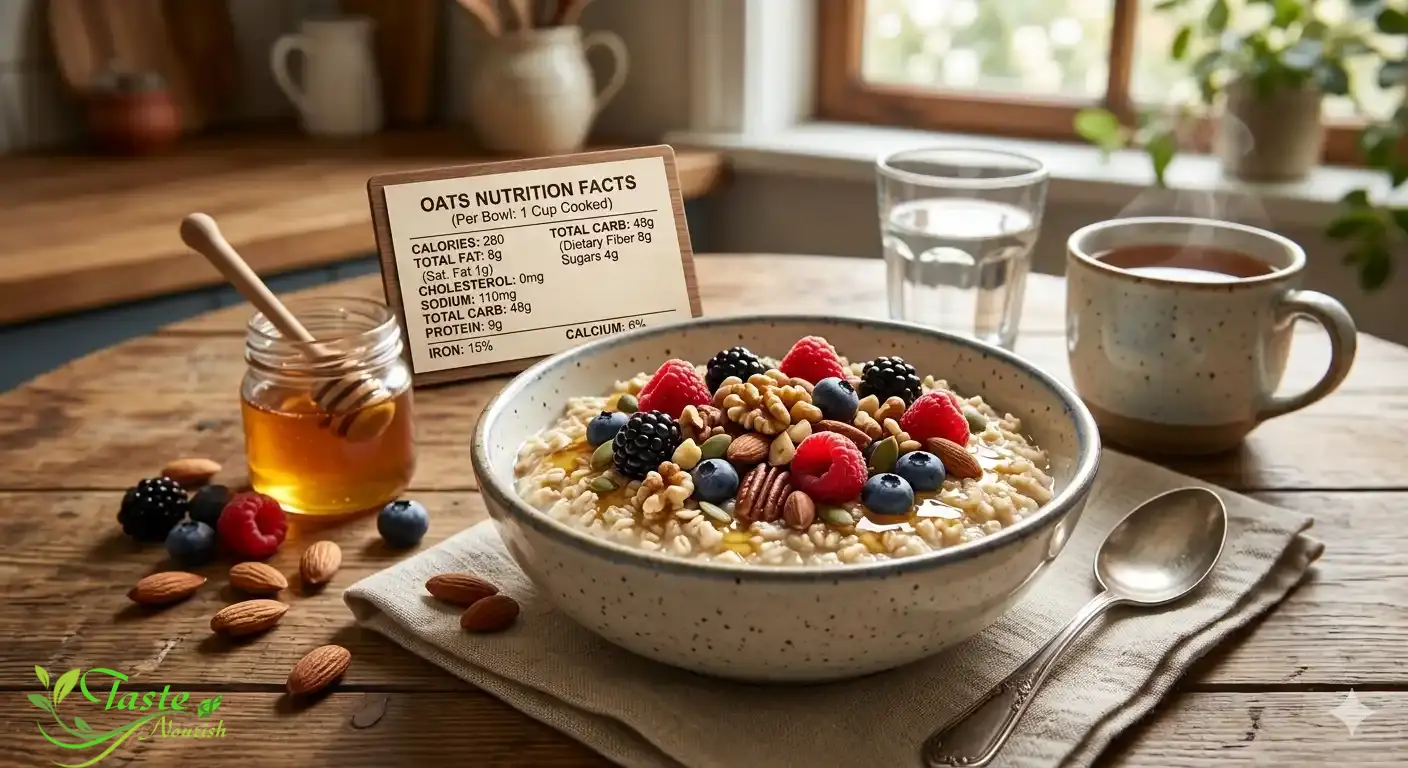
Oats nutrition facts are easiest to read per serving, because the per-100-gram numbers in most databases describe a pile of dry oats that nobody eats in one sitting. This page gives both: a table for a 1/2-cup (40 g) dry serving, the 100-gram values, and what changes once the oats are cooked.
The data comes from the USDA FoodData Central entries for plain, unfortified rolled and quick oats. Flavored packets, fortified products, and other oat types will differ, so use the label of the product you buy.
Oats Nutrition Facts: Quick Answer
Oats nutrition facts for a 1/2-cup (40 g) serving of plain dry oats: about 152 calories, 27 g carbohydrate, 4 g fiber, 5 g protein, and 2.6 g fat. Oats are especially high in manganese and selenium and a good source of several minerals and thiamin. Values differ for cooked oatmeal, which is mostly water.
Key Takeaways: Oats Nutrition Facts
- The oats nutrition facts that matter most per dry serving are fiber (14% of the Daily Value) and a strong mineral profile, led by manganese and selenium.
- Oats are a good source of copper, thiamin (vitamin B1), magnesium, phosphorus, and zinc, but they supply almost no vitamin C, vitamin A, vitamin B12, or calcium.
- The table values are for dry oats. A cooked cup (234 g) is mostly water and has about 166 calories, so always compare dry with dry and cooked with cooked.
- The USDA entry does not list beta-glucan, the soluble fiber behind most oat research, and the amount varies by product.
- Flavored, instant, and fortified oat products can differ a lot from plain oats, so the label of your product is the best reference.
Oats Nutrition Facts per Serving (1/2 Cup Dry)
The values below are for 1/2 cup (about 40 g) of plain, unfortified rolled or quick oats, measured dry. They are calculated from the USDA FoodData Central entry for oats, regular and quick, not fortified, dry, and rounded. Percent Daily Values use the current FDA Daily Values.
| Nutrient | Amount | % Daily Value |
|---|---|---|
| Calories | 152 | – |
| Total fat | 2.6 g | 3% |
| Saturated fat | 0.4 g | 2% |
| Sodium | 2 mg | 0% |
| Total carbohydrate | 27.1 g | 10% |
| Dietary fiber | 4.0 g | 14% |
| Total sugars | 0.4 g | – |
| Protein | 5.3 g | 11% |
Fiber is the headline nutrient. Under FDA’s guide to Daily Values, 10% to 19% per serving counts as a good source, so 14% fits that range, while 20% or more counts as high. The protein percentage is calculated on the basis of quantity, not protein quality. Five grams is respectable for a grain, and a bowl made with milk, yogurt, nuts, or seeds will have noticeably more.
Oats Nutrition Facts per 100 Grams, Dry and Cooked
Databases and many labels use 100 grams, which makes it easy to compare foods. The key point for oats is that 100 grams of dry oats and 100 grams of cooked oatmeal are very different amounts of food, because cooked oats are mostly water. The third column converts the cooked values to one cup using the USDA entry for oats cooked with water (without salt), where a cup weighs 234 g.
| Nutrient | Dry, 100 g | Cooked, 100 g | Cooked, 1 cup (234 g) |
|---|---|---|---|
| Calories | 379 | 71 | 166 |
| Protein | 13.2 g | 2.5 g | 5.9 g |
| Total fat | 6.5 g | 1.5 g | 3.6 g |
| Carbohydrate | 67.7 g | 12.0 g | 28.1 g |
| Dietary fiber | 10.1 g | 1.7 g | 4.0 g |
| Total sugars | 1.0 g | 0.3 g | 0.6 g |
| Sodium | 6 mg | 4 mg | 9 mg |
The cooked-cup column is calculated from the per-100-gram values, so it is rounded. If you want to know how milk and toppings change the total, the oats calories guide walks through dry versus cooked measurements and sample bowls.
Vitamins and Minerals in Oats
Oats are a better source of minerals than of vitamins. The table lists the nutrients that are meaningful in a serving, with FDA’s wording in brackets where it applies: “high” at 20% of the Daily Value or more, and “good source” at 10% to 19%.
| Nutrient | Per 40 g | % Daily Value (per 40 g) | Per 100 g |
|---|---|---|---|
| Manganese | 1.45 mg | 63% (high) | 3.63 mg |
| Selenium | 11.6 µg | 21% (high) | 28.9 µg |
| Copper | 0.16 mg | 17% (good source) | 0.39 mg |
| Thiamin (vitamin B1) | 0.18 mg | 15% (good source) | 0.46 mg |
| Magnesium | 55 mg | 13% (good source) | 138 mg |
| Phosphorus | 164 mg | 13% (good source) | 410 mg |
| Zinc | 1.5 mg | 13% (good source) | 3.64 mg |
| Iron | 1.7 mg | 9% | 4.25 mg |
| Riboflavin (vitamin B2) | 0.06 mg | 5% | 0.15 mg |
| Potassium | 145 mg | 3% | 362 mg |
| Folate | 13 µg DFE | 3% | 32 µg DFE |
| Calcium | 21 mg | 2% | 52 mg |
Plain oats contain no vitamin C, vitamin A, vitamin B12, or vitamin D, and very little calcium. That is normal for a grain, and it is one reason oats pair well with milk, fruit, and seeds. Fortified instant oatmeal can list more iron and other nutrients than the plain-oats values above, so check the label.
What the Label Does Not Show: Beta-Glucan
The USDA entry does not break out beta-glucan, the soluble fiber behind most of the cholesterol research on oats, and the amount varies by product. FDA’s health-claim rules define eligible rolled oats as containing at least 4% beta-glucan by dry weight, and oat bran at least 5.5% (21 CFR 101.81). If the label lists soluble fiber, that number is more useful than a guess. For how much beta-glucan the studies used and what they found, see the benefits of oats article.
Do Different Types of Oats Have Different Nutrition?
Plain rolled, quick, and instant oats are made from the same grain, and their nutrient values are broadly similar by dry weight. Steel-cut oats are chopped groats, and the main differences from rolled oats are texture, cooking time, and how quickly they raise blood sugar, not their basic nutrient profile.
Oat bran is more concentrated. It is the outer layer of the grain and has the higher beta-glucan minimum above, and its numbers differ from whole oat products. Flavored packets and fortified products are the real exceptions: they can add sugar, sodium, and added vitamins and minerals.
How to Read an Oats Label
- Check the serving size. Plain oats usually list about 40 g dry. Some packets list the prepared weight, which changes every number.
- Look at added sugars. Plain oats have under 1 g of sugar per serving. Flavored packets can have much more.
- Look at sodium. Plain dry oats have almost none, while some flavored or savory products add it.
- Look for “fortified.” Fortification adds iron and vitamins that plain oats do not provide in those amounts.
- Look for “gluten-free” if you have celiac disease (see below).
Oats, Gluten, and Cross-Contact
FDA’s gluten-free labeling rule does not list oats as a gluten-containing grain (FDA questions and answers), but oats are at substantial risk of cross-contact with wheat, barley, or rye during growing and processing. In one retrospective analysis of tested products, 24 of 213 oat-containing products (11%) had quantifiable gluten. People with celiac disease should choose oats labeled gluten-free and ask their healthcare provider about oats.
Oats Nutrition Facts FAQs
How many carbs and how much protein are in 1/2 cup of dry oats?
A 1/2-cup (40 g) serving of plain dry oats has about 27 g of carbohydrate, including 4 g of fiber and under 1 g of sugar, and about 5 g of protein. Cooking with water adds weight, not nutrients.
Are oats a good source of iron?
Plain oats provide about 1.7 mg of iron per 40 g serving, or 9% of the Daily Value, which is a modest contribution. Fortified instant oatmeal can contain more, so check the label. If you are concerned about your iron intake, ask a clinician.
Do cooked oats have the same nutrients as dry oats?
The oats themselves provide the same nutrients, but cooked oatmeal is mostly water, so the same weight has far fewer nutrients and calories. Compare dry with dry and cooked with cooked, or measure the dry oats before cooking.
Are oats gluten-free?
FDA does not classify oats as a gluten-containing grain, but cross-contact with wheat, barley, and rye is common. People with celiac disease should use oats labeled gluten-free and check with their healthcare provider.
Easy Oatmeal Bowl Recipe
A science-backed, high-fiber, high-protein oatmeal bowl made with rolled oats, milk, and wholesome toppings. Designed to maximize the nutritional benefits of oats including beta-glucan, protein, and slow-release energy.
1
servings5
minutes5
minutes350
kcalIngredients
80g rolled oats (plain, unsweetened)
240ml whole milk or unsweetened almond milk
1 tablespoon natural almond butter or peanut butter
1/2 cup fresh or frozen blueberries
1 tablespoon chia seeds
1 teaspoon raw honey (optional)
1/4 teaspoon ground cinnamon
Pinch of salt
Directions
- Pour 240ml of milk into a small saucepan and bring to a gentle simmer over medium heat. Using milk instead of water adds protein and calcium to the finished bowl.
- Add 80g of rolled oats and a pinch of salt to the simmering milk. Stir to combine and reduce heat to medium-low.
- Cook for 4–5 minutes, stirring occasionally, until the oats have absorbed most of the liquid and reached your preferred consistency. The mixture will thicken as beta-glucan fiber activates.
- Stir in 1/4 teaspoon of ground cinnamon during the last minute of cooking for flavor and added blood sugar regulation benefits.
- Transfer the cooked oatmeal to a bowl. Top with 1 tablespoon of almond butter, 1/2 cup of blueberries, and 1 tablespoon of chia seeds for added protein, healthy fat, and antioxidants.
- Drizzle with 1 teaspoon of raw honey if desired. Serve immediately for best texture and flavor.
The Bottom Line on Oats Nutrition Facts
The oats nutrition facts add up to a whole grain that is moderate in calories, high in fiber for its size, and notably rich in manganese and selenium, with a useful amount of several other minerals. I would read the table as a profile of what oats contribute to a meal, not as a verdict on any single food.
Explore Oats by Topic
- Benefits of Oats: what the research shows on cholesterol, blood sugar, digestion, and more.
- Oats Calories: dry versus cooked, plus how milk and toppings change the total.
- Oats for Gut Health: fiber types, IBS tolerance, and ways to avoid bloating.
- Oats for Weight Loss: portions, toppings, and sample breakfast ideas.
This article provides general nutrition information and is not personal medical advice. If you have celiac disease, diabetes, a digestive condition, or a food allergy, or you take medication, check with a qualified healthcare professional before changing how you eat.