Pistachio baklava should crackle when you bite it, not slump under its syrup. This recipe gets there with thin, evenly buttered phyllo, a coarse cardamom-spiced pistachio filling, and a lemon-honey syrup poured in stages. Get the layering, baking cues, syrup timing, and storage right, and you can make a tray that stays crisp for days.
Pistachio baklava is made by layering butter-brushed phyllo with spiced ground pistachios, cutting it into pieces before baking, and baking at 350°F (175°C) until deep golden. Pour cooled lemon-honey syrup over the hot pastry right away, then rest it at least four hours so the syrup spreads through the layers while the top stays crisp.
Key Takeaways: Pistachio Baklava
Pistachio baklava depends on raw, unsalted pistachios ground to a coarse crumb. Grinding them to a paste makes the filling oily and heavy.
Clarified butter, brushed thinly and evenly on every sheet including the edges, gives crisper layers than whole melted butter.
Cut all the way through the unbaked pastry. This lets the syrup reach every layer and stops the top from shattering when you serve it.
Bake until deep golden, about 45 to 55 minutes. Pale phyllo bakes up chewy, not crisp.
Pour cooled syrup over hot pastry in stages and stop when it is visible in the cuts but not pooling in the pan.
Rest the pan uncovered for at least four hours, then keep the baklava loosely covered at room temperature rather than sealed or refrigerated by default.
Which Style of Baklava This Is
Baklava is made across Türkiye, the Levant, Greece, and the Balkans, and the versions differ. Gaziantep in southeastern Türkiye is widely associated with pistachio baklava. Turkish-style versions typically use many thin sheets, clarified butter (sade yağ), and a lemon-spiked sugar syrup (şerbet). Greek versions more often use walnuts and a honey syrup with cinnamon or clove. Levantine versions commonly use ghee (samneh) and a syrup called atar or qatr, often scented with orange blossom or rose water. These are tendencies, not rules, since bakeries and families vary. This recipe sits closest to the Turkish pistachio style, with optional flower water for a Levantine note.
Ingredient Notes Before You Start
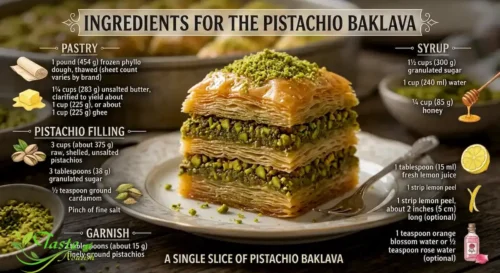
Phyllo (filo). Phyllo is a flour-and-water dough with almost no fat, so the butter you brush between sheets is what lets the layers puff apart and crisp instead of fusing. Thaw it slowly in the refrigerator, still sealed, following the package directions. Thawing in a hurry leaves condensation that glues the sheets together. Sheet size and thickness vary by brand. Sheets measuring 9 × 14 inches (23 × 35 cm) need only a light trim for this pan, and 14 × 18-inch sheets can be cut in half crosswise. Turkish bakers often roll their own very thin sheets, but packaged phyllo is the practical choice at home.
Pistachios. Buy raw, shelled, unsalted kernels. Salted roasted pistachios make the filling taste salty, and extra roasting in the oven dulls flavor. If your pistachios smell stale, bitter, or like paint, do not use them. The filling will turn from bright green to a muted olive in the oven, which is normal. The bright green comes from the garnish added after baking.
Clarified butter. Regular butter contains water and milk solids. The water creates steam that can soften the sheets, and the solids brown before the pastry is fully baked. Clarifying removes both and leaves pure golden butterfat. Ghee is already clarified and can be used directly.
Syrup ingredients. The syrup is about 1½ parts sugar to 1 part water by volume, plus honey. Water content matters: a thinner syrup brings more moisture into the pastry and makes sogginess more likely. Lemon juice and honey both help prevent crystallization because they supply or create invert sugars, which keep the syrup smooth.
Two small saucepans, one for the butter and one for the syrup
Sharp, thin-bladed knife or serrated knife
Plastic wrap and a clean, barely damp kitchen towel
Kitchen scale and candy thermometer (helpful, not required)
Instructions
1. Thaw the phyllo. Leave the package sealed in the refrigerator overnight. Before using, let it sit at room temperature for about an hour, or as the package directs, so the sheets unroll without cracking.
2. Clarify the butter. Melt the butter in a small saucepan over low heat without stirring. Let it stand off the heat for 2 to 3 minutes. Skim the foam from the top, then pour the clear golden fat into a bowl, leaving the milky layer behind. You should have about 1 cup. Keep it liquid at warm room temperature.
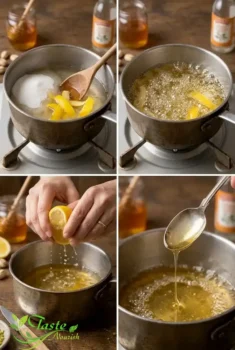
3. Make the syrup first. Combine the sugar, water, honey, and lemon peel in a saucepan. Stir over medium heat only until the sugar dissolves, then bring to a boil. Add the lemon juice and simmer gently, without stirring, for 8 to 10 minutes. The syrup is ready when it leaves a thin, glossy film on a spoon and runs off in a thin stream rather than clinging like honey. A thermometer should read about 220°F (104°C). Remove the peel, stir in the flower water if using, and let the syrup cool to room temperature. It will thicken as it cools. It must not be hot when it meets the pastry.
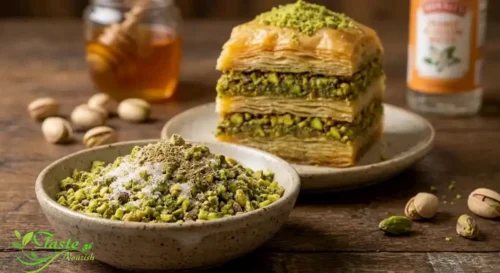
4. Prepare the filling. Pulse the 3 cups of pistachios in short bursts until they range from coarse sand to small pea-sized pieces. Stop before they clump or turn oily. Toss with the sugar, cardamom, and salt. Separately, grind 2 tablespoons of pistachios to a fine powder for garnish.
5. Preheat and prepare the pan. Heat the oven to 350°F (175°C) with a rack in the center. Brush the bottom and sides of the pan lightly with clarified butter.
6. Trim and cover the phyllo. Unroll the stack and trim it to fit the pan, using one trimmed sheet as a template. Cover the stack with plastic wrap and then the barely damp towel. Remove one sheet at a time.
7. Build the bottom layers. Lay a sheet in the pan and brush it lightly with butter, covering the edges and corners. Repeat until you have used about 40 percent of the sheets (16 sheets from a typical 40-sheet package). The butter should leave a thin sheen without pooling. Small tears will not show.
8. Add half the filling. Spread half the pistachio mixture evenly to the edges and press lightly with your palm.
9. Build the middle layers. Add about 20 percent of the sheets (8 from a 40-sheet package), brushing each one. Spread the remaining filling over them and press lightly.
10. Build the top layers. Layer the remaining sheets (about 16), brushing each. Tuck in any overhanging edges. Finish with a generous but even coat of the remaining butter on the top sheet.
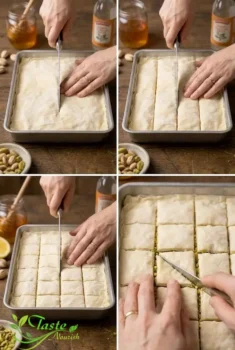
11. Cut before baking. With a sharp knife held vertical, cut all the way to the bottom of the pan. Make 3 cuts parallel to the long side to form 4 strips, then 5 cuts across to form 24 squares. For smaller pieces, cut each square in half diagonally. Press the top layers down lightly with your free hand as you cut.
12. Bake. Bake for 45 to 55 minutes, until the top is deep golden brown, the layers look puffed and crisp, and the edges have started to pull slightly from the pan. If the top browns well before the edges, tent loosely with foil. At 45 minutes, lift a corner piece with a small spatula to check that the underside is golden, not pale.
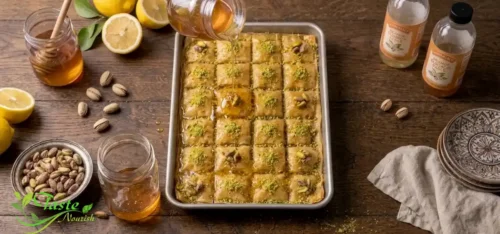
13. Add the syrup. Pour the cooled syrup over the hot pastry right after it leaves the oven. Start with about 1 cup, drizzling slowly over the cuts and surface. It will sizzle. Wait a minute or two, then add more in stages until the top looks glossy and syrup is visible in the cuts without standing in the pan. You may have a few tablespoons left over.
14. Garnish. Sprinkle the ground pistachios over the top while the syrup is still tacky.
15. Rest. Leave the pan uncovered at room temperature for at least 4 hours, ideally overnight. Re-cut any pieces that have stuck together, then serve.
Nutrition Facts
Approximate nutrition per piece (1 of 24)
Nutrient
Amount
Calories
about 290
Total fat
about 17 g
Saturated fat
about 7 g
Carbohydrates
about 32 g
Total sugars
about 18 g
Fiber
about 2 g
Protein
about 5 g
These figures are estimates calculated from standard ingredient values, not laboratory analysis. They assume all the butter and syrup are consumed. Because some syrup is left in the pan and brands of phyllo differ, actual values may be somewhat lower.
How to Keep Pistachio Baklava Crisp: The Reasoning Behind the Steps
The target texture is a crackling top, a tender, syrupy center, and a bottom that is crisp without being hard. Four decisions control it.
Thin, even butter
Each sheet needs a coat thin enough to leave a sheen but not a puddle. Too little butter leaves layers dry and papery, and they stick together instead of separating. Too much collects at the bottom of the pan and fries the lower layers, which turns them greasy. Brush all the way to the edges, because uncoated edges bake hard and pale.
Cutting before baking
Fully baked phyllo is brittle. A knife pushed through it crushes the top layers and sends flakes across the pan. Cutting before baking lets the pieces bake as separate units, and it gives the syrup channels to reach the middle and bottom layers.
Cooled syrup on hot pastry
Hot, dry pastry takes up cool syrup steadily and releases steam through the cuts as it does, which keeps the layers crisp. If both are hot, the thin syrup soaks in too quickly and the layers can collapse. If both are cold, the syrup sits on the surface and the center stays dry. A temperature difference between the two is the working principle. Pouring in stages also lets you stop when the pastry is saturated, since absorption varies with the pan, the number of layers, and how well the pastry was baked.
Resting
Syrup keeps moving through the layers for hours after it is poured. A rest of at least four hours lets the middle become tender and evenly sweet while the top dries and re-crisps as the pan cools.
Substitutions for Pistachio Baklava: What Works and What Doesn’t
Ghee for clarified butter: Use it in equal volume. The flavor is slightly nuttier and the crispness is the same.
Walnuts or almonds for part of the pistachios: Replace up to half by weight. Walnuts add a faint bitterness and a softer crunch, while almonds are milder. The filling will lose its green color and distinctive flavor, so a full replacement makes a different dessert.
Honey: Replace it with an equal amount of light corn syrup or glucose syrup for a more neutral flavor. Or leave it out and add ¼ cup (50 g) more sugar to the syrup. Keep the lemon juice either way, since it guards against crystallization. The honey flavor and a little sweetness will be missing.
Cardamom: Omit it or use ¼ teaspoon ground cinnamon. The filling will taste less floral.
Salted pistachios: Not recommended. Removing the salt from the recipe will not fix the pistachios’ own saltiness, and the syrup will not mask it.
Phyllo: There is no reliable substitute. Puff pastry, kataifi, and other doughs behave differently and produce a different dessert. Gluten-free phyllo products exist in some markets but handle differently, so follow the package directions.
Lighter Adjustments for Pistachio Baklava
Baklava is a rich dessert, and the proportions above are what give it its characteristic texture. If you want to adjust it modestly, these changes work without ruining the recipe.
Cut the syrup sugar by up to one quarter (to 1⅛ cups / 225 g). The syrup will be less sweet and a little thinner, so simmer it a minute or two longer and pour slightly less. Thinner syrup raises the risk of a soggy result. Honey is still a sugar and is not a lighter swap.
Reduce the filling sugar to 1 tablespoon. The pistachios supply sweetness and the effect on texture is negligible.
Brush the butter a little more sparingly if you can still coat every sheet evenly. Going too far will cost you crispness first, since the layers need fat to separate.
Cut smaller pieces. Dividing the squares into 48 triangles halves the serving size without changing the recipe.
Troubleshooting Pistachio Baklava
Why is my baklava soggy?
Likely causes are too much syrup, syrup that was too thin or too hot, pastry that was underbaked and pale, or a tight cover placed over warm baklava that trapped steam. Butter pooled at the bottom of the pan can also soften the lower layers. If the pan has already been soaked, transfer the pieces to a baking sheet and warm them at 300°F (150°C) for about 10 minutes, then cool uncovered. This may recover some crispness but will not fully reverse it. Next time, bake to deep golden, pour in stages, and stop when the syrup stops being absorbed.
Why are the layers dry, papery, or tough?
The sheets probably dried out while you worked, or too little butter was used between them. Overbaking can cause the same result. Keep the stack covered, brush each sheet edge to edge, and start checking for color at 45 minutes.
Why is the bottom pale or doughy?
A pan that heats slowly, a rack set too high, or a bake cut short usually causes this. A metal pan on a center or lower rack browns the bottom more reliably than glass. If the top is already dark, tent it with foil and bake a little longer.
Why did the top layers shatter and slide when I cut?
The baklava was probably cut after baking, or the knife was dull. Cut the unbaked pastry with a sharp, thin knife held vertical, and press the top gently with your free hand.
Why did my syrup turn grainy?
Stirring after the syrup boils, sugar crystals clinging to the pan sides, or leaving out the lemon juice are the usual causes. To fix it, add 2 to 3 tablespoons of water, warm gently until the crystals dissolve, and bring it back to a brief simmer. To prevent it, stir only until the sugar dissolves and wipe down the pan sides with a wet brush.
Why did the nuts taste bitter or the top burn?
An oven running hot, a rack set too high, or stale pistachios can all cause this. Check your oven temperature with a thermometer, and tent the pan with foil if the top darkens early.
Serving Pistachio Baklava
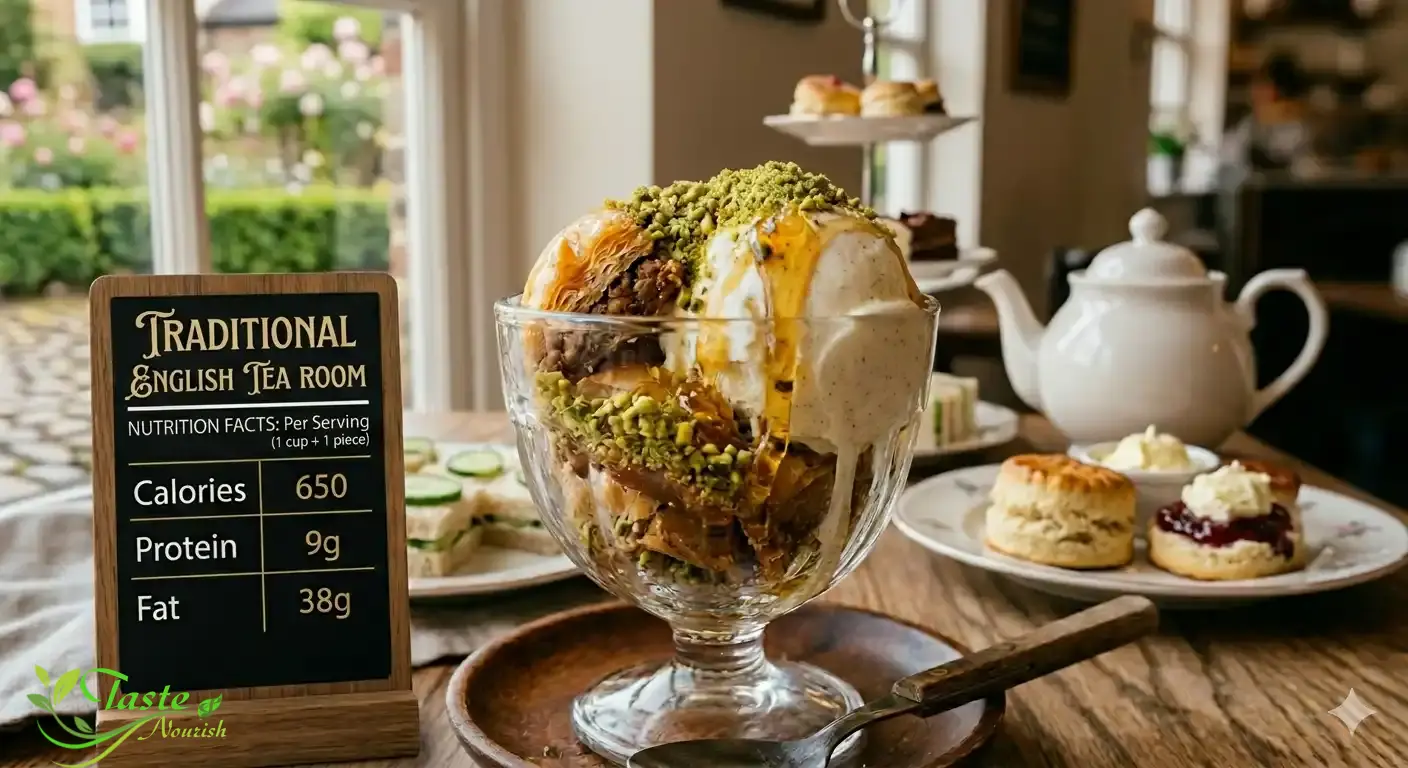
Serve baklava at room temperature in small pieces, since it is very rich. Strong Turkish tea or coffee is a traditional pairing. A spoonful of kaymak (clotted cream) or plain ice cream is also common. Keep any dairy accompaniment refrigerated until just before serving. Paper liners help keep sticky pieces from sticking together on a platter, and wiping the knife between cuts keeps the edges clean. Add the ground pistachio garnish right after the syrup goes on, not later.
Variations on Pistachio Baklava
Pistachio-walnut: Replace up to half the pistachios with finely chopped walnuts for a more affordable filling with a deeper, slightly bitter note.
Floral: Stir ½ teaspoon of rose water into the syrup after cooking. Rose water is strong, so add it sparingly.
Orange-lemon syrup: Replace the lemon peel with a strip of orange peel and keep the lemon juice for stability.
Dairy-free: Brush the sheets with a light neutral oil in the same thin coat. The pastry will crisp, but it will lack the flavor of butter and may brown slightly differently.
Storing and Freezing Pistachio Baklava
Room temperature. After the first rest, cover the pan loosely with foil or a lid left slightly ajar. A tight seal traps moisture and softens the top. Crispness fades gradually, with the best texture in the first few days. Keeping it at cool room temperature is the traditional approach. Refrigeration firms the butter and hardens the layers, so reserve it for a very warm kitchen, in an airtight container, and let the pieces return to room temperature before serving. Baklava has no eggs or fresh cream, but the butter and nuts can turn rancid. Discard it if you see mold or notice a sour, stale, or rancid smell, and do not taste it to check.
Freezing. Baklava freezes reasonably well, though the layers come out somewhat less crisp. Cool it completely, then layer pieces in an airtight container with parchment between them, or wrap them tightly in plastic and foil. Thaw in the refrigerator, then bring to room temperature. If you like, re-crisp the pieces at 300°F (150°C) for 5 to 8 minutes and cool them again. USDA guidance notes that food kept constantly at 0°F stays safe, and that storage times are about quality. Food stored too long can develop rancid or off odors and should be discarded.
From My Kitchen
I recommend making the syrup before you unwrap the phyllo, so it cools while you assemble and bake. Trim one sheet to the pan and cut the others against it so the stack stays uniform. When cutting, keep the knife vertical and press only enough to hold the top layers in place, because sawing at an angle drags the pastry. I’d also hold the garnish pistachios until the syrup is on, since that is when their bright green shows best.
Pistachio Baklava FAQs
Can I make pistachio baklava ahead of time?
Yes, and it is best made the day before serving. The four-hour rest is part of the recipe, so baking in the afternoon for the next day works well. See the storage section for keeping it afterward.
Do I have to clarify the butter?
It is not strictly required, but it produces crisper layers. Whole melted butter works, though the water in it can soften the sheets and the milk solids may brown faster. Ghee is a convenient shortcut.
What if my phyllo tears or dries out while I work?
Small tears in the middle layers are invisible once baked, so patch them with scraps. Dry, cracked sheets usually mean the stack was uncovered too long. Keep it under plastic wrap and a barely damp towel and remove one sheet at a time.
Can I pour hot syrup on baklava that has already cooled?
Yes. The reverse approach, hot syrup on cooled baklava, relies on the same temperature contrast. This recipe uses cool syrup on hot pastry because it is easier to time for beginners.
Why is my filling olive green instead of bright green?
Heat dulls the green of pistachios during baking. Garnishing with fresh ground pistachios after the syrup goes on restores the bright color.
Can I make a smaller batch or use a different pan?
For an 8 × 8-inch (20 cm) pan, halve the recipe. The layer depth stays similar, so start checking for color at about 45 minutes. Use a metal pan when possible.
Who should avoid this baklava?
People with wheat, milk, or tree nut allergies should avoid it, since pistachios are a tree nut and tree nuts, milk, and wheat are all major food allergens recognized by the FDA. Because the syrup contains honey, do not serve it to infants under 12 months. University of Florida IFAS Extension notes the CDC and American Academy of Pediatrics recommendation against honey for infants.
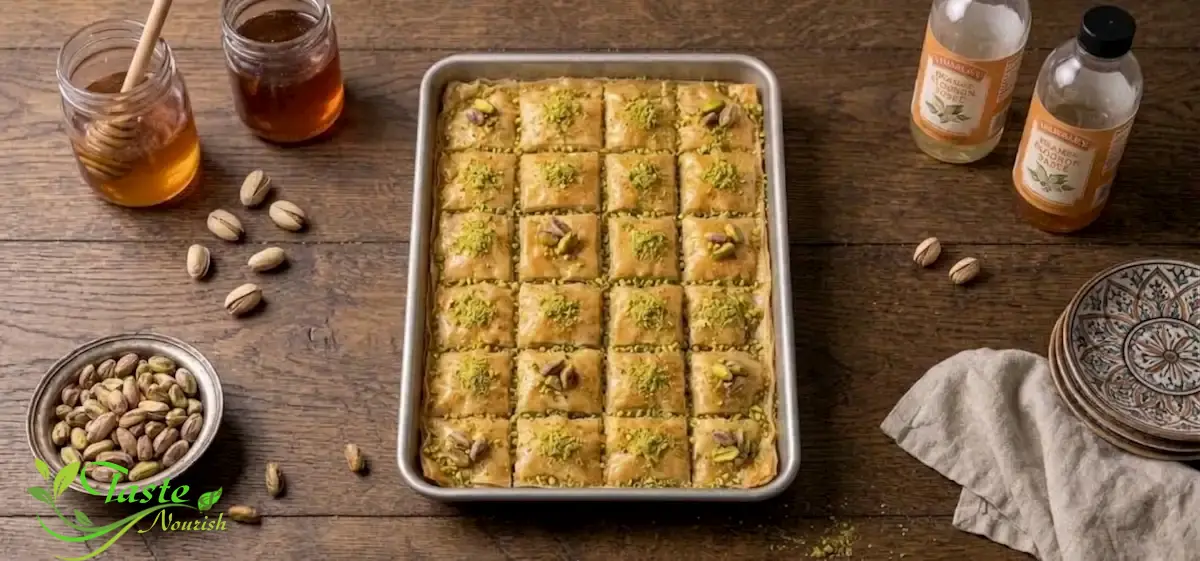
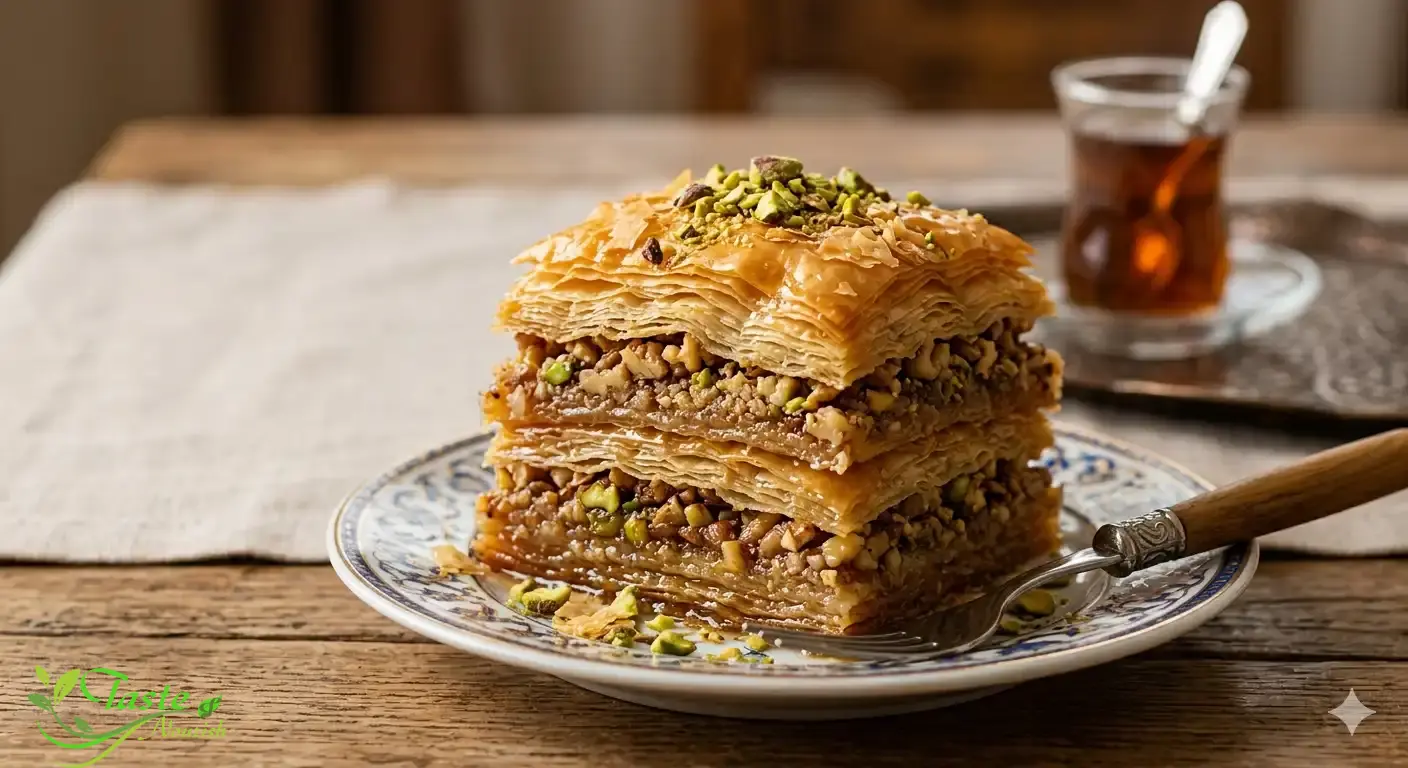
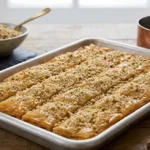
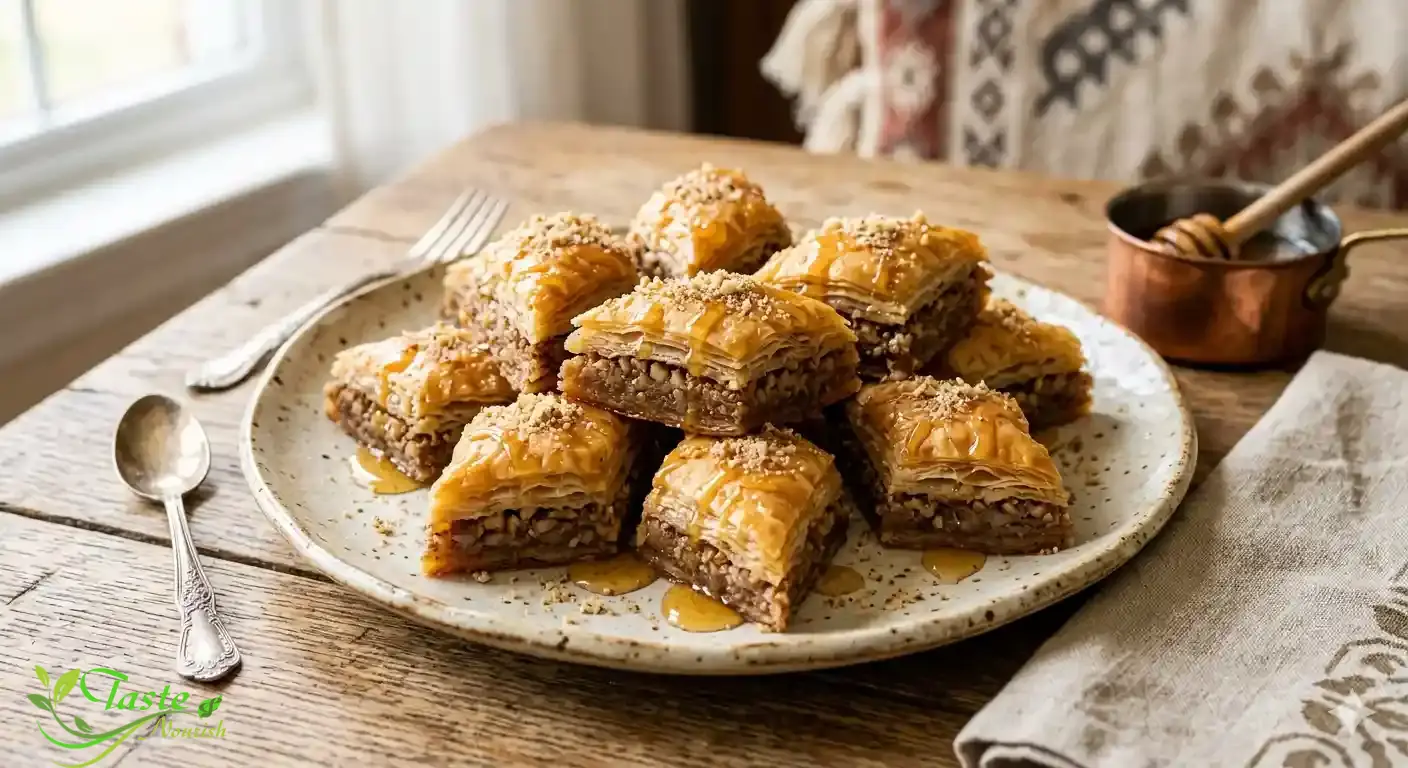
Crisp, golden pistachio baklava made with thin butter-brushed phyllo, a coarse cardamom-spiced pistachio filling, and a cooled lemon-honey syrup poured over hot pastry.
Leave the phyllo sealed in the refrigerator overnight. Before using, let it sit at room temperature for about an hour, or as the package directs, so the sheets unroll without cracking.
Melt the butter in a small saucepan over low heat without stirring. Let it stand off the heat for 2 to 3 minutes. Skim the foam, then pour the clear golden fat into a bowl, leaving the milky layer behind. You should have about 1 cup. Keep it liquid at warm room temperature.
Combine the sugar, water, honey, and lemon peel in a saucepan. Stir over medium heat only until the sugar dissolves, then bring to a boil. Add the lemon juice and simmer gently, without stirring, for 8 to 10 minutes, until the syrup leaves a thin glossy film on a spoon (about 220°F / 104°C). Remove the peel, stir in the flower water if using, and cool to room temperature.
Pulse the 3 cups of pistachios in short bursts until they range from coarse sand to small pea-sized pieces, stopping before they turn oily. Toss with the sugar, cardamom, and salt. Separately, grind 2 tablespoons of pistachios to a fine powder for garnish.
Heat the oven to 350°F (175°C) with a rack in the center. Brush the bottom and sides of a 9 × 13-inch (23 × 33 cm) metal pan lightly with clarified butter.
Unroll the phyllo stack and trim it to fit the pan. Cover the stack with plastic wrap and a barely damp towel, and remove one sheet at a time.
Lay a sheet in the pan and brush it lightly with butter, including the edges and corners. Repeat until you have used about 40 percent of the sheets (16 sheets from a typical 40-sheet package). The butter should leave a thin sheen without pooling.
Spread half the pistachio mixture evenly to the edges and press lightly with your palm.
Add about 20 percent of the sheets (8 from a 40-sheet package), brushing each one with butter. Spread the remaining filling over them and press lightly.
Layer the remaining sheets (about 16), brushing each with butter. Tuck in any overhanging edges and finish with a generous, even coat of butter on the top sheet.
With a sharp knife held vertical, cut all the way to the bottom of the pan. Make 3 cuts parallel to the long side to form 4 strips, then 5 cuts across to form 24 squares. For smaller pieces, cut each square in half diagonally.
Bake for 45 to 55 minutes, until the top is deep golden brown, the layers look puffed and crisp, and the edges pull slightly from the pan. If the top browns well before the edges, tent loosely with foil. At 45 minutes, lift a corner piece to check that the underside is golden, not pale.
Right after the pan leaves the oven, pour the cooled syrup over the hot pastry. Start with about 1 cup, drizzling slowly over the cuts and surface. Wait a minute or two, then add more in stages until the top looks glossy and syrup is visible in the cuts without pooling in the pan.
Sprinkle the finely ground pistachios over the top while the syrup is still tacky.
Leave the pan uncovered at room temperature for at least 4 hours, ideally overnight. Re-cut any pieces that have stuck together, then serve.
Notes
If your phyllo package has fewer, thicker sheets, keep the same proportions (about 40, 20, and 40 percent) and expect the baking time to land at the higher end of the range.
Contains wheat, milk, and tree nuts. The syrup contains honey.
Conclusion
Three controls make the difference in pistachio baklava: thin, even butter on every sheet, a bake that reaches deep golden, and cooled syrup added in stages. Once you have felt how the pastry looks at the right moment, you can tune the sweetness, the flower water, and the nut blend to your own taste without losing the crunch.
**Hanan Abo Samra** shares practical cooking insights, delicious recipes, and evidence-based nutrition information. Drawing on more than 20 years of hands-on cooking experience, she creates helpful food content that combines everyday cooking knowledge with information from reliable scientific sources. Her goal is to help readers better understand the foods they eat, explore their nutritional benefits, and prepare delicious meals with confidence.