Blueberries show up on nearly every “superfood” list, and there’s real substance behind the hype. This small, deep-blue fruit packs fiber, vitamin C, vitamin K, and a group of plant pigments called anthocyanins into a low-calorie package. In this guide, we’ll walk through the health benefits of blueberries, what the science actually supports, how many you should eat, and how to store and prepare them so you get the most out of every handful.
The health benefits of blueberries mainly come from their antioxidant and anti-inflammatory plant compounds, especially anthocyanins, combined with their fiber, vitamin C, and vitamin K content. Research suggests that regular blueberry intake may support heart health, help regulate blood sugar, and contribute to healthy brain aging. A single cup provides meaningful nutrition for under 90 calories, making blueberries an easy addition to most eating patterns. As with any single food, they work best as part of an overall healthy diet rather than a stand-alone fix.
Key Takeaways
The health benefits of blueberries are largely tied to anthocyanins, the pigments responsible for their deep blue color.
One cup of raw blueberries has about 84 calories, roughly 3.6 grams of fiber, and solid amounts of vitamin C and vitamin K.
Research suggests blueberries may support heart health, blood sugar regulation, and cognitive function, though much of the strongest evidence comes from studies using concentrated amounts rather than occasional snacking.
Blueberries are generally safe for most people, but those on blood-thinning medication or with certain kidney conditions should discuss regular intake with a doctor.
Frozen blueberries retain essentially the same nutrition as fresh ones, so “fresh is always better” is more myth than fact.
What Are Blueberries?
Blueberries belong to the genus Vaccinium, the same plant family as cranberries and huckleberries. Most blueberries sold in grocery stores are highbush varieties, cultivated across North America and increasingly around the world. Wild, or lowbush, blueberries are smaller and slightly more intense in flavor, with a somewhat higher concentration of anthocyanins per gram.
Botanically, blueberries are true berries, meaning the entire fruit develops from a single flower with one ovary. They ripen from green to deep blue-purple, with a natural waxy coating called “bloom” that helps protect the fruit and gives it a slightly dusty appearance.
Blueberry Nutrition Facts
Here’s what a standard 1-cup (148 g) serving of raw blueberries provides, according to the USDA .
Nutrient
Amount per 1 cup (148 g)
% Daily Value
Calories
84
—
Total Carbohydrate
21 g
8%
Dietary Fiber
3.6 g
13%
Total Sugars
15 g
—
Protein
1.1 g
2%
Total Fat
0.5 g
1%
Vitamin C
14 mg
16%
Vitamin K
28.6 mcg
24%
Manganese
0.5 mg
22%
Potassium
114 mg
2%
Blueberries are also about 84% water, which is part of why they’re so low in calories relative to their volume.
Health Benefits of Blueberries: What Science Says
Below are the areas where research is most consistent. It’s worth noting upfront that many studies use blueberry powders, extracts, or larger daily amounts than a typical snack portion, so results don’t always translate one-to-one to casual eating.
Heart Health and Blood Pressure
Several controlled studies have looked at blueberries and cardiovascular markers. According to Harvard Health Publishing, a study of healthy men found that consuming about one cup of blueberries daily for a month improved blood vessel function and modestly lowered systolic blood pressure compared with a control drink. Researchers linked this effect to anthocyanins improving how well the cells lining blood vessels work.
Separately, long-term observational research from the Harvard T.H. Chan School found that women who regularly ate blueberries and strawberries had a lower risk of heart attack over an 18-year follow-up period compared with women who rarely ate them.
Blood Sugar and Type 2 Diabetes Risk
Blueberries have a moderate glycemic index, and their fiber and polyphenol content may help slow the rise in blood sugar after eating. Population-level research has associated regular blueberry consumption with a somewhat lower risk of developing type 2 diabetes over time, though this doesn’t prove cause and effect on its own.
Brain Health and Memory
Interest in blueberries and cognitive aging has grown substantially. A comprehensive review published in the journal Antioxidants and hosted on the National Institutes of Health’s PubMed describes evidence linking anthocyanins to neuroprotective effects and improved markers of brain function in aging populations, largely through reduced oxidative stress and inflammation.
That said, most of the strongest cognitive findings come from clinical trials using blueberry powder or juice concentrate over several weeks, not from occasional fresh berries sprinkled on cereal.
Benefits of Eating Blueberries for Weight Management
Blueberries are low in calories and high in fiber and water, which can help with feeling full. Harvard-affiliated research has also linked diets rich in anthocyanin-containing foods, mainly blueberries and strawberries, to better long-term weight maintenance. Among the practical benefits of eating blueberries, their satiety-per-calorie ratio is one reason they’re a popular swap for higher-calorie snacks.
Immune and Skin Support
Vitamin C plays a role in collagen production and immune cell function, and a single cup of blueberries provides a meaningful share of the daily requirement. Antioxidant compounds in blueberries may also help offset some of the oxidative stress linked to skin aging, though direct human skin-outcome studies are still limited.
Exercise Recovery and Inflammation
Some nutritional intervention research has found that blueberry supplementation around exercise may support faster recovery from exercise-induced muscle damage, an effect researchers attribute to the fruit’s anti-inflammatory properties.
The Scientific Evidence Behind the Health Benefits of Blueberries
It helps to understand how strong the evidence actually is. A 2024 perspective paper in Frontiers in Nutrition, written by a panel of researchers convened for a blueberry health roundtable, summarized the current state of the science this way: regular blueberry consumption is associated with potential support for cardiovascular function, pre-diabetes and type 2 diabetes management, and brain and cognitive function, particularly in people with existing health conditions or age-related decline.
The same paper also pointed out where the science still has gaps. Much of the evidence comes from short-term clinical trials or observational studies, and researchers haven’t fully worked out optimal doses, how findings apply across different populations, or how blueberries compare directly to other polyphenol-rich foods. In short, the research direction is promising and consistent, but blueberries aren’t a substitute for medical treatment or a balanced diet overall.
Potential Risks and Side Effects of Blueberries
Blueberries are considered safe for the vast majority of people, but a few things are worth knowing:
Digestive discomfort: Eating large quantities at once may cause bloating or loose stools in people sensitive to fructose or high-fiber foods.
Blood thinner interactions: Vitamin K plays a role in blood clotting. People on warfarin or similar medications are usually advised to keep their vitamin K intake consistent day to day, rather than avoiding it entirely.
Oxalate content: Blueberries contain a modest amount of oxalates, which in very high amounts may be a consideration for people prone to certain types of kidney stones.
Allergic reactions: True blueberry allergies are rare but not impossible, and can include itching, swelling, or digestive symptoms.
Pesticide residue: Blueberries have appeared on some “higher residue” produce lists, which is one reason many people choose to rinse them thoroughly or buy organic when possible.
Who Should Avoid It?
Most people don’t need to avoid blueberries. A few groups should talk to a healthcare provider before making them a daily habit:
People on blood-thinning medication who haven’t discussed vitamin K intake with their doctor
People with a history of certain kidney stones who have been told to limit oxalate-rich foods
Anyone with a diagnosed berry or salicylate allergy
People closely managing blood sugar who need individualized guidance on fruit portions
How Much Should You Eat?
Most research linking blueberries to health benefits uses amounts around 1 cup (roughly 150 grams) per day, sometimes as fresh fruit and sometimes as an equivalent amount of freeze-dried powder or juice concentrate.
For general health, a cup a day is a reasonable, well-supported target for most healthy adults. There’s no evidence that eating more provides proportionally greater benefits, and very high fruit intake can add unnecessary sugar and calories to the diet.
How to Choose the Best Blueberries
Look for berries that are firm and have a deep blue to blue-purple color with a light silvery “bloom” on the skin.
Avoid berries that look shriveled, dull, or have visible mold, especially at the bottom of the container.
Check the bottom of the packaging for juice stains, which can signal crushed or overripe fruit underneath.
Size doesn’t indicate quality. Smaller wild blueberries are often more concentrated in flavor and anthocyanins than large cultivated ones.
For frozen blueberries, choose bags where the berries move freely rather than being clumped into a solid block, which can indicate thawing and refreezing.
Storage Tips
Store fresh blueberries unwashed in the refrigerator, ideally in a container that allows some airflow. They’ll typically keep for 1 to 2 weeks this way. Wash them only right before eating, since excess moisture speeds up spoilage and mold growth.
For longer storage, spread unwashed berries in a single layer on a baking sheet, freeze until solid, then transfer to a freezer bag. This keeps them from clumping and lets you pour out just what you need. Frozen properly, blueberries stay in good quality for up to a year.
Best Ways to Eat or Cook Blueberries
Eat them raw as a snack, or toss into oatmeal, yogurt, or salads
Blend into smoothies, where freezing doesn’t reduce their nutritional value
Fold into muffins, pancakes, or quick breads for natural sweetness
Simmer into a light compote or sauce for pancakes, yogurt, or roasted meats
Add to homemade salad dressings or vinaigrettes for natural color and flavor
Cooking at high heat for long periods can reduce some heat-sensitive antioxidants, so gentle cooking methods and shorter cook times generally preserve more of their beneficial compounds.
Common Mistakes
Washing before storing — This introduces moisture that speeds up mold growth.
Judging quality by size alone — Bigger berries aren’t necessarily more nutritious or flavorful.
Assuming frozen is inferior — Frozen blueberries are typically picked and flash-frozen at peak ripeness, preserving most nutrients.
Overcooking them — Long exposure to high heat can degrade some antioxidant compounds.
Relying on blueberries alone for health outcomes — They work best alongside a varied diet, not as an isolated fix.
Myths vs Facts About Blueberries
Myth
Fact
Fresh blueberries are always healthier than frozen
Frozen blueberries have a comparable nutrient profile, since they’re usually frozen at peak ripeness
Blueberries can cure or reverse memory loss
Research suggests they may support brain health, but no food reverses diagnosed cognitive decline
Bigger blueberries are more nutritious
Smaller wild varieties often have a higher concentration of anthocyanins per gram
You need blueberry supplements to get the benefits
Whole fruit is generally recommended over pills or extracts by nutrition researchers
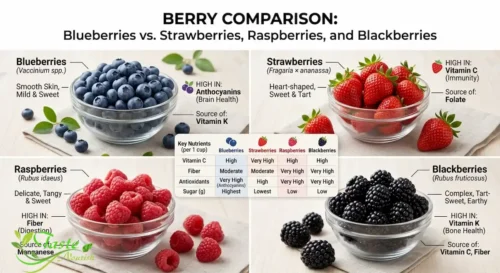
Blueberries vs Other Berries: A Quick Comparison
Berry (1 cup, raw)
Calories
Fiber
Vitamin C
Notable Strength
Blueberries
84
3.6 g
14 mg
High in anthocyanins and vitamin K
Strawberries
49
3 g
89 mg
Very high vitamin C, lower calories
Raspberries
64
8 g
32 mg
Highest fiber of the common berries
Blackberries
62
7.6 g
30 mg
High fiber and vitamin K
FAQs About the Health Benefits of Blueberries
Are blueberries good for you every day?
For most healthy adults, eating around a cup of blueberries daily is well within a normal, balanced diet and aligns with the amounts used in much of the supporting research.
Do frozen blueberries have the same benefits as fresh?
Yes. Frozen blueberries are usually picked at peak ripeness and flash-frozen shortly after, which preserves most of their vitamins, fiber, and antioxidant compounds.
Can blueberries help with weight loss?
They aren’t a weight-loss food on their own, but their low calorie count, fiber, and water content can make them a satisfying swap for higher-calorie snacks as part of a broader eating plan.
Are blueberries safe for people with diabetes?
Blueberries have a moderate glycemic index and are often considered a reasonable fruit choice for people managing blood sugar, though portion size and individual response still matter. Anyone with diabetes should check with a healthcare provider about how fruit fits into their specific plan.
What are the benefits of eating blueberries compared to a supplement?
Whole blueberries provide fiber, water, and a broader mix of plant compounds that isolated supplements typically lack. Most nutrition researchers recommend getting these benefits from the whole fruit rather than concentrated pills.
Conclusion: The Health Benefits of Blueberries in Perspective
The health benefits of blueberries are backed by a genuinely strong and growing body of research, particularly around heart health, blood sugar regulation, and brain aging. They’re not a miracle food, and no single ingredient can replace an overall healthy diet, but blueberries are an easy, low-calorie way to add fiber, vitamins, and antioxidant plant compounds to your day. Whether fresh, frozen, or baked into something warm, a regular cup of blueberries is a small habit with research-backed upside.
Hanan Abo Samra is the founder of Taste & Nourish, sharing trustworthy nutrition guidance and recipes drawn from 20+ years of hands-on cooking experience. When she's not developing new recipes, Hanan is researching the science behind everyday ingredients to bring readers practical, evidence-based guidance for a healthier lifestyle.