
Brussels Sprouts Nutrition Facts: Calories in 1 Cup
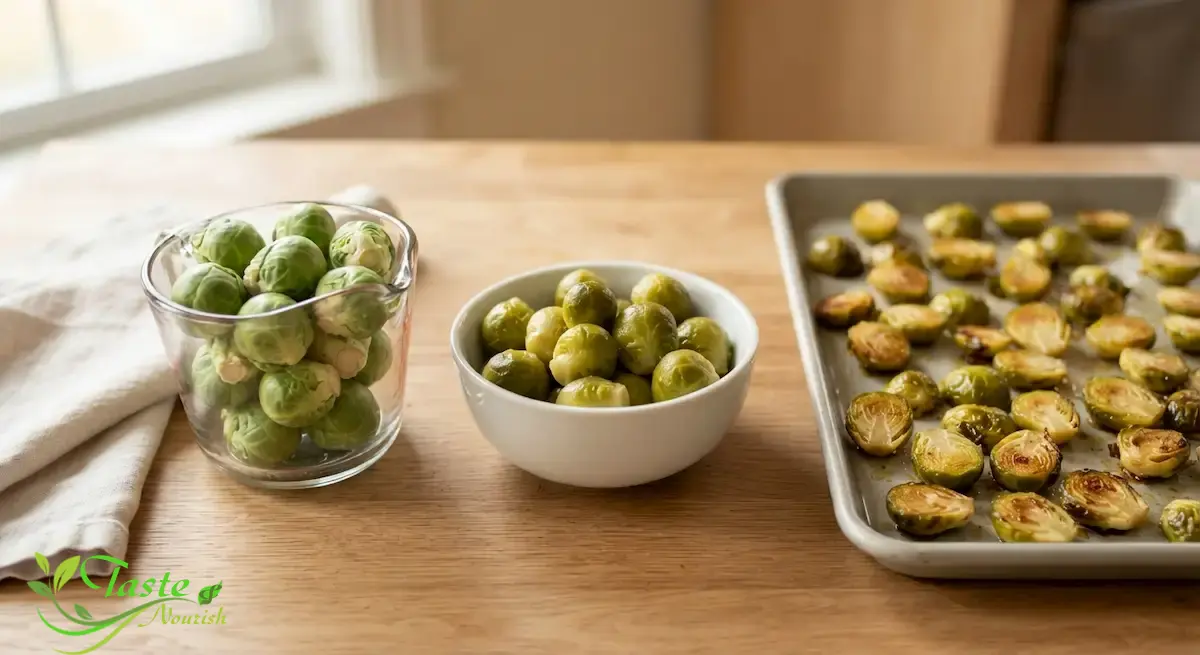
Searching for brussels sprouts nutrition facts usually turns up one tidy set of numbers, as if every sprout were weighed, trimmed, and cooked the same way. The calories, carbs, and vitamin figures you see actually depend on whether the sprouts are raw or cooked, which USDA record a site copied, how heavy a “cup” is, and how much oil went into the pan.
This page puts the numbers side by side for raw, boiled, frozen, and roasted-style preparations, explains why reputable tables disagree, and shows how to estimate the portion on your own plate.
Brussels Sprouts Nutrition Facts: Quick Answer
Brussels sprouts nutrition facts in brief: a cup of raw sprouts has roughly 38 calories, about 8 g of carbohydrate, 3 g of fiber, and 3 g of protein. It also covers more than a full day’s vitamin K and most of the vitamin C Daily Value. Cooking, cup size, and added oil change these numbers.
Key Takeaways
- The brussels sprouts nutrition facts you find online differ because USDA publishes several records for the same vegetable. Vitamin C shows the widest gap, so treat any single figure as part of a range.
- Added fat, not the vegetable, drives most of the calorie spread between plain and roasted sprouts. Oil is the variable worth measuring.
- A cup of raw sprouts and a cup of cooked sprouts hold different amounts of vegetable, so cup-to-cup comparisons mislead. Compare by weight or by sprout count.
- Brussels sprouts carbs come with a meaningful share of fiber, so the carbs left after fiber are well below the headline carbohydrate number.
- Protein is modest. Sprouts work best as a nutrient-dense side rather than as a protein source.
- People who take warfarin do not need to avoid sprouts, but NIH advises keeping vitamin K intake consistent from day to day.
What Are Brussels Sprouts?
Brussels sprouts are the small, cabbage-like buds that grow along the stalk of a Brassica oleracea plant. That is the same species that gives us cabbage, kale, and broccoli. Nutritionally they sit close to their cruciferous relatives: low in calories, notable for vitamin K and vitamin C, and a useful source of fiber.
For a look at how the most familiar member of that family is evaluated, see our guide to broccoli’s health benefits.
Brussels Sprouts Nutrition Facts per Cup: Raw vs. Boiled
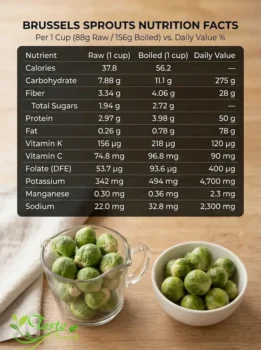
The table uses USDA’s SR Legacy entries for raw sprouts and for boiled, drained sprouts without salt. USDA lists the boiled entry per half cup (78 g), so the cooked column doubles those values to give a 156 g cup. Daily Values come from FDA’s reference list.
| Nutrient | Raw, 1 cup | Boiled, 1 cup | Daily Value |
|---|---|---|---|
| Calories | 37.8 | 56.2 | n/a |
| Carbohydrate | 7.88 g | 11.1 g | 275 g |
| Fiber | 3.34 g | 4.06 g | 28 g |
| Total sugars | 1.94 g | 2.72 g | n/a |
| Protein | 2.97 g | 3.98 g | 50 g |
| Fat | 0.26 g | 0.78 g | 78 g |
| Vitamin K | 156 µg | 218 µg | 120 µg |
| Vitamin C | 74.8 mg | 96.8 mg | 90 mg |
| Folate (DFE) | 53.7 µg | 93.6 µg | 400 µg |
| Potassium | 342 mg | 494 mg | 4,700 mg |
| Manganese | 0.30 mg | 0.36 mg | 2.3 mg |
| Sodium | 22.0 mg | 32.8 mg | 2,300 mg |
Notice that the boiled cup shows more vitamin C than the raw cup. Cooking does not add vitamin C. A cooked cup simply holds more sprouts by weight, which is why per-cup comparisons across preparations need care.
Vitamins and Minerals in Brussels Sprouts: What Counts as a Good Source
FDA’s label guide treats 5% of the Daily Value or less as low and 20% or more as high. Its nutrient content claim rules set the “good source” band at 10% to 19%. By that yardstick, a cup of raw sprouts is high in two nutrients: vitamin K at 130% of the Daily Value and vitamin C at 83%, according to USDA’s raw entry.
Folate, manganese, vitamin B6, thiamin, and fiber each land between 10% and 13% in that same entry, which makes raw sprouts a good source of those. Potassium, iron, protein, and calcium fall below 10% (7%, 7%, 6%, and 3%), so they are small contributions rather than reasons to choose sprouts.
That matters for protein in particular. Brussels sprouts are sometimes grouped with protein-rich vegetables, but at 6% of the Daily Value per raw cup they do not reach the good-source line. They are better described as a vegetable that adds a little protein alongside fiber.
USDA also reports 1,399 µg of lutein plus zeaxanthin and 396 µg of beta-carotene per raw cup. Neither has a Daily Value, and vitamin A itself is only 4% of the Daily Value.
Why Brussels Sprouts Nutrition Facts Differ Between Websites
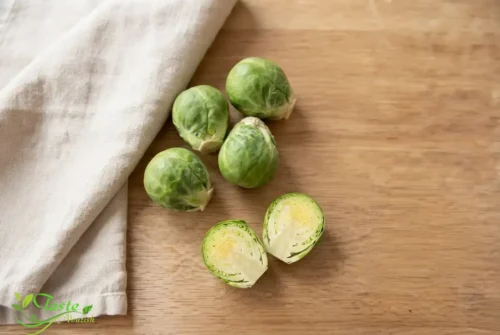
USDA’s SR Legacy record and its newer Foundation Foods record both describe raw sprouts, but they do not agree.
| Nutrient | SR Legacy | Foundation Foods |
|---|---|---|
| Calories | 43 | 48.8 |
| Protein | 3.38 g | 3.98 g |
| Carbohydrate | 8.95 g | 9.62 g |
| Fiber | 3.80 g | 4.79 g |
| Potassium | 389 mg | 477 mg |
| Folate | 61.0 µg | 86.0 µg |
| Vitamin C | 85.0 mg | 143 mg |
Neither record is an error. They describe different samples analyzed by different methods, and SR Legacy is USDA’s older reference data set, whose last release dates to 2018 per the FoodData Central documentation. Natural variation in variety, growing conditions, and storage adds to the spread.
In practice, pick one record and use it consistently if you track food. If you are counting on sprouts for a particular nutrient, read vitamin C especially as a range rather than a fixed figure.
Brussels Sprouts Calories: Raw, Boiled, Frozen, and Roasted
USDA’s entries for raw, boiled, frozen and boiled, cooked with no added fat, and cooked with fat added put calories per cup anywhere from the high 30s to just over 100. Almost all of that spread comes from cup weight and added fat rather than from the sprouts themselves.
| Preparation (USDA record) | Per 100 g | Per cup (weight) |
|---|---|---|
| Raw | 43 | 37.8 (88 g) |
| Boiled, drained, unsalted | 36 | 56.2 (156 g) |
| Frozen, boiled, drained, unsalted | 42 | 65.1 (155 g) |
| Cooked, no added fat (survey food) | 45 | 69.8 (155 g) |
| Cooked, fat added (survey food) | 67 | 107 (160 g) |
If you count sprouts instead of cups, one raw sprout comes to about 8 calories.
Calories in Roasted Brussels Sprouts
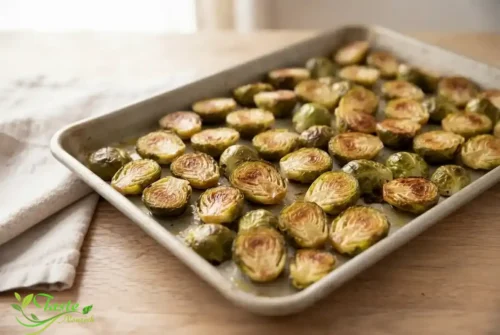
USDA has no record specifically for roasted Brussels sprouts, so any roasted figure is an estimate built from the vegetable plus the oil. The closest evidence is the pair of survey records for cooked sprouts without added fat and with fat added. They differ by roughly 37 calories per cup, and that gap is the fat.
The oil is the part you control. A tablespoon of olive oil carries about 119 calories. A pan tossed with 2 tablespoons that serves four therefore adds about 60 calories per serving before the sprouts are counted, and somewhat less if oil stays behind on the sheet pan. For what the research says about the oil itself, see our guide to olive oil’s health benefits.
Roasting also shrinks and dries the sprouts, so a cup of roasted sprouts holds more vegetable than a cup of raw. For a roasting method you can adapt, our balsamic roasted broccoli recipe is a good starting point.
Brussels Sprouts Carbs and Fiber: Carbs After Fiber
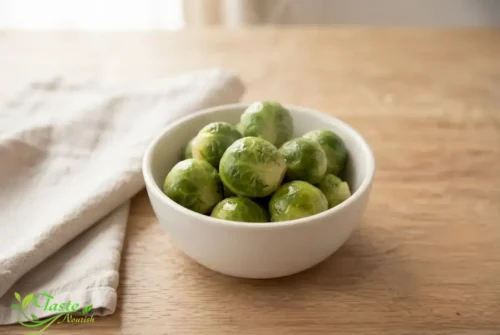
“Net carbs” is not an official FDA labeling term, but the arithmetic is simple: total carbohydrate minus fiber. For a raw cup in USDA’s raw record, that leaves about 4.5 g, and sugars make up roughly a quarter of the total carbohydrate.
A cup of boiled sprouts leaves about 7 g after fiber, using the doubled values from the boiled record. The difference reflects the larger amount of sprouts in a cooked cup, not a change in the vegetable’s makeup. Anyone tracking carbohydrates closely should log cooked sprouts by weight.
How Cooking Changes Brussels Sprouts Nutrition
Cooking mainly shifts the weight basis and can wash water-soluble nutrients into the pot. Per 100 g, USDA’s unsalted boiled record shows less vitamin C than its raw record (62 versus 85 mg), less vitamin K (140 versus 177 µg), and less potassium (317 versus 389 mg). Folate barely moves (60 versus 61 µg).
Part of that is dilution. Boiled sprouts carry more water, 88.9 g per 100 g compared with 86.0 g for raw, according to the same two records.
Laboratory work points the same way. A study of boiling, microwaving, and steaming on fresh and frozen brassica vegetables, including brussels sprouts, found that boiling lowered most of the plant compounds measured, though it raised some, such as polyphenols in fresh sprouts. Microwaving kept glucosinolates well. These were measurements of compounds in food, not health outcomes in people. How much is lost always depends on the nutrient, method, time, and whether the cooking water is discarded.
Vitamin K is fat-soluble. The NIH vitamin K fact sheet notes that eating vegetables with some fat improves absorption of the vitamin from them. A little oil does something useful here, not just add calories.
Vitamin K and Brussels Sprouts: Who Should Keep Portions Steady
People taking warfarin should keep vitamin K intake consistent from day to day, as the NIH vitamin K fact sheet advises, and Brussels sprouts are a sizable source. A half cup of boiled sprouts provides 109 µg, almost the same as the 110 µg NIH lists for half a cup of boiled broccoli. The guidance is steadiness, not avoidance, and any planned change in how much you eat is worth raising with your prescriber.
Kale is another cruciferous green rich in vitamin K, and our guide to kale’s health benefits covers it in more depth.
Like other cruciferous vegetables, sprouts can cause gas or bloating in some people, particularly after a large serving. People who follow a potassium-restricted diet for kidney disease should count sprouts in their plan with their care team.
Getting Accurate Numbers at Home
- Weigh, don’t scoop. USDA’s cup weights run from 88 g for raw to 160 g for cooked with fat. Weigh after trimming, since stem ends and loose outer leaves are not what the tables describe.
- Match the record to your pan. Use the boiled entry for plain boiled or steamed sprouts, the no-added-fat survey entry for typical cooked sprouts, and the fat-added entry only if you are not counting your own oil separately.
- Watch sodium. The unsalted boiled record has 21 mg per 100 g, while the survey record for typically prepared cooked sprouts, which reflects foods as people usually eat them, has 147 mg. Check frozen bags for seasoning or sauce.
- Measure oil with a spoon. A teaspoon of olive oil is about 40 calories, one third of the tablespoon figure, and pouring from the bottle usually delivers more.
- Use the cooking liquid. If you boil sprouts, fold the water into a soup or sauce so the water-soluble nutrients that leached out are not poured away.
Brussels Sprouts Nutrition Facts: Common Questions
How many Brussels sprouts are in a cup?
About four to five whole raw sprouts. Dividing the 37.84 calories in a raw cup by the 8.17 in one sprout gives roughly 4.6. Halved or shredded sprouts pack differently, so the count changes.
Are frozen Brussels sprouts as nutritious as fresh?
They are broadly comparable, with different strengths in USDA’s data. Per 100 g, frozen sprouts boiled without salt show more folate (101 µg) and less vitamin C (45.7 mg) than fresh sprouts boiled the same way (60 µg and 62 mg). Check the label for added sauce or salt.
Does roasting destroy the nutrients in Brussels sprouts?
Not necessarily, but this page cannot give a roasting-specific retention figure. USDA has no roasted record, and the laboratory comparison cited above tested boiling, microwaving, and steaming. Treat any precise roasting claim with caution and compare roasted portions by weight.
Can you eat Brussels sprouts every day?
For most healthy people, probably yes. The sources reviewed for this page do not set a daily limit for Brussels sprouts specifically, and variety across vegetables matters more than any single one. If you take warfarin, aim for the same amount of vitamin K each day and ask your prescriber how sprouts fit.
My Bottom Line
I would treat brussels sprouts nutrition facts as a range and stop worrying about the second decimal. The sprouts themselves are a low-calorie, fiber-containing vegetable. In my judgment, the figure worth tracking more closely is the oil in the pan, along with steadiness of portions if you take warfarin.
Conclusion
Reading brussels sprouts nutrition facts well comes down to matching the number to the preparation: raw or cooked, which USDA record, and what went into the pan. When those match, the figures hold up. When they do not, two correct-looking tables can disagree. Use the tables above as a starting point and weigh your own portions when precision matters.
Explore Brussels Sprouts and Related Foods by Topic
- Health benefits of broccoli: what the research says about the most familiar cruciferous vegetable.
- Health benefits of kale: nutrients and potential benefits of another vitamin K-rich leafy green.
- Health benefits of olive oil: what the evidence says about the fat most often used for roasting vegetables.
- Balsamic roasted broccoli: a roasting method you can adapt to other cruciferous vegetables.
This article offers general nutrition information and is not medical advice. If you have a medical condition or a food allergy, or you take medication such as a blood thinner, check with a qualified healthcare professional about how much of any food suits you.