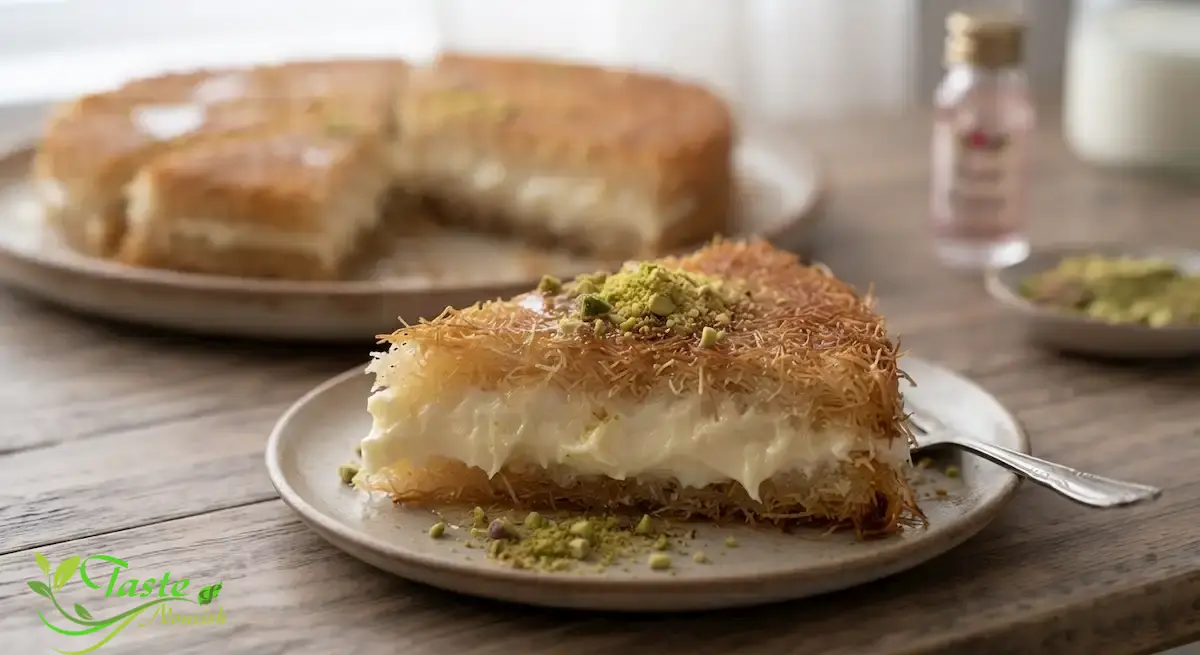
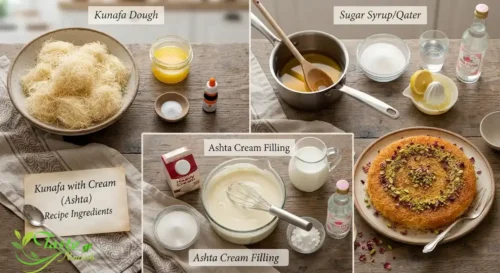
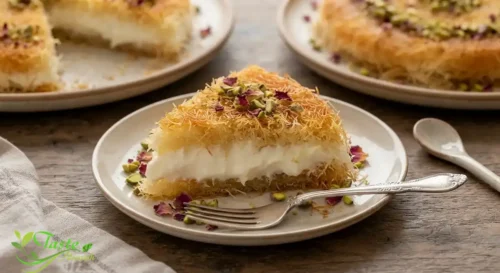
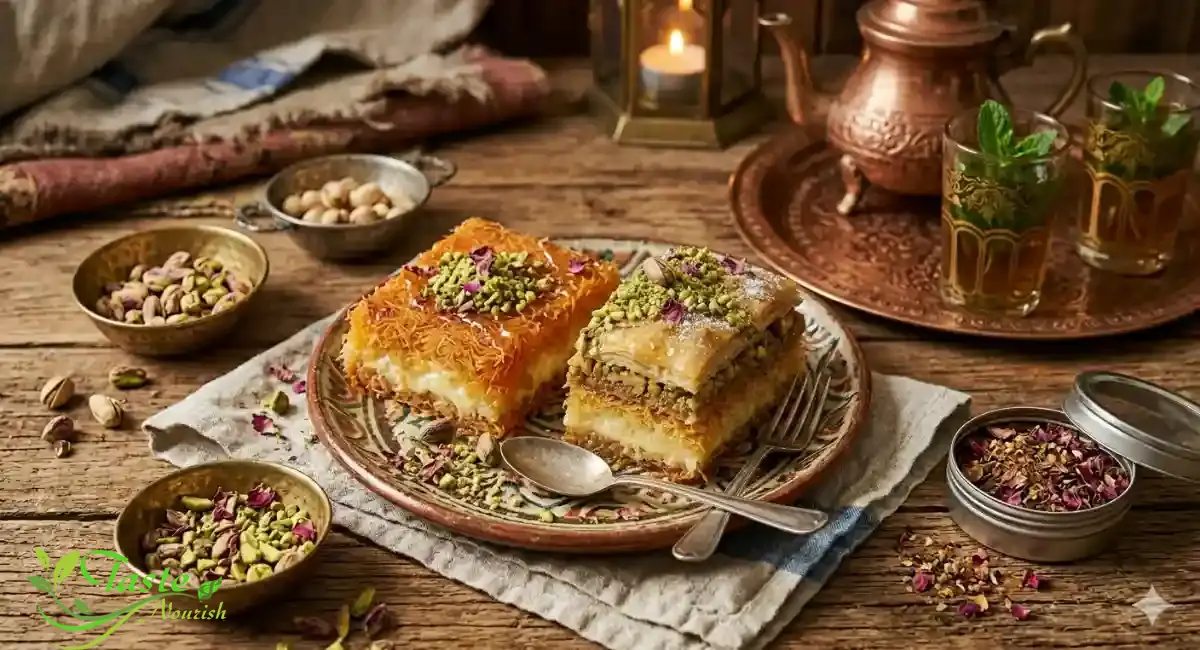
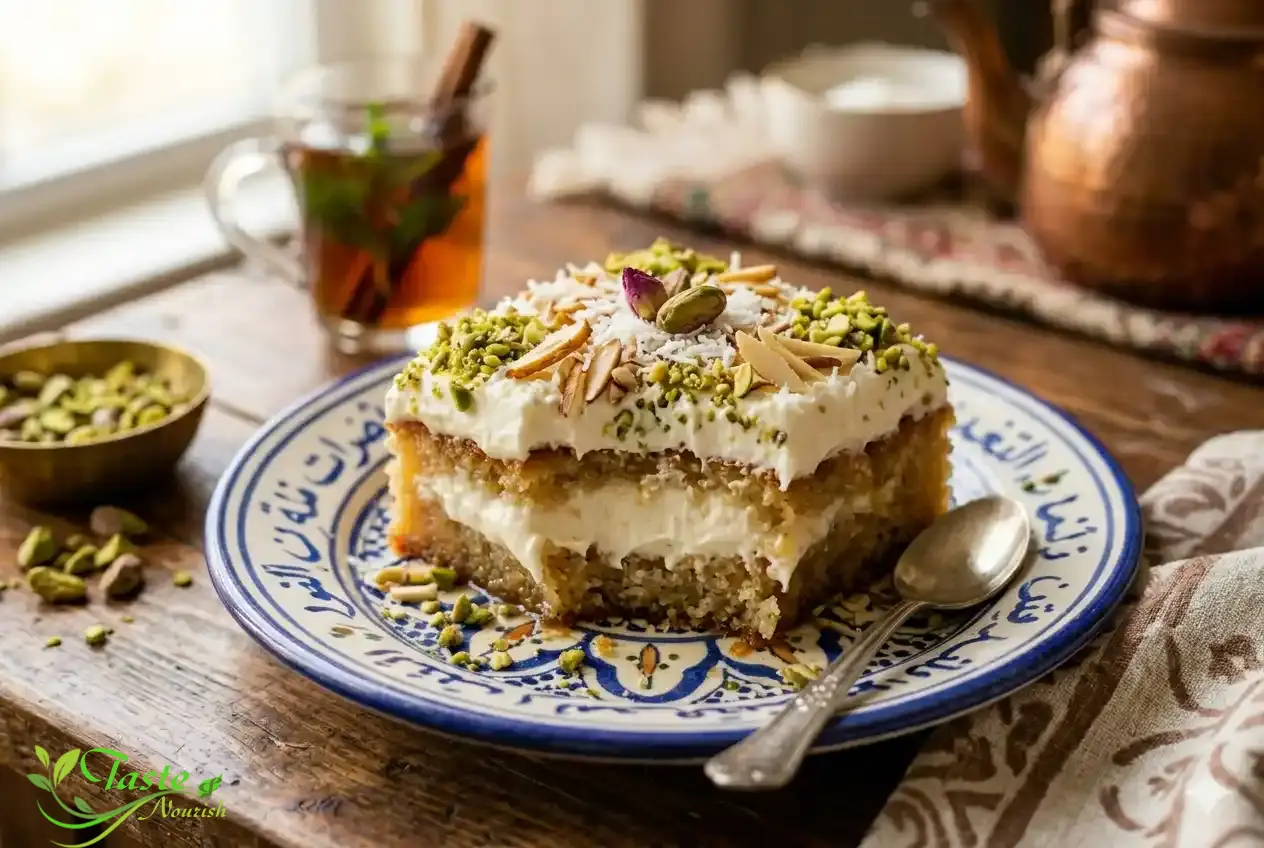
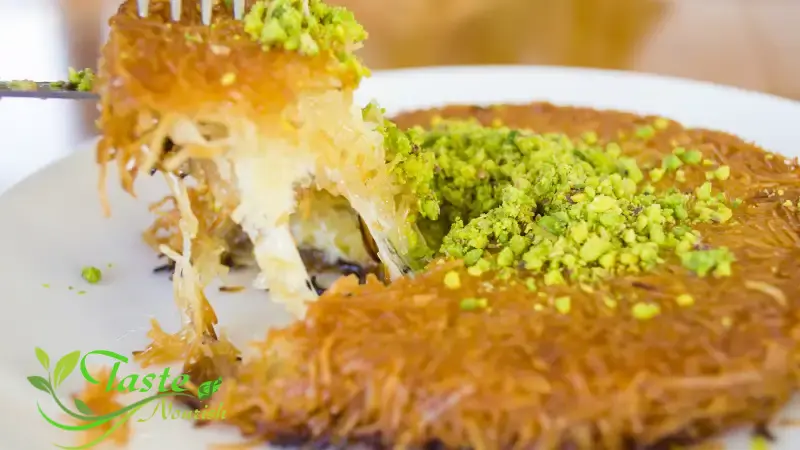
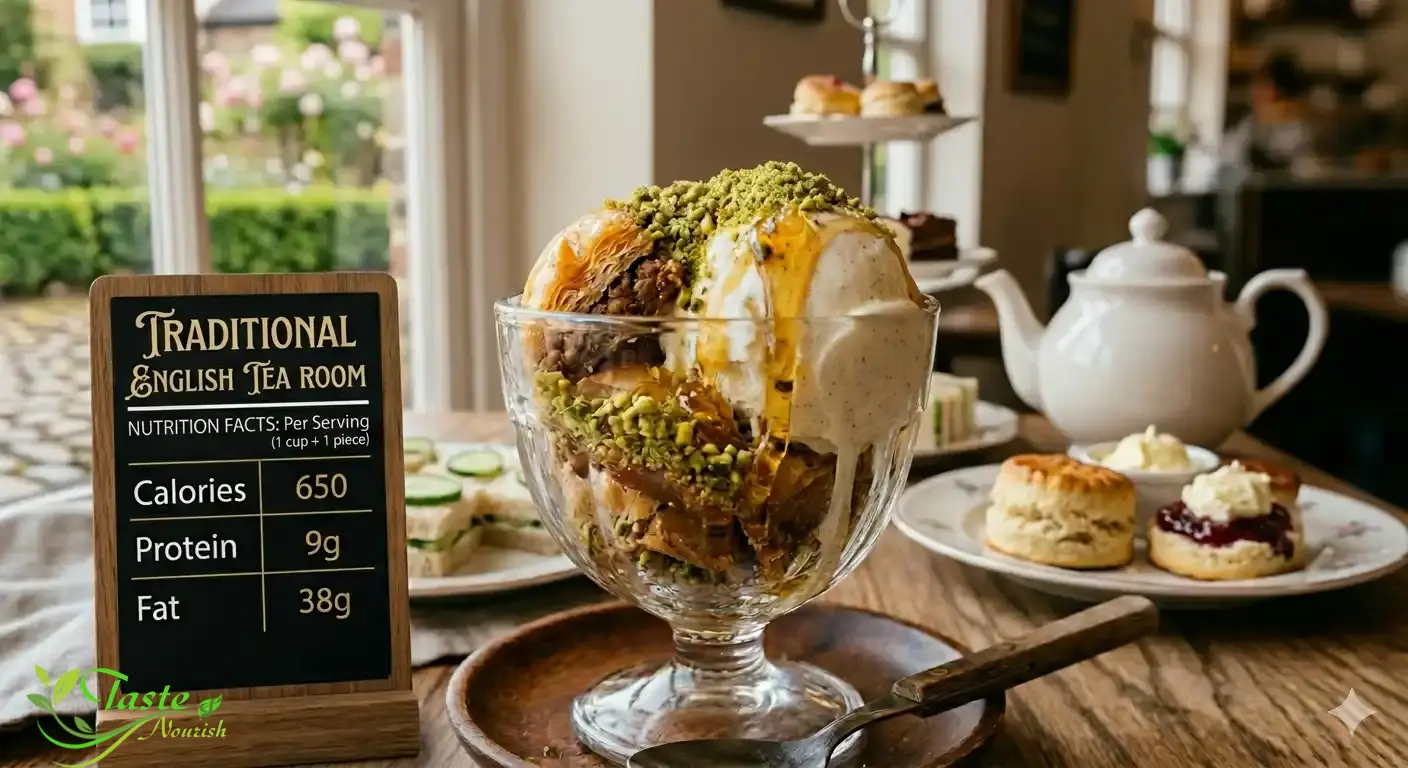
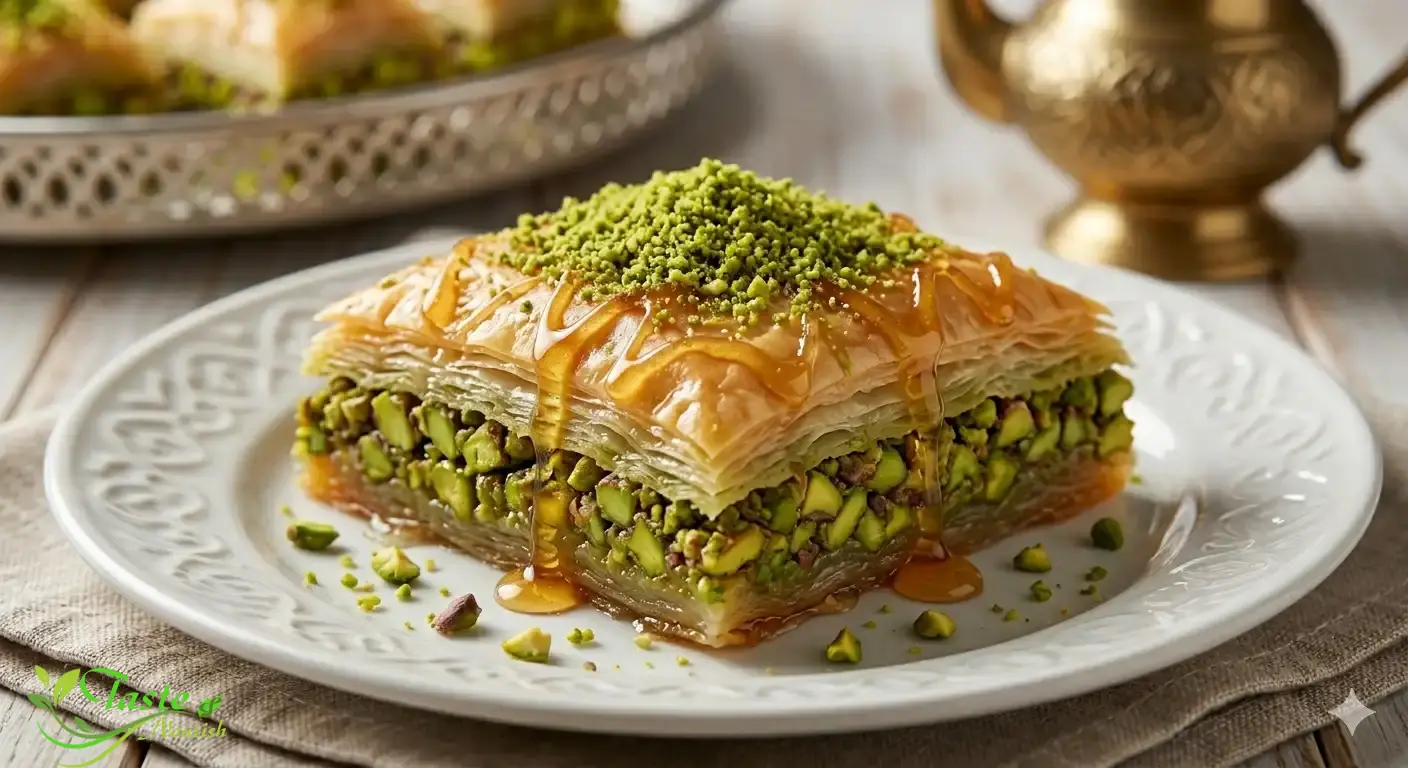
Kunafa with cream — ashta kunafa, or kunafa bil qishta — swaps the soft, syrup-soaked cheese of classic kunafa for a chilled, cornstarch-set milk cream sandwiched between two crisp, butter-baked kanafeh rounds. This kunafa with cream recipe walks through cooking the ashta to the right thickness, baking the dough until fully crisp rather than chewy, and assembling it cold so the crunch actually holds.
This kunafa with cream recipe uses crisp, butter-coated shredded Kunafa dough baked into two golden rounds, then filled with a chilled cornstarch-thickened ashta cream flavored with rosewater or orange blossom water. A light drizzle of sugar syrup and crushed pistachios finish it, keeping the crust crunchy against the cool, silky cream inside.
Key Takeaways: Kunafa with Cream Recipe
This kunafa with cream recipe layers crisp, butter-coated shredded kanafeh around a chilled, cornstarch-thickened ashta cream instead of baking the filling inside the dough.
Coating every strand of kunafa dough in melted butter or ghee before pressing it into the pan is what allows it to crisp rather than steam in the oven.
The ashta must be cooked until it visibly thickens and coats a spoon, then fully chilled, or it will be too thin to hold between the crusts.
Letting both baked crusts cool completely before filling protects the crispness; warm dough softens as soon as it meets the cream.
Syrup is drizzled lightly over the top crust rather than soaked through, preserving the contrast between the crisp shell and the smooth filling.
Because the filling is a cooked dairy cream, the assembled dessert needs refrigeration and is best enjoyed within a few days rather than left at room temperature.
What Is kanafeh with Cream?
Across the Levant and Egypt, kunafa (also spelled knafeh or kanafeh) most often refers to a version filled with a mild, stretchy white cheese and served warm and syrup-soaked, particularly the Nabulsi style associated with the city of Nablus. Ashta kunafa is a widely made regional variation that swaps the cheese for a cooked milk cream. Because the filling isn’t meant to melt or stretch the way cheese does, ashta kunafa is typically assembled cold rather than served hot, and the crust is treated more like a crisp pastry shell than a soaked base.
Both versions are traditional; neither is a lesser or more “authentic” form of the dessert, they’re simply built around different fillings with different serving expectations.
2–3 drops orange gel food coloring (optional, for the traditional golden-orange hue)
For the Ashta Cream Filling
2 1/2 cups (600 ml) whole milk
1/2 cup (120 ml) heavy cream
1/4 cup (30 g) cornstarch
1/3 cup (65 g) granulated sugar
1 tablespoon (15 ml) rosewater or orange blossom water
Pinch of salt
For the Sugar Syrup (Qater)
1 cup (200 g) granulated sugar
1/2 cup (120 ml) water
1 teaspoon fresh lemon juice
1 teaspoon rosewater or orange blossom water
For Garnish
1/3 cup (40 g) shelled pistachios, finely crushed
Dried edible rose petals (optional)
Ingredient Notes
Kataifi dough: This is the shredded, angel-hair-like pastry sold frozen at Middle Eastern grocers and increasingly at larger supermarkets. Thaw it in the refrigerator overnight, then let it sit at room temperature for about 20 minutes before handling so the strands separate easily instead of tearing.
Ghee versus butter: Ghee has had the milk solids and water removed, so it browns more evenly and produces a slightly crisper crust. Regular unsalted butter works well too and adds a touch more flavor, but watch it more closely near the end of baking since the milk solids can brown faster in spots.
Cornstarch: This is what sets the ashta into a spreadable, sliceable cream. Measure it level rather than packed, and always whisk it into cold milk before heating; adding it to hot liquid causes lumps that are difficult to smooth out.
Rosewater and orange blossom water: Brands vary significantly in strength. Start with the amount listed, taste, and add a few more drops only if needed. Too much reads as floral or soapy rather than fragrant.
Substitutions
Phyllo instead of kataifi: In a pinch, shredded phyllo sheets (cut into thin strips by hand) can stand in for kataifi. The finished texture will be flakier and less traditionally “hair-like,” but it still crisps well when coated in butter.
All-purpose flour instead of cornstarch: Not recommended. Flour thickens differently than cornstarch and needs roughly double the amount to reach the same consistency, and the result tends to taste pasty and cook cloudier rather than smooth and glossy.
Milk-only ashta (no heavy cream): You can use 3 cups (720 ml) whole milk in place of the milk-and-cream combination. The filling will be a little less rich and may set slightly firmer once chilled.
Honey in the syrup: Replacing part of the sugar with honey adds flavor complexity but changes the syrup’s color, sweetness level, and crystallization behavior, so it isn’t a direct one-to-one swap; start by replacing no more than a third of the sugar.
Equipment You’ll Need
Medium saucepan (for the ashta cream)
Small saucepan (for the syrup)
Whisk
9-inch round cake pan (one pan reused for both bakes, or two pans if you have them)
Large mixing bowl, for tossing the dough with butter
Offset spatula or the back of a spoon, for spreading the cream
Kitchen scale (optional, but improves consistency for the cornstarch and butter)
Sharp knife, wiped clean between cuts
How to Make This Kunafa with Cream Recipe
1. Prepare the Sugar Syrup
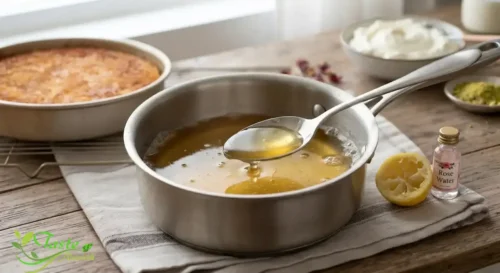
Combine the sugar and water in a small saucepan over medium heat. Stir just until the sugar dissolves, then stop stirring and let it simmer undisturbed for 3–4 minutes; stirring after it starts simmering can encourage sugar crystals to form.
Add the lemon juice, which also helps prevent crystallization, and simmer until the syrup coats a spoon in a thin, honey-like sheen.
Remove from heat, stir in the rosewater or orange blossom water, and set aside to cool to room temperature.
2. Cook the Ashta Cream
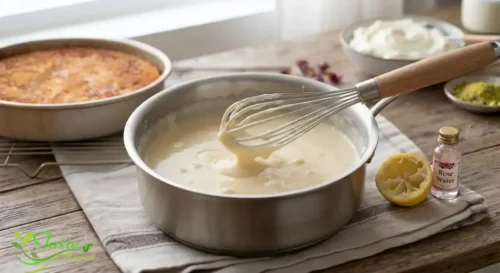
In a medium saucepan, whisk the milk, heavy cream, cornstarch, sugar, and salt together while still cold; this keeps the cornstarch from clumping once heat is added. Set over medium heat and whisk constantly.
As it approaches a simmer, the mixture will thicken fairly quickly, over about 6–9 minutes. It’s ready when it thickly coats the back of a spoon and mounds slightly rather than pooling when dripped from the whisk. Remove from heat and stir in the rosewater or orange blossom water.
Transfer to a bowl, press plastic wrap directly onto the surface to prevent a skin from forming, and cool at room temperature for about 20–30 minutes before refrigerating until fully chilled and firm enough to spread, at least 1 hour.
3. Prepare and Bake the Kunafa Dough
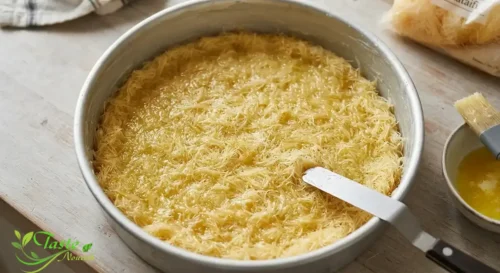
Preheat the oven to 375°F (190°C) with a rack in the center. Butter a 9-inch round cake pan. Divide the thawed kataifi in half. Working with one portion at a time, gently pull the strands apart with your fingers to remove dense clumps, then toss with half the melted butter (and food coloring, if using) until every strand looks coated and glossy; dry patches will steam instead of crisping.
Press the buttered dough firmly and evenly into the prepared pan in a compact, level layer about 1/4 to 1/3 inch thick. Bake for 20–22 minutes, until deep golden brown and crisp all the way through, not just at the edges. Let the crust cool in the pan for 10 minutes, then carefully slide it onto a rack or plate to cool completely, about 20 minutes more. Wipe out the pan, rebutter it, and repeat with the second portion of dough to bake the second crust.
4. Assemble the Kunafa
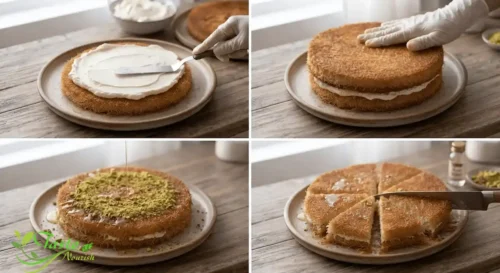
Both crusts and the ashta must be fully cooled before assembling, or the filling will soften the crisp dough. Place one crust on a serving plate and spread the chilled ashta cream evenly over it with an offset spatula, leaving a small border.
Set the second crust on top and press gently to adhere. Drizzle about two-thirds of the cooled syrup over the top crust only, letting it soak into the dough without running down into the cream layer; reserve the rest for serving.
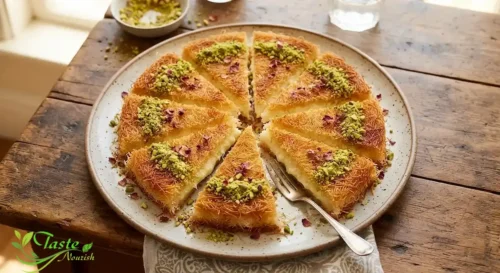
Sprinkle with the crushed pistachios. Refrigerate the assembled kunafa for 20–30 minutes so the filling firms up for clean slicing, then cut into 8 wedges with a sharp knife, wiping the blade between cuts.
Alternative Method: One-Bake Kunafa with Cream
If you’d rather skip the two-stage bake, this single-bake version uses the exact same ingredients and quantities listed above, just assembled and baked as one unit instead of two separate crusts. Raw ghee-coated kataifi goes into the pan first, the ashta is spread over it while still soft enough to smooth, and a second layer of dough seals it in before everything bakes together.
The payoff is a golden, crackling top crust that gives way to a warm, custardy center in a single bite, more like cutting into a filled tart than a crisp sandwich. It’s a faster route to the table, though the interior stays softer and more custard-like than the fully double-baked version, since the cream is never fully sealed behind a pre-baked shell.
Layer the Dough and Cream
Preheat the oven to 375°F (190°C) and butter a 9-inch round cake pan generously, including the sides. Toss the full pound of kataifi with the melted ghee as directed, then divide it in half. Press the first half evenly into the base of the pan in a firm, level layer, the same way you would for the crust in the main method. it needs to be compact enough to support the cream without gaps.
Take the ashta straight from the refrigerator; it should be thick and cool, not soft or runny, or it will run into the dough instead of sitting on top of it. Working from the center outward, drop the cream in evenly spaced spoonfuls across the surface of the dough, then use the back of a spoon or an offset spatula in light, gliding strokes to connect the spoonfuls into one even layer.
Skim the spatula just above the strands rather than dragging through them, and stop about half an inch short of the edge so the cream has room to spread slightly without pushing past the border once the top layer goes on. Avoid pressing down at any point; the goal is to rest the cream on top of the strands, not push it between them.
Toss the remaining half of the kataifi with the rest of the melted ghee and scatter it over the cream, working from the edges toward the center so the border seals first and the filling has nowhere to escape. Press only gently, just enough to level the surface and nudge the edges down to meet the bottom layer around the rim of the pan.
A firmer press here can force cream out at the sides during baking, so treat this top layer more like tucking in a blanket than packing a crust.
Bake Until Golden and Set
Bake on the center rack for 30–35 minutes, longer than the single crusts in the main method since the heat now has to travel through a filled center rather than a thin, open layer. Check at the 25-minute mark: if the top is browning quickly but still looks pale toward the center, tent it loosely with foil for the remaining bake time so the inside catches up without the top scorching.
The kunafa is ready when the entire top surface, not just the edges, is a deep, even golden-brown and sounds faintly crackly if you tap it lightly with a spoon; the edges should also have pulled back slightly from the sides of the pan.
To check the center without cutting into the filling, gently press the middle of the top crust with the back of a spoon. It should feel firm and spring back slightly rather than feeling squishy or sounding wet underneath. If it still feels loose or wobbly, give it another 3–5 minutes and check again, since an underbaked center will taste undercooked and won’t hold a clean slice.
As soon as it comes out of the oven, drizzle about two-thirds of the room-temperature syrup evenly over the hot top crust so it soaks in while the pastry is still warm, the same way syrup is applied to hot, baked phyllo desserts. Scatter the crushed pistachios over the top.
Let the kunafa rest in the pan for 10–15 minutes before slicing; this brief rest lets the residual heat finish setting the cream just enough to hold a clean cut, while the top crust is still at its crispest. Serve warm or at room temperature with the reserved syrup on the side.
Tips for a Crisp Top and Creamy Center
Make sure the ashta is fully chilled and firm before layering it into the pan; a soft or barely-set cream will soak into the bottom dough rather than staying put, leading to a soggier base once baked. Keep the bottom layer’s edges slightly higher than the center when you press it in, like a shallow bowl, so the cream doesn’t creep toward the rim as it settles.
Resist the urge to slice immediately out of the oven; cutting into the kunafa while the center is still very hot will release a filling that hasn’t fully set, even if the top looks perfectly done.
If you want an extra-crisp top, switch the oven to broil for the last 1–2 minutes only, watching constantly, since kataifi can go from golden to burnt in seconds under direct broiler heat.
Achieving a Crisp Kunafa Crust
The crispness of this dessert depends on two things: even fat coverage and full baking. Every strand of kataifi needs a thin coating of butter or ghee before it goes into the pan, because the fat is what allows the strands to fry and brown in the oven’s heat rather than trap steam against each other.
Pressing the dough into a thin, even, compact layer (rather than a loose, fluffy mound) also matters, since thick or uneven spots bake unevenly, leaving pale, chewy patches next to darker, crisper ones. Finally, bake until the color is a deep, even golden-brown rather than pale gold; kunafa dough that looks “done enough” while still pale usually still tastes soft and starchy once cooled.
Food Safety for Cream-Filled Kunafa
Because the ashta filling is a cooked dairy cream, it behaves like any other perishable dessert once it’s made. Bacteria multiply fastest between 40°F and 140°F, a range food safety agencies call the “danger zone,” so the cream shouldn’t sit out at room temperature for more than about 2 hours (1 hour if your kitchen is above 90°F).
Cool the ashta partially at room temperature as directed, then move it to the refrigerator to finish chilling rather than leaving it out longer than necessary. The same 2-hour guideline applies to the assembled kunafa: refrigerate it within that window whenever it isn’t being served, and follow standard clean, separate, cook, and chill practices when handling the dairy filling, such as using clean utensils and covering it promptly.
Storage
Refrigerate the assembled kunafa, covered, and keep the refrigerator at or below 40°F, as recommended for perishable dairy foods by the FDA’s food storage guidance. Cream and custard-filled pastries are generally best eaten within about 3 to 4 days of refrigeration for both quality and safety, similar to other cooked dairy desserts listed on the FoodSafety.gov cold food storage chart.
Expect the crust to gradually soften with time in the refrigerator; this is a texture change, not necessarily a safety issue, but discard the kunafa if it develops an off smell, sliminess, or visible mold.
Freezing
The baked, unfilled kunafa crust freezes reasonably well: wrap it tightly once fully cooled and freeze for up to about a month, then thaw at room temperature and re-crisp briefly in a low oven before filling. The assembled dessert with the ashta cream in place is not a good freezing candidate.
Cornstarch-thickened dairy fillings tend to separate and turn watery once thawed, the same reason the USDA notes that cream sauces don’t freeze well even though freezing itself keeps food safe. For the best texture, bake and freeze the crusts ahead if needed, but make the ashta and assemble close to serving.
Common Mistakes to Avoid
Soggy crust after assembly. This usually happens when the cream is spread onto a crust that’s still warm, or when too much syrup is poured over the top. Let both crusts cool fully and use syrup sparingly.
Pale, chewy dough instead of crisp. Underbaking, an oven that wasn’t fully preheated, or dry patches where the butter didn’t reach every strand all produce the same result. Bake until evenly deep golden and check the center, not just the edges.
Ashta that’s too thin to hold its shape. If the cornstarch mixture is pulled off the heat before it visibly thickens and coats a spoon, it will stay runny even after chilling. Cook until the mounding test passes, then chill fully before spreading.
Ashta that turns gluey or pasty. Cooking the mixture well past the thickening point, or using more cornstarch than called for, gives a stiff, starchy mouthfeel rather than a silky one.
Crust cracking or shattering when sliced. A fully chilled crust can be brittle. Let the assembled kunafa sit at room temperature for a few minutes before cutting, and use a sharp knife with a gentle sawing motion.
Uneven, patchy browning. Clumps of unbuttered or unseparated dough bake unevenly. Take the time to fluff and coat the strands thoroughly before pressing them into the pan.
Grainy or crystallized syrup. Stirring the syrup after it starts to simmer, or skipping the lemon juice, raises the chance of sugar crystals forming. Swirl the pan instead of stirring once it’s simmering.
Overpowering floral flavor. Rosewater and orange blossom water vary a lot in strength between brands. Add the smaller amount first and taste before adding more.
Troubleshooting
Why Is My Kunafa Not Crispy?
The most common causes are underbaking, uneven or insufficient butter coating on the dough strands, an oven that wasn’t fully preheated, or filling the crust before it finished cooling. Humidity in storage can also soften a crust that was crisp when first baked; this is expected once the dessert is refrigerated and filled.
Why Is My Ashta Cream Runny?
Runny ashta almost always means the cornstarch didn’t fully cook and thicken before the pan was removed from the heat, or the filling wasn’t given enough chilling time afterward. Measuring cornstarch inaccurately, or substituting flour without adjusting the amount, can also leave the filling too thin.
Why Did My Kunafa Turn Soggy After Storing?
This is typically the result of using too much syrup at assembly, condensation collecting under a tightly sealed cover in the refrigerator, or the kunafa being assembled too far in advance. For the crispest texture over time, store the crusts and ashta separately and combine them closer to when you plan to serve.
Variations on Ashta Kunafa
Pistachio ashta kunafa: Fold 1/4 cup finely ground pistachios into the finished ashta cream for a nuttier filling; the added dry ingredient shouldn’t change the cooking time noticeably.
Chocolate-drizzled kunafa: Drizzle melted dark chocolate over the top crust alongside or instead of some of the syrup, then add the pistachios. Because chocolate adds its own sweetness, consider using a bit less syrup so the finished dessert isn’t overly sweet.
Orange blossom and rose kunafa: Increase the orange blossom water and rosewater slightly in both the cream and syrup, and finish with dried edible rose petals for a more fragrant, celebratory version.
Individual kunafa cups: Press small portions of buttered dough into a muffin tin instead of a round pan. These bake faster, around 12–15 minutes, and should be watched closely since smaller portions brown quickly. Fill once cooled, just like the full-size version.
Serving and Presentation
Serve kunafa with cream chilled or just barely cool from the refrigerator; the contrast between the cold, smooth filling and the crisp shell is part of the dessert’s appeal, unlike hot, syrup-soaked cheese kunafa. Slice into wedges at the table, pass the reserved syrup on the side so each person can add more if they like, and finish each slice with a few extra crushed pistachios for color and crunch.
Kunafa with Cream Recipe FAQs
Can I make this kunafa with cream recipe ahead of time?
Yes, in parts. Bake the crusts up to a day ahead and store them airtight at room temperature, and make the ashta up to 2 days ahead, covered, in the refrigerator. Assemble the two closer to serving, ideally within a few hours, for the crispest result.
How should I store kunafa with cream?
Cover and refrigerate it, since the filling is a cooked dairy cream. It’s best enjoyed within a few days, and the crust will gradually soften the longer it sits.
Can I freeze ashta kunafa?
The baked, unfilled crust freezes acceptably, but the assembled dessert doesn’t freeze well because the cornstarch-thickened cream tends to separate and weep once thawed.
Can I use phyllo dough instead of kataifi?
Yes, shredded phyllo can substitute for kataifi in a pinch. It produces a flakier, less strand-like texture but still crisps well when coated in butter and baked.
How much syrup should I use?
Less than you might expect. This version is meant to stay crisp, so a light drizzle over the top crust, with extra passed at the table, works better than soaking the dessert the way a hot cheese kunafa is traditionally soaked.
Is ashta the same as clotted cream?
They’re related in concept but not identical. Ashta is a cornstarch-thickened milk cream cooked on the stovetop, while clotted cream (or the Middle Eastern equivalent, kaymak) is typically made by slowly heating and skimming cream over a much longer period without added starch.
Can I use a store-bought pudding mix instead of homemade ashta?
You can, but expect a thinner, more artificially flavored result. If you go this route, check the set consistency before spreading; you may need to reduce the liquid called for on the package to get a filling firm enough to hold between the crusts.
Recipe Card: Kunafa with Cream Recipe
Prep Time: 25 minutes
Chilling/Resting Time: about 1 hour 15 minutes (crust cooling and ashta chilling)
Baking Time: about 40 minutes (two 20-minute bakes)
Total Time: about 2 hours 40 minutes, mostly hands-off
Servings: 8
Yield: one 9-inch round kunafa (8 wedges)
Category: Dessert
Method: Baked crust, stovetop filling, no-cook assembly
Cuisine: Middle Eastern / Levantine
Ingredients
Kunafa dough: 1 lb (450 g) thawed kataifi dough; 3/4 cup (170 g) melted unsalted butter or ghee; pinch of salt; orange food coloring (optional). Ashta cream: 2 1/2 cups (600 ml) whole milk; 1/2 cup (120 ml) heavy cream; 1/4 cup (30 g) cornstarch; 1/3 cup (65 g) sugar; 1 tablespoon rosewater or orange blossom water; pinch of salt. Syrup: 1 cup (200 g) sugar; 1/2 cup (120 ml) water; 1 teaspoon lemon juice; 1 teaspoon rosewater or orange blossom water. Garnish: 1/3 cup (40 g) crushed pistachios; dried rose petals (optional).
Instructions
1. Make the syrup: simmer sugar, water, and lemon juice 3–4 minutes; stir in rosewater and cool.
2. Make the ashta: whisk milk, cream, cornstarch, sugar, and salt cold; cook over medium heat, whisking, until thick; stir in rosewater; chill at least 1 hour.
3. Bake the crusts: toss buttered kataifi and press into a buttered 9-inch pan; bake at 375°F (190°C) for 20–22 minutes per crust until deep golden; cool completely.
4. Assemble: spread chilled ashta over one cooled crust, top with the second, drizzle with syrup, sprinkle with pistachios, chill 20–30 minutes, and slice.
Notes
Both crusts and the ashta must be fully cooled before assembly to protect the crispness. Refrigerate the finished dessert and serve within a few days.
Hanan Abo Samra is the founder of Taste & Nourish, sharing trustworthy nutrition guidance and recipes drawn from 20+ years of hands-on cooking experience. When she's not developing new recipes, Hanan is researching the science behind everyday ingredients to bring readers practical, evidence-based guidance for a healthier lifestyle.