If you’ve searched for broccoli weight loss tips, you’ve probably noticed this vegetable shows up on nearly every “foods that help you slim down” list. There’s a reason for that reputation. Broccoli is low in calories, high in fiber, and mostly water, which is exactly the kind of nutritional profile that tends to support a lower-calorie eating pattern.That said, no single vegetable is a magic bullet. It helps to understand what broccoli for weight loss can realistically offer, and what it can’t, before you build a meal plan around it.
Broccoli weight loss claims are grounded in real nutrition science, but they come with caveats. One cup of raw, chopped broccoli has roughly 31 calories, about 2.5 grams of fiber, and a solid amount of water and protein for a vegetable, which may help you feel full on fewer calories.
Research suggests that swapping higher-calorie foods for low-energy-density vegetables like broccoli can support weight management as part of a broader reduced-calorie eating pattern. Broccoli itself, though, has not been shown in research to cause weight loss on its own.
Key Takeaways
Broccoli is very low in calories and high in fiber and water, which may help support feelings of fullness.
Broccoli weight loss results tend to be more realistic when broccoli replaces higher-calorie foods rather than being treated as a stand-alone fix.
One cup of raw broccoli has roughly 31 calories and about 2.5 grams of fiber.
Research on cruciferous vegetables, including broccoli, links regular intake to several long-term health benefits beyond weight.
No study has shown that eating broccoli by itself produces measurable weight loss; the evidence points to overall dietary patterns instead.
How you cook broccoli matters, since some preparation methods add a meaningful number of calories.
What Is Broccoli?
Broccoli is a cruciferous vegetable in the Brassica oleracea family, the same plant species that also gives us cauliflower, cabbage, kale, and Brussels sprouts. The part most people eat is the flowering head, along with the tender stalks and leaves, all of which are edible and nutritious.
It’s typically classified as either Calabrese broccoli, the large-headed green variety sold in most grocery stores, or sprouting broccoli, which produces smaller, more tender shoots. Both types share a similar nutrient profile, so the choice usually comes down to availability and personal preference rather than nutrition.
Broccoli Nutrition Facts
Calories and Macronutrients
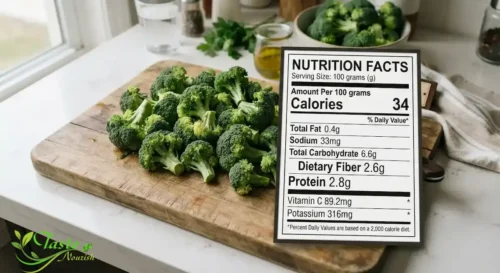
Broccoli’s calorie count is one of the main reasons it comes up so often in weight-related conversations. The table below shows approximate values for 100 grams of raw broccoli, based on USDA FoodData Central figures.
Nutrient
Amount per 100g (raw)
Calories
34 kcal
Water
89.3 g
Protein
2.8 g
Fat
0.4 g
Carbohydrates
6.6 g
Fiber
2.6 g
Sugars
1.7 g
Vitamins and Minerals Worth Knowing
Broccoli is also a strong source of vitamin C, providing close to a full day’s worth in a single 100-gram serving, along with meaningful amounts of vitamin K, folate, and potassium. It contributes smaller but still useful amounts of calcium and iron, which is notable for a vegetable that’s this low in calories.
Broccoli Weight Loss Benefits Worth Knowing
Low Calorie Density, High Volume
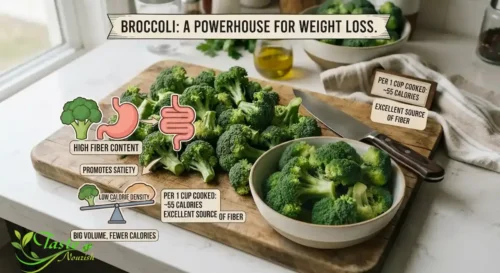
Broccoli has what nutrition researchers call low energy density, meaning it delivers relatively few calories for a large volume of food. The Mayo Clinic explains that foods high in water and fiber tend to fill you up on fewer calories than energy-dense foods like fats and refined carbohydrates.
Practically speaking, this means you can eat a fairly generous portion of broccoli without taking in many calories, which may make it easier to manage overall intake without feeling deprived.
Fiber That May Support Fullness
Fiber slows digestion and adds bulk to meals, both of which can influence how satisfied you feel after eating. A peer-reviewed review published on PubMed Central notes that fiber-rich foods promote satiety and help regulate appetite, which supports their role in weight management strategies.
Broccoli isn’t the highest-fiber vegetable available, but its combination of fiber and water still makes it a reasonable choice for anyone trying to eat fewer calories without constantly feeling hungry.
A Decent Plant-Based Protein Source
For a vegetable, broccoli has a surprising amount of protein, at nearly 3 grams per 100 grams. Protein is generally considered the most filling macronutrient, so pairing broccoli with other protein sources can make a meal more satisfying overall.
Other Health Benefits Beyond the Scale
Cruciferous vegetables have been studied for reasons that go well beyond weight. Harvard Health Publishing reports on research linking regular cruciferous vegetable intake to a lower risk of colon cancer, based on a large pooled analysis of observational studies.
These vegetables have also been studied for their possible role in supporting heart and metabolic health, largely due to compounds called glucosinolates that break down into biologically active substances during digestion.
The Science Behind Broccoli Weight Loss Claims
What the Research Actually Shows
Most of the science behind broccoli and weight loss doesn’t come from studies on broccoli specifically. Instead, it comes from broader research on fiber, low-energy-density foods, and vegetable-rich dietary patterns, which broccoli happens to fit well.
The CDC’s guidance on healthy eating for a healthy weight recommends building meals around vegetables partly because they add volume and nutrients without a large calorie cost, a principle that applies directly to broccoli.
Where the Evidence Falls Short
There isn’t a well-designed clinical trial showing that adding broccoli to a diet, by itself, causes people to lose weight. The research supports broccoli as a smart component of a lower-calorie, higher-fiber eating pattern, not as a standalone solution.
Anyone expecting broccoli to counteract a calorie surplus elsewhere in their diet is likely to be disappointed. Context and overall eating habits matter far more than any single food.
Potential Risks and Side Effects of Eating Broccoli
Broccoli is generally well tolerated, but a few things are worth knowing. Its fiber and natural sugars, including raffinose, can cause gas or bloating in some people, especially when intake increases quickly.
Broccoli also contains compounds called goitrogens, which in very large amounts may interfere with thyroid hormone production, particularly in people with an existing thyroid condition or low iodine intake. Typical dietary amounts are not considered a concern for most healthy adults.
Who Should Be Cautious With Broccoli?
People taking blood-thinning medications such as warfarin should talk to their doctor about broccoli intake, since its vitamin K content can interact with how these medications work. Anyone with a diagnosed thyroid disorder may also want to ask a healthcare provider about appropriate portions of goitrogenic vegetables.
People with sensitive digestion, including some with irritable bowel syndrome, may find that large amounts of broccoli trigger bloating or discomfort and may need to adjust portion sizes accordingly.
How Much Broccoli Should You Eat?
There’s no single official recommendation for broccoli specifically, but general vegetable guidelines offer a useful benchmark. Most adults are encouraged to aim for at least 2 to 3 cups of vegetables per day, with broccoli fitting comfortably into that target.
Building a Low-Calorie Broccoli Diet That Works
A low-calorie broccoli diet doesn’t mean eating broccoli at every meal. It usually works better as one of several vegetables rotated throughout the week, layered into a diet that also includes adequate protein, healthy fats, and whole grains.
A reasonable starting point is one to two cups of broccoli several times a week, adjusted based on your overall calorie needs, digestion, and personal preference.
How to Choose the Best Broccoli at the Store
Look for broccoli with tightly packed, deep green or slightly blue-green florets. Heads that look yellow, have open or flowering buds, or feel soft are past their prime and will have lost some flavor and nutrients.
The stalk should feel firm rather than rubbery, and the leaves, if still attached, should look crisp rather than wilted. Fresh broccoli also has a mild, slightly sweet smell rather than a strong sulfur odor.
Storage Tips to Keep Broccoli Fresh
Store unwashed broccoli in the refrigerator, loosely wrapped in a produce bag or damp paper towel, where it will typically stay fresh for around three to five days. Avoid sealing it in an airtight container, since trapped moisture speeds up spoilage.
If you want to keep broccoli longer, blanching and freezing it is an effective option. Frozen broccoli retains most of its nutritional value and can be kept in the freezer for several months.
Best Ways to Eat or Cook Broccoli
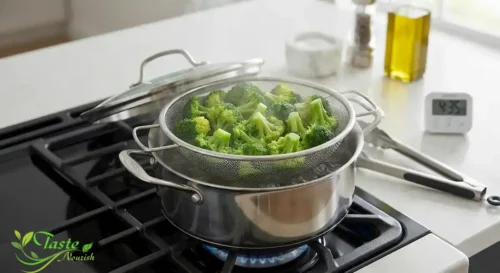
Steaming is one of the gentlest cooking methods and helps preserve more of broccoli’s vitamin C and other water-soluble nutrients compared to boiling. Roasting brings out a deeper, slightly nutty flavor, though it’s worth watching how much oil you use, since oil adds calories quickly.
Raw broccoli works well in salads or with a light dip, and stir-frying is another quick option that keeps the texture crisp. Whichever method you choose, keeping added fats, cheese, and heavy sauces in check will help broccoli stay a genuinely low-calorie addition to your plate.
Common Broccoli Weight Loss Mistakes to Avoid
One common mistake is drowning broccoli in butter, cheese sauce, or creamy dressings, which can turn a low-calorie vegetable into a high-calorie side dish. Another is assuming that eating more broccoli automatically cancels out a calorie surplus from other foods.
Some people also overcook broccoli until it’s mushy, which affects both taste and nutrient retention, making it less appealing to eat consistently. Treating broccoli as a one-time fix rather than part of a sustained eating pattern is another frequent misstep.
Broccoli Weight Loss Myths vs. Facts
Myth
Fact
Eating broccoli burns fat directly.
No food burns fat on its own; weight change depends on overall calorie balance.
Raw broccoli is always healthier than cooked.
Both raw and cooked broccoli offer nutritional benefits; cooking can even increase the availability of some compounds.
You need large amounts of broccoli every day to see benefits.
Moderate, consistent intake as part of a varied diet is generally sufficient.
Broccoli alone can replace the need for exercise or overall diet changes.
Research supports broccoli as a supporting food within a broader healthy pattern, not a replacement for it.
Broccoli vs. Other Low-Calorie Vegetables: A Quick Comparison
Broccoli holds its own against other popular low-calorie vegetables, though each brings something slightly different to the table.
Vegetable (100g, raw)
Calories
Fiber
Protein
Broccoli
34 kcal
2.6 g
2.8 g
Cauliflower
25 kcal
2.0 g
1.9 g
Spinach
23 kcal
2.2 g
2.9 g
Zucchini
17 kcal
1.0 g
1.2 g
Brussels sprouts
43 kcal
3.8 g
3.4 g
Broccoli Weight Loss FAQs
Can eating broccoli alone make you lose weight?
No single food causes weight loss on its own. Broccoli may support a lower-calorie eating pattern, but overall diet and lifestyle are what drive results.
How many calories are in a cup of broccoli?
One cup of raw, chopped broccoli has approximately 31 calories, making it one of the lower-calorie vegetable options available.
Is raw or cooked broccoli better for weight loss?
Both are reasonable choices. Raw broccoli retains slightly more vitamin C, while cooking can make some nutrients easier for the body to absorb; the calorie difference between the two is minor.
How much broccoli should I eat per day?
There’s no strict daily amount, but one to two cups several times a week fits comfortably within general vegetable intake guidelines for most healthy adults.
Does broccoli cause bloating or gas?
It can for some people, mainly due to its fiber and raffinose content. Increasing intake gradually may help reduce digestive discomfort.
Can I eat broccoli every day while trying to lose weight?
Yes, for most people, daily broccoli intake in reasonable portions is considered safe and can fit well into a varied, balanced diet.
Conclusion
Broccoli earns its reputation as a weight-management-friendly food honestly. It’s low in calories, rich in fiber and water, and offers a respectable amount of protein and micronutrients for a vegetable, all of which may help support a lower-calorie eating pattern.
It isn’t a shortcut, though. The research consistently points to broccoli working best as one part of a broader, sustainable approach to eating, rather than a food that produces results on its own. Used that way, alongside adequate protein, whole grains, and regular activity, broccoli can be a genuinely useful addition to a weight-conscious diet.
Hanan Abo Samra is the founder of Taste & Nourish, sharing trustworthy nutrition guidance and recipes drawn from 20+ years of hands-on cooking experience. When she's not developing new recipes, Hanan is researching the science behind everyday ingredients to bring readers practical, evidence-based guidance for a healthier lifestyle.