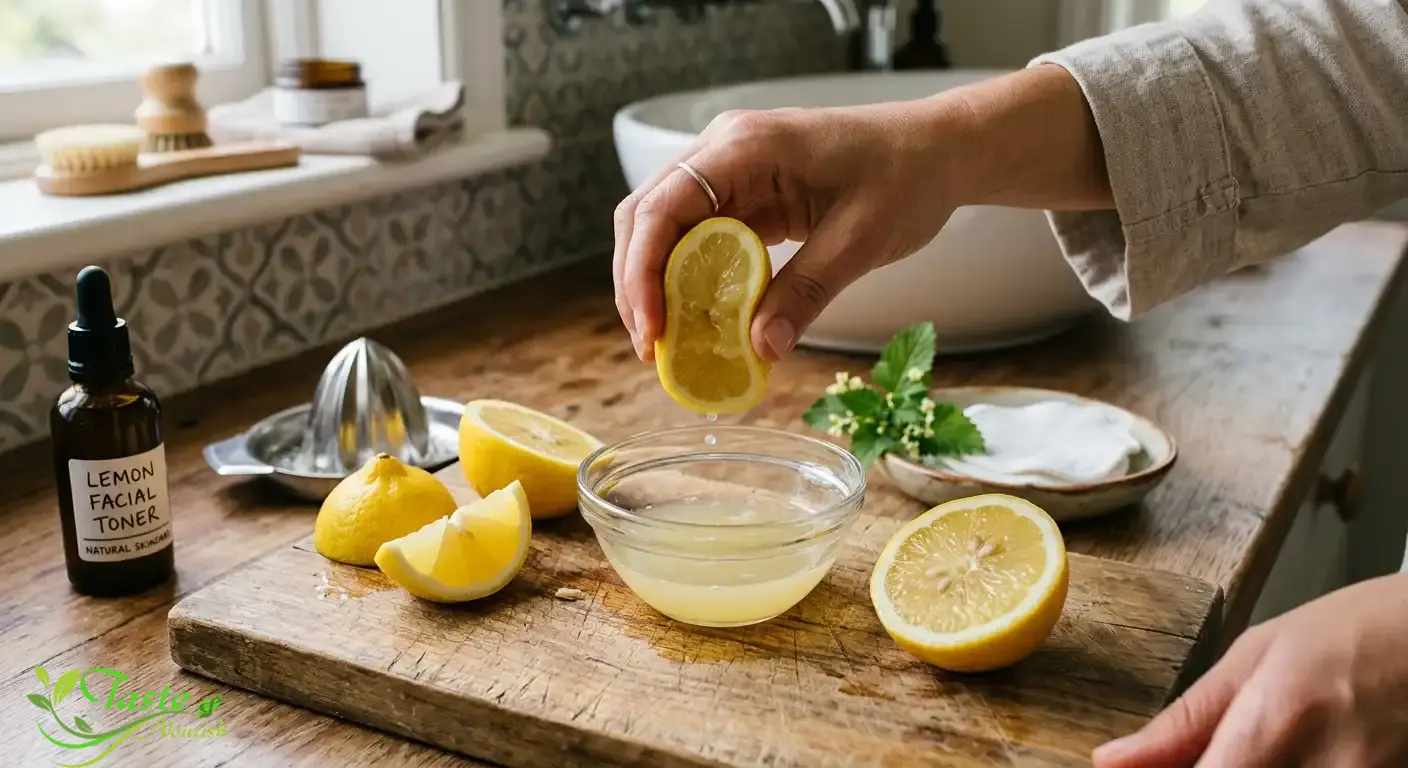
Lemon for Skin show up in half the DIY skincare videos you’ll ever scroll past. Squeeze it on a dark spot, dab it on a pimple, mix it into a mask — the internet treats lemon juice like a cure-all in a fruit bowl. But a lemon is also one of the most acidic things you can put on your face, and that changes the conversation quite a bit.
This guide walks through what’s actually in a lemon, what the research says about its effects on skin, and where the real risks lie. Cautious phrasing matters here — much of what’s circulated online is anecdote dressed up as fact, so we’ll stick to what’s supported by nutrition data and dermatology literature rather than beauty-blog folklore.
Key Takeaways
Lemons are rich in vitamin C and citric acid, both of which are studied for skin-related roles — but mostly in stable, formulated products, not raw juice.
Applying raw lemon juice directly to skin is associated with irritation, dryness, and a sun-triggered reaction called phytophotodermatitis.
People with sensitive skin, eczema, rosacea, or active breakouts with broken skin are generally advised to avoid topical lemon.
A pH-balanced vitamin C serum offers a more predictable, tested alternative to raw citrus.
Lemon’s kitchen and dietary uses remain low-risk; it’s the undiluted topical use that carries the most concern.
What “Lemon for Skin” Really Means
When people say “lemon for skin,” they’re usually lumping together several very different practices. Some mean squeezing juice straight from the fruit onto their face. Others mean a stabilized lemon or citrus extract folded into a cleanser or serum at a controlled concentration. These are not interchangeable, and the gap between them is exactly where most of the confusion — and most of the skin damage — happens.
Raw lemon juice has a pH around 2, according to dermatology sources, which sits far below your skin’s natural surface pH of roughly 4.5 to 5.5. That’s not a small difference; pH is measured on a logarithmic scale, so a jump from 5.5 to 2 represents a substantial increase in acidity. A formulated product, by contrast, is typically buffered and diluted so the active ingredient does its job without dismantling your skin’s protective barrier in the process.
Fresh Lemon Juice vs. Lemon Extract in Formulated Products
Fresh-squeezed lemon juice is a variable, unmeasured mixture — its citric acid and vitamin C content shifts depending on the fruit’s ripeness, growing conditions, and even how long it’s been sitting on your counter. Formulated lemon or citrus extracts used in commercial skincare are standardized, which means the manufacturer knows the exact concentration going onto your skin and can test it for irritation before it reaches shelves. That distinction is a big part of why dermatologists tend to greenlight one and caution against the other.
Nutritional Snapshot: What’s Actually Inside a Lemon
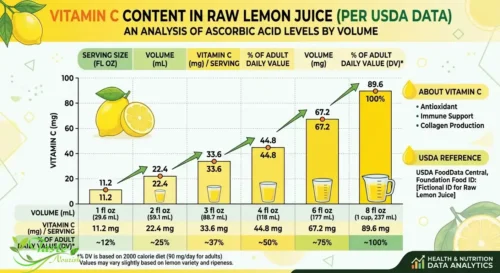
Before getting into skin claims, it helps to know what a lemon is actually made of.Lemon juice is mostly water — more than 90% by weight — with the remainder made up of natural sugars, a modest amount of fiber, trace minerals, and its signature dose of vitamin C. According to USDA, one 100-gram serving of raw lemon juice contains roughly 22 calories, about 35–38 milligrams of vitamin C, and small amounts of potassium and copper.
That vitamin C figure is meaningful in a dietary context — it covers a solid chunk of the daily recommended intake — but it says nothing about how much reaches or benefits your skin when applied topically. Ingested vitamin C is absorbed through the gut and delivered to skin tissue via the bloodstream, a process governed by digestion and circulation, not by direct contact.
♦ Topical effectiveness depends on entirely different factors, including the form of vitamin C used, its concentration, and how stable it remains once exposed to air and light.
Vitamin C and Citric Acid at a Glance
Compound
Role in a Lemon
Skin-Related Association
Vitamin C (ascorbic acid)
Primary antioxidant, water-soluble
Associated with collagen support and antioxidant defense
Citric acid
Organic acid, gives lemon its sourness
Classified as an alpha hydroxy acid (AHA); mild exfoliant
Water
~90%+ of lemon juice
Dilutes other compounds; not inherently active
Natural sugars
Small amount
No established skin role
Essential oils (in peel/zest)
Contains furocoumarins
Linked to photosensitivity reactions
Potential Skin Benefits Linked to Lemon’s Compounds
It would be inaccurate to say lemon does nothing for skin — the compounds inside it genuinely have documented biological roles. The issue isn’t whether vitamin C or citric acid matter for skin health; it’s whether rubbing raw lemon juice on your face is a safe or efficient way to access those benefits. Most of the supportive evidence comes from studies using purified, stabilized forms of these compounds rather than whole citrus juice.
Vitamin C and Collagen Support
Vitamin C is required for collagen synthesis at a cellular level — it’s a cofactor for the enzymes that stabilize collagen’s structure, which is why chronic deficiency (scurvy) leads to poor wound healing and connective tissue breakdown.
A peer-reviewed review in the journal Antioxidants describes ascorbic acid as a cosmeceutical ingredient with real potential to support dermal collagen and reduce oxidative stress linked to skin aging, based on both biochemical mechanisms and clinical evidence (see Boo, 2022, Antioxidants). The catch is that this research centers on topical formulations engineered for stability and skin penetration — not on juice squeezed from a fruit at your kitchen counter.
Citric Acid as a Mild Exfoliant
Citric acid belongs to the alpha hydroxy acid family, the same group that includes glycolic and lactic acid, and AHAs are widely used in professional and over-the-counter exfoliating products. In controlled concentrations, these acids loosen the bonds between dead surface skin cells, which can leave skin looking smoother and more even-toned.
The problem with raw lemon juice is concentration control — you have no way of knowing exactly how much citric acid you’re applying, and it’s typically far higher than what’s used in a tested exfoliating product.
Antioxidant and Antimicrobial Properties
Lemon has been noted for antimicrobial characteristics in laboratory settings, and some skincare marketing points to this as a reason it “fights acne bacteria.” That said, laboratory antimicrobial activity doesn’t automatically translate into a safe or effective real-world acne treatment, especially when the same substance also irritates skin and increases photosensitivity.
♦ Any modest antibacterial upside has to be weighed against the well-documented downside of barrier disruption.
The Risks of Applying Raw Lemon Juice to Your Skin
This is the section that matters most, because it’s where DIY enthusiasm collides with actual clinical evidence. Multiple case reports and dermatology reviews describe adverse skin reactions tied specifically to citrus fruits, including lemons and limes, applied directly to skin.
Phytophotodermatitis: The Lemon-and-Sun Reaction
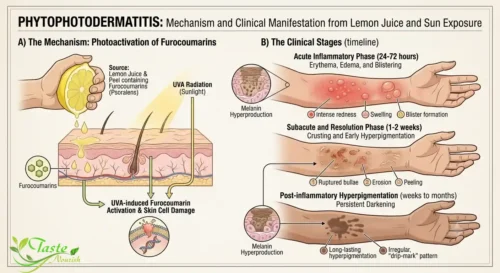
Phytophotodermatitis is a chemical burn-like reaction that occurs when certain plant compounds — furocoumarins, found in citrus peel and juice — contact skin and are then activated by ultraviolet light
. A case report published through the National Center for Biotechnology Information describes a patient who developed a hyperpigmented, irregularly shaped patch after lime juice from a cocktail was rubbed onto skin during a sunny vacation, illustrating exactly how incidental this exposure can be (see Phytophotodermatitis From Lime Margaritas on a Mexico Vacation).
The resulting mark isn’t a sunburn in the ordinary sense — it can persist as a dark, blotchy discoloration for weeks or months after the initial reaction fades.
DermNet, a dermatology education resource maintained by dermatologists, explains that phytophotodermatitis specifically involves skin contact with photosensitizing plant chemicals followed by sun exposure, and lists citrus fruits within the Rutaceae family among the well-documented triggers (see DermNet NZ, Phytophotodermatitis). This is precisely why applying lemon juice and then heading outside — even for a short walk — carries more risk than most people realize.
Irritation, Dryness, and Barrier Damage
Even without sun exposure, raw lemon juice’s low pH can be enough to irritate skin on its own. Reported reactions include stinging, redness, dryness, and in more severe cases, peeling or superficial burns, particularly on skin that’s already compromised by conditions like eczema or over-exfoliation.
Skin’s outermost layer functions as a protective barrier that keeps moisture in and irritants out, and repeatedly exposing that barrier to something with a pH several points below its natural range can wear it down over time.
Chemical Leucoderma and Uneven Pigmentation
Less commonly discussed but clinically documented is chemical leucoderma — a loss of pigment in localized areas of skin — which has been linked in case literature to homemade citrus-based toners used repeatedly over time. This is essentially the inverse problem of the dark-spot fading many people are chasing: instead of an even tone, some users end up with patchy, uneven pigmentation in both directions.
It’s a reminder that “natural” ingredients aren’t automatically gentle just because they didn’t come from a lab.
Who Should Avoid Lemon on Their Skin
Certain skin types and situations raise the risk profile considerably, and it’s worth being direct about who should sit this one out.
People with rosacea, eczema, or generally reactive skin tend to have a compromised barrier already, making acid exposure more likely to trigger flare-ups. Anyone dealing with active acne that includes open lesions, or with recently exfoliated or freshly treated skin (post-retinoid, post-peel, post-laser), should also steer clear, since broken or sensitized skin absorbs irritants more readily and heals less predictably.
Pregnant individuals with heightened skin sensitivity, children, and anyone with a history of hyperpigmentation or melasma are additional groups where caution is reasonable, given how easily citrus-triggered reactions can worsen existing discoloration.
♦ If you’re planning any time outdoors — even brief daytime errands — that’s another reason to avoid topical lemon beforehand, since UV exposure is the second half of the phytophotodermatitis equation.
Safer Ways to Get Lemon’s Benefits
If the goal is brighter, more even-toned skin, there are more predictable paths to that result than raw citrus. This doesn’t mean lemon has zero place in a routine — it means the form matters more than the fruit itself.
Choosing a Vitamin C Serum Instead
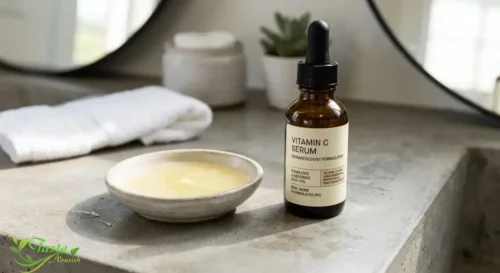
Formulated vitamin C serums are designed to deliver a stable, tested concentration of ascorbic acid (or a derivative like sodium ascorbyl phosphate) without the extreme acidity of raw juice. According to the NIH Office of Dietary Supplements, vitamin C’s role in collagen biosynthesis is well-established at the physiological level, which is part of why cosmetic chemists have spent years developing stable topical delivery systems for it.
A serum lets you access that same underlying chemistry with a formulation that’s been tested for skin tolerance, rather than guessing at concentration with a kitchen fruit.
Feature
Raw Lemon Juice
Formulated Vitamin C Serum
pH
~2 (highly acidic)
Typically 3.0–3.5, buffered
Concentration control
None — varies by fruit
Standardized, labeled
Stability
Degrades quickly, oxidizes
Often stabilized with antioxidant pairing
Photosensitivity risk
Documented (furocoumarins)
Minimal, unless combined with other actives
Testing
None
Typically dermatologist- or lab-tested
Cost
Very low
Moderate to high
If You Still Want to Try Lemon Topically
For readers set on trying a citrus-based approach anyway, a few precautions meaningfully reduce risk. Diluting lemon juice heavily with water, aloe vera gel, or honey lowers the effective acidity before it touches skin.
Patch-testing on a small area of forearm skin for 24–48 hours, rather than applying directly to the face, helps catch a reaction before it affects a visible area.
Pro Tip: If you do experiment with diluted lemon juice, apply it only in the evening and wash it off completely before any daytime sun exposure — this removes the phytophotodermatitis risk almost entirely, since the reaction requires both the plant compound and UV light to occur together.
Avoiding application to broken skin, active breakouts, or recently treated areas is another simple safeguard. If redness, burning, or excessive dryness shows up, stopping immediately and rinsing thoroughly with cool water is the appropriate response — a dermatologist visit is warranted if irritation persists beyond a day or two.
Common Myths About Lemon and Skin
A few claims about lemon and skin circulate so widely they’re worth addressing directly. “Lemon permanently lightens skin” is one of the most persistent — but any brightening effect from citric acid is a surface-level exfoliation result, not a permanent change in melanin production, and it can come at the cost of irritation or rebound pigmentation.
“Lemon cures acne” is another oversimplification; while citric acid’s mild exfoliating action and some antimicrobial properties may play a supporting role, raw lemon juice is not a validated acne treatment and can worsen inflammation in active breakouts.
“Natural means safe” deserves its own callout, since it underlies most of the DIY lemon trend. Poison ivy, certain mushrooms, and phytophotodermatitis-triggering plants are all “natural,” and none of them are safe for skin contact — natural origin says nothing about an ingredient’s safety profile on its own.
Finally, the idea that “more lemon juice equals faster results” ignores dose-response relationships in dermatology entirely; higher concentrations of an irritant generally produce more irritation, not proportionally better outcomes.
Buying and Storing Lemons for Skincare and Kitchen Use
If lemons are already a kitchen staple, a few storage basics keep them fresher for longer, whether you’re using them in cooking or considering diluted topical use. Choose lemons that feel heavy for their size and have smooth, brightly colored skin — a heavier lemon generally holds more juice. Room-temperature storage works for a few days, but refrigeration in a produce drawer can extend freshness to three or four weeks.
Once cut or juiced, lemon juice oxidizes and loses some vitamin C content over time, so fresher is generally better if you’re relying on its nutrient profile for anything. Freezing juice in an ice cube tray is a practical way to portion it out without waste, though repeated freeze-thaw cycles will further reduce vitamin C levels. For culinary use, this degradation is a minor concern; for anyone hoping to maximize topical vitamin C exposure, it’s another argument in favor of a formulated, stabilized product over juice that’s been sitting in the fridge for a week.
What the Science Actually Says
Stepping back, the evidence base here is lopsided in a telling way. Case reports and dermatology reviews documenting adverse reactions to citrus on skin are numerous and specific, while controlled clinical trials demonstrating benefits from raw lemon juice applied topically are essentially absent from the literature.
Most of the positive vitamin C and collagen research — including the review published in Antioxidants — evaluates formulated ascorbic acid delivery systems, not whole fruit juice.
This gap matters for anyone weighing the DIY appeal of lemon against its documented risks. The compounds in lemon aren’t fictional or without merit; vitamin C’s biochemical role in collagen production is well-supported science, and citric acid’s exfoliating mechanism is real.
What’s missing is evidence that the specific act of applying unprocessed lemon juice to facial skin is either effective or safe compared to formulated alternatives — and what does exist, in the form of phytophotodermatitis and chemical leucoderma case reports, points toward caution rather than enthusiasm.
Conclusion
Lemons are genuinely nutrient-dense, and the vitamin C and citric acid inside them have real, documented roles in skin biology. But there’s a meaningful difference between an ingredient having potential and that same ingredient being safe to apply straight from the fruit onto your face.
The acidity of raw lemon juice, combined with its photosensitizing compounds, creates a real risk of irritation, chemical burns, and phytophotodermatitis — risks that formulated, pH-balanced vitamin C products are specifically designed to avoid. If brighter, more even skin is the goal, a tested serum will likely get you there more reliably and with far less guesswork than a fruit from the produce aisle. Save the lemon for your water glass, your salad dressing, and your kitchen counter — and let your skincare products handle the vitamin C.
Lemon for Skin FAQs
Is it safe to put lemon juice directly on your face every day?
Daily use of raw lemon juice is generally discouraged by dermatology sources, since its low pH and photosensitizing compounds are associated with cumulative irritation and an increased risk of phytophotodermatitis with repeated sun-paired exposure.
Can lemon juice remove dark spots or hyperpigmentation permanently?
Any lightening effect tends to be superficial and temporary, resulting from mild exfoliation rather than a lasting change in melanin production, and it may be offset by post-inflammatory pigmentation if the skin becomes irritated.
Why does lemon juice cause dark patches instead of lightening skin sometimes?
This is typically phytophotodermatitis — a reaction between citrus furocoumarins and UV light that can leave irregular, brown, streak-like patches lasting weeks to months, distinct from ordinary sunburn.
Is lemon juice better than a vitamin C serum for the skin?
Formulated vitamin C serums offer standardized concentration, tested stability, and buffered pH, making them a more predictable option than raw lemon juice, whose acidity and compound levels vary fruit to fruit.
Can I use lemon on my skin if I have acne?
It’s generally not recommended on active or broken breakouts, since the acidity may worsen inflammation; those interested in citric acid’s mild exfoliating properties are usually better served by a formulated, tested AHA product.
Boo, Y.C. “Ascorbic Acid (Vitamin C) as a Cosmeceutical to Increase Dermal Collagen for Skin Antiaging Purposes: Emerging Combination Therapies.” Antioxidants, National Center for Biotechnology Information, PubMed Central. https://www.ncbi.nlm.nih.gov/pmc/articles/PMC9495646/
Hanan Abo Samra is the founder of Taste & Nourish, sharing trustworthy nutrition guidance and recipes drawn from 20+ years of hands-on cooking experience. When she's not developing new recipes, Hanan is researching the science behind everyday ingredients to bring readers practical, evidence-based guidance for a healthier lifestyle.