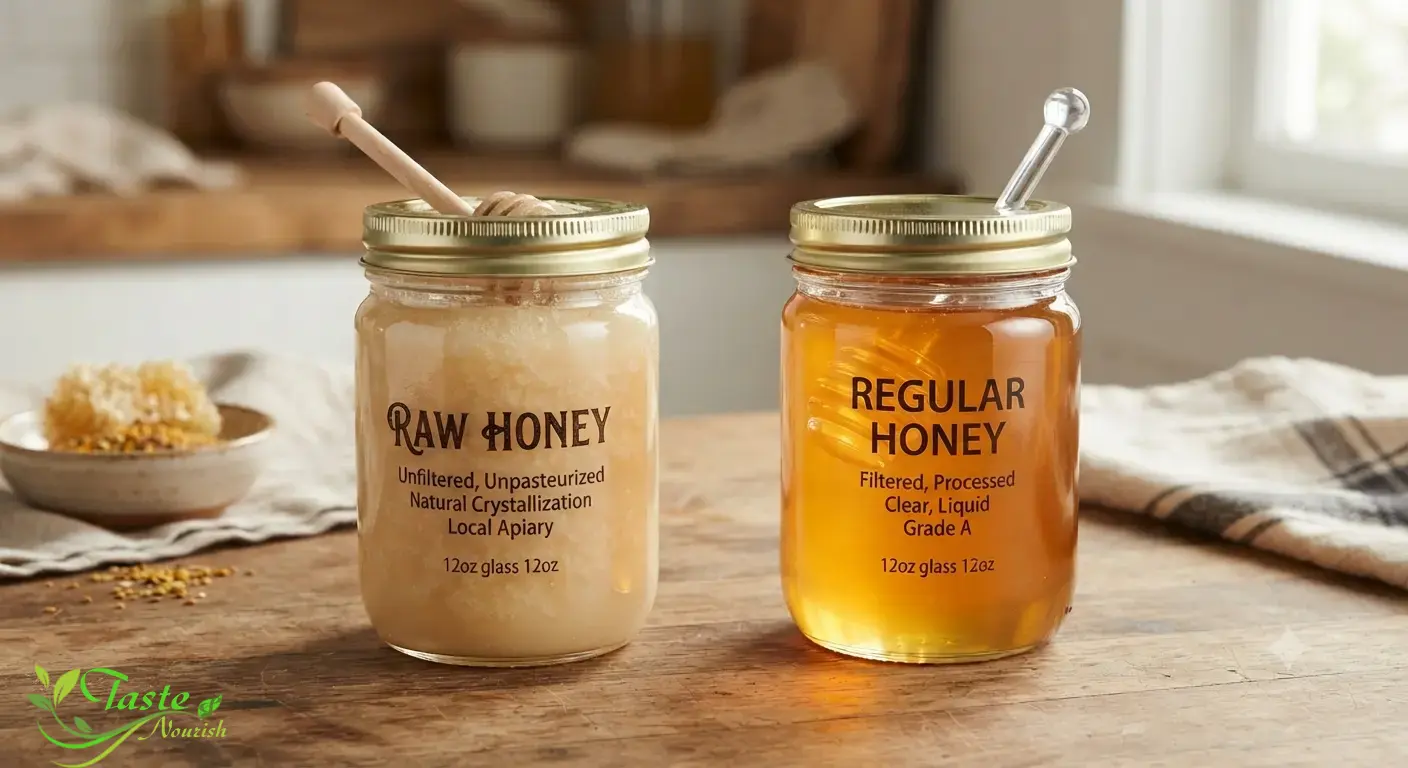
Grab two jars of honey off a grocery shelf, and they might look nearly identical — golden, thick, and sweet. But pop the lids, and you’re often looking at two very different products. One has been strained straight from the hive with almost nothing done to it. The other has traveled through heating tanks, fine filters, and sometimes a blending line before it ever reached the shelf. That gap in processing is exactly what sits behind the “raw honey vs. regular honey” debate, and it affects everything from nutrient content to shelf life to how safe the honey is for certain people to eat.
This guide breaks down what actually separates raw honey from regular, commercially processed honey — no marketing spin, just the facts on taste, nutrition, safety, and buying smart. You’ll also find a few common myths worth retiring, plus practical tips for reading a label so you know exactly what’s in your jar.
What Is Raw Honey?
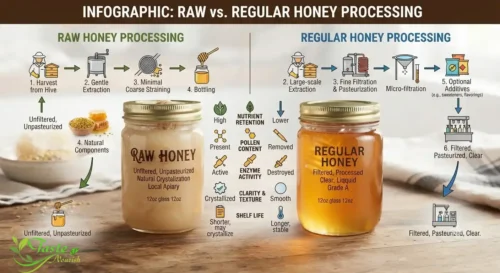
Raw honey is honey the way bees actually made it. Beekeepers extract it from the comb, run it through a coarse strainer to catch wax fragments and stray bee parts, and bottle it. That’s usually the entire process. Nothing gets heated above hive temperature (roughly 95°F), and nothing gets pushed through the ultra-fine filters used in commercial production.
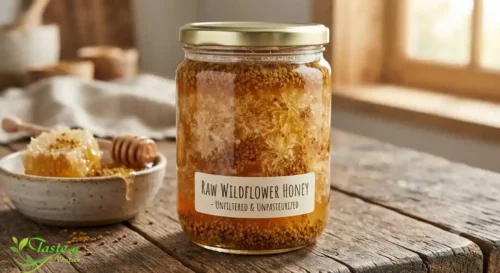
Because raw honey skips pasteurization, it typically retains bits of pollen, small amounts of propolis, and the natural enzymes bees add during nectar processing — things like invertase and glucose oxidase. This is also why raw honey tends to look cloudier, crystallizes faster, and can vary noticeably in color and flavor from batch to batch depending on which flowers the bees visited that season. A jar of raw wildflower honey from Vermont will taste nothing like a jar of raw orange blossom honey from Florida, and that variation is part of the appeal for a lot of honey fans.
Key Takeaway: “Raw” refers to processing, not purity claims about where the honey came from. A honey can be raw and still vary widely in quality depending on how the beekeeper handled it after extraction.
What Is Regular (Processed) Honey?
Regular honey — sometimes labeled “pure honey” on store shelves — is what most people picture when they think of honey: clear, smooth, pourable, and shelf-stable for a long time without crystallizing. Getting it that way takes a few extra manufacturing steps. Producers typically heat the honey to around 160°F, a process similar to pasteurization, then push it through fine mesh or membrane filters at high pressure to remove pollen, wax fragments, and any tiny air bubbles that would otherwise cloud the finished product.
The goal isn’t necessarily to make the honey unhealthy; it’s to make it consistent and convenient. Heating slows fermentation and kills yeast cells that could otherwise cause the honey to bubble or spoil. Filtering keeps it looking uniform batch after batch, which matters a lot for large brands trying to match customer expectations on store shelves. The tradeoff is that heat is hard on delicate compounds. Enzymes and some antioxidant polyphenols are sensitive to temperature, so extended heat exposure can reduce their levels, even though the honey remains a safe, edible sweetener.
Raw Honey vs. Regular Honey: Key Differences at a Glance
Sometimes a side-by-side view makes the differences click faster than paragraphs of explanation ever could. Here’s how the two stack up across the factors that matter most to everyday shoppers.
Feature
Raw Honey
Regular (Processed) Honey
Processing
Strained only, unheated
Heated (~160°F) and finely filtered
Pollen content
Present in trace amounts
Mostly or entirely removed
Enzymes (invertase, diastase)
Largely intact
Partially reduced by heat
Appearance
Cloudy, opaque, may contain fine particles
Clear, smooth, glossy
Crystallization
Happens faster, often within weeks to months
Delayed, sometimes for a year or more
Shelf stability
Long-lasting but can ferment if moisture is high
Very stable, low fermentation risk
Flavor
Complex, varies by floral source
Milder, more uniform
Added sweeteners
None, if genuinely raw
Sometimes blended with corn or cane syrup unless labeled “pure”
Neither column is universally “better” — it depends on what you’re using the honey for, how you feel about texture and crystallization, and how much you value nutrient retention versus convenience.
Nutritional Comparison
Both raw and regular honey are, first and foremost, sugar. Roughly 80% of honey’s weight comes from a combination of fructose and glucose, according to nutrient data from the USDA FoodData Central database. That single fact matters more than most marketing claims: no matter how “raw” or “pure” the label says, honey is still an added sugar, and both the American Heart Association and general dietary guidance recommend keeping added sugar intake modest regardless of the source.
Vitamins, Minerals, and Antioxidants
Where raw and regular honey start to diverge is in the smaller, trace-level compounds layered on top of all that sugar. Raw honey carries small amounts of B vitamins, vitamin C, calcium, iron, potassium, and magnesium, along with a collection of plant-derived antioxidants called polyphenols — flavonoids like quercetin and kaempferol, plus phenolic acids like caffeic and ferulic acid. Darker honey varieties, such as buckwheat, generally test higher in both minerals and antioxidant capacity than lighter varieties like clover or acacia.
Heat is the main variable that separates raw from processed honey nutritionally. A peer-reviewed study published in the journal Molecules and hosted on the National Institutes of Health’s PMC archive found that prolonged heating of honey samples — including lotus, thyme, and multifloral varieties — significantly reduced total phenolic content after about 30 minutes of exposure, even though shorter, standard commercial heat treatments affected antioxidant activity only modestly.
In practical terms, that means commercially processed honey isn’t stripped of every beneficial compound, but it does generally test lower in antioxidants than an unheated, raw counterpart.
Calories and Macronutrients
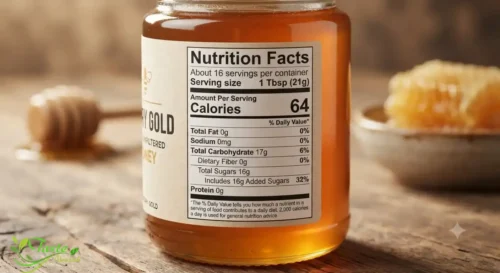
Calorie-wise, raw and regular honey are nearly indistinguishable. Per the USDA’s reference data, one tablespoon (21 grams) of honey provides about 64 calories, roughly 17 grams of sugar, and a negligible 0.1 grams of protein, with no fat or fiber to speak of. That’s actually a bit higher in calories than the same volume of table sugar, which runs closer to 49 calories per tablespoon — though because honey tends to taste sweeter by volume, many people use slightly less of it in recipes and beverages.
Nutrient (per 1 tbsp / 21g)
Amount
Calories
~64 kcal
Total carbohydrates
~17.3 g
Sugars (fructose + glucose, primarily)
~17.2 g
Protein
~0.1 g
Fat
0 g
Fiber
0 g
Pro Tip: If you’re substituting honey for sugar in baking, start with about ¾ cup of honey for every 1 cup of sugar called for, and reduce other liquids in the recipe slightly to compensate — honey adds moisture that granulated sugar doesn’t.
Taste, Texture, and Appearance
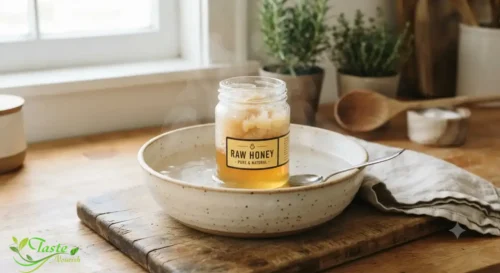
Set a jar of raw honey next to a squeeze bottle of the processed stuff, and the visual difference is usually obvious immediately. Raw honey tends to run darker, cloudier, and thicker, sometimes with visible flecks of pollen or wax suspended in it. It also crystallizes faster — within weeks to a few months, depending on the floral source and storage temperature — turning grainy and semi-solid rather than staying pourable. That’s not spoilage; it’s simply glucose separating out of solution, and it’s easily reversed by gently warming the jar in a bowl of warm water.
Regular honey, by contrast, is built for shelf appeal. The heating and filtering steps that strip out pollen and micro-particles are largely what give it that glassy, consistent shine. It pours easily straight out of the bottle for months on end without clouding or crystallizing, which is exactly why it’s the default choice for squeeze-bottle honey at most grocery stores.
Flavor-wise, raw honey tends to carry more of the “terroir” of its floral source — think grassy, earthy buckwheat honey versus delicate, almost floral orange blossom honey — while processed honey is often blended from multiple sources to hit a consistent, mild flavor profile batch after batch.
Potential Health Benefits
Both raw and regular honey share some baseline benefits simply by being honey. Both are natural sweeteners that don’t come with the artificial additives found in some sugar substitutes, and both have a long history of traditional use for soothing sore throats. That said, raw honey’s higher enzyme and antioxidant content gives it a modest edge in a few specific areas researchers have studied.
Antioxidant and Antibacterial Properties
Raw honey’s most well-documented advantage comes from its antibacterial activity, largely driven by an enzyme called glucose oxidase, which produces small amounts of hydrogen peroxide as honey is diluted with moisture. Because this enzyme is heat-sensitive, raw honey generally retains stronger antibacterial potential than heavily processed varieties, though researchers note that antibacterial activity actually varies quite a bit between individual honey samples regardless of raw or processed status, since floral source and geography play a role too.
The antioxidant polyphenols in raw honey are also associated, in preliminary research, with reduced oxidative stress markers, though most of that evidence comes from lab and animal studies rather than large human trials, so it’s reasonable to view raw honey as a modest nutritional upgrade rather than a medical treatment.
Benefits Shared by Both Types
One of the more surprisingly well-supported uses for honey, raw or regular, is easing cough symptoms in children over age one. A systematic review of randomized controlled trials, published through the National Institutes of Health’s PMC database, found that honey outperformed both placebo and over-the-counter cough medication like dextromethorphan in reducing cough frequency and improving children’s sleep quality, and the World Health Organization has previously listed honey as a recognized demulcent for cough relief.
This benefit doesn’t appear to depend heavily on whether the honey was raw or commercially processed, since honey’s demulcent, coating effect on the throat comes largely from its thick, sugar-based texture rather than from its trace nutrient content.
Risks and Who Should Avoid Honey
Honey has a reputation as an all-natural, universally safe food, but that reputation comes with two important exceptions worth taking seriously.
Infant Botulism Risk
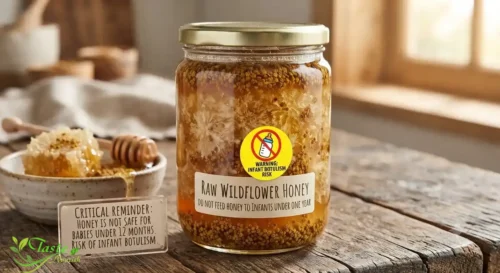
Honey — raw or regular — should never be given to a child under 12 months old. Both types can carry dormant spores of Clostridium botulinum, a bacteria that’s harmless to older kids and adults because a mature digestive system keeps the spores from growing. An infant’s gut hasn’t developed that same protection yet, so the spores can germinate and produce a toxin that leads to infant botulism, a rare but serious condition that can cause progressive muscle weakness and paralysis.
⊗ The Centers for Disease Control and Prevention is direct about this guidance: don’t feed honey, or any product made with it, to a baby younger than one year old, including on a pacifier or a nursing nipple to encourage feeding.
It’s worth noting that pasteurization doesn’t reliably solve this problem. Food scientists have pointed out that the standard commercial heating used to process regular honey isn’t hot enough or sustained long enough to reliably destroy C. botulinum spores — some estimates suggest honey would need sustained heat closer to 250°F for several minutes to fully neutralize them, well beyond typical honey pasteurization parameters. That’s why the “regular honey is heat-treated, so it’s safer for babies” assumption is a myth worth retiring immediately; both types carry the same restriction.
Allergy and Blood Sugar Considerations
People with pollen allergies sometimes wonder whether raw, local honey’s trace pollen content could trigger a reaction, and in rare cases it can, particularly for those with severe pollen or bee product allergies. If you have a known bee sting allergy or a diagnosed pollen allergy, it’s sensible to check with an allergist before adding raw honey to your routine.
Blood sugar is the other major consideration: honey, regardless of type, causes blood glucose to rise, and its glycemic index varies quite a bit by floral source — some studies place acacia honey as low as the low 30s, while buckwheat honey can run above 80.
♦ People managing diabetes or prediabetes should treat honey the same way they’d treat any other concentrated sugar source and monitor their response accordingly rather than assuming “raw” makes it blood-sugar-neutral.
How to Buy and Store Honey
Reading labels carefully matters more with honey than with most pantry staples, mostly because of how loosely some of the industry’s favorite words get used.
How to Spot Real Raw Honey
Look for honey explicitly labeled “raw,” “unpasteurized,” or “unfiltered,” since the word “pure” alone doesn’t guarantee minimal processing — the FDA’s own guidance only requires that “pure honey” contain no added sweeteners, not that it skip heating or filtration. Genuine raw honey should look cloudy or opaque rather than glass-clear, and it’s common to see it partially crystallized on the shelf, especially in cooler months. Buying directly from a local beekeeper or farmers market is one of the more reliable ways to get honey that’s minimally processed, since small-scale producers often lack the equipment for heavy filtration in the first place.
Honey fraud is a real concern worth factoring into your buying decisions. The FDA’s most recent economically motivated adulteration testing assignment found that a portion of both domestic and imported honey samples contained undeclared sweeteners like corn, rice, or sugar beet syrup — cheaper additives blended in to stretch supply and lower costs, all while the product is still labeled simply as “honey.” Under FDA rules, any honey containing added sweeteners is legally required to be labeled a “blend,” not “honey” alone, so a jar that only says “honey” on the front should genuinely contain nothing but honey.
Storage Tips
Both raw and regular honey are shelf-stable for a remarkably long time when stored properly, thanks to honey’s low moisture content and naturally acidic pH, both of which make it inhospitable to most bacteria. Keep honey in a sealed container at room temperature, away from direct sunlight, and it can realistically last for years without spoiling — crystallization is a texture change, not spoilage, and a jar can be restored to liquid form with a gentle warm-water bath.
♦ Refrigeration isn’t necessary and actually speeds up crystallization, so a cool, dark pantry shelf is the better long-term home for your honey jar.
Pro Tip: If your raw honey crystallizes, resist the urge to microwave it. High, uneven heat can scorch the honey and destroy the very enzymes and antioxidants that made raw honey worth choosing in the first place. A slow warm-water bath preserves far more of those compounds.
Common Myths About Raw and Regular Honey
A few honey myths circulate persistently enough that they deserve a direct correction:
Myth 1: “Raw honey never crystallizes.” In reality, raw honey crystallizes more quickly than processed honey because it has not been heat-treated to delay the natural crystallization process. Therefore, crystallization is generally a sign of authenticity rather than a defect.
Myth 2: “Local raw honey cures seasonal allergies.” Current controlled research does not provide strong evidence to support this claim. The amount of pollen in honey is typically too small, and it mainly comes from insect-pollinated flowers, whereas most seasonal allergies are triggered by wind-pollinated plants.
Myth 3: “Processed honey is safer than raw honey for infants.” This is incorrect. Both raw and processed honey carry the same risk of infant botulism and should never be given to children under one year of age.
Conclusion
Raw and regular honey ultimately come from the exact same starting point — nectar, bees, and a hive — but diverge based on what happens after extraction. Raw honey keeps more of its natural pollen, enzymes, and antioxidant compounds because it skips heating and heavy filtration, giving it a cloudier look, a shorter shelf-stable-before-crystallizing window, and a slightly more complex flavor. Regular honey trades some of those trace nutrients for consistency, clarity, and a longer run before crystallizing on the shelf. Neither type is a health risk for adults and older children in normal amounts, and neither is appropriate for infants under 12 months old.
Choosing between them really comes down to priorities: reach for raw if you want maximum nutrient retention and don’t mind a bit of cloudiness or faster crystallization, and reach for regular if a smooth, pourable, long-lasting jar matters more to your kitchen routine.
Raw Honey vs. Regular Honey FAQs
Q1. Is raw honey healthier than regular honey?
Raw honey generally contains more antioxidants, enzymes, and trace pollen than regular, heat-processed honey, since heating and filtering can reduce these compounds. That said, both types are still primarily sugar, so neither should be treated as a health food to consume in unlimited amounts.
Q2. Can raw honey make you sick?
For healthy adults and children over one year old, raw honey is considered safe to eat. The exception is infants under 12 months, for whom both raw and regular honey carry a risk of infant botulism and should be avoided entirely.
Q3. Does raw honey go bad faster than regular honey?
Raw honey crystallizes sooner than regular honey, but crystallization isn’t spoilage — it’s a natural, reversible texture change. Both types can last for years when stored in a sealed container away from moisture and direct heat.
Q4. Is “pure honey” the same as “raw honey”?
No. “Pure” honey legally means no added sweeteners were blended in, but it can still be heated and filtered. “Raw” specifically means the honey wasn’t pasteurized or heavily processed, so a honey can be labeled pure without being raw.
Q5. Which type of honey is better for cooking and baking?
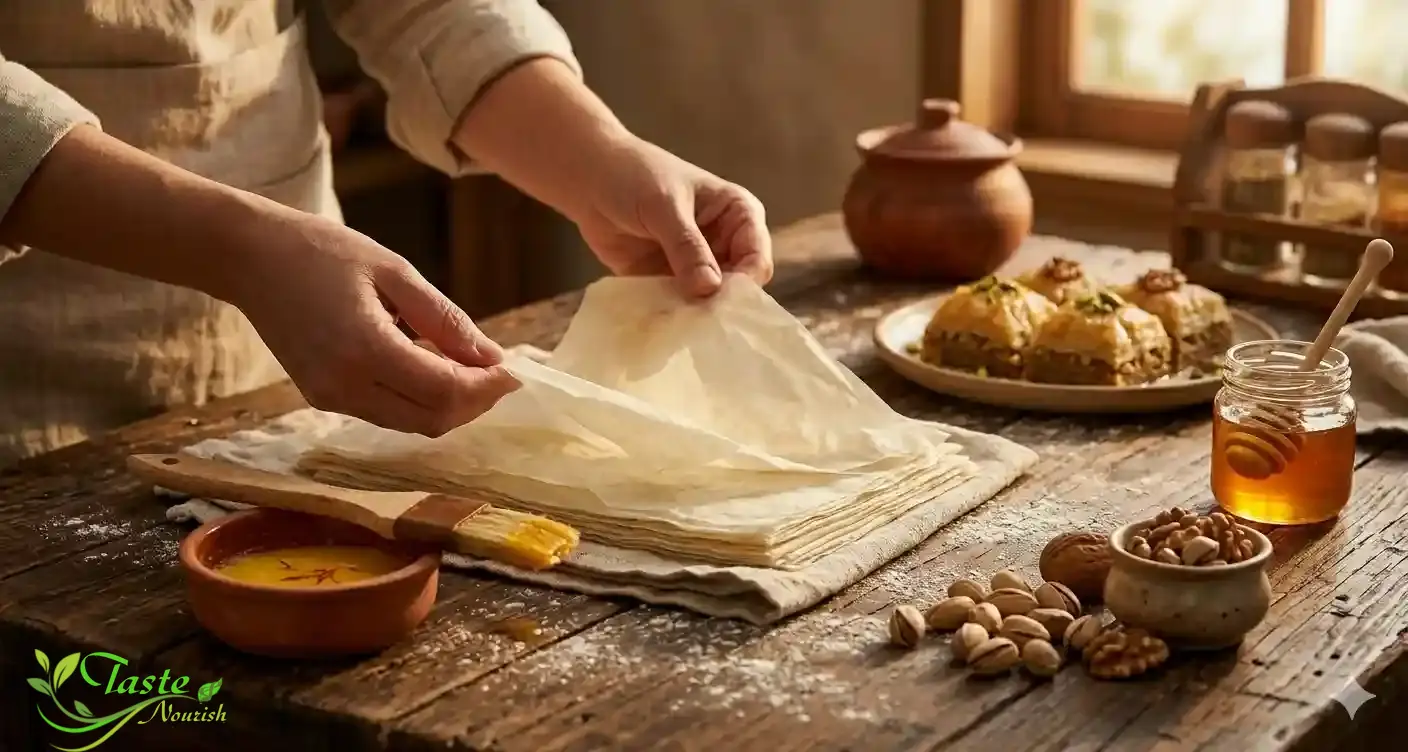
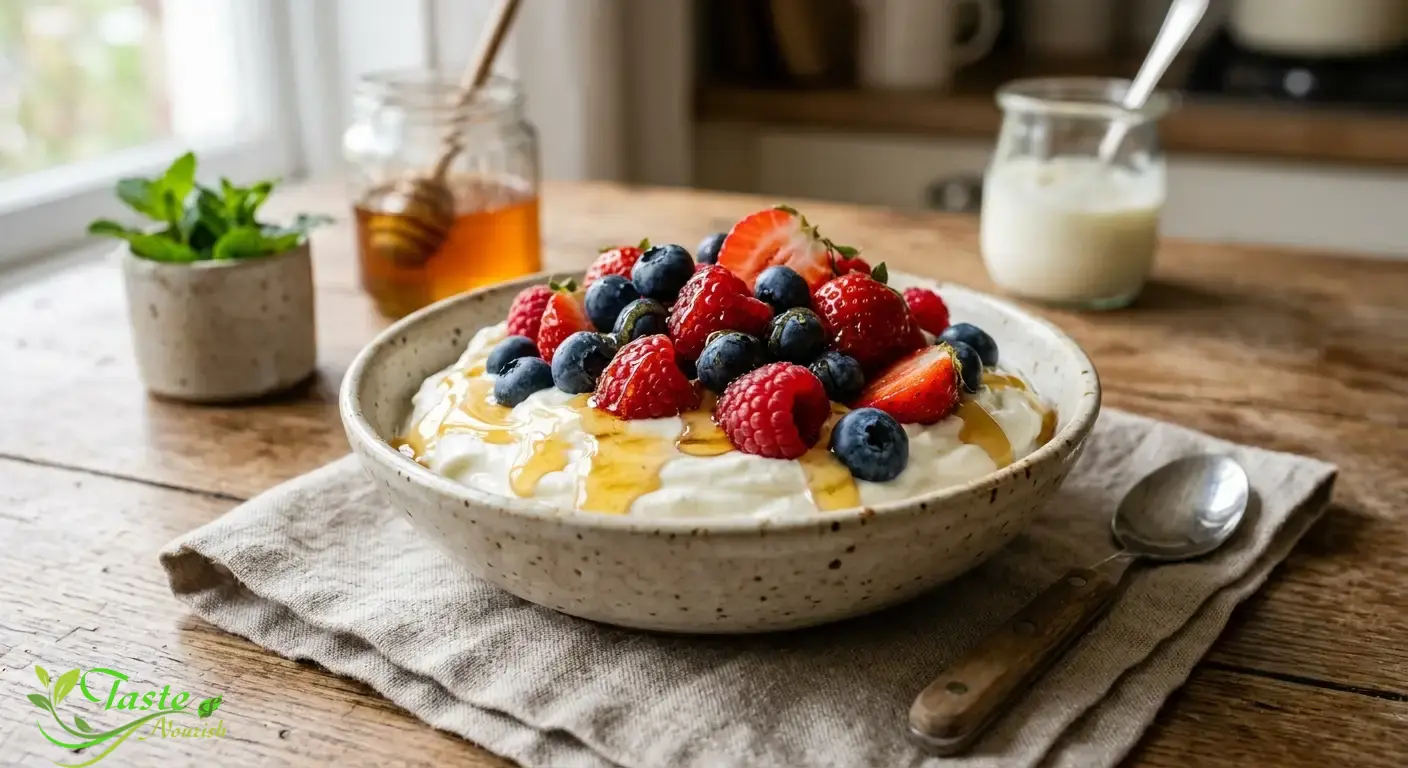
Regular, filtered honey is often easier to work with in recipes because it measures and pours consistently and won’t crystallize mid-recipe. Raw honey works fine for baking too, but its natural enzymes break down somewhat once exposed to oven heat, so save raw honey for uncooked uses — like drizzling over yogurt or stirring into warm (not boiling) tea — if you want to preserve its extra nutritional edge.
National Institutes of Health, National Library of Medicine (PMC). “Effect of Thermal Treatment on Physicochemical and Antioxidant Properties of Honey.” https://pmc.ncbi.nlm.nih.gov/articles/PMC6603282/
Hanan Abo Samra is the founder of Taste & Nourish, sharing trustworthy nutrition guidance and recipes drawn from 20+ years of hands-on cooking experience. When she's not developing new recipes, Hanan is researching the science behind everyday ingredients to bring readers practical, evidence-based guidance for a healthier lifestyle.