If you’ve ever stood in your kitchen cracking an egg into a pan and wondered, “How many calories am I actually adding to my meal right now?” — you’re not alone. Eggs are one of the most commonly eaten foods on the planet, and yet there’s still a surprising amount of confusion around their calorie content, nutritional value, and whether the yolk is a friend or foe.
The truth is, calories in an egg depend on several factors — the size of the egg, how you cook it, and whether you eat the whole thing or just the white. This guide cuts through the noise and gives you every number you need, backed by the latest nutritional data, so you can make smarter food choices every single day.
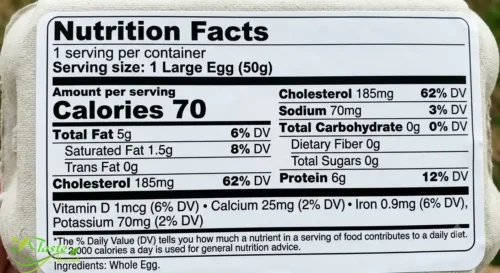
What makes eggs so fascinating from a nutrition standpoint is how much value they pack into such a small, portable package. Each large egg contains six grams of protein and is a good or excellent source of eight essential nutrients — all for just 70 calories.
That’s an extraordinary nutrient-to-calorie ratio that very few foods can match. Whether you’re tracking macros for bodybuilding, managing your weight, or just trying to eat cleaner, understanding exactly what’s in your egg is the first step toward making it work for your goals. Let’s crack into the details.
The short answer is that a standard large egg contains approximately 70–78 calories, depending on whether it’s raw or cooked. But that number shifts quite a bit based on the egg’s size. An egg generally contains between 54 and 96 calories and 0 to 1 grams of carbs, depending on its size. That’s a pretty wide range, so let’s break it down properly so you know exactly what you’re working with before you even turn on the stove.
Think of egg sizes like coffee cup sizes — the difference between a small and a jumbo isn’t just about the shell. Every size tier adds a meaningful number of calories, protein grams, and fat content. Whether you’re picking up a carton at your local grocery store or grabbing farm-fresh eggs at a market, knowing your egg size translates directly into knowing your calorie intake for the day. If you’re tracking nutrition with precision, this matters more than most people realize.
Calories by Egg Size (Small to Jumbo)
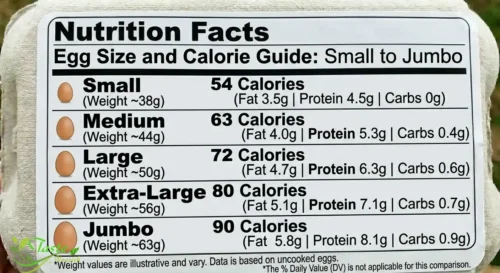
Here’s a full calorie breakdown by egg size, based on current USDA data and verified nutritional sources:
Egg Size
Weight (approx.)
Calories
Protein
Small
38g
54–56 kcal
~4.9g
Medium
44g
64–70 kcal
~5.5g
Large
50g
70–78 kcal
~6.3g
Extra-Large
56g
~85 kcal
~7.0g
Jumbo
63g+
~96 kcal
~7.9g
A small egg has approximately 54–56 calories. A medium egg has approximately 64–70 calories. A large egg has approximately 74–78 calories. An extra-large egg has approximately 85 calories. A jumbo egg has approximately 96 calories.
Most standard recipes and nutrition labels are based on the large egg, so unless specified otherwise, that’s the reference point to use when calculating your daily intake.
Raw Egg Calories vs. Cooked
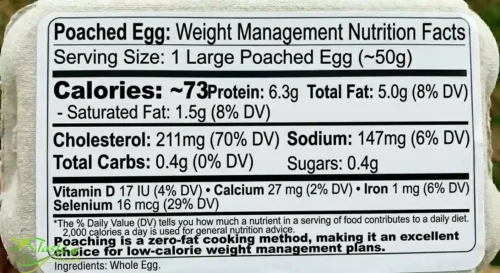
Here’s something interesting that most people don’t think about — does cooking an egg change its calorie count? In the case of boiling or poaching, the answer is essentially no — because you’re adding zero fat to the cooking process. One large raw egg (50g) contains approximately 72 calories.
Cooking method changes this — a hard-boiled egg has about 78 calories, a poached egg about 72, a scrambled egg about 75, and a fried egg about 90 calories — with the difference coming primarily from added cooking fat.
The moment you introduce oil, butter, or cream into the equation, the calorie count climbs — sometimes significantly.
Egg Nutrition Facts — Full Breakdown
Calories only tell part of the story. What makes eggs genuinely special is the quality and variety of nutrients they deliver alongside those calories. Nutritionists often call eggs “nature’s multivitamin,” and when you look at the full nutritional profile of a single large egg, it’s not hard to see why. You get protein, healthy fats, vitamins, minerals, and powerful antioxidants — all from a food that costs just a few cents per serving and takes under five minutes to prepare.
The egg is an encapsulated reserve of proteins, lipids, minerals, and vitamins, remarkable for the diversity of nutrients, their high digestibility, and the balance between the various essential constituents. That’s not marketing language — it’s the biological reality of what an egg is designed to do – provide everything a developing organism needs to survive and grow. For humans, that means we’re tapping into one of nature’s most perfectly engineered foods every time we sit down to breakfast.
Macronutrients in One Large Egg
Nutrient
Amount per Large Egg (50g)
% Daily Value
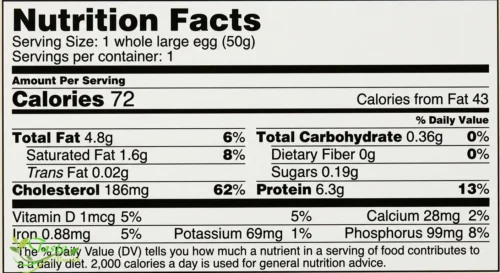
Calories
~72–78 kcal
~4%
Total Fat
4.8–5g
~6%
Saturated Fat
1.6g
~8%
Cholesterol
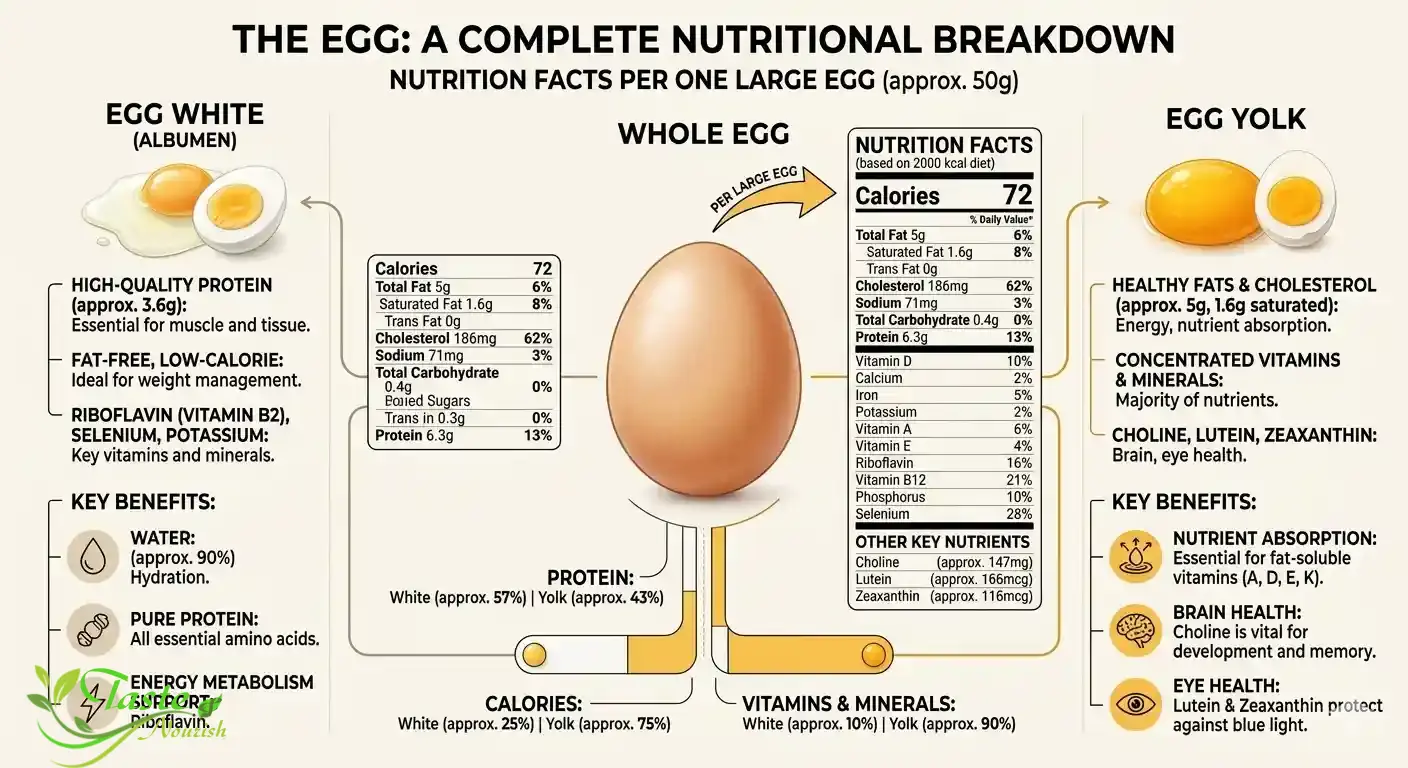
~186mg
~62%
Protein
6.3g
~13%
Carbohydrates
0.4g
~0%
Sodium
~71mg
~3%
Choline
~147mg
~27%
Key Takeaway: Eggs are virtually carb-free, moderately low in fat, and rich in complete protein — making them one of the most macro-friendly foods available for nearly any diet type.
Vitamins and Minerals in Eggs
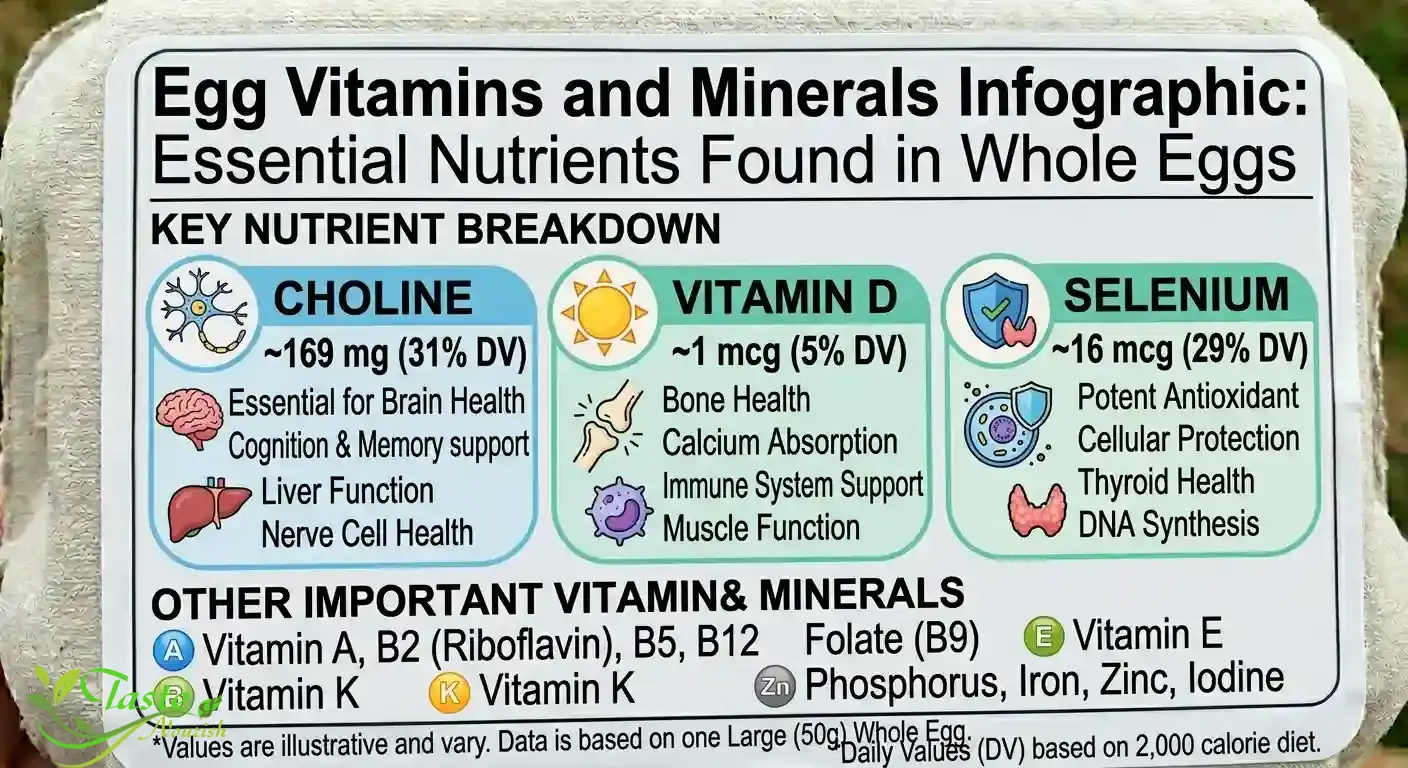
Beyond the macros, eggs deliver a genuinely impressive micronutrient payload. Eggs provide high-quality protein alongside many important vitamins and minerals. They’re one of only a few foods that provide vitamin D, a nutrient that’s vital for healthy bones, immunity, cell growth, and more. Selenium is another important nutrient found in eggs — this trace mineral is important for reproductive health and the production of thyroid hormone.
The list of micronutrients in a single egg is worth knowing:
Vitamin D — found almost exclusively in the yolk; critical for calcium absorption and immune function
Vitamin B12 — essential for neurological health and red blood cell production
Vitamin A — supports vision, skin integrity, and immune defense
Choline — crucial for brain development, liver function, and cell membrane structure
Selenium — a powerful antioxidant mineral that supports thyroid and reproductive health
Lutein and Zeaxanthin — carotenoids that protect against age-related macular degeneration
Eggs also contain lutein and zeaxanthin, two compounds known as carotenoids. They act as antioxidants and help protect your eyes from damage and conditions like macular degeneration and cataracts. These aren’t nutrients you’ll find in every food you eat — eggs are genuinely one of the most convenient ways to hit your daily targets for several of them simultaneously.
Egg White vs. Egg Yolk — Calorie and Nutrition Comparison
This is where things get really interesting — and where a lot of popular diet advice has historically gotten it wrong. For decades, the egg yolk was vilified because of its cholesterol content, and egg white omelets became the breakfast of choice for health-conscious eaters everywhere. But the science has shifted dramatically, and today’s nutritional consensus tells a much more nuanced story about what you’re actually gaining and losing when you separate that yolk from the white.
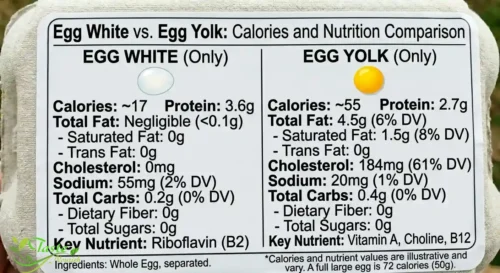
♦ The white portion of one large egg contains 3.6 grams of protein and 17 calories. The yolk contains 2.4 grams of protein and 53 calories. However, the majority of an egg’s essential vitamins and minerals are in the yolk, including choline, selenium, and the antioxidants lutein and zeaxanthin. Egg yolks also contain 4.5 grams of fat per large egg, most of which is unsaturated. So yes, the white is lower in calories — but it’s also dramatically lower in nutrients.
Here’s a direct side-by-side comparison that makes the picture crystal clear:
Component
Egg White (33g)
Egg Yolk (17g)
Whole Egg (50g)
Calories
17 kcal
55 kcal
72–78 kcal
Protein
3.6g
2.7g
6.3g
Fat
0g
4.5g
4.8g
Cholesterol
0mg
~184mg
~186mg
Vitamin D
0%
100%
Yes
Choline
Minimal
~147mg
~147mg
Vitamin A
None
Yes
Yes
Lutein/Zeaxanthin
None
Yes
Yes
Why You Shouldn’t Skip the Yolk
Here’s a striking number worth remembering: skipping the yolk saves just 55 calories while removing the most nutritious part of the egg. Think about that trade-off for a moment.
You’re eliminating all of the vitamin D, all of the choline, all of the fat-soluble vitamins (A, E, K), and the vast majority of the B12, lutein, and zeaxanthin — all to save 55 calories that you could just as easily offset by taking a short walk.
A systematic review by Myers and Ruxton (2023) noted that eggs provide choline at 294 mg per 100g — one of the highest food sources of this essential nutrient, which most adults under-consume relative to the EFSA Adequate Intake of 400 mg/day. Two whole eggs provide approximately 147 mg of choline — a contribution that egg whites alone cannot replicate.
The bottom line? If you’re eating egg whites exclusively for health reasons rather than calorie reasons, the science no longer fully supports that choice for most healthy adults. Eating whole eggs gives you the full nutritional picture that nature intended.
Calories in Eggs by Cooking Method
Cooking transforms eggs not just in texture and flavor, but in their calorie content. The base ingredient is the same, but what you add to the pan — or don’t add — makes a measurable difference. If you’re calorie-conscious, your cooking method is one of the most practical levers you can pull without giving up eggs altogether.
Boiled and Poached Eggs
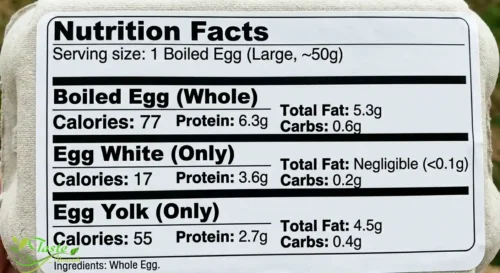
Boiled and poached eggs are the clear winners when it comes to keeping calories low while keeping all the nutritional benefits intact. One boiled egg contains approximately 78 calories and one poached egg has 71 calories.
♦ The reason for the near-identical count between raw and boiled is simple: boiling adds zero calories because you use no oil. You’re cooking the egg entirely in water, which means the only calories on your plate are the ones that came from the egg itself.
Nutritionists consistently recommend these two methods for people managing their weight or following calorie-restricted diets.
Beyond the calorie benefit, there’s a nutrient preservation advantage too. Soft-poached or soft-boiled eggs preserve the most nutrients — particularly choline (which oxidises when the yolk is overcooked) and lutein/zeaxanthin (sensitive to high heat). So not only are you eating fewer calories, you’re also getting more nutritional value from the egg itself. That’s a genuine win-win that requires zero extra effort.
Fried and Scrambled Eggs
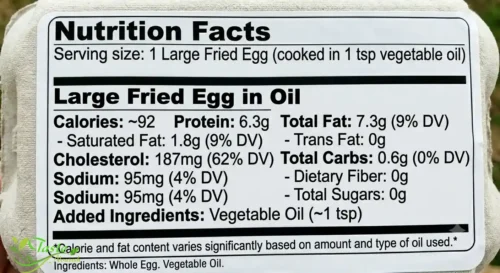
Fried and scrambled eggs are where the calorie count starts to climb, and the reason is straightforward: added fat. Fried eggs, scrambled eggs, and omelets have the most calories at about 90. These methods use cooking sprays, oil, or butter, which can add 20 or more calories to your dish.
A fried egg cooked in a tablespoon of butter can jump from 70 calories to well over 100 calories in seconds — and that’s before you’ve even thought about what you’re serving alongside it.
Consider this eye-opening long-term calculation: the practical difference between a 2-egg poached breakfast (144 kcal) and a 2-egg fried breakfast (180 kcal) is 36 calories per meal. Over a year of daily breakfasts, that single substitution adds up to approximately 13,000 calories — a measurable difference for anyone tracking long-term patterns. That number is the equivalent of nearly four pounds of body fat, just from changing how you cook your morning eggs.
Calories in Omelets and Egg Dishes
Once you start combining eggs with cheese, cream, bacon, and sauces, the calorie count escalates dramatically. A large egg cooked in 1 tablespoon of butter has approximately 174 calories. An omelet with 3 eggs and cheese cooked in butter has about 400 calories. Eggs Benedict, comprising 2 poached eggs with an English muffin, Canadian bacon, and hollandaise sauce, has closer to 900 calories. These dishes are delicious but are a reminder that the egg itself is rarely the calorie culprit — it’s the ingredients surrounding it.
Here’s a practical calorie reference for common egg-based meals:
Hard-boiled egg — ~78 kcal
Poached egg — ~71 kcal
Fried egg (in oil) — ~90 kcal
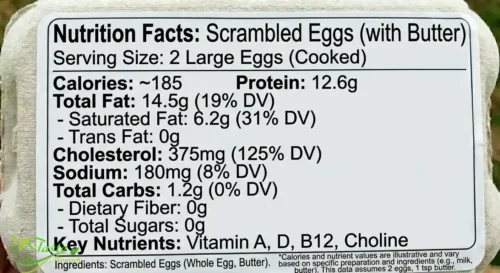
Scrambled egg (2 eggs, no butter) — ~140–150 kcal
Cheese omelet (3 eggs) — ~350–400 kcal
Eggs Benedict (full serving) — ~850–900 kcal
Are Eggs Good for Weight Loss?
This is one of the most Googled questions about eggs, and the answer from modern nutrition science is a resounding yes — with some important nuances.
Eggs are a weight-loss-friendly food for several compelling reasons: they’re high in protein, low in carbohydrates, and — critically — they have a powerful effect on satiety, meaning they keep you feeling full for longer than many other breakfast options. And when you feel full, you eat less. That’s the fundamental mechanism behind effective weight management.
Due to their high-protein and relatively low-calorie content, eggs are helpful for fat loss. The high-quality protein in eggs can increase thermogenesis (calorie burning). Studies show a protein-rich diet with eggs may help stabilize blood sugar. The satiety effect of eggs can reduce overall calorie intake. These aren’t just theoretical benefits — they’ve been demonstrated in multiple controlled clinical studies.
Eggs and Satiety — The Science Behind Feeling Full
The research on eggs and appetite control is genuinely impressive. In a study of adults following a reduced-calorie diet, those who ate eggs for breakfast lost more weight and had a greater reduction in waist size than those who started their day with a bagel, even though both meals had the same number of calories. Starting the day with two eggs helped people feel fuller and more satisfied than a cereal breakfast, without negatively affecting their cholesterol levels.
Adult men who ate an egg-based breakfast consumed fewer calories over the following 24 hours compared to those who ate a bagel breakfast with the same number of calories, suggesting that eggs may help regulate hunger and support appetite control.
What these studies reveal is that all calories are not created equal when it comes to hunger management. The protein in eggs triggers the release of satiety hormones and slows gastric emptying in a way that processed carbohydrates simply don’t. This makes eggs an almost uniquely effective breakfast for people trying to reduce their total daily calorie intake without feeling deprived.
Best Ways to Eat Eggs for Weight Management
If weight management is your primary goal, here are the most effective egg-eating strategies to adopt:
Choose boiled or poached over fried to avoid adding unnecessary fat calories
Eat whole eggs rather than just whites to benefit from the full satiety-promoting protein profile
Pair with vegetables like spinach, tomatoes, or peppers to add volume and fiber with minimal calories
Avoid high-calorie additions like cheese, cream, or hollandaise sauce, which can triple the calorie count of your meal
Eat eggs early in the day — breakfast egg consumption has been specifically linked to reduced calorie intake throughout the rest of the day
Don’t eat eggs alongside high-sodium processed meats like bacon or sausage, which undermine the overall health profile of your meal
Egg Cholesterol — Should You Really Be Worried?
For most of the late 20th century, eating eggs was considered risky because of their cholesterol content. Cardiologists advised patients to limit egg consumption, and the egg white omelet became a staple of “heart-healthy” diets everywhere. But the science has moved on significantly, and the current consensus is far less alarming than the old guidance suggested.
One large egg (50g) contains approximately 186mg of cholesterol, all of which is in the yolk. The current USDA Dietary Guidelines (2020–2025) no longer set a specific cholesterol limit but do recommend consuming as little dietary cholesterol as possible within a balanced diet. However, research has largely shown that dietary cholesterol from whole foods like eggs has a much smaller impact on blood cholesterol levels than saturated fat does. Scientific research has shown little or no effect between dietary cholesterol and heart health.
In fact, moderate egg consumption has been linked with raising HDL levels — the “good” cholesterol that actually protects cardiovascular health.
Reader Note: If you have a diagnosed condition like hyperlipidemia, type 2 diabetes, or existing cardiovascular disease, consult your doctor or registered dietitian about appropriate egg consumption for your specific situation. For healthy adults, current evidence supports eating up to one egg per day without meaningful cardiovascular risk.
Duck, Quail, and Other Egg Types — Calorie Comparison
Chicken eggs dominate most kitchen tables, but they’re far from the only variety available. Duck eggs, quail eggs, and goose eggs all have distinct calorie profiles, and if you’re exploring different egg types for culinary or nutritional reasons, it helps to know what you’re working with before you crack one open.
Here’s a quick comparison of egg types by calorie content:
Egg Type
Calories per Egg
Protein
Notable Feature
Chicken (large)
~72–78 kcal
6.3g
Most widely available
Duck
~130 kcal
~9g
Higher omega-3 content
Quail (per egg)
~14 kcal
~1.2g
Smaller; often eaten multiple at once
Goose
~266 kcal
~20g
Richest flavor; seasonal
Turkey
~135 kcal
~10.8g
Rare but nutritionally dense
Duck eggs contain 884mg/100g and quail eggs 844mg/100g of cholesterol — substantially more than chicken eggs per gram. So if you’re watching cholesterol specifically, chicken eggs remain the most moderate option among common egg varieties. Duck eggs are increasingly popular among bakers and chefs for their richer yolk and higher fat content, which produces fluffier baked goods and creamier sauces.
Practical Tips for Counting Egg Calories
Accurately tracking egg calories doesn’t have to be complicated, but there are a few practical guidelines that will save you from consistently under- or over-counting. Most food tracking apps default to large eggs, so if you’re using smaller or larger eggs at home, adjust accordingly. The margin between sizes can be 15–20 calories, which adds up meaningfully if you’re eating eggs twice a day.
Here’s a simple, actionable list to help you track with accuracy:
Weigh your eggs — a kitchen scale removes all guesswork; target 50g for a standard large egg
Account for cooking fat — even cooking spray adds 5–10 calories per spray
Log the whole meal — if your eggs come with cheese, avocado, or sauce, log those separately
Use the “boiled baseline” — when in doubt, use 78 calories as your reference for a single large cooked egg
Track additions, not just eggs — toast, butter, salt, and even ketchup all contribute to the total
Remember two-egg servings — most people eat two eggs at breakfast, meaning approximately 144–156 calories before any additions
Calories in an Egg FAQs
How many calories are in 2 eggs?
Two large eggs contain approximately 144–156 calories when boiled or eaten plain. If cooked with butter or oil, that number can rise to 180–200 calories depending on the amount of fat used. For a precise count, use 78 calories per large hard-boiled egg as your baseline and multiply accordingly.
Does cooking destroy the nutrients in eggs?
Cooking does reduce some heat-sensitive nutrients like choline and certain B vitamins, but it also makes the protein in eggs significantly more bioavailable. Research shows that the protein digestibility of cooked eggs is around 91% compared to just 51% for raw eggs. Gentle cooking methods — soft boiling and poaching — preserve the most nutrients.
Are eggs a good food to eat every day?
For most healthy adults, yes. Current dietary guidelines and a large body of research support consuming up to one whole egg per day without adverse health effects. In fact, daily egg consumption has been associated with improved HDL cholesterol levels, better eye health from lutein and zeaxanthin, and improved satiety throughout the day.
Which part of the egg has more calories — the white or the yolk?
The yolk contains significantly more calories. One large egg yolk holds approximately 55 calories, while the egg white from the same egg contains only 17 calories. However, the yolk also contains virtually all of the egg’s fat-soluble vitamins (A, D, E, K), choline, and most of the selenium and B12.
Can I eat eggs on a low-calorie diet?
Absolutely. Eggs are an ideal food for calorie-restricted diets because they offer a high satiety-to-calorie ratio. A two-egg boiled breakfast delivers around 156 calories and over 12 grams of protein — keeping hunger at bay for several hours. Pair them with non-starchy vegetables to add volume and micronutrients without adding significant calories.
A simple, healthy hard-boiled egg with full nutritional information.
Ingredients
1 large egg
Water (enough to cover egg)
Directions
Place egg in a saucepan and cover with cold water.
Bring water to a boil over medium-high heat.
Reduce heat and simmer for 9–12 minutes depending on desired doneness.
Transfer egg to ice water for 5 minutes, then peel and serve.
Conclusion
Eggs are, by almost any metric, one of the most nutritionally complete and calorie-efficient foods available to us. A single large egg delivers roughly 70–78 calories, 6+ grams of complete protein, and a rich array of vitamins, minerals, and antioxidants that you’d struggle to replicate from any single alternative food. The calorie count shifts based on egg size and cooking method — ranging from a lean 71 calories in a poached egg to over 90 in a fried one — but the core nutritional value remains intact across preparation styles.
The lesson from the latest science is clear: don’t fear the whole egg. The yolk carries the lion’s share of the micronutrient payload, and discarding it to save 55 calories is rarely a worthwhile trade for healthy adults. Whether your goal is weight loss, muscle building, or simply eating a balanced diet, eggs earn their place at your table. Choose your cooking method wisely, be mindful of what you pair them with, and let one of nature’s most perfect foods do its job.
Hanan Abo Samra is the founder of Taste & Nourish, sharing trustworthy nutrition guidance and recipes drawn from 20+ years of hands-on cooking experience. When she's not developing new recipes, Hanan is researching the science behind everyday ingredients to bring readers practical, evidence-based guidance for a healthier lifestyle.