

Are Eggs Healthy? Cholesterol, Nutrition & How Many

Eggs have been blamed for clogged arteries, praised as nearly perfect protein, and then partly forgiven, all within a single generation of dietary advice. Each swing arrived with confident headlines, and the studies underneath were rarely as tidy as the headlines suggested.
So, are eggs healthy? I want to be clear about what the research does and does not show, because the honest answer depends on who is eating them and what else is on the plate. This article covers what is actually in an egg, where the cholesterol evidence stands, who should be more careful, and how to cook and serve eggs sensibly.
Quick Answer
Are eggs healthy? For most healthy adults, yes, in moderation. Eggs supply high-quality protein, choline, and selenium in a compact package, and heart-health guidance allows an egg a day within a balanced diet. Evidence on heart disease and type 2 diabetes is mixed, so people with high LDL cholesterol or diabetes should be more cautious.

Key Takeaways: Are Eggs Healthy?
- Are eggs healthy? It depends on the person: your cholesterol, your blood sugar, and the foods served alongside matter as much as the egg itself.
- Eggs are one of the more concentrated common sources of choline, a nutrient most adults take in less of than the Daily Value.
- On average, eating eggs nudges LDL cholesterol up slightly, but responses vary from person to person.
- Large observational studies disagree about heart disease risk, which is why guidelines focus on overall eating patterns rather than single foods.
- Raw and undercooked eggs can carry Salmonella, and cooking until the yolk and white are firm is the simple fix.
- Claims about eye health and weight loss rest on thin evidence and should not drive how many eggs you eat.
What One Large Egg Gives You
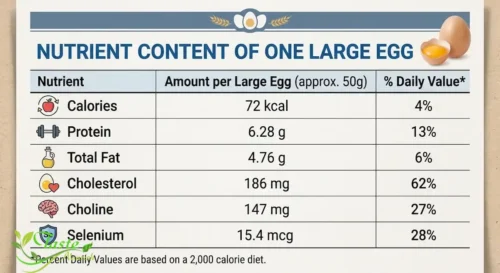
This article is about chicken eggs; duck, quail, and goose eggs have different profiles. An egg is a compact package: a white that is mostly protein and water, and a yolk that holds the fat, the cholesterol, and much of the vitamin content.
The table below scales values from the USDA FoodData Central entry for whole raw egg, which are listed per 100 grams, to one large egg of 50 grams. Figures are rounded, and feed, brand, and cooking fat can shift them.
| Nutrient | Amount | % Daily Value |
|---|---|---|
| Calories | 72 | — |
| Protein | 6.3 g | 13% |
| Total fat | 4.8 g | 6% |
| Saturated fat | 1.6 g | 8% |
| Carbohydrate | 0.4 g | Under 1% |
| Dietary fiber | 0 g | 0% |
| Cholesterol | 186 mg | 62% |
| Choline | 147 mg | 27% |
| Selenium | 15.4 µg | 28% |
| Vitamin B12 | 0.45 µg | 19% |
| Riboflavin | 0.23 mg | 18% |
| Vitamin D | 1.0 µg | 5% |
By the FDA’s Daily Value thresholds, a large egg is an excellent source of choline and selenium, a good source of protein, vitamin B12, and riboflavin, and low in vitamin D. It has no fiber and no vitamin C, which is the main reason eggs work better as part of a plant-heavy plate than as a meal on their own. For every other vitamin and mineral, see our complete egg nutrition breakdown.
Choline is where eggs earn their keep. The NIH’s choline fact sheet lists one hard-boiled large egg at 147 mg, or 27% of the Daily Value of 550 mg.
The same fact sheet reports average daily choline intakes of 402 mg in men and 278 mg in women, both below the Daily Value, with meat, poultry, fish, dairy products, and eggs as the main sources. That makes eggs a practical way to close the gap, though they are not the only way.
Eggs and Cholesterol: What Controlled Trials Show
Eggs are one of the largest single sources of dietary cholesterol in the American diet, according to the AHA’s science advisory on dietary cholesterol, which is why they sat at the center of the cholesterol debate for decades. That advisory also found that current research does not support a specific numerical limit on cholesterol from food, and it steered readers toward overall eating patterns instead.
Randomized trials give the cleanest answer about blood cholesterol. A meta-analysis of 28 randomized trials found that adding eggs raised LDL cholesterol by about 5.55 mg/dL and HDL cholesterol by about 2.13 mg/dL on average, with no change in the LDL-to-HDL ratio. Individual responses varied, and the authors attributed part of the differences between studies to how strongly participants responded to dietary cholesterol.
A later meta-analysis of 17 randomized trials in healthy people was less reassuring, finding higher LDL cholesterol and a higher LDL-to-HDL ratio in the groups eating more eggs. Both analyses measured blood markers rather than heart attacks or strokes, so they show direction, not outcomes.
Are Eggs Healthy for Your Heart? Two Large Studies, Two Answers
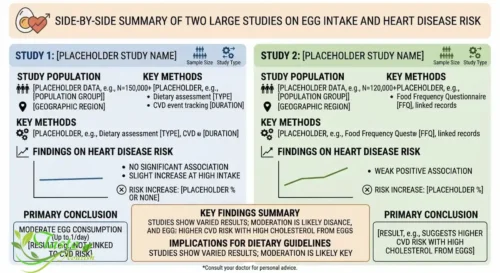
A JAMA pooled analysis of six US cohorts with 29,615 participants found that each additional half egg per day was associated with a higher risk of cardiovascular disease (hazard ratio 1.06). The egg association was no longer significant once the researchers adjusted for total dietary cholesterol.
A BMJ analysis of three large US cohorts plus an updated meta-analysis reached a different conclusion: moderate intake, defined as up to one egg a day, was not associated with cardiovascular disease risk overall. It also noted potentially lower risk in Asian populations, which may reflect other differences in diet and lifestyle rather than eggs themselves.
The AHA advisory points to one reason results can diverge: in the American diet, dietary cholesterol and saturated fat rise together because eggs are often served with bacon or sausage, which makes it hard to separate the egg from its company. I would not read either study as the last word. Both are observational, so they can show associations but cannot prove that eggs cause or prevent anything.
How Many Eggs Is Reasonable?
For healthy adults, the AHA advisory’s answer is up to one whole egg, or an equivalent amount of egg, a day within a heart-healthy eating pattern. For older adults with normal cholesterol, a summary of the advisory notes that up to two eggs a day is acceptable in that context.
Federal guidance is broadly consistent. This university extension summary of the 2025–2030 guidelines shows that the Dietary Guidelines for Americans include eggs among recommended protein foods while keeping saturated fat below 10% of daily calories. Long-term outcomes at much higher intakes are harder to judge from the evidence discussed here, and our article on the side effects of eating too many eggs covers what is known about larger amounts.
Who Should Be More Careful With Eggs
Are Eggs Healthy If You Have Diabetes or High LDL Cholesterol?
They can be, but this is where individual guidance matters most. The AHA advisory urges caution with cholesterol-rich foods for people with dyslipidemia, particularly those with diabetes or at risk for heart failure.
On type 2 diabetes, the evidence is mixed. A meta-analysis of prospective cohort studies found a modest higher risk with three or more eggs a week, but only in US studies, and cohort data cannot show that eggs were the cause.
If this describes you, ask your doctor or a registered dietitian how eggs fit your plan, and keep taking any prescribed medication as directed.
Egg Allergy
Egg is one of the most common food allergens in children, and both the yolk and the white contain proteins that can trigger reactions, with white allergy being more common. Reactions range from hives to, rarely, anaphylaxis, and while most children outgrow the allergy, not all do, according to Mayo Clinic’s egg allergy overview. Anyone with a diagnosed egg allergy should avoid eggs regardless of anything else here.
Whole Eggs or Just the Whites?

Egg whites are mostly protein and water with no fat or cholesterol, which is why they are the usual swap for people watching cholesterol or calories. The trade-off is that the yolk carries the fat-soluble vitamins, most of the choline, and the carotenoids that give it color, so whites alone are leaner but less nutrient-dense. For a side-by-side look, see our comparison of egg whites versus whole eggs.
Popular Claims Beyond Heart Health, and How Strong the Evidence Is
Yolks contain lutein and zeaxanthin, carotenoids found in the macula of the eye. In a 90-day randomized trial of healthy adults, eggs enriched with these carotenoids raised blood levels but did not change macular pigment density, and the trial was supported in part by the company supplying the enriched eggs. Enriched eggs contain more of these carotenoids than ordinary ones, so the results do not translate directly to supermarket eggs, and the evidence that eating eggs protects vision is preliminary.
Eggs are often marketed for weight control because of their protein. Short-term studies have looked at fullness after egg-based meals, but the available research does not establish that adding eggs leads to lasting weight loss on its own, so they are better seen as a convenient protein than a weight-loss tool. For the wider list of potential benefits and how strong each one is, see the evidence behind egg benefits.
Eating Eggs Safely

Raw and undercooked eggs can carry Salmonella, and the FDA’s egg safety guidance comes down to three habits: keep eggs refrigerated at 40°F or below, cook them until the yolk and white are firm, and cook egg-containing dishes such as casseroles to 160°F.
Pregnant people, young children, older adults, and anyone with a weakened immune system are most vulnerable to food poisoning, so runny yolks and raw-egg recipes are best skipped or made with pasteurized eggs, according to FDA guidance. For where eggs should live and how long they keep, see our egg storage guide.
Building a Better Egg Plate

The AHA advisory recommends focusing on patterns such as Mediterranean-style and DASH-style eating, which are inherently relatively low in cholesterol and built around vegetables, fruit, whole grains, and legumes. Since eggs contain no fiber, that is the natural way to serve them. I’d rather see eggs next to sautéed greens, tomatoes, or beans and whole-grain toast than next to bacon, sausage, or a pile of cheese, because the saturated fat in those sides is part of the heart-health picture too.
For cooked combinations that follow this approach, see our high-protein egg breakfast ideas.
Egg Health FAQs
What is the healthiest way to cook eggs?
Boiling and poaching are the leanest methods because they add no fat. Scrambling or frying in a small amount of olive or another liquid vegetable oil is also reasonable, and butter and cheese add more saturated fat than the egg does. Whatever the method, cook until the yolk and white are firm.
Are raw eggs healthier than cooked eggs?
No. Raw eggs are not a proven nutritional upgrade, and they carry a Salmonella risk that thorough cooking eliminates. If a recipe calls for raw egg, such as homemade mayonnaise, use pasteurized eggs instead.
Are pasteurized eggs worth buying?
Yes, for recipes that stay raw or lightly cooked and for anyone in a higher-risk group. The FoodSafety.gov guidance on Salmonella and eggs advises considering pasteurized eggs and egg products, which are widely available.
Bottom Line
I’d stop asking whether eggs are good or bad and ask a narrower question: does this egg fit my lab results and my plate? If your LDL cholesterol or blood sugar is already a concern, ask your clinician or a registered dietitian how many eggs make sense for you before changing anything. If neither applies, I’d spend less energy counting eggs and more on what sits beside them.
Conclusion
So, are eggs healthy? For most people, yes, as one part of a varied, plant-rich diet, with the real questions centering on cholesterol status, diabetes, allergy, and food safety rather than on the egg itself. The evidence is strong enough to stop treating eggs as either a miracle food or a menace, and not strong enough to settle every detail for every person.
Explore Eggs by Topic
- Benefits of eggs: A closer look at which egg benefits the evidence really supports.
- Side effects of too many eggs: What the science says about eating eggs in large amounts, and for whom it matters.
- Egg nutrition facts: Calories, protein, vitamins, and health benefits of eggs gathered in one reference.
- Egg white vs whole egg: Protein, calories, and nutrition compared between egg whites and whole eggs.
- Calories in an egg: How egg size and cooking method change calories and overall nutrition.
This article offers general nutrition information and is not medical advice. If you have heart disease, diabetes, high cholesterol, or an egg allergy, or you take medication, talk with a doctor or registered dietitian before changing how many eggs you eat.