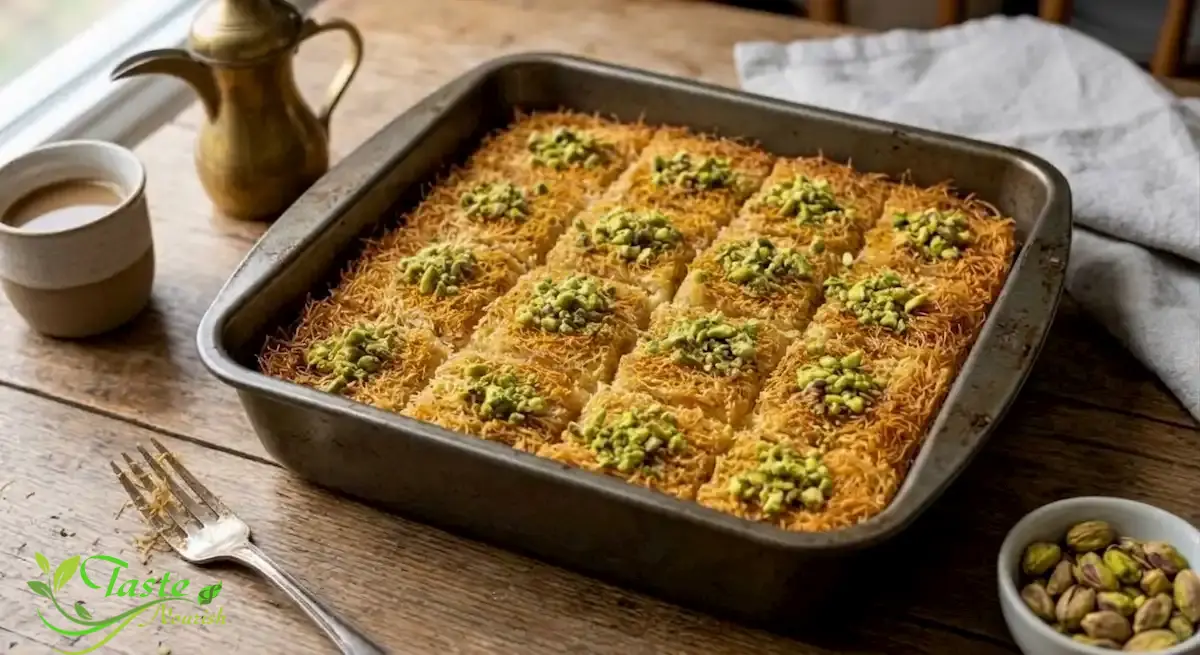
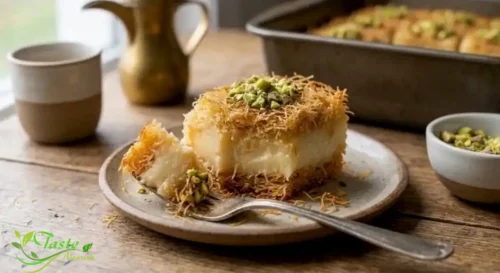
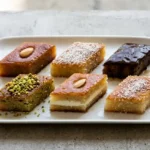
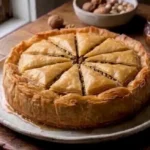
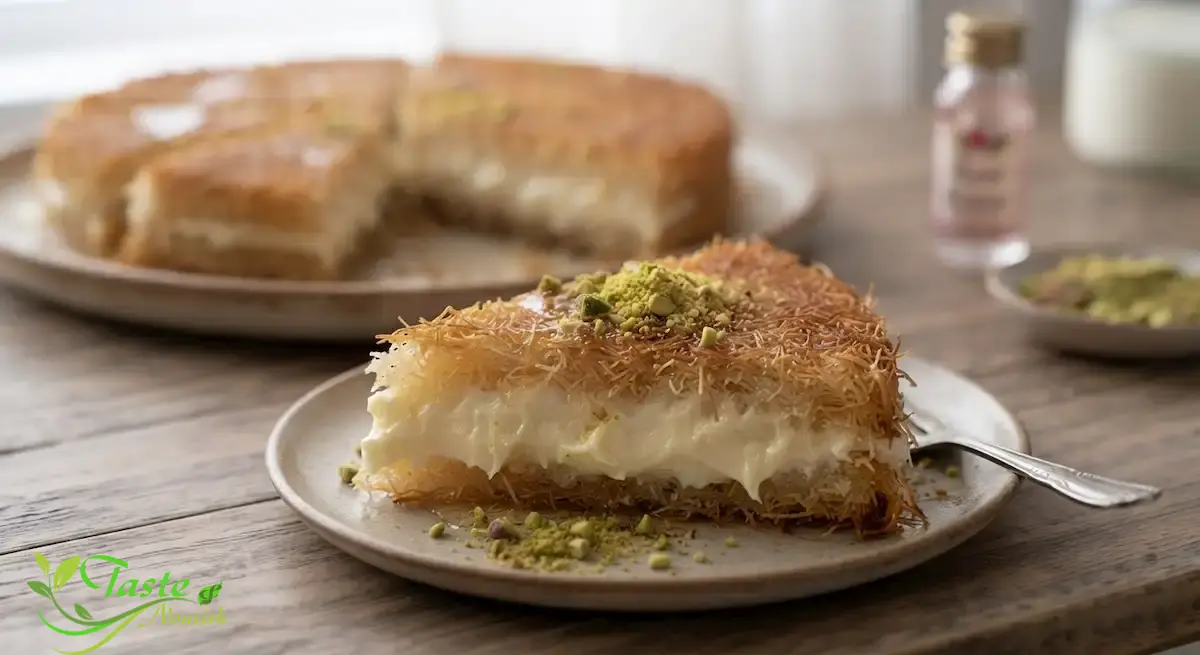
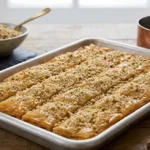
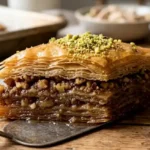
This vegan kunafa recipe gives you crisp golden kataifi, a soft cornstarch cream center, and a light syrup, with no butter, ghee, cheese, or eggs. It bakes in an 8-inch (20 cm) square pan and cuts into squares, diamonds, or triangles.
Kunafa is also spelled knafeh, kanafeh, and künefe, and it has many regional versions. Most of the time is hands-off. The filling and the syrup both need to cool before assembly, and the baked pan needs a short rest before cutting. The steps below cover the filling thickness, fat coverage, and syrup timing that keep the top crisp.
A vegan kunafa recipe replaces the usual butter, ghee, and cheese with plant-based fat and a cornstarch cream. Coat shredded kataifi dough in melted refined coconut oil and layer it around a cold plant milk filling. Bake until golden. Pour cooled syrup over the hot kunafa straight from the oven.
This vegan kunafa recipe keeps what defines the dessert: crisp golden strands of kataifi dough, a soft cream layer in the center, and a light syrup. Plant-based fat replaces butter and ghee, and a cornstarch cream replaces dairy cream or cheese. The dessert is dairy-free and egg-free.
Key Takeaways: Vegan Kunafa Recipe
A vegan kunafa recipe works best when every kataifi strand has a thin coat of melted fat. Uncoated strands bake pale and dry.
The filling has no eggs or dairy, so cornstarch does all the thickening. It must be boiled briefly to set and then chilled until cold and firm.
Press the bottom layer firmly and the top layer lightly. This gives clean slices without squeezing out the filling.
Time is only a guide. The finished top should look dry and deep golden, and the edges should pull slightly from the pan.
Pour cooled syrup over the hot kunafa straight from the oven.
The cream filling is perishable, so leftovers belong in the refrigerator. The crisp top softens gradually as the kunafa sits.
What Changes in a Vegan Kunafa
Traditional kunafa is usually made with butter or ghee. The filling may be sweet cheese, a thick dairy cream called ashta, or nuts, depending on the region. No single filling is the only correct one.
This version makes three changes. The fat is refined coconut oil or block-style vegan butter. The filling is a cream made from soy milk, coconut milk, and cornstarch. The dough and sugar get a quick label check, which the ingredient notes explain. For the dairy version made with cream, see our guide to kunafa with ashta cream.
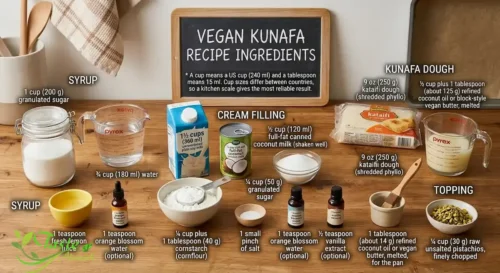
Vegan Kunafa Recipe Ingredients
A cup means a US cup (240 ml) and a tablespoon means 15 ml. Cup sizes differ between countries, so a kitchen scale gives the most reliable result.
Syrup
1 cup (200 g) granulated sugar
¾ cup (180 ml) water
1 teaspoon fresh lemon juice
1 teaspoon orange blossom water (optional)
Cream Filling
1½ cups (360 ml) unsweetened plain soy milk
½ cup (120 ml) full-fat canned coconut milk, shaken well
¼ cup plus 1 tablespoon (40 g) cornstarch (cornflour)
¼ cup (50 g) granulated sugar
1 small pinch of salt
1 teaspoon orange blossom water (optional)
½ teaspoon vanilla extract (optional)
Kunafa Dough
9 oz (250 g) kataifi dough (shredded phyllo, also called kadayif or kunafa dough)
½ cup plus 1 tablespoon (about 125 g) refined coconut oil or block-style vegan butter, melted
1 tablespoon (about 14 g) refined coconut oil or vegan butter, melted, for the pan
Topping
¼ cup (30 g) raw unsalted pistachios, finely chopped
Ingredient Notes
Kataifi dough. This is pastry made of very thin, long wheat strands. It is sold frozen or chilled in Middle Eastern, Turkish, and Greek grocery stores and in some large supermarkets. Most kinds are made from wheat flour and water, but check the label for butter, dairy, or egg. Packages are often larger than 250 g. Wrap the rest tightly and follow the package storage directions. There is no reliable substitute for kataifi in this recipe.
Fat. Ghee and butter are not vegan. Refined coconut oil has a neutral flavor and is solid at room temperature, which helps the baked strands stay crisp. Unrefined coconut oil adds a coconut taste. Use block-style vegan butter, not a soft spread, because soft spreads contain more water.
Plant milks. Soy milk gives the filling a neutral flavor and some body. Use canned full-fat coconut milk, not the thin carton drink. The fat separates in the can, so shake it well before measuring.
Cornstarch. This is the pure white starch, called cornflour in the UK and some other countries. Do not use corn meal or masa flour.
Orange blossom water. This is a distilled flavoring sold in Middle Eastern shops and some supermarkets. Strength varies by brand, so start with the amount given. Leave it out if you do not have it.
Sugar and vanilla. In some countries, refined sugar is filtered with animal bone char. If this matters to you, choose sugar labeled vegan or ask the maker. Vanilla extract contains alcohol, so omit it or use an alcohol-free vanilla if needed.
Allergens. This recipe contains wheat (kataifi), soy (soy milk), coconut, and tree nuts (pistachios). Some vegan butters also contain soy or nuts. Allergen labeling rules differ by country, so check your local labels.
Equipment
8-inch (20 cm) square metal baking pan, at least 2 inches (5 cm) deep
Medium heavy-bottomed saucepan and a small saucepan
Whisk and a large mixing bowl
Kitchen scale (strongly recommended)
Kitchen scissors and a flat-bottomed glass for pressing the layers
Sharp serrated knife and a thin spatula
How to Make Vegan Kunafa
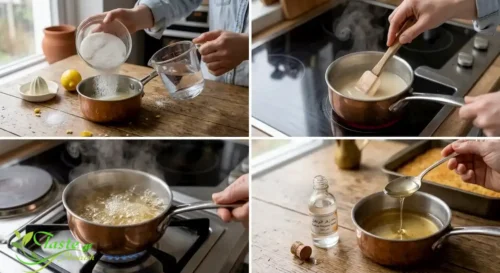
1. Make the syrup first. Combine the sugar, water, and lemon juice in the small saucepan. Stir over medium heat only until the sugar dissolves. Bring to a boil, lower the heat, and simmer without stirring for 8 minutes. The syrup should coat the back of a spoon but still pour easily. Remove from the heat and stir in the orange blossom water. Let it cool to room temperature, about 68–72°F (20–22°C). This usually takes about an hour.
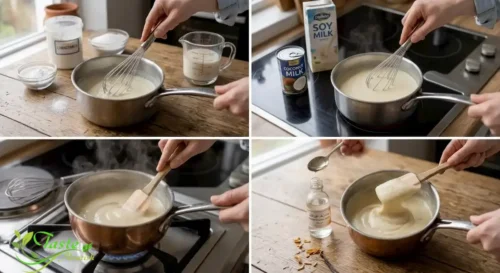
2. Cook the filling. In the medium saucepan, whisk the cornstarch, sugar, salt, and ½ cup (120 ml) of the cold soy milk until no lumps remain. Whisk in the rest of the soy milk and the coconut milk. Cook over medium heat, whisking constantly and scraping the corners, until the mixture thickens and begins to bubble. Cook 1 more minute while whisking. It should be as thick as a firm pudding. Remove from the heat and stir in the orange blossom water and vanilla.
3. Chill the filling. Scrape the filling into a shallow dish. Press plastic wrap or parchment directly onto the surface to prevent a skin. Refrigerate once it stops steaming, until it is completely cold and firm, about 1½ hours.
4. Prepare the oven and pan. Heat a conventional oven to 375°F (190°C) with the rack in the middle. Fan or convection ovens often brown faster, so check 5 minutes early. Brush the base and sides of the pan with the 1 tablespoon of melted fat.
5. Coat the dough. If the kataifi is frozen, thaw it as the package directs, then leave it at room temperature for about 30 minutes before opening. Weigh 250 g into a large bowl. Pull the strands apart with your fingers. Snip through them a few times with scissors so the pieces are about 2 inches (5 cm) long, which makes slicing easier. Pour the 125 g of melted fat over the dough. The fat should be just melted, not hot. Rub it in with your fingertips for about 2 minutes, until every strand looks glossy with no dry patches. If the coconut oil starts to set, warm it briefly and continue.
6. Build the base. Divide the coated dough into two equal portions, about 190 g each. Spread one portion evenly in the pan and push it into the corners. Press firmly with the bottom of a flat glass until the layer is compact and about ½ inch (1 cm) thick.
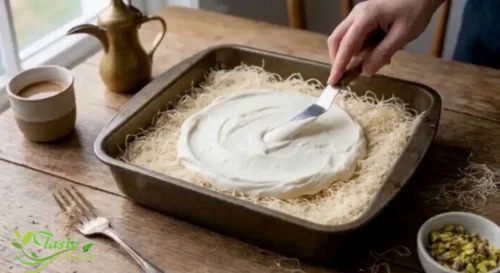
7. Add the filling. Whisk the cold filling for about 20 seconds until smooth. Spread it over the base, leaving a ½-inch (1 cm) border so the filling does not squeeze out later.
8. Add the top layer. Scatter the second portion over the filling, covering the edges first and then the center. Press gently with your palm only until the surface is level. Press the edges a little more firmly so they meet the pan.
9. Bake. Bake for 30 to 40 minutes, until the top is deep golden and looks dry and the edges pull slightly away from the pan. If the top darkens before the edges, cover it loosely with foil. Oven times vary, so go by color and not the clock.
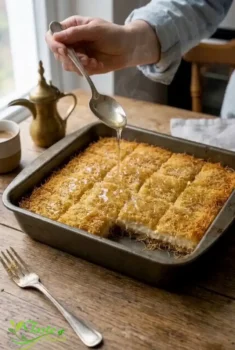
10. Add the syrup. Pour cooled syrup over the hot kunafa straight from the oven. Spoon it slowly across the surface, a few spoonfuls at a time, and let each addition soak in. It will sizzle. Stop when syrup begins to pool on the surface. You may not need all of it, so keep the rest in a jar to serve on the side. Set the pan on a wire rack.
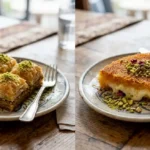
11. Rest and finish. Let the kunafa rest for 30 minutes so the syrup is absorbed and the filling firms slightly. Sprinkle with the pistachios. Cut with a sharp serrated knife using a sawing motion, all the way to the bottom of the pan.
How to Cut the Pan
Each serving is 1/16 of the pan. Piece counts depend on the shape you choose, so they are approximate for diamonds and triangles.
Squares: Make 3 lengthwise cuts to create 4 strips about 2 inches (5 cm) wide. Then make 3 crosswise cuts. This gives 4 × 4 = 16 squares.
Diamonds: Make the same 3 lengthwise cuts. Then cut diagonally across the strips, spacing the cuts about 2½ inches (6 cm) apart. Expect roughly 14 to 18 pieces, including smaller edge triangles.
Triangles: Cut the 16 squares in half diagonally to make 32 triangles. One serving is about 2 triangles.
Getting the Texture Right
The goal is a dry, golden, crisp top and base, a thick but soft cream center, and syrup that sweetens the surface without turning the strands wet. Three choices control this.
First, the fat. Coconut oil is solid at room temperature, so the baked strands set crisp as they cool. Block-style vegan butter also works, but it contains some water and can give a slightly less crisp result.
Second, the filling temperature. A cold, firm filling keeps the bottom layer dry during assembly. A warm filling melts the fat in the dough and softens the base before it reaches the oven.
Third, the syrup. Cooled syrup poured on hot pastry soaks in quickly without softening the strands the way hot syrup does. Kunafa gets its crunch from fine loose strands, while baklava gets it from thin flat sheets. Our article on how baklava and kunafa differ compares the two in more detail.
Substitutions
Fat: Refined coconut oil gives the crispest result. Block-style vegan butter adds more flavor but can bake slightly less crisp and may brown faster. A neutral liquid oil is untested here, and strands made with it tend to feel less crisp once cool. Soft spreads are not recommended.
Soy milk: Other unsweetened plant milks, such as oat or almond, usually work because cornstarch does the thickening. The flavor changes, and very thin milks can taste watery. This swap is untested here.
Orange blossom water: Use ½ teaspoon of rose water instead, since it is stronger. You can also use 1 teaspoon of vanilla or a little finely grated orange zest.
Pistachios: Walnuts or almonds work as a topping. For a nut-free version, see the variations below.
Kataifi and sugar: There is no reliable substitute for either. The syrup needs granulated sugar to reach the right consistency.
Lighter Adjustments
These are optional changes for readers who want a less sweet or less rich dessert. They are not health claims, and the nutrition figures below describe the recipe as written.
Less sugar in the filling: Reduce it from ¼ cup (50 g) to 2 tablespoons (25 g). The filling still sets, and the syrup supplies most of the sweetness.
Less syrup: Stop pouring as soon as syrup begins to pool, and serve the rest on the side so each person adds their own.
Lighter filling: Replace the coconut milk with another ½ cup (120 ml) of soy milk. The filling will be less rich but should still set.
Keep the dough fat: Cutting back on the fat in the dough leaves dry, pale strands, so keep it as written.
Common Mistakes and Troubleshooting
Why Is My Vegan Kunafa Soggy?
The usual causes are a filling that was not fully cold, hot syrup, too much syrup, or covering the pan while it is still warm. Chill the filling until it is firm. Pour cooled syrup over the hot kunafa straight from the oven, and stop when syrup begins to pool. Leave the pan uncovered on a wire rack until it is cool. A soggy top can be dried a little by returning it uncovered to a hot oven for a few minutes, but it will not fully recover.
Why Are Some Strands Pale or Dry?
Those strands did not get enough fat. Rub the fat in for the full 2 minutes and check for dull patches. If pale spots remain before baking, dab them with a little extra melted fat.
Why Is the Filling Runny or Lumpy?
A runny filling usually means the cornstarch was not cooked long enough. Return it to the heat and whisk until it bubbles, then cook 1 more minute. Lumps form when cornstarch is added to hot liquid or is not whisked into cold soy milk first. Whisk the cooled filling hard, or press it through a sieve.
Why Does It Fall Apart When Cut?
The base was probably not pressed firmly, or the pan was cut too soon. Press the bottom layer firmly with a glass, rest the pan for 30 minutes, and use a sharp serrated knife with a sawing motion.
Why Is the Top Dark but the Bottom Pale?
This often comes from the pan or the rack position. Glass and thick ceramic dishes brown differently from metal, and a high rack browns the top first. Use a metal pan on the middle rack and cover the top loosely with foil if it darkens early.
Why Does It Taste Greasy or Waxy?
Coconut oil firms up when cold, so kunafa served straight from the refrigerator can feel waxy. Let it come to room temperature or warm it briefly before serving. A greasy result can also mean the fat was not rubbed in evenly and pooled in the bowl, so scrape the dough from the bowl without adding any leftover pooled fat.
Why Did My Syrup Crystallize?
Stirring after the syrup boils, or sugar crystals on the pan sides, can trigger crystals. The lemon juice helps prevent this. To fix a grainy syrup, add a splash of water and warm it gently until the crystals dissolve.
Serving Suggestions
Serve the kunafa slightly warm or at room temperature, straight from the pan. Keep the extra syrup in a small jar on the table. A little fresh fruit or a spoonful of plant-based yogurt can balance the sweetness. Unsweetened tea or coffee also pairs well with it.
Vegan Kunafa Recipe Variations
Rose cream: Replace the orange blossom water in the filling with ½ teaspoon of rose water. Add more only after tasting, because rose water is strong.
Cardamom cream: Whisk ¼ teaspoon of ground cardamom into the filling with the cornstarch. This is an untested flavor addition, but it does not change the structure.
Nut filling (untested): Replace the cream with about 1½ cups (180 g) of finely chopped pistachios or walnuts mixed with 3 tablespoons (about 35 g) of sugar. The filling needs no cooling, but the layer will be drier and will take up more syrup.
Nut-free topping: Leave off the pistachios or use a little toasted shredded coconut. Check the kataifi label for cross-contact warnings if the allergy is serious.
Crunchy chocolate bars: For kunafa bars with a pistachio filling in a chocolate shell, see our chocolate pistachio kunafa bars. That recipe is separate from this one, so check its ingredients for dairy.
Storage and Food Safety
The cream filling makes this a perishable dessert. US guidance says perishable food should not stay out of refrigeration for more than 2 hours, or 1 hour when the temperature is above 90°F (32°C), as explained in USDA FSIS advice on keeping food out of the danger zone. Rules in other countries may differ, so check your local food safety authority. In hot or humid weather, refrigerate sooner and expect the crisp top to soften faster.
Cool leftover kunafa, cover it, and refrigerate it. This recipe gives no fixed number of days, because shelf life depends on how well the filling was chilled and on your refrigerator temperature. If a leftover piece smells sour, shows mold, or looks slimy, discard it. Never taste food to check whether it is safe.
Crispness fades gradually as the top absorbs syrup and refrigerator moisture, so the best texture is on the day it is baked. Chilled kunafa feels firmer because the coconut oil sets, so let a piece warm up before serving. A brief reheat uncovered in the oven can dry the top a little, but the result varies and has not been tested here.
The assembled kunafa is not recommended for freezing. Starch-thickened fillings can turn watery after thawing, and the top will soften. Unused kataifi dough can be stored as the package directs.
Kitchen Notes
Set the baked pan on a wire rack while the syrup soaks in, so steam can escape from underneath and the base stays crisp. Use a heavy-bottomed saucepan for the filling and scrape the corners as you whisk, because starch sets there first. Lift cut pieces with a thin spatula, since the strands break easily.
Nutrition Facts
Based on 1 serving, which is 1/16 of the pan. Values are rounded estimates calculated from the ingredient quantities, not laboratory analysis. They assume all of the syrup is used and that the dough fat is refined coconut oil, so they will be lower if you leave some syrup unused. Sodium was not calculated because it varies widely between brands.
Nutrient
Per serving (approx.)
Calories
230
Total fat
12 g
Saturated fat
9 g
Carbohydrates
30 g
Total sugars
16 g
Fiber
1 g
Protein
3 g
Vegan Kunafa Recipe FAQs
Can I use vegan cheese instead of the cream filling?
You can try it, but no reliable result is known. Many plant-based cheeses soften without stretching like the cheese used in traditional kunafa, and their saltiness varies by brand. If you try one, choose a mild, unsalted, melting type and expect a different texture. This swap is untested here.
Can I use a different pan?
A 9-inch (23 cm) round metal pan has nearly the same area as the 8-inch square pan, about 415 cm² compared with 400 cm². The amounts should fit, though this has not been tested here. Make 8 cuts through the center to get 16 wedges, so each serving is still 1/16 of the pan.
Can I make vegan kunafa gluten-free?
Kataifi is made from wheat, and there is no reliable gluten-free replacement for the dough in this recipe.
Can I prepare parts of it ahead?
The filling can be made the day before and kept covered in the refrigerator. Whisk it smooth before spreading. The syrup can be made ahead and kept in a clean covered jar. Assemble and bake close to serving time. Assembling the pan and baking it later has not been tested.
Can I use hot syrup to save time?
Hot syrup softens the crisp strands, so wait until it cools. To speed this up, set the saucepan in a bowl of cold water and stir now and then. Then follow the same rule: Pour cooled syrup over the hot kunafa straight from the oven.
How do I get the bright orange color of bakery kunafa?
Some bakers add food coloring to the melted fat. This recipe skips it and relies on baking to turn the strands golden. If you add color, mix a small amount of food-safe coloring into the melted fat before coating the dough. This is untested here, and results vary by product.
A dairy-free kunafa with crisp kataifi dough, a cornstarch cream filling, and a light sugar syrup.
Ingredients
Syrup:
1 cup (200 g) granulated sugar
¾ cup (180 ml) water
1 teaspoon fresh lemon juice
1 teaspoon orange blossom water (optional)
Cream Filling:
1½ cups (360 ml) unsweetened plain soy milk
½ cup (120 ml) full-fat canned coconut milk, shaken well
¼ cup plus 1 tablespoon (40 g) cornstarch (cornflour)
¼ cup (50 g) granulated sugar
1 small pinch of salt
1 teaspoon orange blossom water (optional)
½ teaspoon vanilla extract (optional)
Kunafa Dough:
9 oz (250 g) kataifi dough (shredded phyllo, also called kadayif or kunafa dough)
½ cup plus 1 tablespoon (about 125 g) refined coconut oil or block-style vegan butter, melted
1 tablespoon (about 14 g) refined coconut oil or vegan butter, melted, for the pan
Topping:
¼ cup (30 g) raw unsalted pistachios, finely chopped
Directions
Simmer the sugar, water, and lemon juice for 8 minutes after it boils. Stir in the orange blossom water. Cool the syrup to room temperature, about 68–72°F (20–22°C).
Whisk the cornstarch, sugar, salt, and ½ cup (120 ml) of the cold soy milk until smooth. Whisk in the remaining soy milk and the coconut milk. Cook over medium heat, whisking constantly, until it bubbles, then cook 1 more minute. Stir in the orange blossom water and vanilla.
Cover the filling surface and refrigerate for about 1½ hours, until completely cold and firm.
Heat a conventional oven to 375°F (190°C) with the rack in the middle. Brush the pan with the 1 tablespoon of melted fat.
Pull apart and snip the kataifi into pieces about 2 inches (5 cm) long. Rub in the 125 g of melted fat for about 2 minutes, until every strand is coated.
Divide the dough into two equal portions of about 190 g each. Press one portion firmly into the pan, about ½ inch (1 cm) thick.
Whisk the cold filling until smooth and spread it over the base, leaving a ½-inch (1 cm) border.
Scatter the second portion on top and press gently to level it, pressing the edges a little more firmly.
Bake for 30 to 40 minutes, until the top is deep golden and dry and the edges pull slightly from the pan.
Pour cooled syrup over the hot kunafa straight from the oven. Add it slowly and stop when syrup begins to pool.
Rest for 30 minutes. Sprinkle with the pistachios and cut with a sharp serrated knife.
Notes
Each serving is 1/16 of the pan. Squares: 3 lengthwise and 3 crosswise cuts make 16. Diamonds make roughly 14 to 18 pieces. Triangles make 32, and 2 triangles are one serving.
Allergens: contains wheat, soy, coconut, and tree nuts. Check labels for hidden ingredients and cross-contact.
Fan or convection ovens often brown faster, so check early.
The cream filling is perishable. Refrigerate leftovers and do not leave the kunafa out for more than 2 hours (1 hour above 90°F/32°C, US guidance).
Conclusion
Once you know how the dough, filling, and syrup behave, you can change one element at a time. Try a different flower water, a new topping, or less sugar in the filling, and you will see what each change does. Whatever you adjust, keep one rule fixed: Pour cooled syrup over the hot kunafa straight from the oven. Serve small pieces, because the dessert is rich.
**Hanan Abo Samra** shares practical cooking insights, delicious recipes, and evidence-based nutrition information. Drawing on more than 20 years of hands-on cooking experience, she creates helpful food content that combines everyday cooking knowledge with information from reliable scientific sources. Her goal is to help readers better understand the foods they eat, explore their nutritional benefits, and prepare delicious meals with confidence.