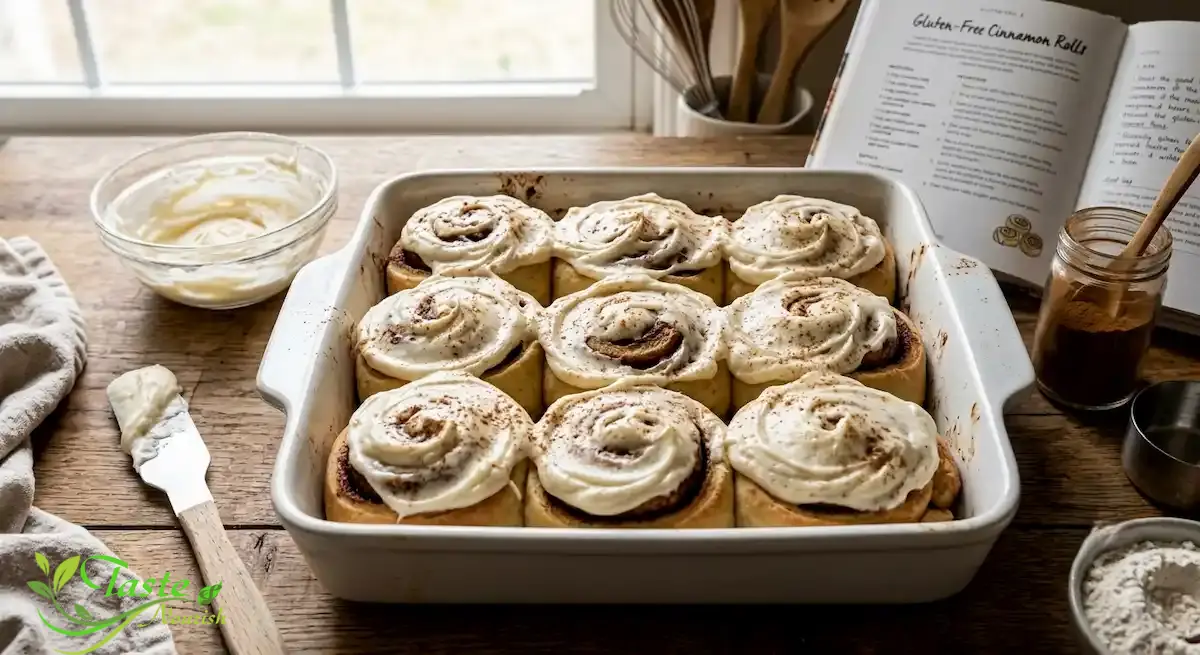
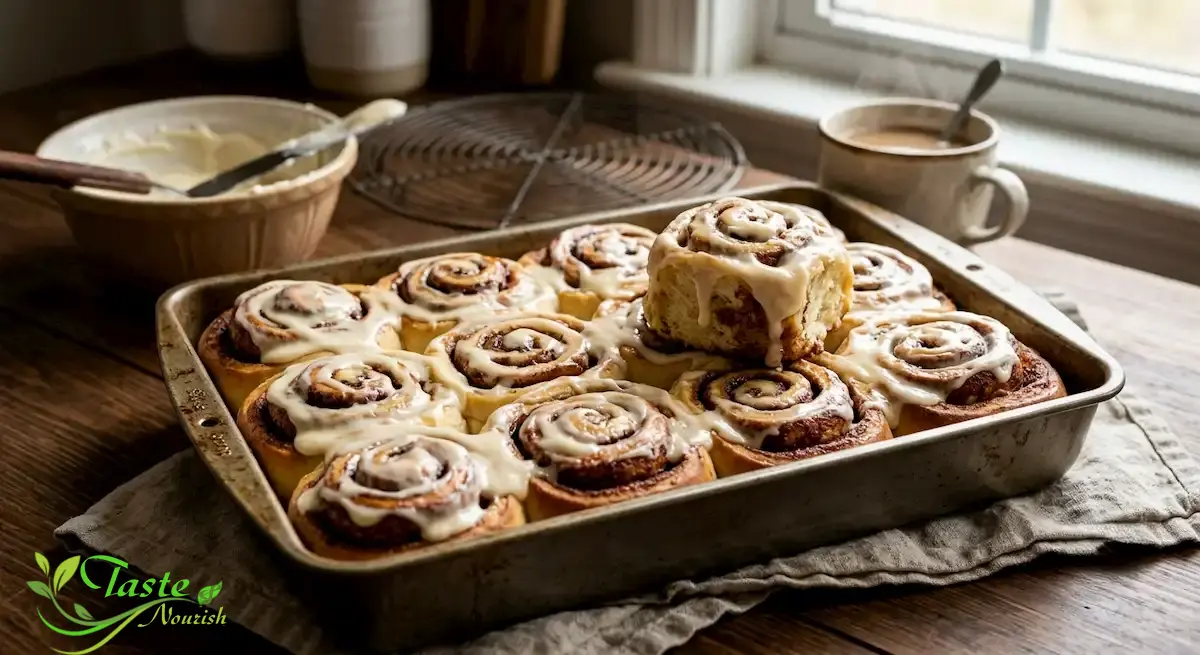
Few things smell better on a weekend morning than cinnamon and butter meeting warm dough in the oven. This gluten free cinnamon rolls recipe delivers that same soft, pillowy, cinnamon-swirled result without a single grain of wheat, so anyone avoiding gluten can pull a pan of rolls out of the oven that taste every bit as good as the traditional version.
Gluten-free yeast baking has a reputation for turning out dense, gummy, or crumbly results. This recipe sidesteps those problems with a specific flour blend, precise hydration, and a rolling technique built around the fact that gluten-free dough behaves more like a soft batter than traditional dough. The payoff is a tray of rolls with tender layers, a caramelized cinnamon-sugar swirl, and a tangy cream cheese frosting.
This gluten free cinnamon rolls recipe uses a 1:1 gluten-free flour blend, active dry yeast, and eggs to build a soft, enriched dough that’s rolled with butter, brown sugar, and cinnamon, then baked until golden and topped with cream cheese frosting. The dough is stickier than wheat dough, so it’s rolled between parchment sheets rather than on a floured counter, and it needs only one full rise before baking.
Key Takeaways
This gluten free cinnamon rolls recipe uses a store-bought 1:1 gluten-free flour blend, so there’s no need to hunt down or measure out multiple specialty flours.
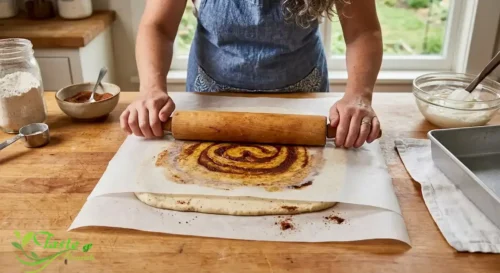
Gluten-free dough is soft and sticky by nature; rolling it between two sheets of parchment paper solves the mess without adding extra flour that would toughen the rolls.
One rise is enough. A long second proof tends to overwork the structure and can cause gluten-free dough to collapse rather than rise further in the oven.
Xanthan gum (or the lack of it in your flour blend) makes or breaks the texture — check your bag before you start.
The rolls are best eaten the day they’re baked, but the dough and even the assembled rolls can be prepped a day ahead and refrigerated.
Why You’ll Love This Gluten-Free Cinnamon Rolls Recipe
The dough comes together in one bowl with a hand or stand mixer — no kneading, no gluten window to check for, and no guessing about texture cues that only apply to wheat dough. Because the recipe uses a yeasted, enriched dough rather than a quick-bread shortcut, the rolls have real bakery-style layers instead of a single dense spiral.
Cinnamon itself brings more than flavor to the table. According to Harvard Health Publishing’s overview of holiday spices, a Harvard T.H. Chan School of Public Health nutrition researcher notes that cinnamon is among the better-studied spices for anti-inflammatory potential. That’s not a reason to treat cinnamon rolls as a health food, but it’s a nice bit of context for a spice that’s already doing a lot of flavor work in this recipe.
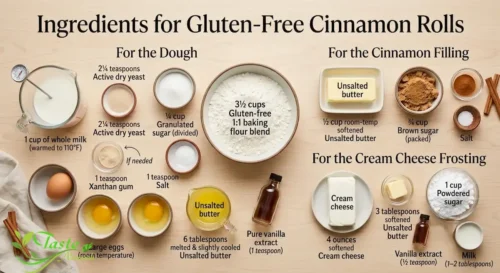
Ingredients for Gluten-Free Cinnamon Rolls
For the Dough
Whole milk — 1 cup, warmed to about 110°F. Dairy-free option: unsweetened oat milk works well and stays neutral in flavor.
Active dry yeast — 2¼ teaspoons (one standard packet).
Granulated sugar — ¼ cup, divided between blooming the yeast and the dough itself.
Gluten-free 1:1 baking flour blend — 3½ cups. Choose a blend labeled for baking (not an all-purpose “cup for cup” mix meant for frying) and confirm whether it already contains xanthan gum.
Xanthan gum — 1 teaspoon, only if your flour blend doesn’t already include it. Skipping this when it’s needed is the single most common cause of crumbly gluten-free dough.
Salt — 1 teaspoon.
Large eggs — 3, room temperature. Eggs add structure that gluten would normally provide, so don’t reduce this amount.
Unsalted butter — 6 tablespoons, melted and cooled slightly. Dairy-free option: a stick-style vegan butter substitutes evenly.
Pure vanilla extract — 1 teaspoon.
For the Cinnamon Filling
Unsalted butter — ½ cup, softened to room temperature so it spreads without tearing the dough.
Brown sugar — ¾ cup, packed.
Ground cinnamon — 2 tablespoons.
Salt — a small pinch, to balance the sweetness.
For the Cream Cheese Frosting
Cream cheese — 4 ounces, softened.
Unsalted butter — 3 tablespoons, softened.
Powdered sugar — 1 cup.
Vanilla extract — ½ teaspoon.
Milk — 1–2 tablespoons, to thin the frosting to a spreadable consistency.
Ingredient Notes and Substitutions
Not every gluten-free flour blend behaves the same way in yeasted dough, since the ratio of rice flour, starches, and binders varies by brand. If you’re baking for someone with celiac disease rather than a personal preference, check that your flour blend and any packaged add-ins (like vanilla extract) are certified gluten-free rather than simply wheat-free; products labeled “gluten-free” in the United States are required to meet the FDA’s gluten-free labeling standard, which caps gluten content at under 20 parts per million.
Gluten-free flour blends also don’t always match wheat flour’s nutrient profile. Peer-reviewed research on the nutritional quality of gluten-free diets has found that commercial gluten-free products can run lower in fiber and certain B vitamins than their wheat-based counterparts, since the starches used to replace gluten don’t naturally carry the same nutrients. Choosing a blend that includes whole-grain components like brown rice or sorghum flour, rather than one built mostly on refined starch, helps narrow that gap.
Kitchen Tools Needed
Stand mixer with a paddle attachment, or a large bowl and hand mixer
9×13-inch baking pan
Two sheets of parchment paper, for rolling the dough without added flour
Offset spatula or the back of a spoon, for spreading the filling
Unflavored dental floss or a sharp serrated knife, for slicing clean rolls without squashing them
How to Make Gluten-Free Cinnamon Rolls
Make the Dough
Warm the milk to about 110°F — warm to the touch but not hot. Stir in 1 tablespoon of the sugar and the yeast, then let it sit for 5–10 minutes until foamy. If it doesn’t foam, the yeast is dead and won’t leaven the dough; start over with a fresh packet.
In the mixer bowl, whisk together the flour blend, xanthan gum (if using), salt, and remaining sugar.
Add the bloomed yeast mixture, eggs, melted butter, and vanilla. Beat on medium speed for 2–3 minutes. The dough will look more like a thick, sticky batter than a traditional kneadable dough — that’s expected with gluten-free flour.
Cover the bowl with plastic wrap or a damp towel and let the dough rise in a warm spot for 45–60 minutes, until visibly puffed. It won’t double the way wheat dough does.
Roll, Fill, and Slice
Turn the dough out onto a sheet of parchment paper and top with a second sheet. Roll between the two sheets into roughly a 12×16-inch rectangle. This keeps the sticky dough from tearing or picking up extra flour.
Peel back the top parchment. Spread the softened butter evenly over the dough, then sprinkle with the brown sugar, cinnamon, and salt mixture, pressing it gently into the butter.
Using the bottom parchment to help lift and guide, roll the dough tightly from the long edge into a log.
Slice into 12 even rolls using unflavored dental floss slid underneath the log, or a sharp serrated knife with a gentle sawing motion, to avoid flattening the spiral.
Second Rise and Bake
Arrange the rolls cut-side up in a greased 9×13-inch pan, leaving a little space between each for expansion. Cover and let rise for 20–30 minutes, until slightly puffed.
Preheat the oven to 350°F while the rolls finish rising.
Bake for 25–30 minutes, until the tops are golden brown and the centers reach about 190°F on an instant-read thermometer. Tent loosely with foil after 15 minutes if the tops are browning faster than the centers are cooking through.
Frost and Serve
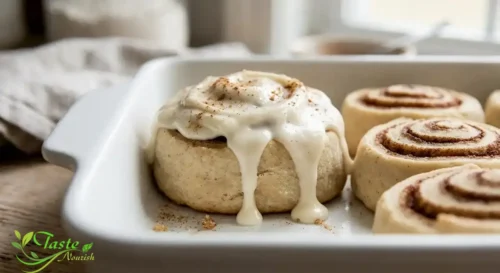
Let the rolls cool in the pan for about 10 minutes. Frosting rolls while they’re too hot melts the frosting into the crevices instead of letting it sit on top.
Beat the cream cheese and butter until smooth, then add the powdered sugar and vanilla. Thin with milk, a teaspoon at a time, until spreadable.
Spread the frosting over the warm (not hot) rolls and serve.
Expert Tips for the Best Gluten-Free Cinnamon Roll Dough
Weigh the flour if you can. Gluten-free flour blends pack down in the bag, and scooping directly can add up to 20% more flour than a recipe intends, leading to dry, dense rolls.
Keep the milk and melted butter warm, not hot, before adding them to the yeast or dough — anything above about 120°F can kill the yeast outright.
Resist the urge to add extra flour while rolling. The dough is supposed to be soft; parchment paper, not more flour, is the fix for stickiness.
Room-temperature eggs incorporate more evenly and help the dough rise more consistently than cold eggs straight from the fridge.
Common Mistakes to Avoid
Skipping the xanthan gum when it’s needed. Without it or a blend that already contains it, the dough has nothing to hold it together, and the rolls fall apart when sliced. Check the flour bag’s ingredient list before starting.
Over-flouring while rolling. Because gluten-free dough looks unusually soft compared to wheat dough, it’s tempting to add flour to make it feel more familiar. That extra flour dries out the finished rolls. Use parchment instead.
Overbaking. Gluten-free baked goods dry out faster than wheat-based ones once they pass the doneness point. Start checking at the 25-minute mark rather than waiting for the full 30.
Skipping the second rise entirely. It’s shorter than the first, but it’s what gives the individual rolls their final lift; baking directly from slicing produces flatter, denser rolls.
Recipe Variations
Dairy-free version: Swap the milk for unsweetened oat milk, use a stick-style vegan butter in the dough and filling, and make the frosting with dairy-free cream cheese and butter alternatives.
Orange-cinnamon rolls: Add 1 tablespoon of orange zest to the filling and a teaspoon to the frosting for a brighter, citrus-forward twist.
Pecan cinnamon rolls: Sprinkle ½ cup of finely chopped toasted pecans over the filling before rolling for added crunch and flavor.
Overnight rolls: Assemble and slice the rolls, place them in the pan, cover tightly, and refrigerate overnight instead of doing the second rise right away. Let them come to room temperature for about 30 minutes before baking.
Serving Suggestions
These rolls hold their own as the centerpiece of a brunch spread. Pair them with fresh fruit or a citrus salad to cut the sweetness, alongside scrambled eggs or a vegetable frittata for protein and balance. A simple black coffee or a spiced chai latte echoes the cinnamon without competing with it.
Nutrition Information
The following values are approximate estimates per roll, based on standard ingredient databases, and will vary depending on the specific flour blend and brands used.
Nutrient
Approximate Amount
Calories
320
Total Fat
14 g
Carbohydrates
46 g
Fiber
2 g
Sugars
24 g
Protein
4 g
Ground cinnamon itself contributes very little to these totals in the amount this recipe uses, but it’s worth noting as a benchmark: according to USDA FoodData Central’s nutrient profile for ground cinnamon, a 100-gram amount provides roughly 247 calories, 1.2 grams of fat, and 80.6 grams of carbohydrate, and the 2 tablespoons used in this recipe’s filling amount to only a small fraction of that.
Storage Instructions
Store leftover rolls in an airtight container at room temperature for up to 2 days, or in the refrigerator for up to 5 days, since the cream cheese frosting is perishable. Gluten-free baked goods tend to dry out a little faster than wheat-based ones, so a tightly sealed container matters more here than with a standard recipe.
To freeze, freeze the unfrosted rolls individually on a tray until solid, then transfer to a freezer bag for up to 2 months. Thaw at room temperature and warm gently before frosting and serving. Reheat in a 300°F oven for about 8 minutes, or microwave individual rolls for 15–20 seconds — the oven method does a better job of keeping the texture soft without turning it rubbery.
Make-Ahead Tips
The dough can be mixed, rolled, filled, and sliced up to a day ahead. Cover the pan tightly and refrigerate before the second rise; let the rolls sit at room temperature for about 30 minutes before baking so they aren’t going into the oven cold. The frosting can also be made up to 3 days ahead and stored in the refrigerator; let it soften slightly at room temperature before spreading.
This gluten free cinnamon rolls recipe uses a 1:1 gluten-free flour blend, active dry yeast, and eggs to build a soft, enriched dough rolled with butter, brown sugar, and cinnamon, then topped with cream cheese frosting.
Ingredients
1 cup whole milk, warmed to 110°F
2 1/4 teaspoons active dry yeast
1/4 cup granulated sugar, divided
3 1/2 cups gluten-free 1:1 baking flour blend
1 teaspoon xanthan gum (only if not already in the flour blend)
1 teaspoon salt
3 large eggs, room temperature
6 tablespoons unsalted butter, melted and cooled
1 teaspoon pure vanilla extract
1/2 cup unsalted butter, softened, for the filling
3/4 cup packed brown sugar
2 tablespoons ground cinnamon
1 pinch salt, for the filling
4 ounces cream cheese, softened
3 tablespoons unsalted butter, softened, for the frosting
1 cup powdered sugar
1/2 teaspoon vanilla extract, for the frosting
1-2 tablespoons milk, for the frosting
Directions
Warm the milk to about 110°F, stir in 1 tablespoon of sugar and the yeast, and let sit for 5–10 minutes until foamy.
Whisk together the flour blend, xanthan gum (if using), salt, and remaining sugar in the mixer bowl.
Add the bloomed yeast mixture, eggs, melted butter, and vanilla. Beat on medium speed for 2–3 minutes until combined into a soft, sticky dough.
Cover the bowl and let the dough rise in a warm spot for 45–60 minutes, until visibly puffed.
Roll the dough between two sheets of parchment paper into a 12x16-inch rectangle.
Spread the softened butter over the dough, then sprinkle with the brown sugar, cinnamon, and salt mixture.
Roll the dough tightly into a log using the parchment paper to guide it, then slice into 12 rolls using dental floss or a serrated knife.
Arrange the rolls in a greased 9x13-inch pan and let rise for 20–30 minutes while the oven preheats to 350°F.
Bake for 25–30 minutes, until golden brown and the centers reach about 190°F.
Let the rolls cool for 10 minutes, then top with cream cheese frosting made from cream cheese, butter, powdered sugar, vanilla, and milk.
Noute
Gluten-free flour blends vary by brand, so they don't all behave the same way in yeasted dough. For anyone baking for someone with celiac disease, it's important to confirm that the flour blend and any add-in ingredients (like vanilla extract) are certified gluten-free rather than simply wheat-free, since official gluten-free labeling requires gluten content to stay below a very small threshold.
These blends also tend to fall short of wheat flour nutritionally — they're often lower in fiber and certain B vitamins, since the starches used to replace gluten don't carry the same nutrients. Choosing a blend built around whole-grain ingredients like brown rice or sorghum flour, rather than one based mainly on refined starch, helps narrow that gap.
Gluten-Free Cinnamon Rolls Recipe FAQs
Can I use almond flour or coconut flour instead of a gluten-free blend?
Not as a direct substitute. Almond and coconut flour absorb liquid very differently from a 1:1 gluten-free baking blend and will produce a dense, gummy, or crumbly dough. Stick with a blend specifically labeled for baking.
Why does my gluten-free cinnamon roll dough feel so sticky?
That’s expected. Without gluten to provide structure, gluten-free dough is naturally softer and tackier than wheat dough. Rolling it between parchment sheets, rather than adding extra flour, keeps the texture right.
Do I need xanthan gum if my flour blend already contains it?
No. Adding xanthan gum on top of a blend that already includes it can make the dough gummy. Check the ingredient list on your specific flour before adding more.
Can I make this recipe dairy-free?
Yes. Substitute the milk with unsweetened oat milk, use a stick-style vegan butter in place of dairy butter in both the dough and filling, and choose dairy-free cream cheese and butter for the frosting.
Why didn’t my rolls rise very much?
Gluten-free dough rises less dramatically than wheat dough even when everything goes right, so a smaller, puffier rise (rather than doubling in size) is normal. If the rolls didn’t rise at all, the most likely causes are yeast that didn’t bloom (check water temperature) or a rising spot that was too cool.
Can I freeze the baked, frosted rolls?
It’s better to freeze them unfrosted. Cream cheese frosting doesn’t thaw as cleanly, and the rolls themselves keep their texture better without it. Frost after thawing and reheating instead.
Final Thoughts on This Gluten-Free Cinnamon Rolls Recipe
Once you’ve made this gluten free cinnamon rolls recipe a couple of times, the process stops feeling like a science experiment and starts feeling like any other weekend baking project — the main shift is trusting that sticky dough and a shorter rise are simply how gluten-free yeast baking works, not signs that something’s gone wrong.
**Hanan Abo Samra** shares practical cooking insights, delicious recipes, and evidence-based nutrition information. Drawing on more than 20 years of hands-on cooking experience, she creates helpful food content that combines everyday cooking knowledge with information from reliable scientific sources. Her goal is to help readers better understand the foods they eat, explore their nutritional benefits, and prepare delicious meals with confidence.