
Oats vs Quinoa: USDA Nutrition, Cook Times & Which to Pick
Stuck between a bag of oats and a bag of quinoa? The oats vs quinoa debate gets simpler once you see the numbers side by side. A cooked cup of quinoa carries more protein, fiber, iron, and magnesium, while a cooked cup of oats is lighter and ready in minutes.
Below you’ll find USDA nutrition figures, water ratios and simmer times for rolled, quick, and steel-cut oats and for quinoa, gluten-label tips, and a clear verdict for breakfast, salads, and meal prep.
Quick Answer
When weighing oats vs quinoa, pick oats for a soft, creamy bowl that cooks in minutes and works in baking, and pick quinoa for firm, separate grains with more protein and fiber per cooked cup. Both are naturally gluten-free, but people with celiac disease should buy versions labeled gluten-free, and oats are the higher-risk grain because they are often processed on shared equipment.
Oats vs Quinoa Nutrition: What the USDA Numbers Show
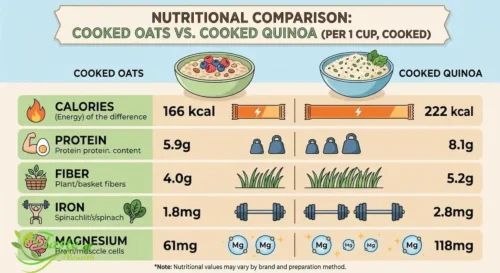
The values below come from USDA FoodData Central entries for plain cooked food with no added salt: quinoa, cooked and oats, regular and quick, cooked with water. The numbers are approximate, because brands, varieties, and preparation change them, and the product label is the best reference for what you bought. The oat entry covers rolled and quick oats, so steel-cut oats and flavored instant packets can differ.
Per 100 g (3.5 oz) of cooked food:
| Nutrient | Oats (cooked with water) | Quinoa (cooked) |
|---|---|---|
| Calories | 71 | 120 |
| Protein | 2.5 g | 4.4 g |
| Fiber | 1.7 g | 2.8 g |
| Carbohydrates | 12.0 g | 21.3 g |
| Total fat | 1.5 g | 1.9 g |
| Iron | 0.9 mg | 1.5 mg |
| Magnesium | 27 mg | 64 mg |
Per 1 cup cooked, using USDA’s household weights of 234 g for oats and 185 g for quinoa (scaled from the values above and rounded):
| Nutrient | Oats (1 cup, 234 g) | Quinoa (1 cup, 185 g) |
|---|---|---|
| Calories | 166 | 222 |
| Protein | 6 g | 8 g |
| Fiber | 4 g | 5 g |
| Carbohydrates | 28 g | 39 g |
| Total fat | 3.5 g | 3.5 g |
| Iron | 2.1 mg | 2.8 mg |
| Magnesium | 63 mg | 118 mg |
Quinoa comes out ahead on calories, protein, fiber, iron, and magnesium in both tables, which makes it the denser choice. Part of the gap is water. USDA lists about 84 g of water per 100 g of cooked oats versus about 72 g for cooked quinoa, so a scoop of porridge holds less grain than a scoop of quinoa.
Fiber type matters too. Oats are known for beta-glucan, a soluble fiber, and FDA’s authorized label claim for oat beta-glucan is tied to 3 g or more of beta-glucan per day from whole oats. So which is healthier depends on the goal: quinoa gives more protein and minerals per cup, while oats give a lighter, softer bowl with beta-glucan.
Our guide to the benefits of oats looks at what oats offer beyond these numbers.
Oats vs Quinoa Cooking Ratios and Times
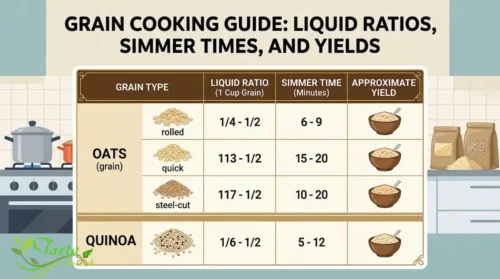
Cooking is where the two differ most. Rolled and quick oats soften in a few minutes, steel-cut oats take much longer, and quinoa needs a rinse before it simmers until the liquid is absorbed.
| Grain | Liquid per 1 cup dry | Simmer time | Cooked yield |
|---|---|---|---|
| Rolled (old-fashioned) oats | 2 cups (about 475 ml) water | 3–5 minutes | About 2 cups |
| Quick oats | 2 cups (about 475 ml) water | 1–2 minutes | About 2 cups |
| Steel-cut oats | 3–4 cups (about 710–950 ml) water | 20–30 minutes | 3–4 cups |
| Quinoa, rinsed | 2 cups (about 475 ml) water | 12–15 minutes | 3+ cups |
Montana State University Extension’s cooked oatmeal recipe supplies the 2-to-1 ratio, the old-fashioned and quick-oat times, and a yield of two 1-cup servings. Quaker’s old-fashioned oats directions also call for about five minutes. The quinoa figures come from the Whole Grains Council’s whole grain cooking chart.
Sources disagree on steel-cut oats, so the table shows a range. The Whole Grains Council chart gives 4 cups of water per cup of oats, about 20 minutes, and 4 cups cooked. Oregon State University Extension’s stovetop steel-cut oats recipe uses 3 cups of water, 20 to 25 minutes, and makes 3 cups. Quaker’s steel-cut oats directions use 4 cups of water or milk and 25 to 30 minutes. Flavored instant packets vary by brand, so follow the package for those.
Stovetop oats

- Bring the water to a boil, adding a pinch of salt if you like.
- Stir in the oats, lower the heat, and cook for the time in the table, stirring occasionally.
- Remove the pan from the heat and let it stand, covered, until the oatmeal reaches the thickness you want.
Stovetop quinoa

- Rinse the quinoa in a fine-mesh strainer under cool running water, rubbing the seeds gently, until the foam fades. This washes off the natural bitter coating.
- Combine the quinoa and water in a pot, bring to a boil, then reduce to a gentle simmer and cover.
- Cook until the liquid is absorbed, then let the pot stand covered off the heat for a few minutes and fluff with a fork.
Texture, Flavor, and Best Uses
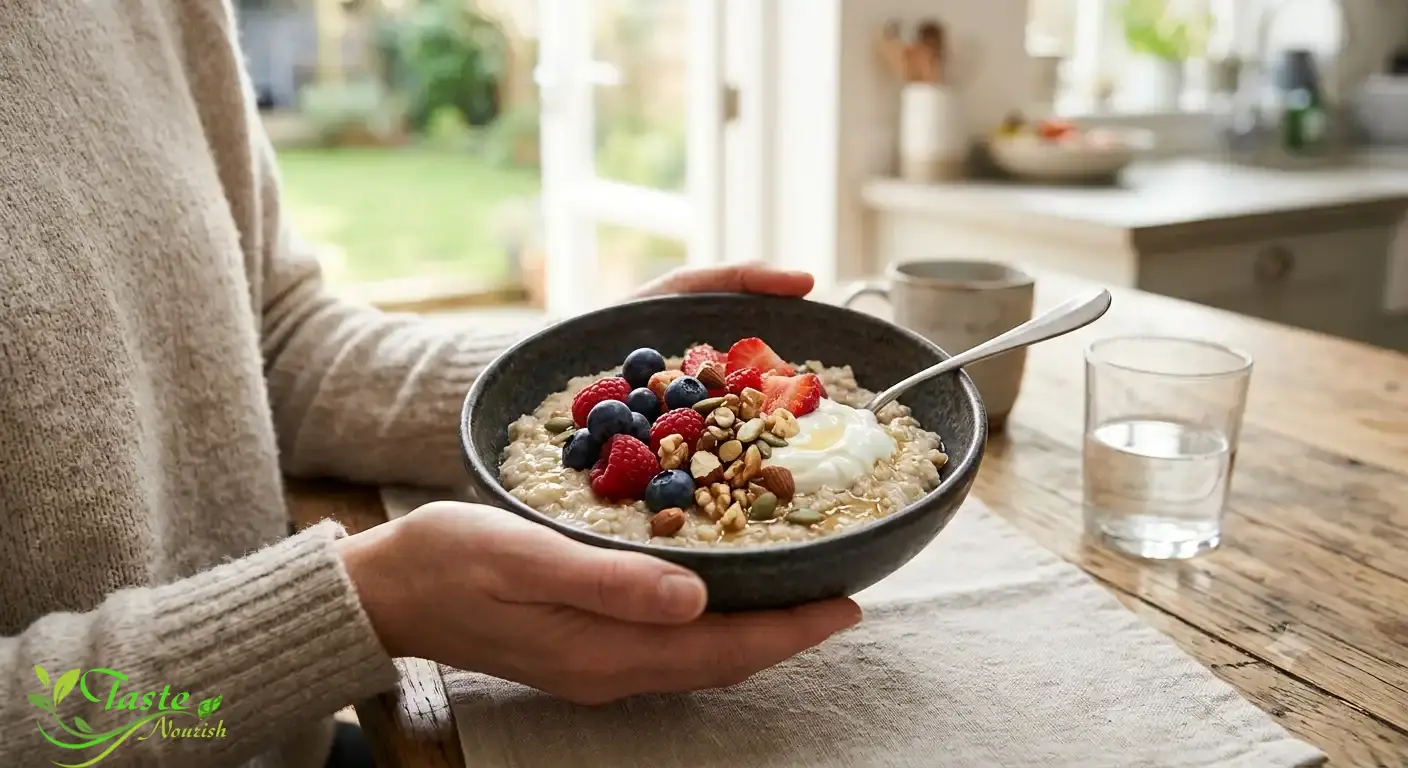
Oats cook down to a soft, mild-tasting porridge, while quinoa stays in distinct grains with a faint pop and a mild, slightly earthy flavor. That difference decides where each one works.
- Oats suit hot porridge, overnight oats, muffins and cookies, crisp fruit toppings, and binding meatballs or veggie burgers.
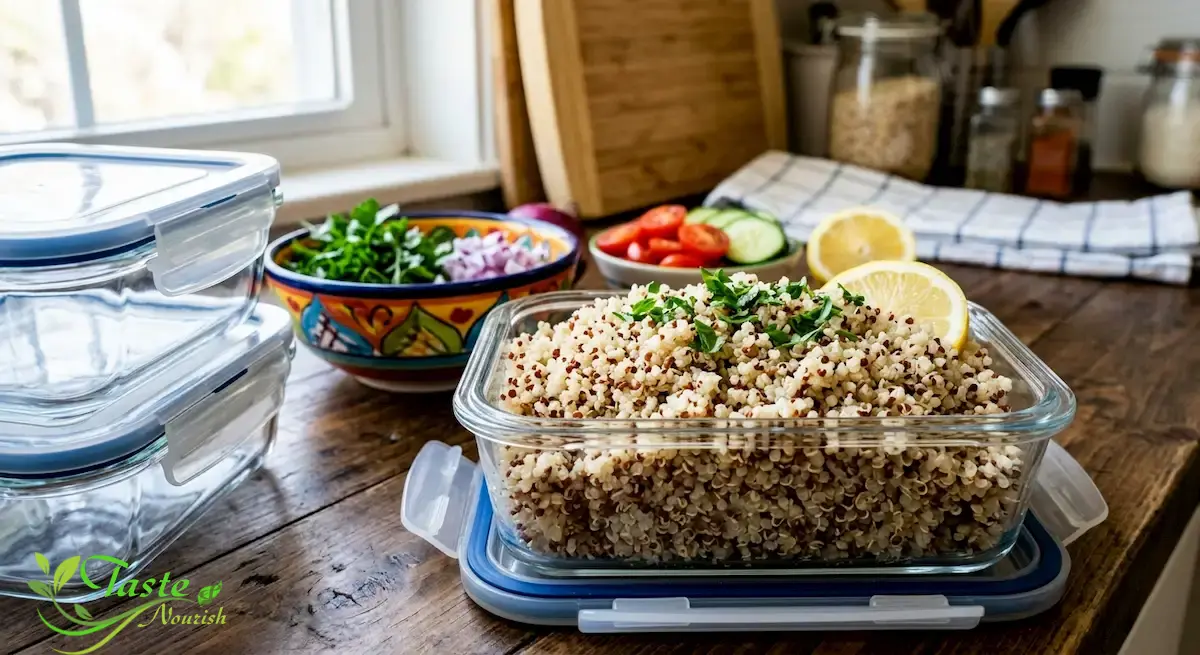
- Quinoa suits grain bowls, cold salads, stuffed vegetables, pilaf-style sides, and stirring into soups.
Can You Swap Oats and Quinoa?
Not one for one, because they absorb liquid and set differently. If a recipe calls for cooked quinoa, 1 cup dry makes 3+ cups cooked, so scale from the table above rather than from the dry measure.
- Quinoa in place of oats at breakfast: cook it separately, then warm it with milk and cinnamon. Expect distinct grains rather than a creamy bowl.
- Oats in place of quinoa in a salad or bowl: cooked oats of any type tend to turn soft and sticky, so they rarely work as a stand-in.
- Baking swaps: cooked quinoa is wet and dry oats are absorbent, so replace only a small portion first and expect the moisture to change.
Gluten-Free Status and Label Reading
Both oats and quinoa are naturally gluten-free, and the concern is cross-contact during harvesting and processing. The Celiac Disease Foundation’s food labeling guide lists quinoa among naturally gluten-free grains and advises buying naturally gluten-free grains labeled gluten-free, because they may come into contact with gluten during manufacturing. It also says people with celiac disease must avoid oats that are not labeled gluten-free.
Oats are the higher-risk grain. The foundation’s gluten-free foods page says oats are often harvested and processed with the same equipment used for wheat, so they are easily contaminated, and it advises buying only oats specifically labeled gluten-free. For grains in general, it notes that some naturally gluten-free grains may pick up gluten, suggests versions tested to contain less than 20 parts per million, and recommends against bulk bins. For the risks and which brands to look for, see our guide on whether oats are gluten-free.
Storing Oats and Quinoa, Dry and Cooked

Cooked oats and quinoa are ordinary cooked leftovers, so the same USDA rules apply. The USDA Food Safety and Inspection Service’s guidance on leftovers and food safety says to refrigerate cooked food within 2 hours (1 hour if the air temperature is above 90°F/32°C) and to use most leftovers within 3 to 4 days. It also says to reheat them to 165°F (74°C). Shallow containers help cooked grains cool quickly. For quinoa-specific storage detail, see our guide to how long cooked quinoa lasts.
Storing dry oats and quinoa. The USDA’s WIC Works guidance on whole grains advises keeping whole grains in airtight containers with tight-fitting lids in a cool, dry place away from sun and heat. It adds that the freezer can extend shelf life for up to a year. Both oats and quinoa appear on its whole-grain list.
Oats vs Quinoa: Which Should You Choose?
- Choose oats if you want a creamy hot breakfast in minutes, plan to bake, or prefer a lighter bowl per cup.
- Choose quinoa if you want more protein, fiber, iron, and magnesium per cup, or need firm grains for salads, bowls, and meal prep.
- Choose either, labeled gluten-free, if you have celiac disease, keeping in mind that oats are the higher-risk grain.
- Use both if you like variety, for example oats at breakfast and quinoa as a lunch base, or cooked quinoa stirred into oatmeal for extra chew.
If timing matters, our guide to the best time to eat oats covers morning, workout, and night.
Troubleshooting
Oatmeal turns gluey
Overcooking or stirring hard is the usual cause. Off the heat, stir in a splash of hot water or milk to loosen it. Next time, stop at the short end of the time range and stir only occasionally.
Oatmeal is too thin
It was either undercooked or given too much liquid. Simmer a minute or two longer, then let it stand covered, since it thickens as it sits. Measure the liquid with the ratios in the table next time.
Quinoa tastes bitter
The seeds were not rinsed well enough. Cooking won’t remove the bitterness, so rinse the next batch until the foam fades. Rinse even if the package says pre-rinsed.
Quinoa is mushy or still crunchy
Mushy quinoa had too much liquid or cooked too long. Drain it in a fine-mesh strainer, return it to the warm dry pot, and cover it so it steams off the excess. Next time start checking at the short end of the time range.
If the grains are still firm, the liquid ran out too soon. The Whole Grains Council advises adding more water and continuing to cook until tender.
Common Mistakes to Avoid
- Judging oats by a sweetened instant packet against plain quinoa. Compare plain with plain, and read the Added Sugars line.
- Reading a label’s nutrition column without checking whether it is “as packaged” (dry) or “as prepared” (cooked). Dry and cooked values are not interchangeable.
- Boiling quinoa hard in an open pot. Keep it at a gentle simmer under a lid so the liquid lasts until the grains are tender.
- Assuming the USDA values above still apply when you cook in milk or broth. They describe oats cooked with water and plain cooked quinoa, so check the label of whatever you add.
- Assuming a gluten-free label settles the question for everyone with celiac disease. The foundation’s advice on oats notes that some people react to avenin, a protein in oats, and avoid all oats, so ask your healthcare provider first.
Oats vs Quinoa FAQs
Can you freeze cooked oats or quinoa?
Yes. USDA FSIS says food frozen at 0°F (-18°C) stays safe indefinitely, though frozen leftovers can lose moisture and flavor over long storage, and it suggests 3 to 4 months for best quality. Portion the cooled food into airtight containers, thaw it in the refrigerator, in cold water, or in the microwave, and reheat it to 165°F (74°C).
How much dry oats or quinoa should I cook per person?
Montana State’s recipe uses 1 cup of dry oats to make two 1-cup servings, so about 2 cups dry feeds four. One cup of dry quinoa makes 3+ cups cooked, according to the Whole Grains Council, which is roughly three 1-cup portions.
Can I cook oats and quinoa together in one pot?
Not from the start, because quinoa needs far longer than rolled or quick oats. Cook the quinoa first, then stir it into hot cooked oatmeal.
Why does oatmeal boil over in the microwave?
Oatmeal foams and rises as it heats. Montana State’s directions call for a large microwave-safe bowl so it doesn’t overflow, and they stir after each minute of cooking.
What if my package directions differ from the ratios here?
Follow the package for that specific product. The Whole Grains Council notes that cooking time varies with the age of the grain, the variety, and the pan, so tenderness is the real test. If the grain is still firm, add water and keep cooking, and if it is tender before the liquid is absorbed, drain the excess.
Can I cook oats or quinoa in a rice cooker?
Yes, but ratios depend on the cooker, so check your manual first. Food Network Kitchen’s rice cooker quinoa method is to rinse the quinoa, grease the pot, use 1 cup quinoa to 2 cups liquid on the white rice setting, and take it out as soon as the cycle ends, because it turns mushy if held on warm. Zojirushi’s grain chart for one 5.5-cup model instead calls for 1¼ cups of liquid per cup of quinoa on its Quick setting and 1½ cups per cup of rolled oats on its White setting, with no rinse for the oats and no keep-warm for either. Given that spread, treat 1¼ to 2 cups of liquid per cup of quinoa as the range and start with your manual’s figure.
Can I cook oats in milk or quinoa in broth?
Yes. Quaker’s directions for old-fashioned and steel-cut oats allow water or milk in the same amounts, so you can swap one for one. Food Network Kitchen says quinoa can be cooked in any broth at the usual 1 cup quinoa to 2 cups liquid, and it prefers low-sodium broth with extra salt added to the finished dish. USDA’s WIC Works guidance also suggests reduced-sodium broth for flavoring whole grains.
Key Takeaways: Oats vs Quinoa
- In oats vs quinoa, quinoa is the denser grain, with more calories, protein, fiber, iron, and magnesium per cooked cup.
- Rolled and quick oats cook in minutes, steel-cut oats in 20–30 minutes, and rinsed quinoa in 12–15 minutes.
- Oats suit creamy porridge and baking, while quinoa suits salads, bowls, and savory sides.
- Both oats and quinoa are naturally gluten-free, but people with celiac disease should choose versions labeled gluten-free, and oats are the higher-risk grain.
- Refrigerate cooked oats or quinoa within 2 hours and use them within 3 to 4 days.
Conclusion
The oats vs quinoa choice is less a contest than a match between grain and job: oats for a soft, quick bowl and quinoa for a firmer, denser base. Use the ratios above, rinse the quinoa, and buy by the role each one will play in your week.
Explore Oats and Quinoa by Topic
- Oats and their benefits: A broader look at what oats offer, beyond the numbers in this comparison.
- Choosing when to eat oats: How timing around mornings, workouts, and bedtime changes the way oats fit your day.
- Gluten-free oats and safe brands: What cross-contact means for oats and how to choose a safer product.
- Storing cooked quinoa: Storage guidance for cooked quinoa, including how long it keeps in the refrigerator.