If you’ve ever cut into a chicken breast and second-guessed whether it’s actually done, you’re not alone. Color, juices, and even how firm the meat feels can all be misleading. The only number that actually tells you whether chicken is safe to eat is chicken internal temperature, measured with a food thermometer. This guide covers the exact temperature chicken needs to reach, where to check it for every cut, and the small mistakes that lead to either undercooked meat or dry, overcooked chicken.
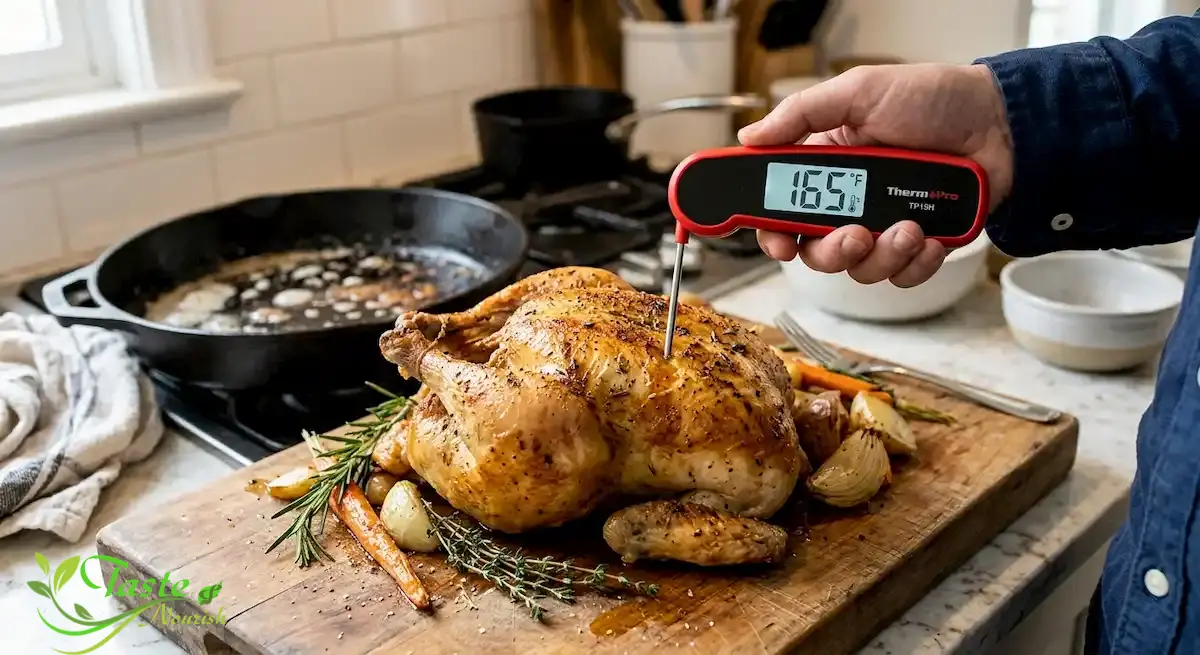
Chicken is safe to eat once it reaches an internal temperature of 165°F (74°C), measured with a food thermometer in the thickest part of the meat. This applies to whole chicken, breasts, thighs, wings, drumsticks, and ground chicken. Chicken internal temperature is the only reliable way to confirm doneness — appearance, texture, and juice color are not accurate substitutes for a thermometer reading, according to the USDA Food Safety.
Key Takeaways
Chicken internal temperature must reach 165°F (74°C) in the thickest part of the meat to be safe, no matter the cut or cooking method.
Color is not a reliable doneness test — chicken can be fully safe at 165°F and still look pink near the bone.
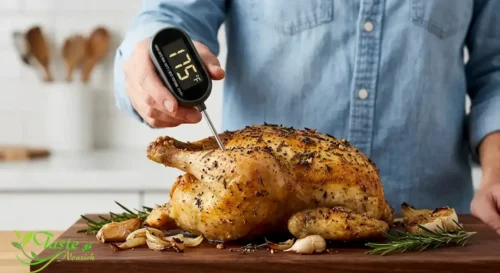
Dark meat (thighs and drumsticks) is often more tender when taken to 175°F–180°F, since the extra time helps break down connective tissue.
Ground chicken should reach 165°F throughout, with no pink remaining in the center.
Always check temperature in the thickest part of the meat, away from bone, which heats differently than muscle.
Chicken’s temperature can continue to climb slightly after it’s removed from heat, so a short rest helps it finish safely and evenly.
Why Chicken Internal Temperature Matters for Food Safety
Raw chicken can carry Salmonella, Campylobacter, and Clostridium perfringens. These bacteria live on the surface and sometimes inside the meat, and they aren’t something you can see, smell, or taste. Heat is what destroys them, but only once the meat reaches a specific internal temperature and holds it long enough.
The Centers for Disease Control and Prevention recommends cooking poultry, including any dish that contains chicken, to a safe internal temperature of 165°F. At that point, the bacteria most commonly associated with raw poultry are reduced to safe levels almost instantly, which is why 165°F works as a single, practical target rather than a range that depends on cooking time.
This is also why appearance is a poor substitute for a thermometer. Firmness, clear juices, and white-looking meat can all show up before chicken is actually safe, or after it’s already overcooked. A thermometer removes the guesswork entirely.
Chicken Doneness Temp Chart by Cut
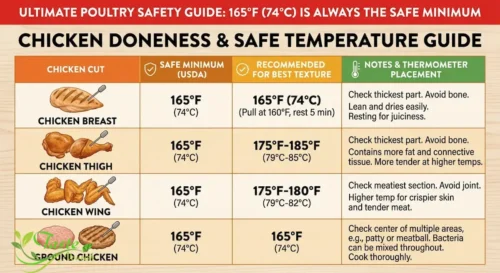
Every cut of chicken has the same safety threshold, but where you check it — and how much higher you can push it for texture — varies. Use this chicken doneness temp chart as a quick reference, based on guidance from the USDA FSIS .
Cut
Safe Minimum Temperature
Best Practical Target
Where to Check
Whole chicken
165°F
165°F
Innermost thigh, innermost wing, and thickest part of the breast
Chicken breast (bone-in or boneless)
165°F
165°F
Thickest part of the breast, away from bone
Chicken thighs
165°F
175°F–180°F for extra tenderness
Center of the thigh, away from bone
Drumsticks
165°F
175°F–180°F for extra tenderness
Center of the meat, away from bone
Wings
165°F
165°F–175°F
Thickest part of the wing, away from bone
Ground chicken (patties, meatballs, meatloaf)
165°F
165°F
Center of the thickest portion
Stuffing cooked inside chicken
165°F
165°F
Center of the stuffing itself, not just the meat
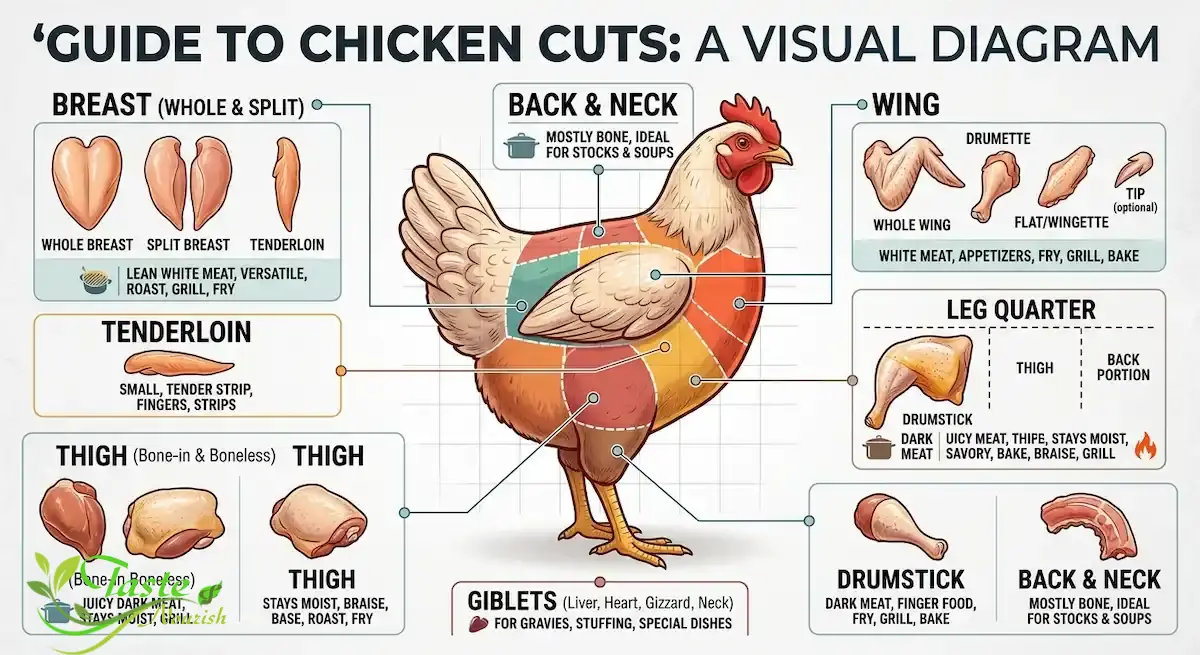
Dark meat can be taken above 165°F without drying out because thighs and drumsticks contain more connective tissue and fat than breast meat. That extra fat and collagen keep the meat moist even as it cooks longer, and the added heat helps tenderize it. Breast meat has far less fat, so pushing it past 165°F tends to dry it out rather than improve it.
How to Check Chicken Internal Temperature Step by Step
Use an instant-read digital thermometer. These give the fastest, most accurate readings and are worth the small investment if you cook chicken regularly.
Insert the probe into the thickest part of the meat. Avoid bone, gristle, and fat, since they heat differently than muscle and will give an inaccurate reading.
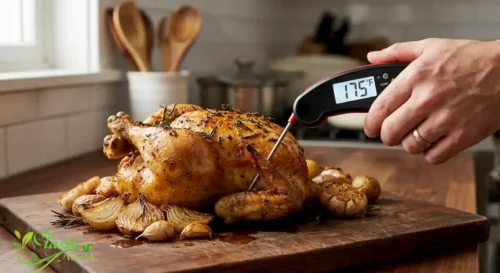
For a whole chicken, check three spots. Test the innermost part of the thigh, the innermost part of the wing, and the thickest part of the breast. All three need to reach 165°F.
Hold the thermometer steady and wait for the reading to stabilize. Most instant-read thermometers settle within a few seconds; dial thermometers can take up to 20 seconds.
Confirm the reading is 165°F or higher. If any spot reads lower, return the chicken to heat and recheck in a few minutes rather than guessing it will finish carryover cooking.
Clean the probe between uses. Wipe it with a hot, soapy cloth or use an alcohol wipe before testing a different piece, so you’re not transferring bacteria from an undercooked spot to a finished one.
Safe Chicken Cooking Temperature for Every Cooking Method
The safe chicken cooking temperature target doesn’t change based on how you cook it — it’s always 165°F internally. What changes is the oven, grill, or appliance setting you use to get there.
Roasting or baking: Set the oven to at least 325°F, per FoodSafety. Lower oven temperatures can leave chicken in the bacterial danger zone for too long before it finishes cooking.
Grilling: Grill over consistent medium heat and check temperature in multiple spots, since grills often have hot and cool zones. Move pieces to indirect heat if the outside is browning faster than the inside is cooking.
Pan-searing or sautéing: Thinner cuts cook quickly on the stovetop, which makes it easy to misjudge doneness by color alone. Always finish with a thermometer check rather than relying on how long the pan has been on.
Air frying: Air fryers cook fast and unevenly across different models, so check the thickest piece a few minutes before the recipe’s suggested time is up.
Pressure cooking or Instant Pot: Chicken can reach a safe temperature quickly under pressure, but it’s still worth confirming with a thermometer once the pot depressurizes, especially for bone-in pieces.
Slow cooker: Chicken needs to pass through the danger zone quickly, so start with a high or low setting as directed rather than leaving raw chicken on “warm,” and check the internal temperature before serving.
Why Cooked Chicken Can Still Look Pink
Pink chicken at 165°F isn’t a sign of undercooking — it’s usually one of a few harmless causes. Myoglobin, a protein in muscle tissue, can give fully cooked chicken a rosy tint, especially near the bone in young birds. Freezing chicken before cooking can also cause a pink tint, since ice crystals can rupture cells in the bone marrow and release pigment into the surrounding meat.
The rule to remember: if the thermometer confirms 165°F at the thickest part, the chicken is safe, regardless of color. If the temperature hasn’t reached 165°F, color should never be used to decide it’s done — only the thermometer reading matters.
Common Mistakes to Avoid
Checking only one spot on a whole chicken. The thigh, wing, and breast cook at different rates. Checking just one can leave another part undercooked.
Letting the probe touch bone. Bone conducts heat faster than muscle and will give a falsely high reading.
Relying on juice color. Clear juices can appear before chicken is actually safe, particularly in older birds or chicken that was previously frozen.
Cooking straight from frozen without adjusting time. Frozen chicken takes roughly 50% longer to cook through and needs closer temperature monitoring, not just a longer guess.
Not resting the thermometer probe long enough. Pulling it out too quickly, especially with a dial thermometer, can give a reading that’s several degrees off.
Assuming smaller pieces are automatically done. Thin cutlets and tenders cook fast, but uneven thickness means the thickest section can still lag behind.
Skipping the check on ground chicken. Because it’s chopped and mixed, ground chicken can look cooked on the outside while the center is still raw.
Expert Tips for Accurate Chicken Temperature Readings
Calibrate your thermometer occasionally in ice water (it should read 32°F) to make sure it’s still accurate.
For bone-in cuts, angle the probe so the tip sits in the meat itself, not against the bone.
Check temperature a few minutes before you expect the chicken to be done, then again once you think it’s ready, so you’re not caught guessing.
For a whole roasted chicken, pull it when the breast is close to 165°F and the thighs are slightly higher — everything tends to even out during resting.
Keep a second thermometer on hand for backup; batteries and calibration drift are common failure points.
When cooking multiple pieces of different sizes, test each one individually rather than assuming they’ll finish together.
What to Do If Chicken Isn’t at Temperature Yet
If a piece reads below 165°F, return it to the heat source and continue cooking — don’t rely on it “finishing” from residual heat alone unless it’s very close, like 160°F or higher and about to rest. Recheck in a few minutes rather than estimating.
If chicken has already been resting off heat for a while and still hasn’t reached temperature, it’s safer to return it to an oven or pan set at a moderate temperature until it does, rather than serving it and hoping for the best.
Chicken Internal Temperature FAQs
What temperature should chicken be cooked to?
Chicken should reach an internal temperature of 165°F (74°C) in the thickest part of the meat. This applies to whole chicken, all bone-in and boneless cuts, and ground chicken.
Is it safe to eat chicken at 165°F even if it’s still pink inside?
Yes. If a thermometer confirms 165°F at the thickest part, the chicken is safe even if it appears pink, which can happen due to myoglobin or prior freezing. Below 165°F, pinkness should not be used to judge doneness.
Do chicken thighs need to reach a higher temperature than chicken breasts?
Both are safe at 165°F. Thighs and drumsticks simply tend to taste better and stay juicier when taken higher, to around 175°F–180°F, because their higher fat and connective tissue content responds well to extra cooking time.
Do I need to rest chicken after it reaches 165°F?
A short rest of a few minutes helps juices redistribute and allows carryover heat to even out the temperature across the meat, but it isn’t required for safety once 165°F has been reached throughout.
Where do I put the thermometer in a whole chicken?
Check three spots: the innermost part of the thigh, the innermost part of the wing, and the thickest part of the breast. All three need to read 165°F.
Is ground chicken safe at 165°F, or does it need to be higher?
165°F is the safe minimum for ground chicken as well. Because it’s chopped and mixed, check the center of the thickest portion, since it can look done on the outside before it’s fully cooked through.
Can chicken be safe at a lower temperature if it’s cooked longer?
Extended time at lower temperatures can theoretically destroy the same bacteria, but it requires precise, sustained temperature control that isn’t practical in a typical home kitchen. For everyday cooking, 165°F is the reliable target.
Conclusion
Chicken internal temperature is the one number that actually tells you whether your chicken is safe to eat — not color, not how long it’s been on the heat, and not how firm it feels. Hit 165°F in the thickest part of the meat, check more than one spot on larger cuts, and let a thermometer do the deciding instead of guesswork. Once that habit sticks, undercooked chicken and dry, overcooked chicken both become much less likely.
Hanan Abo Samra is the founder of Taste & Nourish, sharing trustworthy nutrition guidance and recipes drawn from 20+ years of hands-on cooking experience. When she's not developing new recipes, Hanan is researching the science behind everyday ingredients to bring readers practical, evidence-based guidance for a healthier lifestyle.