
How to Grind Flax Seeds: The Best Methods for Fresh Flaxseed Meal
Whole flax seeds look nutritious on the label, but most of that nutrition never reaches your body unless you grind them first. Knowing how to grind flax seeds properly — and doing it in small, fresh batches — is the one step that turns flax from a fiber-only topping into a real source of omega-3s, lignans, and minerals.
Quick Answer
The most reliable way to grind flax seeds is in a small electric coffee or spice grinder, which produces a fine, even meal in about 10 to 15 seconds. Blenders and food processors work too, but need at least a cup of seeds to grind evenly. However you grind them, use small batches and store the meal cold, since ground flaxseed oxidizes quickly.
Key Takeaways: How to Grind Flax Seeds
- Flax seeds have a hard outer coat that resists chewing and digestion, so whole seeds often pass through the digestive tract largely intact.
- Learning how to grind flax seeds properly — and doing it in small, fresh batches — is what makes their omega-3 fat, fiber, and plant compounds accessible to your body.
- A dedicated coffee or spice grinder gives the fastest, most consistent results for home use; blenders and food processors are better suited to larger batches.
- Ground flaxseed oxidizes far faster than whole seeds. Refrigerate or freeze it in an airtight container and use it within a short time.
- Pre-ground “flax meal” from the store is a reasonable substitute if you don’t want to grind your own, as long as it’s stored cold and used before it smells or tastes off.
Why Grinding Flax Seeds Matters
Whole flax seeds are protected by a tough seed coat that human teeth and digestive enzymes don’t break down well during normal digestion. Because of that, a meaningful share of whole seeds can pass through the gut largely unopened, along with the nutrients locked inside them.
This isn’t just a theory. In a randomized controlled trial, healthy adults who ate milled (ground) flaxseed or flaxseed oil for a month showed significant increases in blood levels of alpha-linolenic acid (ALA), the plant omega-3 fat flax is known for, while the group that ate whole flaxseed did not show a significant increase (Austria et al., 2008, PubMed). A review of flaxseed research reached a similar conclusion: ALA and lignan bioavailability depend heavily on the form flaxseed is eaten in, and grinding is the step that unlocks them ( PMC).
Grinding also has a food-safety upside. The same review notes that mechanical processing such as grinding can help inactivate cyanogenic glycosides, naturally occurring compounds in flax seeds that are more concerning in their whole, unprocessed state ( PMC).
Separately, the NIH’s National Center for Complementary and Integrative Health advises against eating raw or unripe flaxseeds, since they may contain potentially harmful compounds — another reason to buy clean, mature seed from a regular food source rather than harvesting it yourself (NCCIH).
None of this means whole flax seeds are useless. Their fiber still contributes to gut health as it passes through the digestive tract. But if your goal is the ALA, lignans, and minerals flax is valued for, grinding is the part of the process that gets them there.
The Best Way to Grind Flaxseed: Comparing Your Options
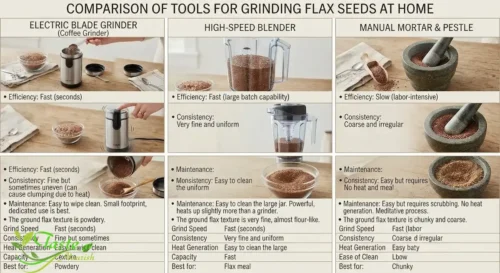
There isn’t a single best way to grind flaxseed for every kitchen — it depends on how much you’re grinding and what equipment you already own.
| Method | Typical Batch Size | Texture | Best For |
|---|---|---|---|
| Coffee or spice grinder | 1–4 tablespoons | Fine, even meal | Daily single servings; smoothies, oatmeal, yogurt |
| Blender or food processor | 1 cup or more | Slightly coarser, can be uneven | Batch-grinding for baking or weekly meal prep |
| Dedicated flax or pepper mill | 1–2 tablespoons | Coarse to medium, on-demand | Sprinkling fresh flax directly onto food |
| Mortar and pestle | 1–2 tablespoons | Coarse, uneven | No electric grinder available; small amounts |
For most home cooks, a coffee or spice grinder is the most practical choice: it’s inexpensive, fast, and lets you grind exactly what you’ll use in the next few days rather than a large batch that has to be stored. A blender or food processor makes sense if you’re grinding flax for a recipe that calls for a cup or more, since these appliances don’t work well with very small quantities — the blades need enough volume to catch and process the seeds evenly.
A mortar and pestle or a repurposed pepper mill will get the job done without any electricity, though the grind tends to be coarser and less uniform.
Flaxseed Grinder vs. Coffee Grinder: Do You Need a Dedicated Tool?
You don’t need to buy a flaxseed-specific grinder. A standard blade-style electric coffee grinder handles flax seeds well, and it’s the tool most home cooks already reach for. The main consideration isn’t performance — it’s flavor transfer. If you use the same grinder for coffee beans and flax seeds, residual coffee oil can carry over into your flax meal, and vice versa.
There are three practical ways to handle this:
- Keep a separate grinder for flax and other spices. A basic blade grinder is inexpensive enough that many people dedicate one purely to seeds and spices.
- Clean the grinder thoroughly between uses. Wipe out the chamber and run a spoonful of raw rice or bread through it to absorb oils and odors before switching foods.
- Buy a purpose-made flaxseed or spice mill. These are usually just rebranded pepper mills or small manual grinders, and they’re a fine option if you’d rather not share equipment at all, though they typically grind more coarsely than an electric grinder.
In short, a coffee grinder isn’t a compromise — it’s the standard tool for this job. A dedicated flaxseed grinder only adds value if you want to avoid flavor cross-contamination or prefer a manual, no-electricity option.
How to Grind Flax Seeds at Home, Step by Step
Using a Coffee or Spice Grinder
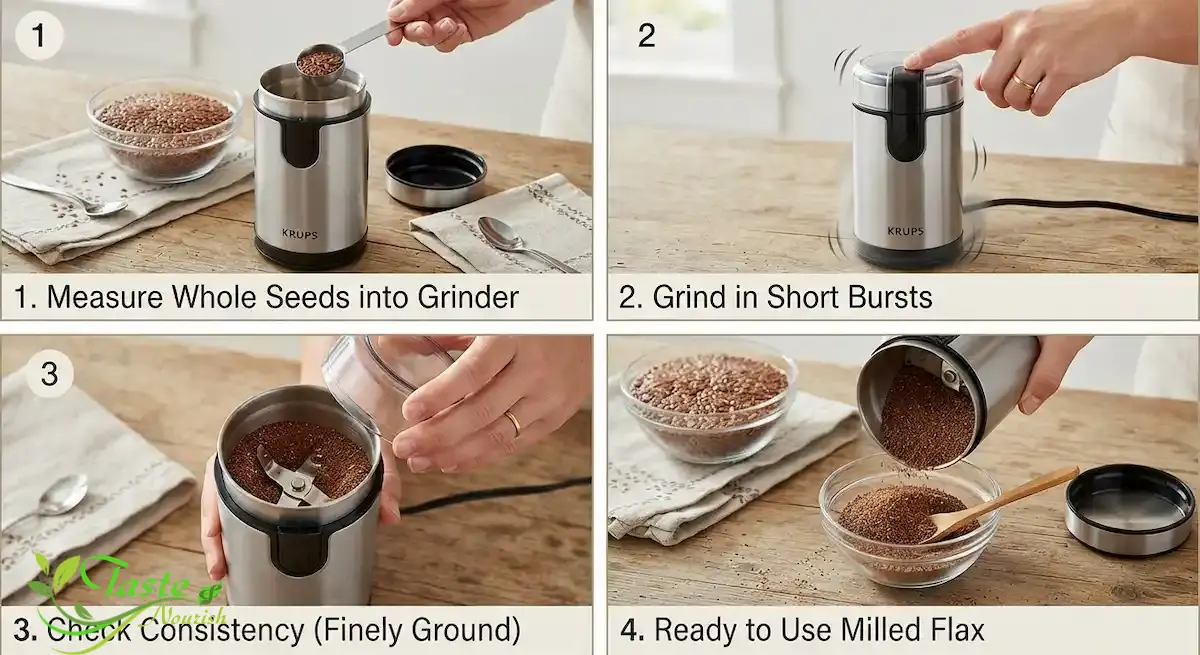
- Add whole flax seeds to the grinder up to its fill line — usually about 2 to 4 tablespoons for a small grinder.
- Secure the lid and pulse or run the grinder for 10 to 15 seconds.
- Stop and check the texture. If some seeds are still whole, pulse again in short bursts rather than running the machine continuously, which can heat the seeds and turn the oil pasty.
- Transfer the ground flax to an airtight container immediately.
Using a Blender or Food Processor
- Add at least 1 cup of whole flax seeds to the blender or processor bowl. Smaller amounts tend to scatter around the blades instead of grinding evenly.
- Pulse in 20 to 30 second bursts, stopping to scrape down the sides as needed.
- Continue until the flax reaches a fine, even meal. This can take a few minutes total, longer than a dedicated grinder.
- Store what you won’t use within the next few days in the refrigerator or freezer.
Grinding by Hand
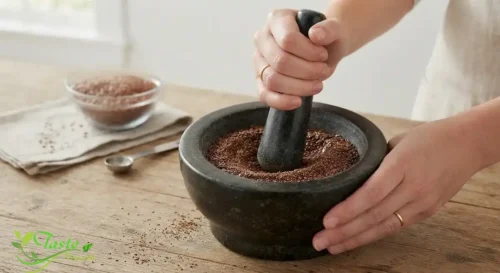
A mortar and pestle works for small amounts: add a tablespoon or two of seeds and grind with a firm, twisting motion until the coat breaks and the meal turns coarse and slightly oily-looking. A clean pepper mill or a dedicated flax mill works the same way you’d use it for peppercorns — fill the chamber and twist to dispense ground flax directly onto food.
Both methods take more effort than an electric grinder and produce a coarser, less consistent grind, but they’re a reasonable backup if you don’t own one.
How Fine Should Ground Flaxseed Be?
There’s no official standard for flaxseed meal texture. A fine, powdery grind blends invisibly into smoothies, batters, and yogurt, and it’s generally what a coffee grinder produces. A coarser, more textured grind — closer to what a mortar and pestle or blender produces — works fine sprinkled over oatmeal, salads, or baked goods where a bit of crunch isn’t a problem.
The main thing to avoid is over-processing: flax seeds are roughly 40% oil by weight, and grinding them for too long in a warm-running appliance can turn the meal into a sticky, buttery paste rather than a dry powder.
Storing Ground Flaxseed So It Doesn’t Go Rancid
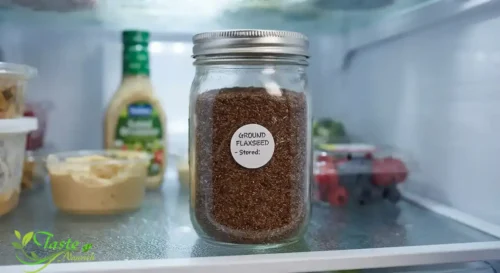
Whole flax seeds keep reasonably well at room temperature in a sealed container because the intact seed coat shields the oil inside from air and light. Once you grind flaxseed, that protection is gone. The oil is directly exposed to oxygen, and because flax is so rich in polyunsaturated ALA, that oil oxidizes noticeably faster than the oil in a whole seed (Klupczynska Prokopowicz et al., PMC).
A few practical habits keep ground flax from spoiling before you finish it:
- Grind only what you expect to use in the near term rather than a large stockpile.
- Transfer ground flax to an airtight container right away — a small jar with a tight lid works well.
- Store it in the refrigerator, or the freezer if you want it to last longer between grinding sessions.
- Keep it away from direct light and heat, both of which speed up oxidation.
Fresh ground flaxseed has a mild, nutty flavor. If it starts to smell fishy or paint-like, or tastes distinctly bitter, that’s a sign the oil has oxidized, and it’s a good idea to grind a fresh batch rather than keep using it.
Ground Flaxseed vs. Whole Flax Seeds: What Actually Changes
Whole and ground flaxseed start out with identical nutrition on paper. According to USDA FoodData Central, flaxseed provides about 534 calories, roughly 41 grams of fat, 27 grams of fiber, and 18 grams of protein per 100 grams, with alpha-linolenic acid making up the majority of that fat (USDA FoodData ).
The NIH’s Office of Dietary Supplements lists flaxseed among the richest food sources of ALA, alongside chia seeds and walnuts, and notes that most adults need between about 1.1 and 1.6 grams of ALA per day depending on age and sex (NIH Office ).
The difference between whole and ground flax isn’t what’s in the seed — it’s how much of it your body can actually access. As the clinical trial cited above found, grinding is the step that reliably raises ALA levels in the blood after eating flax; whole seeds largely did not (Austria et al., 2008, PubMed). If you’re adding flax to your diet specifically for its omega-3 content, fiber that dissolves into food easily, or its lignans, ground is the form that delivers them.
If you’re using whole flax purely as a topping for crunch, that’s a reasonable culinary choice, but it isn’t accomplishing the same nutritional goal.
Common Mistakes to Avoid
- Grinding a huge batch “to save time.” The more you grind at once, the more of it will oxidize before you use it. Small, frequent batches beat one large one.
- Running the grinder too long. Flax seeds heat up quickly under continuous grinding and can clump into a paste. Short pulses work better than one long run.
- Leaving ground flax in a bag on the counter. Room-temperature, loosely sealed storage is the fastest way to end up with rancid flax.
- Assuming whole and ground flax are interchangeable in a recipe or a diet plan. They behave the same in baking, but they are not nutritionally equivalent once eaten.
- Skipping water. Like other high-fiber foods, flaxseed is generally taken with enough fluid; this becomes more relevant as the amount you eat increases.
Who May Need to Be Careful With Flaxseed
Grinding flax seeds is a food-preparation step, not a treatment, and flaxseed itself isn’t right for everyone in every amount. The NIH’s NCCIH notes that flaxseed or flaxseed oil may cause digestive symptoms like bloating and diarrhea at higher doses, and that there are theoretical reasons flax could interact with anticoagulant or antiplatelet medications, so anyone on blood-thinning medication should check with a healthcare provider before adding flaxseed regularly (NCCIH).
The same source notes that evidence on flaxseed’s safety during pregnancy is not conclusive, and little is known about its safety while breastfeeding, so pregnant or breastfeeding individuals should also talk with their provider first (NCCIH). This guidance applies to flaxseed itself, whether whole or ground; grinding doesn’t change these considerations.
How to Grind Flax Seeds FAQs
Do I really need to grind flax seeds, or can I eat them whole?
You can eat flax seeds whole, and their fiber will still pass through and support digestion. But research shows most of their ALA omega-3 fat isn’t well absorbed unless the seed is ground, so if you’re eating flax for its omega-3 or lignan content specifically, grinding matters.
What’s the best way to grind flaxseed without a grinder?
A mortar and pestle is the most common no-appliance option: crush a tablespoon or two of seeds with a firm, twisting motion until the coat breaks. A clean pepper mill works too, though both methods produce a coarser grind than an electric grinder and take more effort.
Can I use my regular coffee grinder for flax seeds?
Yes. A standard blade coffee grinder works fine for flax. The main thing to manage is flavor transfer between coffee and flax — either dedicate a grinder to seeds and spices, or clean it thoroughly between uses.
How long does ground flaxseed last?
Ground flaxseed oxidizes much faster than whole seeds because grinding exposes the oil to air. Storing it airtight in the refrigerator or freezer slows that process; a rancid smell or bitter taste is the signal that it’s time to grind a fresh batch.
Is store-bought ground flaxseed (flax meal) as good as grinding it myself?
Nutritionally, yes, as long as it’s fresh and hasn’t oxidized on the shelf. Grinding your own lets you control freshness and grind only what you need, but a properly stored, recently purchased bag of pre-ground flax meal is a reasonable alternative if you’d rather skip the extra step.
Does grinding flax seeds reduce their fiber content?
No. Grinding changes the seed’s texture and how accessible its nutrients are, but it doesn’t remove fiber, fat, or protein from the seed itself.
Conclusion
The short version of how to grind flax seeds is this: use a coffee or spice grinder for small, fresh batches, a blender or food processor for larger ones, and store whatever you don’t use right away in an airtight container in the fridge or freezer. The extra minute it takes is what turns flax from a seed that mostly passes through digestion into one that actually delivers its omega-3s, fiber, and lignans. Whichever tool you use, grinding only what you’ll eat within a short window is the habit that matters most.
References
- Austria JA, et al. Bioavailability of Alpha-Linolenic Acid in Subjects after Ingestion of Three Different Forms of Flaxseed. Journal of the American College of Nutrition. PubMed. https://pubmed.ncbi.nlm.nih.gov/18689552/
- Kajla P, et al. The Role of Flaxseed in Improving Human Health. PMC, National Library of Medicine. https://www.ncbi.nlm.nih.gov/pmc/articles/PMC9914786/
- Dietary Modulation of the Human Gut Microbiota and Metabolome with Flaxseed Preparations. PMC, National Library of Medicine. https://www.ncbi.nlm.nih.gov/pmc/articles/PMC9499670/
- National Center for Complementary and Integrative Health (NCCIH), National Institutes of Health. Flaxseed and Flaxseed Oil: Usefulness and Safety. https://www.nccih.nih.gov/health/flaxseed-and-flaxseed-oil
- Office of Dietary Supplements, National Institutes of Health. Omega-3 Fatty Acids – Consumer. https://ods.od.nih.gov/factsheets/Omega3FattyAcids-Consumer/
- U.S. Department of Agriculture, Agricultural Research Service. FoodData Central: Seeds, flaxseed. https://fdc.nal.usda.gov/food-details/169414/nutrients