If dropping a few pounds is on your mind, chances are someone has pointed you toward kale. Type “kale weight loss” into any search bar and you’ll find everything from miracle-food hype to skeptical takes dismissing it entirely. The truth lands somewhere in between. Kale won’t melt fat on its own, but its low calorie count, high fiber content, and dense nutrient profile can genuinely support a weight loss plan when it takes the place of higher-calorie foods on your plate.This guide covers what kale actually offers nutritionally, what the science says about kale for weight loss, and how to use it in a way that fits real life — not just Instagram photos of salads.
Kale itself doesn’t burn fat or trigger weight loss through any special compound. What it does offer is a lot of nutrition for very few calories, along with fiber that may help you feel full on less food. Used consistently in place of higher-calorie ingredients, kale weight loss results are realistic — but they depend on your total diet and calorie balance, not on kale alone.
Research suggests that fiber-rich, low-energy-dense vegetables like kale can support appetite regulation and weight management as part of an overall healthy eating pattern.
Key Takeaways
Kale weight loss potential comes mainly from its low calorie density and fiber content, not from any unique fat-burning property.
One cup of raw kale has well under 20 calories, so it adds volume and nutrients without adding much to your daily calorie total.
Kale is a strong source of vitamins K, C, and A, along with calcium, potassium, and antioxidant compounds.
No clinical study has tested kale in isolation for weight loss — the evidence comes from research on fiber, vegetable intake, and low-energy-dense diets more broadly.
People taking blood thinners like warfarin need to keep their vitamin K intake consistent, which affects how much kale they should eat.
Piling on high-calorie dressings, cheese, or fried kale chips can cancel out the benefits kale brings to a weight loss plan.
What Is Kale?
Kale is a leafy green vegetable in the Brassica family, related to broccoli, cabbage, and Brussels sprouts. Unlike its relatives, kale doesn’t form a tight head — its leaves grow loosely from a central stalk, which is why it’s usually sold as bunches of leaves rather than a compact vegetable.
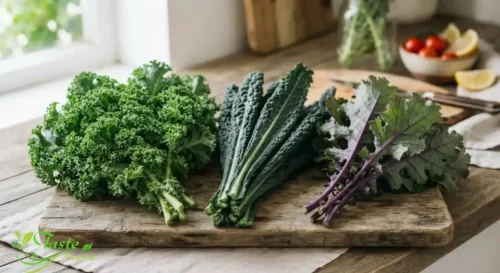
A few common varieties show up at most grocery stores and farmers markets:
Curly kale — the most widely available type, with ruffled, slightly tough leaves and a peppery bite.
Lacinato kale (also called dinosaur or Tuscan kale) — flatter, darker leaves with a milder, slightly sweeter flavor.
Red Russian kale — flat, frilly-edged leaves with reddish stems and a more tender texture than curly kale.
Baby kale — young, small leaves often sold pre-washed for salads, milder and more tender than mature kale.
All varieties share a similar nutritional profile, so the choice mostly comes down to texture and taste preference.
Kale Nutrition Facts
Kale is what nutrition experts often call a low-energy-dense food — meaning it delivers a lot of nutrients and volume for very few calories. Here’s how raw kale breaks down per 100 grams, based on data from the USDA FoodData Central database.
Nutrient
Amount per 100g raw kale
% Daily Value
Calories
35 kcal
—
Protein
2.9 g
—
Carbohydrates
4.4 g
—
Fiber
4.1 g
~15%
Fat
1.5 g
—
Vitamin K
389 mcg
~320%
Vitamin C
93 mg
~100%
Vitamin A (RAE)
241 mcg
~27%
Calcium
254 mg
~20%
Potassium
348 mg
~7%
Iron
1.6 mg
~9%
A typical cup of raw, chopped kale weighs far less than 100 grams, so these numbers represent a fairly generous portion. Even a modest handful delivers meaningful nutrition for very little caloric cost.
Health Benefits of Kale
Kale’s benefits extend beyond weight management, though that’s often the reason people start eating more of it.
Low calorie density. Kale lets you eat a satisfying volume of food without a large calorie cost, which can help when you’re trying to reduce overall intake.
Fiber for fullness. The fiber in kale adds bulk and may help slow digestion, supporting a feeling of fullness after meals.
Bone-supportive nutrients. Kale is rich in vitamin K and calcium, both involved in maintaining healthy bones.
Antioxidant content. Kale contains flavonoids like quercetin and kaempferol, along with carotenoids such as lutein and zeaxanthin, which are associated with cellular protection against oxidative stress.
Nutrient density for the calories. Because kale packs so many vitamins and minerals into so few calories, it’s often grouped among the vegetables researchers describe as most nutrient-dense relative to their energy content.
The Science Behind Kale Weight Loss
There isn’t a clinical trial that isolates kale specifically and tracks its effect on body weight — that kind of single-food study is rare in nutrition research. What exists instead is broader evidence about the mechanisms kale relies on: fiber, low energy density, and vegetable intake generally.
A systematic review and meta-analysis of randomized controlled trials found that soluble dietary fiber supplementation was associated with modest reductions in body weight among overweight and obese adults over periods of 12 weeks or longer, an effect researchers linked to improved satiety and changes in gut microbiota activity.
Separately, public health guidance from the CDC explains that the water and fiber content in vegetables like kale add volume to meals, which may allow people to eat a satisfying amount of food while consuming fewer total calories — a principle sometimes called dietary energy density.
Put together, this research suggests kale weight loss benefits are indirect: kale supports the same mechanisms — fiber intake, lower energy density, and vegetable-forward eating patterns — that are consistently linked to weight management in the broader scientific literature. It’s not that kale contains a special ingredient; it’s that swapping refined, calorie-dense foods for foods like kale is one of the underlying strategies that tends to work.
Potential Risks and Side Effects
Kale is safe for most people in normal food amounts, but a few things are worth knowing.
Vitamin K and blood thinners. Kale is extremely high in vitamin K, which plays a role in blood clotting. Sudden increases in intake can interfere with medications like warfarin.
Oxalates. Like many leafy greens, kale contains oxalates, compounds that in very high amounts may contribute to kidney stone formation in people who are already prone to them.
Digestive discomfort. Raw cruciferous vegetables, kale included, can cause gas or bloating in some people, especially when eaten in large quantities or introduced quickly into the diet.
Goitrogenic compounds. Kale contains glucosinolates that can, in very large and consistent amounts, interfere with iodine uptake by the thyroid. Research indicates the kale varieties most commonly eaten contain relatively low levels of these compounds compared with some other brassica vegetables, so typical servings are unlikely to pose a meaningful risk for most people.
Who Should Avoid It?
Most people don’t need to avoid kale, but a few groups may need to be more cautious:
People taking warfarin or similar anticoagulant medications should keep their vitamin K intake consistent day to day, rather than suddenly adding or removing large amounts of kale.
People with a history of calcium oxalate kidney stones may want to talk with a doctor or dietitian about how much kale and other high-oxalate vegetables fit into their diet.
People with diagnosed thyroid conditions, particularly those with low iodine intake, may benefit from asking a healthcare provider about reasonable serving sizes of raw cruciferous vegetables, since cooking reduces goitrogenic activity.
How Much Kale Should You Eat for Weight Loss?
There’s no official recommended dose of kale for weight loss, since it’s a food, not a supplement. General dietary guidance suggests adults aim for 2 to 3 cups of vegetables a day as part of a balanced eating pattern, and kale can reasonably make up a portion of that.
A common, practical approach is 1 to 2 cups of raw kale (or the cooked equivalent) a few times a week, worked into salads, smoothies, or side dishes in place of less nutrient-dense options. There’s no evidence that eating more kale than that accelerates weight loss — more isn’t automatically better, and total calorie intake still matters more than any single vegetable.
How to Choose the Best Kale
A little attention at the store makes a real difference in flavor and texture.
Look for firm, deeply colored leaves without yellowing or browning at the edges.
Avoid bunches with wilted, slimy, or limp leaves, which signal age or poor storage.
Smaller, younger leaves tend to be more tender and milder, while larger leaves are heartier and better suited to cooking.
Check the stems — they should be firm and snap cleanly rather than bend.
Pre-washed bagged kale is convenient but generally best used within a few days of purchase.
Storage Tips
Kale keeps reasonably well if stored properly.
Store unwashed kale in a loose or perforated plastic bag in the refrigerator’s crisper drawer.
Wash it just before you plan to use it, not right after buying it, since excess moisture speeds up wilting.
Fresh kale typically stays good for about 5 to 7 days refrigerated.
To freeze kale, blanch the leaves briefly in boiling water, cool them in ice water, dry thoroughly, and store in an airtight bag or container for up to several months.
Best Ways to Eat Kale for Weight Loss
How you prepare kale matters almost as much as how much you eat, since toppings and cooking methods can quietly add a lot of calories.
Massaged raw salads. Rubbing raw kale leaves with a small amount of olive oil and lemon juice softens their texture and makes them easier to eat in larger portions.
Smoothies. Blending a handful of kale into a fruit or protein smoothie adds volume, fiber, and nutrients without much extra flavor impact.
Sautéed as a side. A quick sauté in a small amount of oil with garlic keeps kale low-calorie while making it more palatable than raw.
Added to soups and stews. Stirring chopped kale into broth-based soups adds bulk and nutrients for very few added calories.
Baked kale chips. A lighter alternative to potato chips when made with a small amount of oil and salt, though it’s easy to overdo the oil.
Common Mistakes
Drowning it in dressing. A modest kale salad can end up higher in calories than a burger once creamy dressings, cheese, and croutons are added.
Overcooking it. Boiling kale for a long time can leach out water-soluble vitamins like vitamin C.
Skipping the massage step for raw salads. Unmassaged raw kale can be tough and bitter, which often leads people to give up on eating it raw.
Frying kale chips in a lot of oil. This turns a low-calorie snack into a much higher-calorie one.
Expecting kale alone to cause weight loss. Adding kale to a diet that’s otherwise unchanged is unlikely to produce noticeable results on its own.
Kale Weight Loss Myths vs. Facts
Myth
Fact
Kale burns fat.
No food burns fat directly. Kale supports weight loss indirectly through low calories and fiber, not through any fat-burning mechanism.
You have to eat kale raw to get its full benefits.
Cooking reduces some heat-sensitive vitamins slightly but also makes certain minerals easier to absorb and reduces goitrogenic compounds — both raw and cooked kale have a place in a healthy diet.
Eating more kale always means faster weight loss.
Total calorie balance matters more than the amount of any single vegetable. More kale doesn’t override a high-calorie diet overall.
Kale juice or kale chips are automatically diet-friendly.
Juicing removes most of the fiber, and kale chips can be high in added oil — both can be far less useful for weight management than whole, minimally processed kale.
Kale vs. Other Leafy Greens: A Comparison
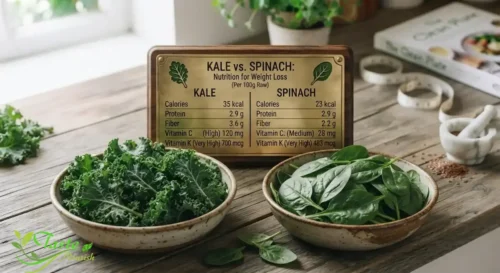
Kale is often compared with other leafy greens when people are deciding what to build a weight-conscious diet around. Here’s how it stacks up per 100 grams raw.
Green
Calories
Fiber
Vitamin K
Vitamin C
Kale
35 kcal
4.1 g
389 mcg
93 mg
Spinach
23 kcal
2.2 g
483 mcg
28 mg
Romaine lettuce
17 kcal
2.1 g
103 mcg
4 mg
All three are low-calorie, nutrient-dense choices well suited to a weight loss-focused diet. Kale stands out for its notably higher fiber and vitamin C content, while spinach has a slight edge in vitamin K and romaine offers the lowest calorie count of the three. In practice, rotating between them adds variety without meaningfully changing the calorie math.
Kale Weight Loss FAQs
Does kale help you lose weight?
Kale can support weight loss as part of a balanced diet because it’s low in calories, high in fiber, and can help you feel full on fewer calories overall. It doesn’t cause weight loss by itself — results depend on your total eating pattern and calorie balance.
How much kale should I eat a day to lose weight?
There’s no set amount required. A cup or two of raw kale, a few times a week, worked into meals in place of less nutrient-dense foods is a reasonable and sustainable approach.
Is kale better than spinach for weight loss?
Both are low-calorie, high-nutrient greens, and neither has a documented advantage for weight loss specifically. Kale offers slightly more fiber and vitamin C; spinach is slightly lower in calories. Either fits well into a weight-conscious diet.
Can I eat kale every day?
For most people, yes. Those on blood-thinning medication or with certain thyroid or kidney conditions should discuss consistent daily amounts with a healthcare provider first.
Is a kale smoothie good for weight loss?
A kale smoothie can be a low-calorie way to add nutrients and fiber to your diet, but calories can add up quickly depending on what else goes into the blender, such as fruit, nut butter, or sweetened liquids.
Conclusion
Kale earns its reputation as a smart addition to a weight loss plan, though not because it contains any special fat-burning property. It’s low in calories, high in fiber, and dense with vitamins and minerals — qualities that research consistently links to better appetite regulation and easier calorie management. Kale weight loss results come from using it thoughtfully: swapping it in for higher-calorie foods, preparing it without piling on heavy add-ons, and treating it as one part of an overall balanced diet rather than a shortcut on its own.
References
Kale, raw — FoodData Central, U.S. Department of Agriculture, Agricultural Research Service
**Hanan Abo Samra** shares practical cooking insights, delicious recipes, and evidence-based nutrition information. Drawing on more than 20 years of hands-on cooking experience, she creates helpful food content that combines everyday cooking knowledge with information from reliable scientific sources. Her goal is to help readers better understand the foods they eat, explore their nutritional benefits, and prepare delicious meals with confidence.