Greek yogurt has gone from a niche import to one of the most popular items in the American dairy case, and it’s easy to see why. It’s thick, tangy, versatile, and packed with protein compared to a lot of other breakfast staples. But not all containers labeled “Greek yogurt” are created equal, and the health claims around it range from well-supported to overstated.
This guide walks through what Greek yogurt actually is, what the nutrition label really shows, who should think twice before digging in, and how to use it well in the kitchen.
What Is Greek Yogurt?
Greek yogurt is regular yogurt that has been strained to remove much of its liquid whey. That straining step is the whole story here — it’s not a different starting ingredient, just an extra stage in processing. The result is a denser, richer product with noticeably more protein per spoonful than unstrained yogurt, along with a thicker texture that holds up well in cooking.
How It’s Strained and Made
The basic process is simple, even if manufacturers scale it up considerably. Milk is pasteurized and cultured with live bacteria, typically Lactobacillus bulgaricus and Streptococcus thermophilus, which ferment the milk sugars and thicken it into standard yogurt.
From there, the yogurt is strained — traditionally through cheesecloth, commercially through centrifuges or filtration systems — to separate out the watery whey.
What’s left behind is a concentrated, spoonable product with less volume but a higher density of protein and fat per serving. Some brands add extra milk protein concentrate instead of straining, which technically mimics the texture without the traditional method, so the ingredient list is worth a glance if authenticity matters to you.
Greek Yogurt vs. Regular Yogurt vs. Skyr
Side by side, the differences among strained dairy products come down to protein concentration, tang, and thickness. Here’s how they typically compare per similar serving sizes:
Feature
Greek Yogurt
Regular Yogurt
Icelandic Skyr
Straining
Strained once
Not strained
Strained more heavily
Protein (per 6 oz)
~15–18g
~8–9g
~17–20g
Texture
Thick, creamy
Pourable, looser
Very thick, almost cheese-like
Tartness
Moderately tangy
Mild
Mild to tangy, brand-dependent
Calcium
Slightly reduced by straining
Generally higher per serving
Slightly reduced by straining
One detail that surprises people: straining doesn’t just concentrate protein, it also removes some calcium along with the whey. So while Greek yogurt wins clearly on protein, regular yogurt can sometimes edge it out on calcium per serving. Neither is “better” across the board — it depends on what you’re optimizing for.
Where Greek Yogurt Actually Comes From
The name suggests a straightforward origin, but the real story is more tangled. Strained yogurt has deep roots across the Eastern Mediterranean, the Balkans, and parts of the Middle East, where similar products go by names like labneh or süzme.
Greece does have its own long tradition of straining yogurt this way, so the label isn’t inaccurate, but it’s also not the sole birthplace of the technique. What turned “Greek yogurt” into a household phrase in the United States was largely a marketing and business story from the 2000s, when a handful of companies — most notably Chobani, founded by a Turkish immigrant, and Fage, an actual Greek dairy company — began selling strained yogurt at scale to American shoppers.
Within about a decade it went from a specialty item to a mainstream grocery category, reshaping the yogurt aisle in the process.
Taste and Texture: What Sets It Apart
If you’ve only ever had regular yogurt, the first spoonful of Greek yogurt can be a bit of a surprise. It’s noticeably thicker, closer in consistency to a soft cream cheese than to a pourable drink, and it holds its shape on a spoon instead of sliding off. The flavor tends to be tangier and slightly more sour, a byproduct of the concentrated lactic acid left behind after straining.
Full-fat versions taste rounder and creamier, while nonfat versions can taste sharper and more acidic on their own, which is part of why so many people prefer to sweeten or flavor them.
Texture also varies meaningfully by brand — some are silky and smooth, others are noticeably grainier — so it’s worth trying a couple of options before deciding which one earns a permanent spot in your fridge.
Greek Yogurt Nutrition Facts
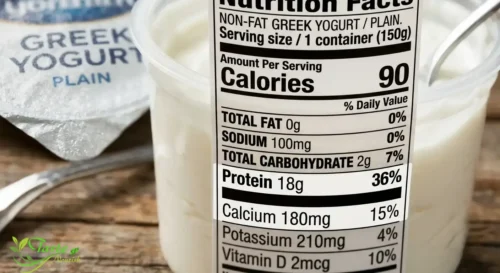
Greek yogurt’s reputation as a protein powerhouse is well earned, but the exact numbers shift depending on fat content and brand formulation. According to the USDA , nonfat Greek yogurt, a typical serving delivers a strong protein-to-calorie ratio compared to most other dairy products, which is a big part of its appeal for people managing weight or building muscle.
Calories, Protein, and Fat by Type
Here’s a general comparison across the three most common versions found in stores, based on a standard 6 oz (about 170g) serving. Brands vary, so treat these as ballpark figures rather than a substitute for reading your specific label.
Type
Calories
Protein
Fat
Carbs
Nonfat plain
~100
~17–18g
0g
~6g
Low-fat (2%) plain
~130
~16–17g
~3–4g
~6g
Whole milk plain
~150–190
~14–16g
~8–9g
~6g
Flavored varieties change this picture substantially. Fruit-on-the-bottom or vanilla styles often add 8 to 15 grams of sugar per serving on top of the yogurt’s naturally occurring lactose, so the calorie count can climb well past 150 without any change in protein content. Reading the “added sugars” line, not just “total sugars,” is the most reliable way to tell how much of that sweetness came from the manufacturer rather than the milk itself.
Calcium, B12, and Other Micronutrients
Beyond protein, Greek yogurt is a genuinely useful source of several micronutrients. The NIH Office of Dietary Supplements’ calcium fact sheet , lists the current Daily Value for calcium at 1,300 mg for adults and children over age four, and a typical serving of Greek yogurt supplies somewhere in the range of 10 to 15 percent of that, depending on brand and straining method. It also contributes meaningful amounts of vitamin B12, phosphorus, and potassium, along with smaller amounts of riboflavin.
♦ None of these nutrients are unique to Greek yogurt specifically, but the combination in one convenient, ready-to-eat food is part of what makes it such a popular staple for quick breakfasts and snacks.
✅ Key takeaway: Greek yogurt is protein-dense and calorie-efficient, but it’s not automatically higher in calcium than regular yogurt — straining trades some calcium for concentrated protein.
Potential Health Benefits
Greek yogurt’s popularity isn’t purely about marketing — a reasonable amount of research backs up several of its potential benefits, though the strength of evidence varies by claim.
Muscle Support and Satiety
The high protein content per calorie is Greek yogurt’s clearest practical advantage. Protein is more satiating than carbohydrates or fat gram-for-gram, which is why a serving of Greek yogurt tends to keep people fuller for longer than an equivalent-calorie serving of regular yogurt or cereal.
It’s also a convenient way to support muscle maintenance, particularly for older adults or anyone trying to preserve lean mass during weight loss, since adequate protein intake spread across the day is associated with better outcomes for muscle preservation.
Bone Health
Calcium and protein both play supporting roles in bone health, and Greek yogurt provides a reasonable dose of each in a single serving. That said, it shouldn’t be treated as a bone-health cure-all on its own. Vitamin D, weight-bearing exercise, and overall dietary pattern matter at least as much as any single food, and people with diagnosed osteoporosis or osteopenia should work with a healthcare provider on a broader plan rather than relying on yogurt intake alone.
Gut Health and Probiotics
Many Greek yogurts contain live and active cultures, and probiotics broadly are associated with several digestive benefits. According to Mayo Clinic Press’s overview of yogurt and digestion, these live bacteria may help balance the gut microbiome and support immune and inflammatory regulation, though the research notes that results vary significantly depending on the specific probiotic strains studied, the dose, and the individual.
♦ In other words, “probiotic” isn’t a single, uniform benefit — it depends heavily on which cultures survive processing and reach the gut in meaningful numbers, which not every brand discloses clearly on the label.
Blood Sugar and Type 2 Diabetes
This is one of the more scientifically notable developments in yogurt research. In March 2024, the FDA announced a qualified health claim allowing yogurt products to state that regular consumption — at least two cups, or three servings, per week — may be associated with a reduced risk of type 2 diabetes, based on limited but credible evidence.
Separately, researchers at the Harvard T.H. Chan School found a similar association across several large cohort studies, though the team was careful to note that the underlying biological mechanism isn’t fully understood and may involve improved insulin sensitivity linked to probiotic activity.
♦ It’s worth being precise about what this claim actually says: it’s an association from observational data, not proof that yogurt prevents diabetes, and it applies to yogurt broadly rather than Greek yogurt specifically.
Risks and Who Should Be Cautious
Greek yogurt is a safe food for most people, but a few groups have good reasons to pay closer attention to how much and what kind they eat.
People with lactose intolerance: Because straining removes much of the liquid whey, Greek yogurt naturally contains less lactose than milk or regular yogurt, and the live cultures help further break down what remains. The NIDDK’s guidance on lactose intolerance notes that many people can tolerate around 12 grams of lactose — roughly the amount in one cup of milk — without symptoms, which is often more lactose than a serving of yogurt contains.
People with a milk protein allergy: This is a distinct condition from lactose intolerance and isn’t solved by choosing a lower-lactose product. Anyone with a diagnosed milk allergy should avoid Greek yogurt entirely and talk to an allergist about safe alternatives.
People managing chronic kidney disease: Greek yogurt’s concentrated protein also means concentrated phosphorus and potassium, two minerals that some renal diets restrict. A renal dietitian can help determine an appropriate serving size, if any.
People watching sodium or added sugar: Flavored varieties and some savory-style Greek yogurts can carry more sodium or added sugar than shoppers expect, so the nutrition label deserves a second look rather than an assumption based on the “healthy” halo around the category.
💡 Pro tip: If a food scale or exact macros matter to you, weigh out a serving rather than eyeing it — Greek yogurt’s density means a “small-looking” scoop can carry more calories than it appears to.
How to Buy the Best Greek Yogurt
Not every tub on the shelf delivers the same nutritional value, so a little label-reading goes a long way. Start with the ingredient list: a genuinely traditional product should list milk and live active cultures, without a long tail of stabilizers, gums, or added milk protein concentrate standing in for real straining. From there, check the protein-to-calorie ratio — a higher protein number relative to calories generally signals a more concentrated, less diluted product.
Sodium and added sugar are the next things worth comparing, especially across flavored options where formulations vary enormously between brands.
Plain and flavored versions each have their place, but they serve different goals:
Buying plain and sweetening it yourself — with fresh fruit, a drizzle of honey, or a splash of vanilla extract — is generally the more nutrient-efficient choice, since it lets you control exactly how much sugar ends up in the bowl.
Storage and Shelf Life
Unopened Greek yogurt typically keeps in the refrigerator until the date printed on the container, generally somewhere between one and three weeks depending on the brand and processing method.
Once opened, it’s best eaten within about five to seven days for optimal taste and texture, even if the printed date hasn’t passed yet.
A layer of liquid pooling on top after opening is just whey separating out again — it’s harmless and can be stirred back in or poured off, whichever you prefer.
Freezing is possible and won’t make it unsafe to eat, but the texture typically turns grainier and less smooth after thawing, so frozen Greek yogurt works better blended into smoothies than eaten straight from a spoon.
Cooking and Everyday Uses
Greek yogurt’s thick texture and mild tang make it one of the more flexible ingredients in a typical kitchen, well beyond the breakfast bowl:
It substitutes reasonably well for sour cream in dips, dressings, and dollops on baked potatoes, usually with a similar tang and far less saturated fat.
In baking, it can replace some or all of the butter or oil in muffins and quick breads, adding moisture and a subtle richness while cutting overall fat content.
Blended into smoothies, it adds body and protein without watering down the flavor the way milk sometimes can.
Savory uses work just as well — whisked into curries and marinades, it tenderizes meat and adds creaminess without the heaviness of heavy cream, and it makes a quick base for herb-and-garlic dips that come together in minutes.
A few practical substitution notes are worth keeping in mind. Because Greek yogurt is more acidic and less fatty than sour cream or heavy cream, dishes that rely on high heat can cause it to curdle or “break” if added directly to a simmering pot — tempering it first with a spoonful of the hot liquid before stirring it in helps prevent that.
In baked goods, a straight one-to-one swap for oil sometimes leaves the crumb slightly denser, so many bakers replace only part of the fat rather than all of it for the best texture.
Common Myths About Greek Yogurt
A few persistent claims about Greek yogurt don’t hold up well under scrutiny. The idea that it’s automatically higher in calcium than regular yogurt is one of the most common — as covered earlier, straining actually removes some calcium along with the whey, so regular yogurt can sometimes contain more per serving.
Another myth is that all Greek yogurt contains meaningful amounts of live probiotics; heat-treated or “Greek-style” products that skip true straining in favor of thickeners may not carry the same live cultures as traditionally strained versions, and pasteurization after culturing can kill off the bacteria entirely.
There’s also a common assumption that anything labeled “Greek yogurt” is inherently low in sugar or “diet food,” which falls apart quickly once you compare a plain tub to a dessert-style flavored one sitting right next to it on the same shelf.
And finally, the name itself is often taken to mean the product is exclusively a Greek invention, when in fact strained yogurt has parallel traditions across several regions, with the American “Greek yogurt” boom being more of a 21st-century marketing phenomenon than an ancient one.
Conclusion
Greek yogurt earns its popularity honestly: it’s a genuinely protein-dense, versatile food with reasonable evidence behind several of its health associations, from gut support to a possible link with lower type 2 diabetes risk. It’s not a miracle food, and the fine print matters — added sugar in flavored varieties, phosphorus and potassium for people with kidney concerns, and the reality that “Greek yogurt” isn’t a single standardized product across brands.
Reading the label, choosing plain over flavored when possible, and understanding what the research does and doesn’t say will get you most of the benefit without falling for the hype.
Greek Yogurt FAQs
Is Greek yogurt healthier than regular yogurt?
It depends on your goal. Greek yogurt has more protein per serving, but regular yogurt often has more calcium, since straining removes some calcium along with the whey. Neither is universally “healthier” — it’s a trade-off.
Can people with lactose intolerance eat Greek yogurt?
Many can, in moderate amounts. Greek yogurt naturally contains less lactose than milk due to straining, and its live cultures help digest what remains, though individual tolerance still varies.
Does Greek yogurt really help prevent type 2 diabetes?
The FDA allows a qualified health claim stating that regular yogurt consumption — at least three servings a week — may be associated with reduced type 2 diabetes risk, based on limited evidence. It’s an association from observational research, not a guarantee or a treatment.
Is flavored Greek yogurt a bad choice?
Not inherently, but many flavored varieties carry significantly more added sugar than plain versions. Checking the “added sugars” line on the label is the most reliable way to judge a specific product.
Can I substitute Greek yogurt for sour cream in recipes?
Yes, in most cold or lightly cooked applications, it works well as a substitute with less saturated fat. In dishes with high, direct heat, tempering it first helps prevent curdling.
Hanan Abo Samra is the founder of Taste & Nourish, sharing trustworthy nutrition guidance and recipes drawn from 20+ years of hands-on cooking experience. When she's not developing new recipes, Hanan is researching the science behind everyday ingredients to bring readers practical, evidence-based guidance for a healthier lifestyle.